
BAR-214 · Lesson 7 of 12 · 20 min
Illinois courts and civil procedure
▶ Video coming soon A video version of this lesson is on the way.
This lesson begins the part of the course aimed at practice rather than the exam. Marchetti scheduled it for the week after Marisol's MBE review was done, and opened with a warning. 'Nothing in the next four lessons is on your bar exam,' she said. 'Everything in them is on your desk the first Monday you're licensed.' Marisol's firm had just given her a premises liability file to work up for a motion, so the timing was good. The lesson covers the structure of Illinois courts, the Code of Civil Procedure and the Supreme Court Rules, and the procedural moments a new litigator meets first. Statute and rule numbers are given so readers can look them up; the current text always controls.
The courts
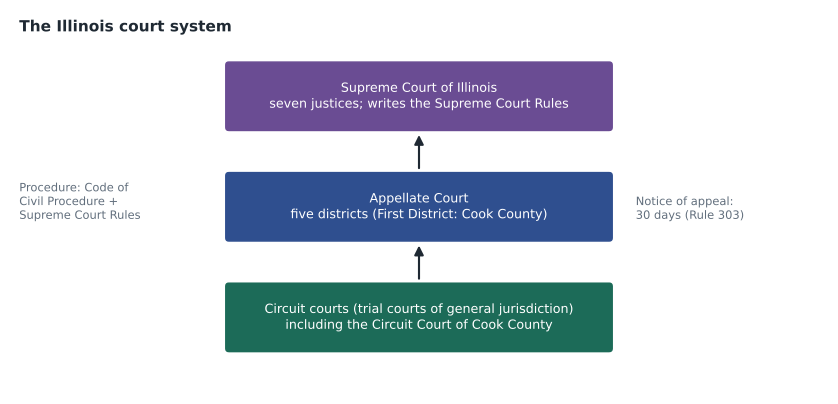
Illinois has a unified three-level court system under the Illinois Constitution of 1970. The circuit courts are the trial courts of general jurisdiction, organized into judicial circuits. The Circuit Court of Cook County is the largest, with divisions for law, chancery, domestic relations, probate, criminal cases and more, and municipal districts for smaller cases. There are no separate lower courts: small claims, traffic matters and major civil trials all fall within the circuit courts.
The Appellate Court of Illinois hears appeals from the circuit courts and is divided into five districts. The First District covers Cook County. The Supreme Court of Illinois has seven justices elected from judicial districts, with the First District, Cook County, electing three. The Supreme Court hears appeals by leave in most cases, appeals as of right in a narrow set of cases, and has supervisory authority over all Illinois courts. It also writes the Illinois Supreme Court Rules, which govern much of civil practice alongside the Code of Civil Procedure.
Two sources of procedure
Illinois civil procedure comes from two places. The Code of Civil Procedure, at 735 ILCS 5, is a statute passed by the General Assembly. It covers pleading, motions, judgments, limitation periods and many special proceedings. The Illinois Supreme Court Rules, adopted by the court, cover discovery, pretrial procedure, appeals and much else. When they overlap, the court's rules on matters of judicial procedure generally prevail. A new lawyer needs both open on the desk, along with the local rules of the circuit where the case is pending.
Fact pleading
Illinois is a fact-pleading jurisdiction. A complaint must allege facts, not just conclusions, sufficient to bring the claim within a legally recognized cause of action. This is a stricter standard than federal notice pleading. It is also a frequent source of motions: a defendant who believes the complaint states conclusions instead of facts will move to dismiss it, and a plaintiff often responds by amending.
Marisol's premises liability complaint, for a client who fell on an icy loading dock, had to allege the facts of the fall, the condition of the dock, how long the ice had been there, what the owner knew or should have known, and how the condition caused the injury. Saying only that the owner negligently maintained the premises would invite a motion to dismiss.
The two motions to dismiss
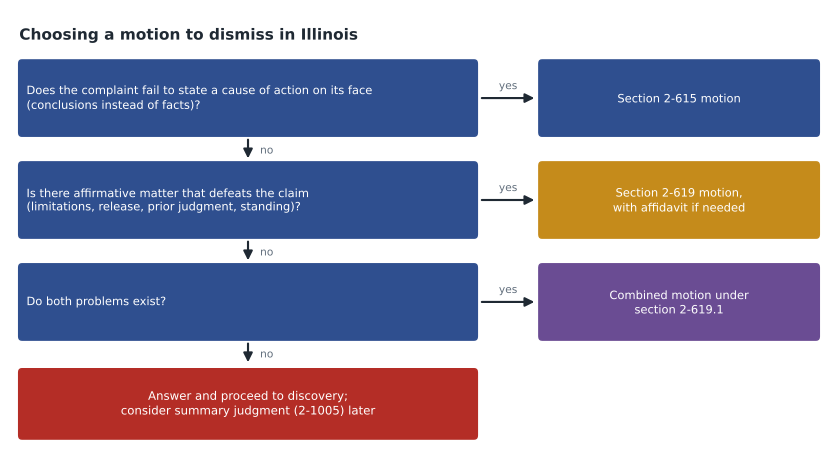
Illinois practice centers on two motions under the Code. A section 2-615 motion attacks the legal sufficiency of the complaint on its face: taking the well-pleaded facts as true, does the complaint state a cause of action? A section 2-619 motion admits the legal sufficiency of the complaint but raises an affirmative matter that defeats the claim, such as the statute of limitations, a prior judgment, a release or lack of standing. Section 2-619.1 allows the two to be combined in one filing, with each part identified. Using the wrong section is a common mistake. A limitations defense that depends on dates outside the complaint, for example, belongs under section 2-619, supported by an affidavit if needed.
Summary judgment is available under section 2-1005 when the pleadings, depositions, admissions and affidavits show no genuine issue of material fact and the movant is entitled to judgment as a matter of law.
Discovery under the Supreme Court Rules
Discovery in Illinois is governed mainly by Supreme Court Rules 201 to 224. Rule 201 sets out the general scope and the duty to confer before bringing discovery disputes to the court. Rule 213 governs interrogatories and the disclosure of witnesses, including the three categories of trial witnesses: lay witnesses, independent expert witnesses and controlled expert witnesses. A party who fails to disclose a witness or an opinion properly under Rule 213 risks having the testimony barred at trial, which makes Rule 213 disclosures one of the most consequential tasks a junior lawyer handles. Rule 222 provides limited and simplified discovery for cases seeking money damages of 50,000 dollars or less, with mandatory early disclosures and limits on discovery.
Limitation periods
Illinois limitation periods are in Article XIII of the Code. Commonly used periods include two years for personal injury under section 13-202, five years for oral contracts and for property damage under section 13-205, and ten years for written contracts under section 13-206. Many claims have their own periods, and the discovery rule, tolling for minors and persons under legal disability, and special notice requirements for claims against local public entities under the Local Governmental and Governmental Employees Tort Immunity Act can all change the calculation. A new lawyer should calculate the period on day one of every file and calendar it twice.
| Claim | Typical period | Source |
|---|---|---|
| Personal injury | Two years | 735 ILCS 5/13-202 |
| Oral contract; property damage | Five years | 735 ILCS 5/13-205 |
| Written contract | Ten years | 735 ILCS 5/13-206 |
| Relief from a final judgment | Generally within two years | 735 ILCS 5/2-1401 |
Juries, small claims and arbitration
Illinois civil juries have twelve members. The General Assembly tried to reduce civil juries to six in 2015, but the Supreme Court of Illinois held that change unconstitutional in Kakos v. Butler in 2016. Small claims cases, for money claims up to 10,000 dollars under the Supreme Court Rules, follow simplified procedures. Many circuits also run court-annexed mandatory arbitration for smaller damage claims under Supreme Court Rules 86 and following, in which a panel of lawyers hears the case and either side may reject the award and proceed to trial, subject to rules on costs and good-faith participation.
Appeals
Final judgments are appealed by filing a notice of appeal within 30 days under Supreme Court Rule 303. A judgment that resolves fewer than all claims or parties is appealable only if the trial court makes a written finding under Rule 304(a) that there is no just reason for delaying enforcement or appeal, or both. Some interlocutory orders are appealable as of right under Rule 307, and others by permission under Rule 308. Missing the 30-day deadline is usually fatal, so Marchetti's habit is to calendar the deadline the day the judgment is entered. Appellate courts publish opinions and also issue Rule 23 orders. Since January 1, 2021, nonprecedential Rule 23 orders entered on or after that date may be cited for persuasive purposes.
Worked problem
Choosing the right motion
Marisol's firm represents a defendant in a slip-and-fall case. The complaint was filed two years and three months after the fall, and it alleges only that the defendant "negligently maintained the premises." Which motions should the firm consider?
Show solution
- The pleading states a conclusion rather than facts, so a section 2-615 motion could attack its legal sufficiency.
- The limitations defense depends on the date of the fall; a two-year period applies under section 13-202, and the complaint was late.
- If the date appears on the face of the complaint, the defense could be raised under section 2-615 or 2-619; if it depends on outside facts, section 2-619 with an affidavit is the vehicle.
- The two can be combined under section 2-619.1, with each part clearly identified.
Answer: A combined section 2-619.1 motion: a section 2-615 part for insufficient fact pleading and a section 2-619 part for the limitations bar.
Common mistakes
MistakePleading conclusions in an Illinois complaint.
InsteadIllinois requires fact pleading; allege the facts that bring the claim within a recognized cause of action.
MistakeRaising an affirmative defense based on outside facts in a section 2-615 motion.
InsteadUse section 2-619, which admits legal sufficiency but raises affirmative matter, supported by affidavit when needed.
MistakeTreating Rule 213 disclosures as a formality.
InsteadUndisclosed witnesses and opinions can be barred at trial.
MistakeAppealing a partial judgment without a Rule 304(a) finding.
InsteadWithout the finding, a judgment on fewer than all claims or parties is generally not appealable.
Practice problems
Work each problem on paper first, then reveal the answer to check.
What is the difference between a section 2-615 and a section 2-619 motion?
Show answer
Section 2-615 attacks legal sufficiency on the face of the complaint; section 2-619 admits sufficiency but raises affirmative matter defeating the claim.
How long does a party have to file a notice of appeal from a final judgment?
Show answer
30 days under Supreme Court Rule 303.
How many jurors sit on an Illinois civil jury?
Show answer
Twelve; the Supreme Court struck down the 2015 six-person jury law in Kakos v. Butler (2016).
Following one case from filing to appeal
Marisol's firm handles premises cases in the Circuit Court of Cook County, so Marchetti walks her through the life of a typical one. The plaintiff files a complaint that pleads the facts supporting each element of the claim, not just conclusions, and serves the defendant. The defendant has a set time to appear and respond. If the complaint is thin, the defense files a section 2-615 motion; if the complaint is filed too late or the claim was released, the defense files a section 2-619 motion with the supporting documents. A defendant with both kinds of objection files a combined motion under section 2-619.1, keeping the two parts separate.
If the case survives, it moves to written discovery under the Supreme Court Rules: interrogatories, requests to produce and requests to admit, followed by depositions. Smaller cases may be governed by simplified discovery rules, and in Cook County many cases below the arbitration limit go to mandatory arbitration under the court's local program before any trial. After discovery, either side may move for summary judgment under section 2-1005. Cases that remain are tried, often to a jury, and the losing side may appeal to the Appellate Court within 30 days of a final judgment.
Why the motion choice matters
The difference between the two dismissal motions is more than a label. A section 2-615 motion attacks the complaint on its face. The court accepts the well-pleaded facts as true and asks only whether they state a claim; the movant cannot add facts. A section 2-619 motion admits the legal sufficiency of the complaint but raises some other matter that defeats it, and it may be supported by affidavits and documents. Filing the wrong one can waste months, because a court may deny a motion that relies on outside facts under section 2-615 or that attacks only the pleading under section 2-619.
Practitioners also pay attention to what happens after a dismissal. A dismissal under section 2-615 is often with leave to amend, giving the plaintiff a chance to plead more facts. A dismissal under section 2-619 based on the limitations period usually ends the claim. That is one reason Illinois lawyers check limitation periods before anything else when a new matter comes in.
Worked problem
A second motion problem
A tenant sues a building owner for an injury on a stairway. The complaint alleges only that the owner was negligent and that the tenant was hurt. The owner also has a signed release in which the tenant gave up all claims in exchange for a rent credit. What should defense counsel file?
Show solution
- The complaint states conclusions rather than facts showing duty, breach and causation, which is a section 2-615 problem.
- The release is affirmative matter outside the complaint that defeats the claim, which is a section 2-619 problem.
- Because both problems exist, a combined motion under section 2-619.1 is appropriate.
- Each part of the combined motion must identify which section it relies on and keep the arguments separate.
Answer: Defense counsel files a combined motion under section 2-619.1: the pleading attack under section 2-615 and the release under section 2-619, with the release attached.
Reading Illinois appellate opinions
Marisol also has to read Illinois cases efficiently. Published opinions of the Supreme Court and the Appellate Court carry public-domain citations that include the year, the court and a document number. Unpublished orders under Supreme Court Rule 23 may be cited for persuasive purposes if they were entered on or after January 1, 2021, but they do not bind other courts. She checks which district decided a case, because appellate districts sometimes disagree, and when they do, she looks for authority on which decision binds the trial court in her case before relying on either.
On the bar exam, none of this appears. Civil procedure questions are decided under the federal rules. Marchetti covers it because the first assignment Marisol receives after admission is likely to be a motion in exactly this posture.
Summary and key terms
- Illinois has circuit courts, an Appellate Court in five districts and a seven-justice Supreme Court.
- Procedure comes from the Code of Civil Procedure and the Supreme Court Rules.
- Illinois uses fact pleading; motions to dismiss come under sections 2-615 and 2-619, or both under 2-619.1.
- Key deadlines include the two-year personal injury period and the 30-day notice of appeal.
- Section 2-615 motion
- An Illinois motion attacking the legal sufficiency of a pleading on its face.
- Section 2-619 motion
- An Illinois motion admitting legal sufficiency but raising affirmative matter that defeats the claim.
- Rule 213
- The Illinois Supreme Court Rule governing interrogatories and the disclosure of trial witnesses and opinions.
- Rule 304(a) finding
- A trial court finding that makes a judgment on fewer than all claims or parties appealable.
Lesson quiz · 5 questions
Score 60% or more to complete this lesson.
Create a free account to save your progress, take quizzes and earn a certificate.