
BAR-214 · Lesson 10 of 12 · 20 min
Illinois privacy law and the Rules of Professional Conduct
▶ Video coming soon A video version of this lesson is on the way.
Two parts of Illinois law reach far beyond the state's borders. The first is the Biometric Information Privacy Act, which has made Illinois the center of biometric privacy litigation in the United States. The second is the set of rules every Illinois lawyer practices under, the Illinois Rules of Professional Conduct of 2010, which follow the ABA Model Rules in most places but differ in some that matter. Marisol's firm has one BIPA case, and she will practice under the Illinois rules from the day she is sworn in, so Marchetti gave both a full call.
The Biometric Information Privacy Act
The Biometric Information Privacy Act, usually called BIPA, at 740 ILCS 14, was enacted in 2008. It regulates how private entities collect, use, store and disclose biometric identifiers, such as fingerprints, retina or iris scans, voiceprints and scans of hand or face geometry, and biometric information derived from them. Government agencies are outside its scope, and the Act has exclusions, for example for certain health care information.
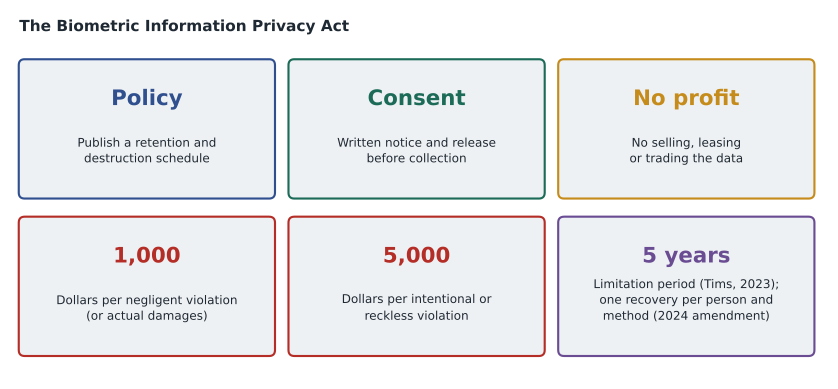
The Act imposes five main duties on a private entity that possesses or collects biometric data. It must publish a written policy with a retention schedule and guidelines for permanently destroying the data, generally when the purpose for collecting it has been satisfied or within three years of the person's last interaction with the entity, whichever comes first. It must inform the person in writing and obtain a written release before collecting the data. It may not sell, lease, trade or otherwise profit from the data. It may not disclose the data except in limited circumstances, such as with consent. And it must protect the data with a reasonable standard of care at least as protective as for other confidential information.
What makes BIPA so significant is its private right of action. A person aggrieved by a violation may sue and recover, for each violation, liquidated damages of 1,000 dollars for a negligent violation or 5,000 dollars for an intentional or reckless violation, or actual damages if greater, plus reasonable attorney's fees and costs and other relief, including an injunction.
Four decisions and an amendment
Four decisions of the Supreme Court of Illinois and one amendment define how BIPA works today.
In Rosenbach v. Six Flags Entertainment Corp. in 2019, the court held that a person is aggrieved, and may sue, when a private entity violates the Act's requirements, even without any actual injury beyond the violation of the statutory rights. A teenager's season-pass fingerprint scan, taken without the required written notice and release, was enough.
In McDonald v. Symphony Bronzeville Park in 2022, the court held that the exclusivity provisions of the Workers' Compensation Act do not bar BIPA claims by employees for statutory liquidated damages. That opened the way for the many workplace timekeeping claims based on fingerprint and hand-scan time clocks.
In Tims v. Black Horse Carriers in 2023, the court held that a five-year limitation period applies to all BIPA claims.
In Cothron v. White Castle System in 2023, the court held that a separate claim accrues each time a private entity scans or transmits a person's biometric data in violation of the Act, not only the first time. Because each scan could be a separate violation, potential damages for employees who scanned in and out every day for years became enormous. The court noted that liquidated damages are discretionary and invited the General Assembly to address the policy concerns.
The General Assembly responded in 2024. The amendment, signed in August 2024, provides that a private entity that collects or discloses the same biometric data from the same person using the same method commits only a single violation for purposes of recovery, so a plaintiff may recover at most once for that series. The amendment also confirmed that an electronic signature can satisfy the written release requirement. Courts have since addressed whether the amendment applies to cases pending when it took effect, and a lawyer working on a BIPA case must check the current state of that question.
| Decision or law | Year | Holding |
|---|---|---|
| Rosenbach v. Six Flags | 2019 | A violation of the Act's requirements makes a person aggrieved, without other injury |
| McDonald v. Symphony Bronzeville Park | 2022 | Workers' compensation exclusivity does not bar BIPA claims for liquidated damages |
| Tims v. Black Horse Carriers | 2023 | A five-year limitation period applies to all BIPA claims |
| Cothron v. White Castle | 2023 | A claim accrues with each scan or transmission; damages are discretionary |
| 2024 amendment | 2024 | Same data, same person, same method counts as one violation for recovery; electronic signatures allowed |
The Illinois Rules of Professional Conduct
Illinois lawyers practice under the Illinois Rules of Professional Conduct of 2010, adopted by the Supreme Court of Illinois and effective January 1, 2010. They follow the ABA Model Rules in structure and much of their text. The bar exam's MPRE tests the ABA Model Rules, not the Illinois rules, but an Illinois lawyer is disciplined under the Illinois rules, and some differences are important.
Confidentiality. Illinois Rule 1.6 makes disclosure mandatory in one situation where the Model Rule makes it optional. Under Illinois Rule 1.6(c), a lawyer shall reveal information relating to the representation of a client to the extent the lawyer reasonably believes necessary to prevent reasonably certain death or substantial bodily harm. Under the ABA Model Rule, the lawyer may reveal such information but is not required to.
Reporting misconduct. Illinois Rule 8.3 requires a lawyer who knows that another lawyer has committed a violation raising a substantial question about that lawyer's honesty, trustworthiness or fitness to report it, as the Model Rule does. Illinois has a famous reminder of how seriously it takes the duty: In re Himmel, decided by the Supreme Court of Illinois in 1988, suspended a lawyer for failing to report another lawyer's conversion of a client's settlement funds, even though the client had asked him not to report it.
Discrimination. Illinois did not adopt ABA Model Rule 8.4(g). Its Rule 8.4 includes its own provision addressing discrimination, linked to unlawful discrimination found by a tribunal, so the Illinois standard should be read in its own words.
Trust accounts and registration. Client funds are held under Rule 1.15, with nominal or short-term funds placed in IOLTA accounts. Every Illinois lawyer registers each year with the ARDC under Supreme Court Rule 756, reports whether he or she carries malpractice insurance and reports pro bono service. Illinois does not require malpractice insurance, but since 2018 lawyers in private practice without it must complete an online self-assessment of their practice management, part of Illinois's proactive management-based regulation.
Worked problem
Must the lawyer tell?
During a meeting, Marisol's supervising lawyer's client says he plans to burn down a building that night while a security guard is inside. The lawyer reasonably believes the threat is real. What does Illinois Rule 1.6 require?
Show solution
- The information relates to the representation and is confidential.
- Disclosure would prevent reasonably certain death or substantial bodily harm to the guard.
- Under the ABA Model Rule, disclosure would be permitted but not required.
- Under Illinois Rule 1.6(c), the lawyer shall reveal the information to the extent reasonably necessary to prevent the harm.
Answer: The lawyer must disclose enough to prevent the harm. In Illinois this is mandatory, not optional.
Common mistakes
MistakeAssuming BIPA claims need proof of actual harm.
InsteadRosenbach (2019) held that a violation of the Act's requirements makes a person aggrieved.
MistakeCounting every scan as a separate recovery after the 2024 amendment.
InsteadThe amendment treats the same data from the same person by the same method as one violation for recovery.
MistakeAnswering MPRE questions under the Illinois rules.
InsteadThe MPRE tests the ABA Model Rules; Illinois rules govern discipline in Illinois.
MistakeTreating disclosure to prevent death or substantial bodily harm as optional in Illinois.
InsteadIllinois Rule 1.6(c) makes it mandatory.
Practice problems
Work each problem on paper first, then reveal the answer to check.
What liquidated damages does BIPA provide?
Show answer
1,000 dollars per negligent violation and 5,000 dollars per intentional or reckless violation, or actual damages if greater, plus fees.
What limitation period applies to BIPA claims?
Show answer
Five years, under Tims v. Black Horse Carriers (2023).
What did In re Himmel (1988) involve?
Show answer
A lawyer suspended for failing to report another lawyer's misconduct.
A compliance checklist for a client that uses biometrics
Marisol's one BIPA matter came from a small employer that installed fingerprint time clocks. Marchetti uses it to show how a lawyer advises on prevention rather than litigation. The core steps follow the structure of the Act.
| Step | What the client does | Why it matters |
|---|---|---|
| Inventory | Lists every device or service that captures fingerprints, face geometry, hand scans, voiceprints or retina or iris scans | A client cannot comply for systems it does not know about |
| Written policy | Publishes a retention schedule and destruction guidelines available to the public | Required by the Act for any private entity in possession of biometric data |
| Written notice and release | Gives written notice of what is collected, why and for how long, and obtains a written release before collection | Collection without a release is the most common claim |
| Vendors | Reviews contracts with time clock and software vendors for who holds the data and how it is protected | Vendors and employers have both been sued |
| Destruction | Destroys data when the purpose is satisfied or within the time the Act allows after the last interaction, whichever comes first | Keeping data too long is a separate violation |
| Records | Keeps signed releases and the policy history | Proof of compliance is the defense |
The 2024 amendment changed the exposure for a client that missed these steps in the past, by limiting recovery to one violation per person for the same collection method rather than one per scan. It also confirmed that an electronic signature can satisfy the written release requirement. It did not change the duties themselves. Marchetti's point to Marisol is that the cheapest BIPA case is the one prevented by a signed form and a posted policy.
Confidentiality: where Illinois goes further
The section above introduced the Illinois version of Rule 1.6. The feature that surprises lawyers from other states is that Illinois requires, rather than permits, disclosure of information to the extent the lawyer reasonably believes necessary to prevent reasonably certain death or substantial bodily harm. Under the ABA Model Rule, the same disclosure is permitted but not required. A lawyer trained elsewhere who assumes the choice is theirs could violate the Illinois rule by staying silent.
The rest of Rule 1.6 in Illinois looks much like the Model Rule, with permissive exceptions for matters such as securing ethics advice and establishing a claim or defense in a dispute with the client. Each exception is limited to what is reasonably necessary, so even a permitted disclosure should be as narrow as possible.
Reporting another lawyer
Illinois takes the duty to report misconduct by other lawyers seriously. In In re Himmel, decided in 1988, the Supreme Court of Illinois suspended a lawyer for failing to report another lawyer's conversion of client funds, even though the client had asked him not to report it. The case is still taught to every new Illinois lawyer. Rule 8.3 requires a lawyer who knows of another lawyer's misconduct that raises a substantial question about honesty, trustworthiness or fitness to inform the appropriate authority, which in Illinois is the Attorney Registration and Disciplinary Commission, unless the information is protected as confidential.
Worked problem
A second reporting problem
Marisol, newly admitted, learns from opposing counsel's former paralegal that opposing counsel routinely pays personal bills from the client trust account. The paralegal is not Marisol's client. What should she do?
Show solution
- Using client funds for personal bills is conversion, which raises a substantial question about honesty and fitness.
- The information did not come from Marisol's own client, so Rule 1.6 does not prevent disclosure.
- Rule 8.3 and the Himmel decision point to a report to the ARDC.
- She should report what she knows factually, without speculation, and should not use the threat of a report to gain an advantage in the case.
Answer: Marisol should report the conduct to the ARDC. Threatening a report to win concessions in the litigation would raise its own ethical problem.
Trust accounts and the first-year habits
Many disciplinary cases in Illinois start with client trust accounts. Rule 1.15 requires a lawyer to keep client funds separate from the lawyer's own, to keep complete records and to deliver funds promptly when the client is entitled to them. Small amounts held for short periods generally go into a pooled interest-bearing account whose interest funds legal aid. Marisol will not manage the firm's trust account in her first year, but Marchetti tells her to learn how it works, because a new lawyer who signs a trust check is responsible for knowing it is proper.
Summary and key terms
- BIPA requires a retention policy, written notice and release, no profiting, limited disclosure and reasonable security, and gives a private right of action with liquidated damages.
- Rosenbach, McDonald, Tims and Cothron shaped BIPA litigation; the 2024 amendment limits recovery to one violation per person and method.
- Illinois lawyers practice under the 2010 Illinois Rules of Professional Conduct, which make some disclosures mandatory and enforce the reporting duty strictly.
- Lawyers register yearly with the ARDC; uninsured private practitioners complete a practice self-assessment.
- BIPA
- The Illinois Biometric Information Privacy Act of 2008, regulating private entities' handling of biometric data.
- Liquidated damages
- A fixed amount of damages set by statute for each violation, without proof of actual loss.
- Illinois Rule 1.6(c)
- The Illinois rule requiring disclosure to prevent reasonably certain death or substantial bodily harm.
- In re Himmel
- The 1988 Supreme Court of Illinois decision suspending a lawyer for failing to report another lawyer's misconduct.
Lesson quiz · 5 questions
Score 60% or more to complete this lesson.
Create a free account to save your progress, take quizzes and earn a certificate.