
BAR-214 · Lesson 4 of 12 · 20 min
The Illinois bar exam: the UBE, scoring and the 266 passing score
▶ Video coming soon A video version of this lesson is on the way.
By November, Marisol had her filings in and her MPRE score sent. On her fourth call she asked Marchetti to explain, step by step, how her exam would be scored. 'I keep hearing that the essays are curved and the MBE isn't,' she said, 'and that you can fail the essays and still pass. I want to know what's true.' Marchetti said both statements were half right, and spent the call on the details.
Two days, three tests
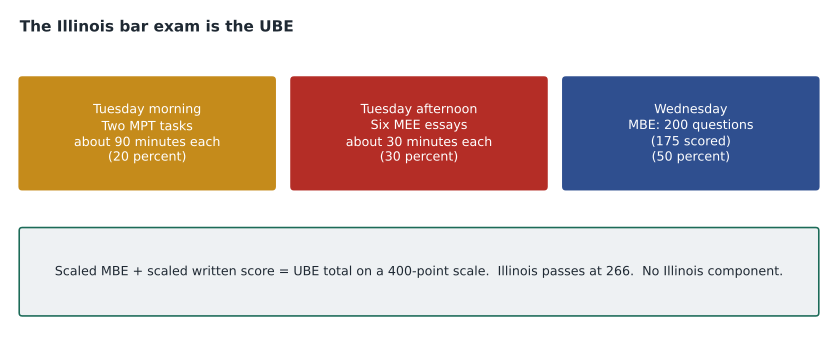
Illinois gives the Uniform Bar Examination on the last Tuesday and Wednesday of February and July. The February 2027 exam falls on February 23 and 24, 2027. The first day is the written day. In the morning, examinees have three hours for two Multistate Performance Test tasks, about 90 minutes each. In the afternoon, they have three hours for six Multistate Essay Examination questions, about 30 minutes each. The second day is the Multistate Bar Examination: 200 multiple-choice questions in two three-hour sessions of 100 questions each. Of the 200 MBE questions, 175 are scored and 25 are unscored pretest questions that look exactly like the others.
Every part of the UBE is written by NCBE, and graders in each jurisdiction grade the written answers using NCBE's grading materials. Illinois does not add its own questions or its own subjects. That is what makes an Illinois score portable: the same exam, graded to the same standards, is given across all UBE jurisdictions.
What each test covers
The MPT gives each examinee a file of facts and a library of law and asks for a practical lawyering task, such as an objective memo, a persuasive brief, a client letter or a demand letter. All the law needed is in the library, which may be fictional. The MPT tests skills: following instructions, extracting rules from cases and statutes, applying them to messy facts and writing clearly under time pressure.
The MEE asks six essay questions drawn from the subjects listed in NCBE's MEE subject matter outline. Starting with the July 2026 exam, NCBE removed four subjects from the MEE: conflict of laws, family law, trusts and estates, and secured transactions. The MEE now draws on business associations and the MBE subjects: civil procedure, constitutional law, contracts and sales, criminal law and procedure, evidence, real property and torts. Family law and trusts and estates can still appear on the MPT, with the necessary law supplied in the library, through the last legacy exam. Marisol had found an old outline that included secured transactions and was relieved to drop it. Marchetti told her to always check NCBE's current outline rather than rely on old materials.
The MBE tests seven subjects with 25 scored questions each: civil procedure, constitutional law, contracts, criminal law and procedure, evidence, real property and torts. The questions are answered under generally accepted law and the Federal Rules of Civil Procedure and Evidence, not Illinois law.
How the score is built
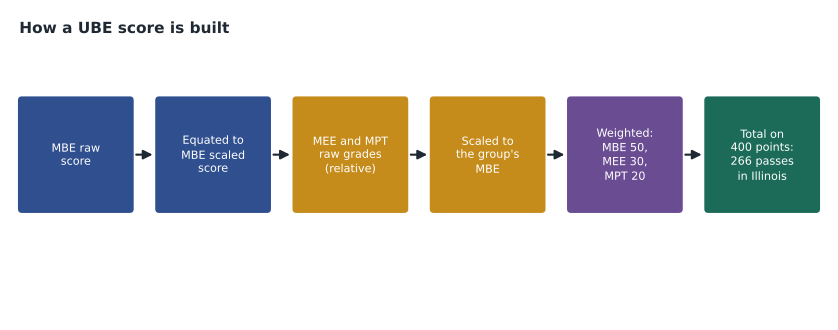
On the UBE, the MBE counts for half of the total score, the MEE for 30 percent and the MPT for 20 percent. The scores are reported on a 400-point scale. The process works in four steps.
First, the MBE raw score, the number of scored questions answered correctly, is converted by NCBE to a scaled score through a statistical process called equating. Equating adjusts for small differences in difficulty between exam forms, so that a given scaled score means the same level of performance whether the exam was taken in February or July, this year or five years ago. There is no curve in the sense of a fixed percentage passing.
Second, the written answers are graded by Illinois graders, usually on a relative scale. Graders sort answers to each question into groups from strongest to weakest, using NCBE's grading materials and calibration sessions. A grade on one essay reflects how that answer compares with the other answers to the same question at that administration.
Third, the written raw scores are scaled to the MBE. The jurisdiction converts each examinee's total written score to the same scale as the MBE, so that the group's written scores have the same average and spread as the group's MBE scores. This is the step people describe as curving the essays. It means the written scores are anchored to the MBE performance of the same group of examinees, which is itself anchored across time through equating.
Fourth, the weighted scores are combined. The scaled MBE score counts for half and the scaled written score for half, with the written half divided between the MEE and the MPT in the 30 to 20 proportion. The result, on the 400-point UBE scale, is compared with the Illinois passing score of 266.
The 266 passing score
NCBE lists the Illinois minimum passing score as 266. On NCBE's chart of UBE jurisdictions, passing scores run from 260 to 270, so Illinois sits in the middle. Since Illinois has no state component, 266 on the UBE is the whole test requirement for an Illinois exam taker. There is no separate minimum on the MBE or on the written portion: an examinee with a weaker written score can pass with a stronger MBE score, and the reverse. Because the MBE counts for half, though, a very weak MBE score is hard to overcome.
Marchetti answered Marisol's question this way. It is true that the written scores are scaled to the MBE, and it is true that a strong performance on one part can carry a weaker one. It is not true that the essays do not matter. The written portion is half the score, and the difference between a middling and a good set of essays and performance tests is often the difference between 262 and 270.
Worked problem
Will the score pass?
An examinee's scaled MBE score is 135. Her scaled written score, on the same 200-point scale, is 129. What is her total UBE score, and does she pass in Illinois?
Show solution
- The UBE total is the scaled MBE score plus the scaled written score, each on a 200-point scale, giving a 400-point total.
- 135 plus 129 equals 264.
- Illinois requires 266.
Answer: Her total is 264, two points short of the Illinois passing score of 266. The same total would also fall short in a 266 jurisdiction such as the District of Columbia, but would pass in a 260 jurisdiction.
Results and score reports
The Board releases results through applicants' private online accounts. For the July 2026 exam, the Board announced that results would be posted by the end of the day on October 1. February results typically come out in the spring. The Board does not post individual results publicly. An examinee who does not pass receives a score report, and NCBE separately reports the MBE score. Examinees who want to understand their performance should look at both the MBE scaled score and the written scaled score, and at the individual essay and MPT grades where the Board provides them.
Test-day rules in brief
Examinees must follow the Board's security rules on identification, permitted items and laptops. The Board's announcements for recent exams address religious attire, which is permitted subject to visual inspection, and religious objects that would normally be barred, which require advance approval. Marchetti tells candidates to read the Board's examinee instructions for their specific exam twice: once when they arrive, and again the week before the exam. Rules on what can be brought into the room, how laptops must be set up and when examinees may leave change from time to time.
Common mistakes
MistakeStudying conflict of laws, family law, trusts and estates and secured transactions for the MEE.
InsteadSince July 2026 those four subjects are no longer on the MEE; family law and trusts and estates may appear on the MPT with the law supplied.
MistakeBelieving there is a minimum score on each part of the Illinois exam.
InsteadIllinois uses a single combined UBE score of 266; strength on one part can offset weakness on another.
MistakeAnswering MBE questions under Illinois law.
InsteadThe MBE is answered under generally accepted law and the federal rules, not Illinois law.
MistakeThinking the written portion is graded against a fixed standard.
InsteadWritten answers are usually graded relatively and then scaled to the group's MBE performance.
Practice problems
Work each problem on paper first, then reveal the answer to check.
What are the UBE weights for the MBE, MEE and MPT?
Show answer
MBE 50, MEE 30 and MPT 20.
An examinee scores a scaled 128 on the MBE and a scaled 140 on the written portion. Does the examinee pass in Illinois?
Show answer
Yes. 128 plus 140 is 268, which meets the 266 passing score.
Which four subjects left the MEE in July 2026?
Show answer
Conflict of laws, family law, trusts and estates, and secured transactions.
Working the MBE
The MBE is half of the score, so Marchetti spends more time on it than on anything else. The 200 questions are split into a morning session and an afternoon session of 100 questions each, with three hours for each session. That works out to about 1.8 minutes per question. Twenty-five of the 200 are unscored pretest questions that look exactly like the others, so there is no point trying to guess which ones do not count.
Her method for each question has four steps. Read the call of the question first, the last sentence that says what is being asked. Then read the facts with that call in mind, marking the facts that trigger a rule. Then predict the answer before looking at the options. Finally, read all four options and pick the one that matches the prediction, or the best of the four if none matches exactly. When two answers both look right, the better one usually states the rule more precisely or rests on the stronger reason.
Marisol tracks her practice results by subject and by the reason she missed each question: she did not know the rule, she knew the rule but misread the facts, or she ran out of time. Each reason has a different fix. Rule gaps call for review, misreading calls for slower reading of the call and the key facts, and timing calls for more timed sets.
Writing an MEE answer
Each MEE essay gets about 30 minutes, and graders read many answers quickly. Marchetti teaches a plain structure. Give each issue its own heading that matches the question's call. State the rule in one or two sentences. Apply the rule to the specific facts, using the facts by name rather than restating them in bulk. Close each issue with a one-line conclusion. An answer that reaches a different conclusion from the model answer can still earn strong credit if the analysis is sound and the rule is right.
She warns against two habits. The first is writing everything known about a subject in the hope that something matches; graders reward analysis of the issues raised, not volume. The second is skipping a question entirely. A short answer with the right headings and rules earns points that a blank page cannot.
Approaching the MPT
The MPT gives the examinee a file of facts and a library of law, and asks for a specific lawyering task, such as an objective memo, a persuasive brief, a client letter or a set of discovery requests. Everything needed is in the packet. Marchetti's rule is to read the task memo first and twice, because it says who the audience is, what format is expected and what to leave out. Then read the library to pull out the rules, then the file to find the facts that matter, and spend at least half of the 90 minutes writing.
Format points matter on the MPT more than anywhere else. A persuasive brief needs argument headings that state a conclusion; an objective memo does not argue. A letter to a client is written in plain language. Following the instructions on format and tone is part of what is being tested.
Worked problem
Reading a score report
A candidate in another UBE jurisdiction receives a scaled MBE score of 138 and a scaled written score of 130. Would that total pass in Illinois, and could it transfer?
Show solution
- The UBE total is the scaled MBE score plus the scaled written score: 138 plus 130 equals 268.
- Illinois passes at 266 on the legacy UBE, so 268 meets the Illinois standard.
- Illinois accepts transferred legacy UBE scores of 266 or higher, up to four years old.
- Character and fitness certification and an MPRE score of 80 are still required.
Answer: The total of 268 would pass in Illinois and could support a transfer within four years, subject to the other admission requirements.
Using practice tests well
NCBE sells released MBE questions, MEE questions with analyses and past MPTs. Marchetti tells students to use them as a measuring tool, not just as reading. Take full sets under real timing at least twice before the exam, once about six weeks out and once about two weeks out, and use the results to decide where the remaining study time goes. A score that climbs steadily is a better sign than any single result.
Summary and key terms
- Illinois gives the UBE on the last Tuesday and Wednesday of February and July: two MPTs and six MEE essays, then the 200-question MBE.
- The MBE is equated, the written portion is scaled to the MBE, and the weights are MBE 50, MEE 30 and MPT 20.
- Illinois requires a combined UBE score of 266 with no separate minimums and no state component.
- Results are posted to applicants' accounts; July 2026 results were posted by October 1.
- Equating
- The statistical process that makes MBE scaled scores comparable across exam forms and administrations.
- Scaling to the MBE
- Converting written scores to the MBE scale so they share the group's MBE mean and spread.
- Pretest questions
- The 25 unscored MBE questions used to evaluate future questions.
- Relative grading
- Grading written answers by comparison with the other answers to the same question.
Lesson quiz · 5 questions
Score 60% or more to complete this lesson.
Create a free account to save your progress, take quizzes and earn a certificate.