
BAR-214 · Lesson 6 of 12 · 20 min
What the exam tests and how Illinois law appears
▶ Video coming soon A video version of this lesson is on the way.
Marisol's firm assigns her Illinois research every day: a Code of Civil Procedure motion one morning, a landlord-tenant ordinance question the next. She asked Marchetti whether she should study Illinois law for the bar. 'For the exam, no,' Marchetti said. 'For the exam you need the national rules, cold. For your career, yes, and the trick is not to let one get in the way of the other.' This lesson explains what the UBE actually tests, where Illinois law fits, and how a clerk who works in Illinois law every day can avoid writing Illinois answers to national questions.
No Illinois component on the exam
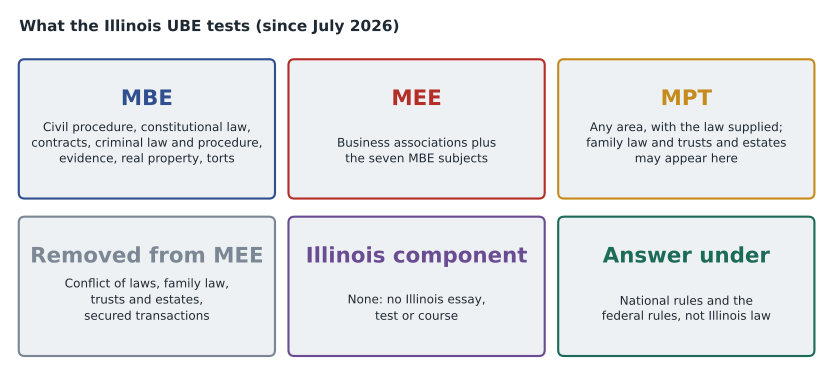
NCBE's jurisdiction information lists no jurisdiction-specific requirement for Illinois, either for the legacy UBE or for NextGen. There is no Illinois essay, no Illinois multiple-choice section and no required Illinois law course before admission. Some other UBE jurisdictions add a local requirement: Arizona and Alabama require an online course on state law, Missouri a state law component test, Washington an open-book law component, Texas a law component on Texas topics. Illinois chose not to.
That choice shapes how an Illinois candidate studies. Every point on the Illinois bar exam comes from national law: the MBE's generally accepted rules, the MEE's tested rules and the MPT's supplied library. An answer that relies on an Illinois rule where it differs from the national rule earns no credit for the difference and may lose credit for the error.
What the UBE tests
The MBE covers seven subjects, with 25 scored questions each: civil procedure, constitutional law, contracts, criminal law and procedure, evidence, real property and torts. Civil procedure questions assume the Federal Rules of Civil Procedure and federal jurisdiction statutes. Evidence questions assume the Federal Rules of Evidence. Contracts questions use the common law and Article 2 of the Uniform Commercial Code. Torts questions assume generally accepted rules, and NCBE's outline tells examinees to assume pure comparative negligence and joint and several liability unless a question says otherwise.
The MEE, since July 2026, draws on business associations and the seven MBE subjects. The MPT can involve any area, with the law supplied, and through the last legacy exam family law and trusts and estates may appear there with the law in the library.
Where Illinois law and the national rule part ways
Marchetti asked Marisol to list the Illinois rules she uses most. Then they marked which ones conflict with what the bar exam expects. The list is a useful warning for any Illinois clerk.
Pleading. Illinois is a fact-pleading jurisdiction: a complaint must allege facts sufficient to bring a claim within a legally recognized cause of action. The federal rules, and therefore the MBE, use notice pleading as refined by the Supreme Court's plausibility standard. On the MBE, the federal standard governs.
Comparative fault. Illinois uses modified comparative fault: a plaintiff more than 50 percent at fault recovers nothing. Unless an MBE question says otherwise, NCBE tells examinees to assume pure comparative negligence. An Illinois instinct to bar recovery at 51 percent fault would be wrong on the exam.
Joint and several liability. Illinois limits joint liability for some defendants. The MBE default is joint and several liability unless the question says otherwise.
Expert evidence. Illinois courts apply the Frye general acceptance test, codified in Illinois Rule of Evidence 702. The Federal Rules of Evidence, and therefore the MBE, apply Rule 702 as interpreted in Daubert and amended in 2023.
Hearsay and other evidence rules. The Illinois Rules of Evidence, codified in 2011, follow the federal rules in structure but differ in places, including some hearsay provisions and the treatment of prior inconsistent statements in criminal cases. On the MBE, only the federal rules matter.
Property. Illinois land trusts, Illinois homestead rules and Illinois recording practices are distinct, but the MBE tests generally accepted property law, including the three recording act types and the common law of estates and future interests.
| Topic | Illinois practice | What the bar exam expects |
|---|---|---|
| Pleading | Fact pleading | Federal notice pleading with plausibility |
| Comparative fault | Modified: barred if more than 50 percent at fault | Pure comparative negligence unless stated |
| Joint liability | Limited for some defendants by statute | Joint and several unless stated |
| Expert evidence | Frye general acceptance (Ill. R. Evid. 702) | Federal Rule 702 and Daubert |
| Evidence rules | Illinois Rules of Evidence (2011) | Federal Rules of Evidence |
Using Illinois knowledge without hurting the score
Marchetti gave Marisol three habits. First, label the rule source in practice notes. When she writes down a rule at work, she marks it Illinois or federal so she does not blur them when studying. Second, answer the question asked. If an MEE question says the events took place in a particular state and gives no special rule, the national majority or the rule the question supplies governs. Third, use Illinois practice for skills, not rules. Her daily work drafting motions and memos is excellent practice for the MPT, which rewards organization, issue spotting and clear writing using a supplied library. The MPT does not care which state she practices in.
There is one place where Illinois knowledge is directly useful: understanding how a real court works. An examinee who has watched a motion to dismiss argued in the Circuit Court of Cook County understands procedure as a living thing, which helps on civil procedure questions about motions, discovery and timing, even though the rules tested are federal.
Worked problem
Spotting the Illinois trap
An MBE question describes a plaintiff found 55 percent at fault for a car accident, with damages of 100,000 dollars, in a jurisdiction that the question does not identify and with no special rule stated. What should the examinee assume?
Show solution
- NCBE's MBE outline tells examinees to assume pure comparative negligence unless the question says otherwise.
- Under pure comparative negligence, the plaintiff's recovery is reduced by her share of fault but not barred.
- Under Illinois's modified rule, a plaintiff more than 50 percent at fault recovers nothing, but Illinois law is not the MBE standard.
Answer: Assume pure comparative negligence: the plaintiff recovers 45,000 dollars. An Illinois-trained answer barring recovery would be wrong.
Illinois law after admission
Although the exam does not test Illinois law, Illinois expects new lawyers to learn it quickly. The first-year continuing legal education requirement, covered in Lesson 11, includes a basic skills course that introduces Illinois practice. And the first months of practice put new lawyers in front of the Code of Civil Procedure, the Supreme Court Rules and the Illinois Rules of Evidence immediately. That is why Lessons 7 to 10 of this course teach the Illinois law a new lawyer meets first. Those lessons are for practice, not the exam. Marchetti told Marisol to read them after her exam, or during bar study only if she had time to spare.
Common mistakes
MistakeWriting Illinois rules on MBE or MEE answers.
InsteadThe UBE tests national law; Illinois rules earn no credit where they differ and can cost points.
MistakeAssuming modified comparative fault on the MBE.
InsteadNCBE tells examinees to assume pure comparative negligence and joint and several liability unless stated.
MistakeSpending bar study time on Illinois procedure.
InsteadIllinois has no state component; study the national rules for the exam and Illinois law for practice.
MistakeIgnoring the MPT because it is only 20 percent.
InsteadThe MPT rewards the practical skills a working clerk already uses and can lift a borderline score.
Practice problems
Work each problem on paper first, then reveal the answer to check.
Does Illinois require any state law component or course before admission?
Show answer
No. NCBE lists no jurisdiction-specific requirement for Illinois.
Which expert evidence standard do Illinois courts apply, and which does the MBE apply?
Show answer
Illinois applies the Frye general acceptance test; the MBE applies Federal Rule 702 and Daubert.
What pleading standard does the MBE assume?
Show answer
Federal notice pleading as refined by the plausibility standard, not Illinois fact pleading.
Turning the subject list into a schedule
Marisol has about ten weeks of full-time study between the end of the holidays and February 23, 2027, plus lighter study in the weeks before. Marchetti helps her build a schedule from the subject list. The MBE subjects come first because they count on both the MBE and the MEE: civil procedure, constitutional law, contracts, criminal law and procedure, evidence, real property and torts. Business associations comes next, since it can appear only on the MEE but appears often. The MPT needs regular practice rather than content review, so it gets a fixed slot every week.
| Weeks | Main focus | Weekly practice |
|---|---|---|
| 1 and 2 | Torts, contracts and sales | Two MBE sets of 33 questions; one MPT; two essays |
| 3 and 4 | Civil procedure and evidence | Three MBE sets; one MPT; three essays |
| 5 and 6 | Real property and constitutional law | Three MBE sets; one MPT; three essays |
| 7 | Criminal law and procedure; business associations | One full 100-question timed session; four essays |
| 8 | Review of the weakest two subjects | Full simulated MBE; one MPT under time |
| 9 | Mixed review; essay drills by subject | Six essays in three hours; two MPTs in three hours |
| 10 | Light review and rest | Short mixed sets only; no new material in the last three days |
The schedule is a draft, not a contract. Marchetti expects it to change after the first simulated exam, when the results show which subjects need more time. What she does not allow is skipping the timed practice: content review feels productive, but the exam measures performance under time.
The subjects removed from the MEE
NCBE removed several subjects from the MEE beginning with the July 2026 exam, including conflict of laws, family law, trusts and estates, and secured transactions. That change simplifies Marisol's schedule, but it does not mean those areas can be ignored entirely. The MPT can be set in any area of law, because it supplies the law. A performance test on a custody dispute or a will contest is possible, and an examinee who has never seen the vocabulary will read the library more slowly.
Marchetti's approach is a single afternoon of orientation on each removed subject: the basic vocabulary and structure, not the detailed rules. That is enough to read an MPT library comfortably.
Where Illinois habits can cost points
Marisol has spent a year in a Chicago firm, and she knows some Illinois rules well. Marchetti warns that this knowledge can mislead on the exam. Unless a question says otherwise, MBE and MEE questions are decided under the generally accepted national rule, the Federal Rules of Civil Procedure and the Federal Rules of Evidence. Three areas illustrate the risk.
Pleading is the first. Illinois uses fact pleading in its own courts, which requires more factual detail than the federal standard. On the exam, a civil procedure question about whether a complaint survives a motion to dismiss is answered under the federal plausibility standard from the Twombly and Iqbal decisions, not the Illinois fact-pleading rule.
Comparative fault is the second. Illinois bars a plaintiff who is more than 50 percent at fault, as Lesson 8 explains. MBE questions usually tell the examinee which comparative fault system applies, and when they do, the stated system controls. When they do not, the examinee should apply the approach the question's facts point to rather than importing the Illinois statute.
Evidence is the third. Illinois codified its own rules of evidence, and they track the federal rules in most respects, but not all. On the exam, the Federal Rules of Evidence control. A candidate who has argued an Illinois evidence point in practice should still answer the federal version.
Worked problem
Federal or Illinois?
An MBE question describes a negligence action filed in a federal court in Illinois. The plaintiff was 55 percent at fault, and the question says the jurisdiction follows pure comparative negligence. What does the plaintiff recover on 100,000 dollars of damages?
Show solution
- The question states the rule: pure comparative negligence.
- Under pure comparative negligence, the plaintiff recovers damages reduced by the plaintiff's share of fault, whatever that share is.
- The Illinois rule that bars a plaintiff more than 50 percent at fault does not apply, because the question supplies a different rule.
- 100,000 dollars reduced by 55 percent leaves 45,000 dollars.
Answer: The plaintiff recovers 45,000 dollars. The stated rule controls, even though Illinois law would bar recovery.
Keeping Illinois law in its place
None of this means Marisol's Illinois knowledge is wasted. It will matter from her first day in practice, and Lessons 7 to 10 cover it so she has a head start. The discipline is to keep two folders in her mind: the national rules for February, and the Illinois rules for the work that follows. When she reviews an Illinois point, she writes the national rule beside it so the contrast is clear.
Marchetti adds one more habit for the essays. When Marisol writes a practice MEE answer, she rereads it once looking only for Illinois rules that crept in. In her first three practice essays she found two: a reference to fact pleading and a reference to the Illinois comparative fault bar. Neither belonged in a national answer, and both would have cost credit.
Summary and key terms
- Illinois has no state law component; every point on the exam comes from national law.
- The MBE covers seven subjects; the MEE covers business associations and the MBE subjects; the MPT supplies the law.
- Illinois practice differs from the exam rules on pleading, comparative fault, joint liability and expert evidence.
- Use Illinois practice to sharpen skills, especially for the MPT, but write national rules on exam day.
- Fact pleading
- The Illinois requirement that a complaint allege facts bringing the claim within a recognized cause of action.
- Frye test
- The general acceptance standard for scientific evidence, followed in Illinois.
- Pure comparative negligence
- A rule reducing a plaintiff's recovery by her share of fault without barring it; the MBE default.
- MBE subject matter outline
- NCBE's list of what the MBE tests and the assumptions examinees should make.
Lesson quiz · 5 questions
Score 60% or more to complete this lesson.
Create a free account to save your progress, take quizzes and earn a certificate.