
BAR-210 · Lesson 6 of 12 · 15 min
Part A: how Florida law is tested
▶ Video coming soon A video version of this lesson is on the way.
Yesenia printed the most recent Part A essays the Board has released and read one, as Marchetti asked, without answering it. 'It started as a divorce question,' she says at their sixth session, 'then it turned into a homestead question, then a question about whether the husband's lawyer could keep representing him. I did not know which subject I was studying.' Marchetti nods. 'That is Part A. The Board writes Florida questions the way Florida clients bring problems: tangled. Today we learn how to untangle them.' This lesson explains what Part A covers, how its essays and multiple-choice questions differ from the MBE, and how to study for a test that rewards precise knowledge of Florida law.
The scope of Part A
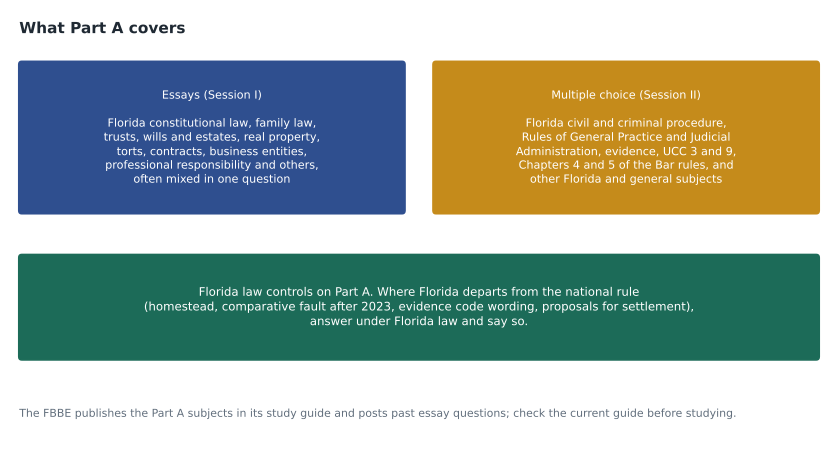
The Board publishes the subjects Part A may cover in its study guide and posts selected past essay questions on its website. In general terms, Part A covers Florida law and some general law in subjects that include Florida constitutional law, federal constitutional law, Florida civil procedure, Florida criminal law and procedure and constitutional criminal procedure, the Florida Rules of General Practice and Judicial Administration, evidence, family law, real property, torts, contracts, trusts, wills and administration of estates, business entities, UCC Articles 3 and 9, and professional responsibility under Chapters 4 and 5 of the Rules Regulating The Florida Bar, together with professionalism. The essays and the multiple-choice questions draw on that list differently.
Because the subject list changes from time to time, the current study guide is the authority. Marchetti makes Yesenia download it and check each subject in her outline against it, crossing off anything her commercial course covers only for the MBE and adding Florida-specific rules where her course was thin.
The essays
Session I gives candidates three essay questions in three hours, so roughly one hour each. Each question presents a fact pattern and asks one or more questions, sometimes as a client's request for advice and sometimes as a memo assignment from a supervising lawyer. The Board's questions often combine subjects. A single question might start with a dissolution of marriage, require an analysis of whether a house is homestead and how it passes if a spouse dies, and end with a professional responsibility problem about a lawyer representing both spouses. Candidates who study subjects in isolation can miss the second and third issues entirely.
Florida essays reward Florida law. Where Florida departs from the general rule, the answer should apply Florida's rule and, ideally, say so. On a homestead question, a generic answer about devising real property is wrong in Florida, because the Florida Constitution restricts devise of homestead when the owner is survived by a spouse or minor child. On a negligence question about an accident after March 24, 2023, an answer that applies pure comparative fault is wrong, because Florida moved to modified comparative fault. Graders look for the Florida rule, applied to the facts, in an organized answer.
A method for Part A essays
Marchetti teaches a five-step method she has refined with Florida candidates. First, read the call of the question before the facts, so you know what you are being asked. Second, read the facts once quickly and once slowly, marking each fact that triggers a rule: dates, relationships, ownership, amounts, residence, and anything that sounds unusual. Third, outline the issues in the order the call asks for them, with the Florida rule for each. Fourth, write in short paragraphs: a heading naming the issue, the rule, the application to these facts, and a conclusion. Fifth, save the last five minutes to reread the call and check that every part has been answered.
Timing is the most common essay problem. Yesenia's diagnostic essay ran out of time on the third issue. Marchetti asks her to write the next three essays with a timer showing a 15-minute warning, and to move to her conclusion on every remaining issue when the warning sounds, even if her analysis of the current issue is unfinished. 'A short paragraph that states the rule and a conclusion on the last issue earns more than a beautiful paragraph on the first issue and nothing on the last,' she says.
| Step | What to do | Time (of 60 minutes) |
|---|---|---|
| 1. Call | Read what is asked; note the role (advisor, memo writer) | 2 minutes |
| 2. Facts | Read twice; mark dates, relationships, property, amounts | 8 minutes |
| 3. Outline | List issues in the order of the call, with the Florida rule | 8 minutes |
| 4. Write | Issue heading, rule, application, conclusion for each issue | 37 minutes |
| 5. Check | Reread the call; make sure every part is answered | 5 minutes |
The multiple-choice questions
Session II gives candidates 100 multiple-choice questions in three hours, about 108 seconds per question, which is slightly more time per question than the MBE allows. The questions concentrate on Florida rules that are precise and testable: deadlines and requirements under the Florida Rules of Civil Procedure, Florida criminal procedure rules such as speedy trial and discovery, the Rules of General Practice and Judicial Administration, provisions of the Florida Evidence Code, trust accounting under Chapter 5 of the Bar rules, and professional conduct under Chapter 4. Questions also test UCC Articles 3 and 9 and other subjects on the Board's list.
Florida multiple-choice questions punish approximate knowledge. A question may turn on whether a deadline is 20 days or 30, whether a rule requires an affidavit or a sworn motion, or whether a privilege belongs to the patient or the provider. Candidates who learned procedure in a national framework must relearn it for Florida. Marchetti recommends flashcards for deadlines and requirements, reviewed daily in short sessions, combined with timed sets of Florida questions from a bar course. 'The MBE rewards reasoning,' she says. 'Florida Session II rewards reasoning plus memory. You need both.'
Where Florida departs from the MBE rule
Some of the most valuable study time for Part A goes to the places where Florida law differs from the rules tested on the MBE. Candidates study the MBE version of a subject on Thursday and the Florida version on Tuesday, and on exam day they must keep the two apart. Marchetti asks Yesenia to build a two-column chart of the differences she finds, adding to it every week.
| Subject | MBE approach | Florida approach |
|---|---|---|
| Comparative fault | Pure comparative fault (MBE default) | Modified: barred if more than 50 percent at fault, except medical negligence (2023) |
| Negligence limitations | Not tested as a state rule | Two years for causes of action accruing after March 24, 2023 |
| Devise of a residence | Owner may devise freely | Homestead restricted if survived by spouse or minor child |
| Expert testimony | Federal Rule of Evidence 702 (Daubert) | Section 90.702, Daubert standard adopted in 2019 |
| Summary judgment | Federal Rule 56 | Rule 1.510, federal standard adopted in 2021 |
| Criminal discovery | Limited federal discovery | Broad reciprocal discovery, including depositions in many cases |
Professionalism on Part A
Florida takes professionalism seriously, and Part A reflects that. The Supreme Court of Florida has adopted a Code for Resolving Professionalism Complaints and Standards of Professionalism, and professionalism appears on the Board's list of Part A subjects. Questions may ask about a lawyer's duties of civility and courtesy, the limits of aggressive litigation tactics, or the obligations of a new lawyer to supervisors and clients. These questions sit alongside the Rules Regulating The Florida Bar, which set enforceable minimum standards. A professionalism question asks what a good Florida lawyer should do; a conduct rule question asks what a lawyer must or must not do.
Studying for Part A
Marchetti's Part A study plan has four parts. First, an outline for each Florida subject, built from the bar course's materials and checked against the study guide. Second, the differences chart. Third, a schedule of timed essays: one per week at first, rising to three per week in the final month, with self-grading against a checklist of issues. Fourth, daily Florida multiple-choice practice, starting with untimed sets of ten and building to full 50-question timed sets. She also asks Yesenia to read the Board's released essays and the sample answers the Board publishes with them, if any, to see what a passing answer looks like.
She adds a fifth habit for candidates who work, like Yesenia. 'Use your job,' she says. 'When the partner asks you to draft a motion, look up the rule in the Florida Rules of Civil Procedure yourself before using the firm's form. When a closing involves a homestead, read the constitutional provision. Part A is the Florida law you will use every week. Learning it at work is not cheating; it is efficient.'
Worked problem
Untangling a Part A essay
An essay describes a married couple in Pinellas County with one minor child. The husband owns their home in his name alone, bought before marriage. He dies with a will leaving the home to his brother. The wife consults a lawyer who also represents the brother in an unrelated matter. What issues should the answer address?
Show solution
- Is the home homestead under the Florida Constitution? It is the family residence owned by a natural person.
- Can the husband devise it? No: he was survived by a spouse and a minor child, so the devise to his brother fails.
- How does it pass? Under section 732.401, the wife takes a life estate with a vested remainder to the descendants, or may elect an undivided one-half interest within six months.
- Can the lawyer represent the wife against the brother's interest while representing the brother? This is a conflict under rule 4-1.7 requiring analysis and, if permissible, informed consent.
Answer: A good answer handles all three subjects in order, applying Florida law to each.
Common mistakes
MistakePart A is just more MBE practice.
InsteadPart A tests Florida law, with its own essays and multiple-choice questions.
MistakeEach Part A essay tests one subject.
InsteadPart A essays often combine several subjects in one fact pattern.
MistakeApproximate knowledge of Florida deadlines is enough for Session II.
InsteadSession II often turns on exact deadlines and requirements.
MistakeProfessionalism and conduct rules are the same thing.
InsteadProfessionalism standards describe ideals; the Bar rules set enforceable minimums.
Practicing with released essays
Marchetti asks Yesenia to write her first full Part A essay at the session, under time, using one of the Board's released questions. She is careful about one thing: the course does not reproduce released questions, and Yesenia must work from the Board's own website, where the questions and any accompanying materials are published. After sixty minutes, Marchetti reads the answer with her. Yesenia's outline was good, but she spent too long describing the facts before stating any rule. 'Graders already know the facts,' Marchetti says. 'Use them as evidence for your conclusions, not as a retelling.'
Her second essay, written at home, is shorter and stronger. Each paragraph opens with an issue heading, states the Florida rule in one or two sentences, applies it with specific facts, and ends with a conclusion. Yesenia grades it herself against a checklist of the issues she thinks a model answer would cover, and marks each issue she missed. Over the next month, she sees the same misses recur: deadlines, the precise wording of a Florida rule, and the second issue in a combined question.
Building the differences chart
Yesenia's differences chart starts with the rows in this lesson's table and grows each week. Marchetti suggests three columns: the subject, the rule she learned for the MBE, and the Florida rule, with a short citation to the Florida source. Each row should be written as a test cue, for example: an accident after March 24, 2023 means modified comparative fault and a two-year limitation period. A row that cannot be turned into a cue is probably too vague to help on exam day.
By the end of December, Yesenia's chart has more than sixty rows. She reviews it every Sunday, reading each row aloud and covering the Florida column to test herself. The rows she misses twice go onto flashcards for daily review.
Multiple-choice technique for Session II
Florida multiple-choice questions often present four answers that are each partly correct. Marchetti teaches Yesenia a three-step technique. First, read the last sentence of the question to know what is being asked: the rule, the result, the best argument or the deadline. Second, predict the answer before looking at the choices, if she can. Third, eliminate choices that misstate a Florida rule or apply the national rule instead. 'Many wrong answers on Session II are correct statements of the general rule,' she says. 'The Board is testing whether you know that Florida is different.'
She also asks Yesenia to track why she misses questions: did she not know the rule, misread the question, or run out of time? Each cause has a different fix. Rule gaps go onto flashcards, misreadings call for slower reading of the question stem, and time problems call for more timed sets.
Summary and key terms
- Part A covers Florida and general law listed in the Board's study guide.
- Session I has three essays in three hours, often combining subjects; apply Florida law and say so where it differs.
- Session II has 100 multiple-choice questions in three hours, concentrating on precise Florida rules.
- Build a chart of differences between MBE rules and Florida rules and review it weekly.
- Professionalism is tested alongside Chapters 4 and 5 of the Rules Regulating The Florida Bar.
- Study guide
- The Board's publication listing Part A subjects.
- Call of the question
- The specific question asked at the end of an essay fact pattern.
- Differences chart
- A list of places where Florida law departs from the MBE rule.
- Professionalism
- Standards of civility and conduct beyond the minimum rules.
- Session II
- The 100-question Florida multiple-choice session of Part A.
Lesson quiz · 5 questions
Score 60% or more to complete this lesson.
Create a free account to save your progress, take quizzes and earn a certificate.