
BAR-210 · Lesson 4 of 12 · 15 min
The Florida bar exam: Part A, Part B and the 136 passing score
▶ Video coming soon A video version of this lesson is on the way.
Yesenia has heard the Florida exam described in half a dozen ways: 'the Florida day and the MBE day', 'three essays and three hundred questions', 'the hardest exam in the Southeast'. At their fourth session, Marchetti draws it on a whiteboard. 'Two days, two parts, equal weight,' she says. 'Once you see how the score is built, you will know where your study hours are worth the most.' This lesson covers the structure of the Florida General Bar Examination, what happens each day, how the two parts are scored and combined, and what 136 means.
Two days, two parts
The Florida General Bar Examination has two parts. Part A, given on the first day, is written by the Florida Board of Bar Examiners and tests Florida law and some general law. Part B, given on the second day, is the Multistate Bar Examination, written by NCBE and given across the country on the same day. Florida does not give the Multistate Essay Examination or the Multistate Performance Test. Its written component is its own.
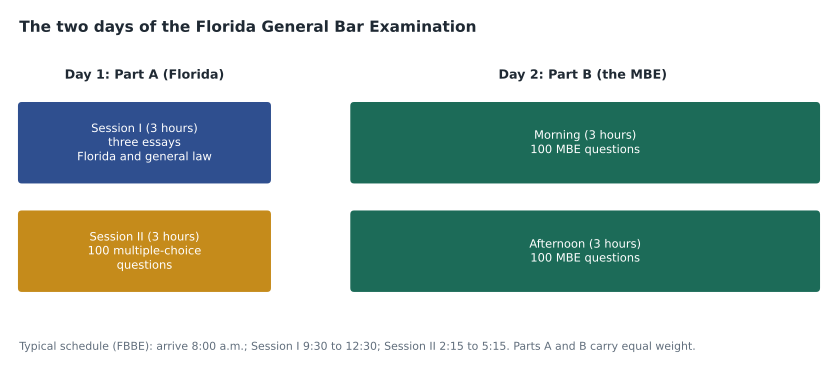
On the first day, Session I runs three hours and consists of three essay questions. Session II, after lunch, runs another three hours and consists of 100 multiple-choice questions written by the Board. The Board's typical schedule calls for candidates to arrive at 8:00 a.m., with Session I from 9:30 a.m. to 12:30 p.m. and Session II from 2:15 to 5:15 p.m. On the second day, candidates take the MBE: 200 multiple-choice questions in two three-hour sessions, covering civil procedure, constitutional law, contracts and sales, criminal law and procedure, evidence, real property and torts. Of the 200 MBE questions, 175 are scored and 25 are unscored pretest questions, indistinguishable from the rest.
What Part A tests
Part A covers both Florida law and general principles. The essays can draw on many subjects, often mixed in one question, such as Florida constitutional law, family law, trusts, wills and estates, real property, torts, contracts, business entities and professional responsibility. The Part A multiple-choice questions concentrate on subjects where Florida's rules are distinctive and precise: Florida civil procedure, Florida criminal procedure, the Florida Rules of General Practice and Judicial Administration, evidence, UCC Articles 3 and 9, business entities, and Chapters 4 and 5 of the Rules Regulating The Florida Bar, along with other subjects listed in the Board's study guide. Lesson 6 looks at Part A in detail.
How the parts are scored
Each part produces a scaled score. Part B, the MBE, is scored and scaled by NCBE, which equates scores across administrations so that a given scaled score represents the same level of performance regardless of which version of the exam a candidate took. Part A is graded by the Board, which scores the essays and the multiple-choice questions and then scales the Part A results to the MBE. Scaling to the MBE is a common technique: it adjusts the written scores so that their distribution matches the distribution of the same candidates' MBE scores, which corrects for differences in difficulty between one exam's essays and another's. NCBE's published Florida information confirms that the written component is scaled to the MBE and that the MBE counts for half of the combined score.
The combined score is reported on Florida's scale. NCBE's Florida information lists a minimum passing total score of 136, on both Florida's reported scale and a 200-point scale. Parts A and B carry equal weight.
Two ways to pass
The Board's published instructions describe two methods of passing. Under the overall method, a candidate passes if the average of the Part A scaled score and the Part B scaled score is 136 or more. Under the individual method, each part is judged on its own: a candidate passes a part by earning a scaled score of 136 or more on that part. The overall method lets a strong performance on one part make up for a weaker one. A candidate with 131 on Part A and 142 on Part B averages 136.5 and passes, even though the Part A score alone is below 136.
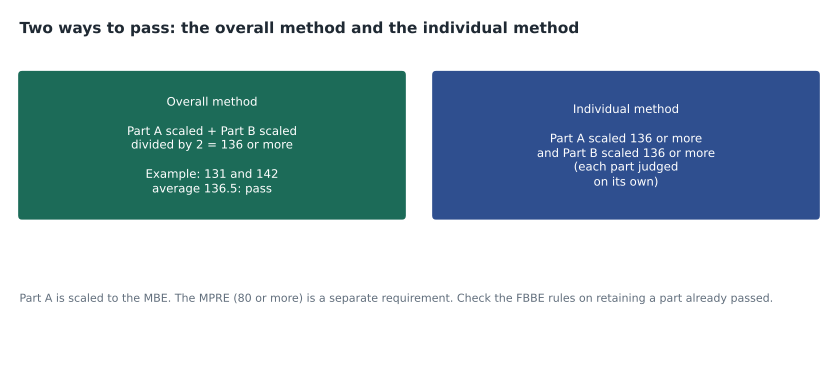
The individual method matters most to repeat takers. Florida's rules allow a candidate who passed one part but not the overall exam to retain the passed part for a period and retake only the other, subject to the rules' conditions and time limits. Because those conditions are technical and have changed over time, a candidate in that position should read the current rule and confirm with the Board before deciding which part to retake. Marchetti tells Yesenia not to plan around the individual method. 'Plan to pass both parts in February,' she says. 'The individual method is a safety net, not a strategy.'
| Part A scaled | Part B scaled | Average | Overall method result |
|---|---|---|---|
| 138 | 134 | 136.0 | Pass |
| 131 | 142 | 136.5 | Pass |
| 140 | 129 | 134.5 | Fail overall (Part A alone meets 136) |
| 133 | 135 | 134.0 | Fail |
Where the points come from
Because the two parts count equally, every point on Part A is worth exactly as much as a point on Part B. That fact drives Marchetti's study advice. Most commercial bar courses devote the bulk of their time to the MBE because it is shared across the country. A Florida candidate who follows a generic plan can arrive at the exam well prepared for the MBE and underprepared for a full day of Florida law. Within Part A, the essays and the multiple-choice questions both count. Candidates who write well but have not memorized Florida's procedural rules lose points in Session II; candidates who know the rules but cannot organize an essay under time pressure lose points in Session I.
Marchetti suggests a simple diagnostic. Yesenia takes a timed set of 25 MBE questions and a timed set of 25 Florida multiple-choice questions from her bar course, and writes one Florida essay. Her MBE set comes back at 64 percent correct, her Florida set at 52 percent and her essay is solid on the law but runs out of time on the third issue. 'That tells us your hours for the next month,' Marchetti says. 'Florida procedure, and essay pacing.'
Exam-day rules
The Board issues detailed instructions before each exam, covering identification, permitted items, laptop requirements, breaks and conduct. Candidates who use laptops for the essays must register them and install the Board's exam software in advance. Candidates should expect strict security: personal items are limited, and the rules on what may be brought into the room are enforced. The Board's instructions control, and candidates should read them as soon as they arrive.
Results and what follows
Grading takes several weeks. NCBE's Florida information estimates six to eight weeks for both the February and July exams, and the Board announces the release date for each exam's results in advance. Results are posted through the Board's system. A candidate who passes still needs character and fitness clearance before the Board will certify admission, which is why early registration matters so much. A candidate who fails receives score information and can file for the next exam as a repeater, paying the re-examination fee.
The Board's rules set out what score information a failing candidate receives and what, if any, review of written answers is available. Candidates should read those rules rather than rely on what other states allow, because grade review practices vary widely and few jurisdictions rescore an exam on request. A candidate who narrowly fails should look closely at which part pulled the average down and plan the next attempt around it.
Worked problem
Reading a score report
Malik took the July 2026 Florida exam. His report shows a Part A scaled score of 130 and a Part B scaled score of 139. Did he pass, and what should he think about?
Show solution
- Average: (130 + 139) / 2 = 134.5, below 136, so he did not pass under the overall method.
- Under the individual method, Part B at 139 meets 136; Part A at 130 does not.
- He should read the Board's current rule on retaining a passed part to see whether he may retake only Part A, and for how long the Part B score can be carried.
- His Part A weakness suggests more time on Florida procedure and essay practice.
Answer: Malik did not pass overall, but depending on the rule's conditions he may be able to focus his next attempt on Part A.
Common mistakes
MistakeFlorida gives the MEE and MPT like UBE states.
InsteadFlorida writes its own Part A and does not give the MEE or MPT.
MistakeThe MBE counts more than Part A because it is national.
InsteadParts A and B carry equal weight.
MistakeA candidate must score 136 on each part to pass.
InsteadUnder the overall method, an average of 136 or more passes.
MistakeGrade review works the same in every state.
InsteadCheck the Board's own rules on score information and review; practices vary widely.
What a scaled score means
Yesenia admits that she does not really understand scaling. Marchetti explains it in plain terms. Raw scores, the number of questions answered correctly or the points awarded by graders, are not directly comparable from one exam to another, because some exams are harder than others. Scaling converts raw scores to a common scale so that a 136 means the same level of performance in February as in July. For Part B, NCBE equates MBE scores across administrations. For Part A, Florida scales the written and multiple-choice scores so that they are comparable over time. Candidates do not need to understand the statistics, but they should understand the consequence: a hard exam does not mean a lower pass rate for the same level of skill, and guessing at the raw score needed to pass is a waste of time.
The practical lesson is that every point matters equally on the day. A candidate cannot know which questions will turn out to be the hard ones, so the right strategy is to answer every question as well as possible and move on, rather than to dwell on questions that feel impossible. On the MBE, scores are based on the number of questions answered correctly, so a blank answer can never earn a point; candidates should read the Board's instructions for Session II as well, but the safe habit is to answer every question.
Planning around the two methods
Because Florida allows candidates to pass either by the overall method or by the individual method, Marchetti asks Yesenia to think about her strengths. Her diagnostic suggests that the MBE is her stronger part and Florida multiple choice her weaker. Under the overall method, a strong Part B can offset a weaker Part A, as long as the average reaches 136. Under the individual method, each part must reach 136 on its own. Yesenia's plan therefore has two aims: raise Part A enough that the average is safe, and keep Part B strong rather than letting it slide while she studies Florida law.
Marchetti warns against a common trap. Some candidates, knowing that a strong MBE can carry them, neglect Part A. But Part A is half of the overall calculation, and Florida essays and multiple-choice questions reward specific preparation that a general MBE course does not provide. A balanced plan is safer than a gamble on one part.
A day at the exam site
Yesenia has never sat a two-day exam, so Marchetti walks her through the experience of a single day. Candidates arrive early, pass through check-in, and find their assigned seats. The Board's rules control what may be brought into the room, and items not allowed must be left elsewhere. Each session is three hours with a lunch break between them. Laptop users must have installed and tested the required exam software in advance, following the Board's instructions. Candidates who handwrite essays should practice writing legibly at speed.
The lunch break is shorter than it feels. Marchetti tells Yesenia to bring or plan a simple lunch, avoid discussing the morning session with other candidates, and spend the last few minutes of the break resting rather than cramming. 'The afternoon session is worth as much as the morning one,' she says. 'Protect it.'
Reading the score information
When Florida releases results, candidates who do not pass receive score information that can help them plan a retake. Marchetti asks Yesenia to read the Board's rules on score information and review now, before the exam, so that she knows what she would receive and what options she would have. It is not pessimism, she says, but planning: a candidate who knows the process in advance spends less time worrying and more time studying.
Summary and key terms
- Day one is Part A: three essays (three hours) and 100 multiple-choice questions (three hours), written by the Board.
- Day two is Part B, the MBE: 200 questions, 175 scored.
- Part A is scaled to the MBE, and the two parts carry equal weight.
- The passing score is 136: an average of 136 under the overall method, or 136 on each part under the individual method.
- Results come several weeks after the exam; admission also requires character clearance.
- Scaled score
- A score adjusted so that it means the same thing across exam versions.
- Scaling to the MBE
- Adjusting written scores to match the distribution of the same candidates' MBE scores.
- Overall method
- Passing by averaging 136 or more across Parts A and B.
- Individual method
- Passing each part separately with 136 or more.
- Pretest question
- An unscored MBE question used to evaluate future questions.
Lesson quiz · 5 questions
Score 60% or more to complete this lesson.
Create a free account to save your progress, take quizzes and earn a certificate.