
BAR-210 · Lesson 5 of 12 · 15 min
Exam changes ahead: NextGen with a Florida law component in July 2028
▶ Video coming soon A video version of this lesson is on the way.
Yesenia will take the old Florida exam, the one with Part A and the MBE, in February 2027. But her younger cousin Teo has just started law school in Gainesville, and he will almost certainly take a very different test. At their fifth session, Marchetti spends time on the change, for two reasons. 'First, people talk about NextGen as if it has already arrived in Florida, and it has not. Second, if you fail in February, you need to know how many more chances you have at the exam you studied for.' This lesson covers the national move to the NextGen bar exam, Florida's decision to adopt it with a Florida law component, the timing, and what the change means for candidates before and after July 2028.
The national change
NCBE spent several years developing a new bar exam, called the NextGen bar exam, to replace the MBE, the MEE and the MPT. NextGen tests a smaller set of legal subjects, which NCBE calls foundational concepts and principles, together with lawyering skills such as legal research, writing, issue spotting, client counseling and negotiation. It uses three question formats: standalone multiple-choice questions, integrated question sets built around a single client file, and performance tasks. Scores are reported on a single scale from 500 to 750. The first NextGen exam was given in July 2026 in a small group of jurisdictions, and NCBE has said it will stop offering the MBE after the February 2028 administration.
That last date matters to every jurisdiction that uses the MBE, including Florida. Once NCBE stops producing the MBE, Florida cannot keep giving its current Part B. Florida therefore had to decide what to do, and it decided early.
Florida's decision
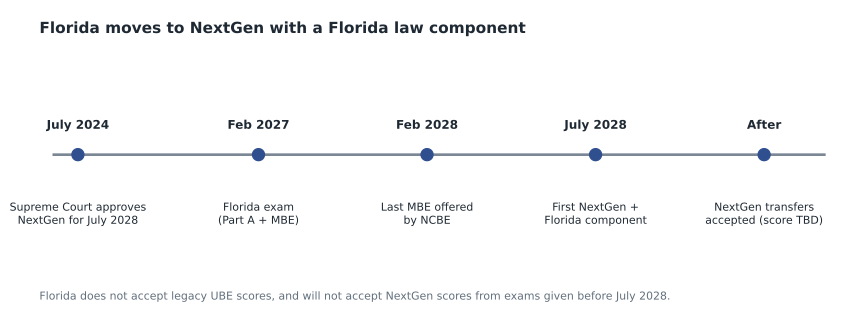
In July 2024, the Supreme Court of Florida approved replacing the MBE with the NextGen bar exam beginning with the July 2028 exam, while keeping a Florida-specific component. The Florida Bar News reported the decision on July 18, 2024, and NCBE announced that Florida had become the twenty-first jurisdiction to commit to NextGen. The Board told candidates that it was still working out the precise format of the Florida portion, which could test subjects from the Board's 2019 to 2022 practice analysis study that NextGen does not cover, and that it would make further announcements as July 2028 approached.
NCBE's chart of NextGen jurisdictions and their state-specific components, which NCBE updates as decisions are made, describes Florida's component as a four-hour state component with essays and multiple-choice questions, given the day before the NextGen exam. Candidates should treat details of the component, including its subjects, scoring and weight, as subject to the Board's final announcements. As of November 2026, the Board had not published a NextGen passing score for Florida.
What stays the same until July 2028
Until July 2028, Florida's exam stays as it is: Part A on the first day and the MBE on the second, scored as described in lesson 4, with a combined passing score of 136. That gives candidates who graduate in 2026 and 2027 several chances at the familiar exam. Yesenia's February 2027 exam is the current format. If she needed to retake, the July 2027, February 2028 and possibly other administrations before the switch would also use the current format, depending on the Board's final schedule. The Board's own notices, not general NextGen news, are the authority on which format applies to which exam.
For repeat takers, the transition raises a practical question. A candidate who fails in February 2028, the last administration with the MBE, will face a different exam in July 2028. Marchetti tells candidates in that position to think hard before deciding to wait. 'If you are close, take the current exam while you can,' she says. 'Switching formats in the middle of a retake is like changing sports.'
Score transfer and NextGen
Florida has never accepted Uniform Bar Examination scores, and it does not accept legacy UBE scores now. NCBE's November 2026 jurisdiction information for Florida says the state will accept NextGen scores beginning with the July 2028 administration, with the minimum passing NextGen score still to be determined. NCBE's NextGen decisions table, updated in July 2026, adds an important detail: Florida, like New York, will not accept NextGen scores earned on exams given before July 2028. A candidate who passes NextGen in Connecticut or Washington in 2026 or 2027 cannot transfer that score to Florida.
Even after July 2028, a transferred NextGen score will not be the whole story. Because Florida keeps a state-specific component and requires its own character and fitness investigation, an applicant transferring a NextGen score from another jurisdiction should expect to meet Florida's component requirement and the rest of the admission rules. The details will be in the Board's rules as they are amended for NextGen.
| Question | Before July 2028 | From July 2028 |
|---|---|---|
| Format of the Florida exam | Part A (Florida) and Part B (MBE) | NextGen plus a Florida law component |
| Passing standard | Combined scaled score of 136 | To be announced by the Board |
| Legacy UBE scores accepted? | No | No |
| NextGen scores accepted? | No | Yes, from exams given July 2028 or later |
| Character and fitness | Board investigation | Board investigation |
How NextGen differs from today's Florida exam
For candidates who will take NextGen in Florida, the most important differences are in content and question types. NextGen covers civil procedure, constitutional law, contracts, criminal law and procedure, evidence, real property, torts and business associations, with family law joining in July 2028, the same month Florida switches. Some topics within each subject are tested from memory, while others are tested with legal resources provided in the question. Integrated question sets and performance tasks test skills such as drafting, research and counseling. Florida's own component will carry forward some of the Florida-specific testing that Part A does today.
Marchetti tells Teo, through Yesenia, that he should not buy NextGen materials in his first year. 'Learn the law in your courses, register with the Board on time, and pick your bar course in your third year. By then the Board will have told everyone exactly what the Florida component covers.'
Why Florida kept a state component
Florida could have adopted NextGen alone, as Connecticut did. It chose to keep a Florida component because so much of Florida practice turns on Florida-specific law: homestead, the Florida Rules of Civil Procedure, the Florida Evidence Code, Florida family law and the Rules Regulating The Florida Bar. The Board's practice analysis study, which surveyed Florida lawyers about the knowledge and skills new lawyers use, gave the Board evidence about which topics matter. The Florida component is meant to test those topics in a way NextGen, a national exam, cannot.
The decision also reflects Florida's position on score portability. A state that keeps a significant state component, and does not accept scores earned before it switches, signals that it wants every new Florida lawyer to have been tested on Florida law. That is consistent with Florida's long-standing refusal to adopt the UBE and its lack of admission on motion.
Practical advice for candidates in the transition years
Marchetti gives three rules to candidates who may sit around the switch. First, read every Board notice for the exam you plan to take, because the format, content and passing score will be announced there. Second, do not assume that what you hear about NextGen in another state applies in Florida; the Florida component and the transfer rules are different. Third, if you plan to practice in more than one state, look at both states' rules before choosing where to sit first, because a NextGen score earned elsewhere before July 2028 will not help you in Florida.
Worked problem
Planning around the switch
Priya will graduate in May 2028. She wants to practice in Florida and possibly later in Georgia. Which Florida exam will she take, and what should she watch?
Show solution
- Graduating in May 2028, she would first sit in July 2028, the first Florida NextGen exam with the Florida component.
- She should watch for the Board's announcements on the Florida component's format and the NextGen passing score.
- Her NextGen score, earned in July 2028 or later, may later help with transfers to other NextGen jurisdictions that accept it, subject to their rules.
- She should still register with the Board as a first-year student so her investigation starts early.
Answer: Priya will take NextGen plus the Florida component in July 2028, and the details she needs will come from the Board's notices.
Common mistakes
MistakeFlorida already gives the NextGen exam.
InsteadFlorida switches in July 2028; until then it gives Part A and the MBE.
MistakeA NextGen score from Connecticut in 2026 can be transferred to Florida.
InsteadFlorida will not accept NextGen scores from exams given before July 2028.
MistakeFlorida will drop its state-specific testing with NextGen.
InsteadFlorida keeps a Florida law component alongside NextGen.
MistakeThe NextGen passing score in Florida will be 136.
InsteadNextGen uses a different scale; Florida's NextGen passing score has not been announced.
What NextGen tests differently
Although Yesenia will never sit NextGen, Marchetti wants her to understand it, partly because her cousin Teo will, and partly because it shows what Florida values. NextGen is designed around the knowledge and skills a newly licensed lawyer needs, as identified in NCBE's practice analysis. It tests a narrower set of legal subjects than the current MBE, and it tests skills such as legal research, writing, issue spotting, client counseling and negotiation more directly, through integrated question sets and performance tasks. Some questions give candidates a short library of legal materials and ask them to apply those materials, rather than to recall rules from memory.
For Florida candidates, the Florida law component remains the place where precise knowledge of Florida rules is tested. The national portion will reward the reasoning and practical skills that Florida candidates already need on Part A essays: reading carefully, identifying the issue, applying the rule to the facts, and writing clearly under time pressure.
Teo's timeline
Teo started law school in Gainesville in August 2026. If he follows the usual three-year path, he will graduate in May 2029 and could sit for the exam in July 2029, after Florida's planned switch to NextGen with the Florida law component. Marchetti sketches his timeline on the whiteboard for Yesenia to share with him: register as a first-year student by the Board's deadline, take the MPRE in his second or third year, follow NCBE and Board announcements about NextGen preparation materials, and choose a bar course that teaches the NextGen format and the Florida component together.
She adds a caution. Florida's rules for the Florida law component, its passing score, and any details of timing and weighting may be announced or changed between now and 2028. Teo should rely on the Board's current announcements and NCBE's official materials, not on what students in older classes remember about the exam they took.
If Yesenia had to retake
Marchetti raises an uncomfortable question. If Yesenia does not pass in February 2027, she will have several more chances under the current format before July 2028. Florida does not limit the number of attempts, according to NCBE's profile. But a candidate who fails repeatedly into 2028 would face a format change, and preparation built for the current Part A and Part B would need to be adapted. 'This is not a reason to panic,' Marchetti says. 'It is a reason to prepare thoroughly for February. The best protection against format changes is passing before they arrive.'
Following the official sources
The transition will generate rumors, commercial advertising and confident claims on social media. Marchetti gives Yesenia a short list of sources to trust: the Florida Board of Bar Examiners' website and its announcements, NCBE's NextGen pages and jurisdiction information, and orders and news from the Supreme Court of Florida and The Florida Bar News. Anything else, including bar course marketing and law school advice, should be checked against those sources. Yesenia passes the list on to Teo with a note: check the Board's website every semester, and read every email the Board sends.
Lessons for today's candidates
The move to NextGen also confirms something about today's exam. Florida chose to keep a Florida law component even when adopting a national exam, which shows how much weight the Supreme Court of Florida places on knowledge of Florida law. Candidates who treat Part A as an afterthought misunderstand what the Court values. That message shapes Yesenia's plan: Florida law first, MBE skills maintained, and both practiced under time pressure.
Summary and key terms
- NCBE's NextGen exam replaces the MBE, MEE and MPT; the MBE ends after February 2028.
- The Supreme Court of Florida approved NextGen with a Florida law component starting in July 2028.
- NCBE describes the Florida component as a four-hour component of essays and multiple choice given the day before; the Board will confirm details.
- Until then, Florida keeps Part A and the MBE with a 136 passing score.
- Florida will accept NextGen scores only from exams given in July 2028 or later, and still does not accept legacy UBE scores.
- NextGen
- NCBE's new bar exam, first given in July 2026.
- Florida law component
- The state-specific portion Florida will give with NextGen from July 2028.
- Foundational concepts and principles
- The legal subjects NextGen tests.
- Integrated question set
- A NextGen question group built around one client file.
- Practice analysis
- A survey of practicing lawyers used to decide what an exam should test.
Lesson quiz · 5 questions
Score 60% or more to complete this lesson.
Create a free account to save your progress, take quizzes and earn a certificate.