
BAR-210 · Lesson 2 of 12 · 17 min
Registration, eligibility, deadlines and fees
▶ Video coming soon A video version of this lesson is on the way.
At their second session, Marchetti asks Yesenia to bring the confirmation email from her first-year registration. 'I want you to see how much of your file was built before you ever thought about the exam,' she says. 'Most of the Florida process is paperwork done on time. People who treat it that way rarely get surprised.' This lesson covers who may sit the Florida exam, how student registration works, the filing deadlines for the next two exams and the fees that come with them.
Who may sit the exam
Florida's admission rules require an applicant to have a qualifying legal education before sitting the General Bar Examination. The core route is a Juris Doctor or equivalent first professional degree in law from an accredited law school. Until October 1, 2026, accredited meant accredited by the American Bar Association. In January 2026, in In re Amendments to Rules Regulating The Florida Bar and Rules of the Supreme Court Relating to Admissions to the Bar, case number SC2025-2064, the Supreme Court of Florida removed the ABA's status as the only qualifying accreditor. From 12:01 a.m. on October 1, 2026, a law school may qualify through any accrediting agency that is recognized by the United States Department of Education and approved by the Court.
The decision followed a workgroup report and public urging from the Governor, and one justice, Justice Jorge Labarga, dissented. It did not create a new accreditor overnight. When the Court ruled, the ABA was the only law school accreditor recognized by the Department of Education, and the Court said it would contact several Department-recognized institutional accreditors to see whether any wished to accredit law schools. Graduates of ABA-accredited schools remain fully eligible, and schools remain free to seek ABA accreditation. For a candidate like Yesenia, who graduated from an ABA-accredited Florida school in May 2026, nothing changed.
Florida also has rules for graduates of foreign law schools and for lawyers admitted elsewhere, which are covered in lesson 11. One point surprises some applicants: a Master of Laws degree from an ABA-accredited school does not, on its own, make a foreign-educated lawyer eligible to sit the Florida exam. NCBE's published information for Florida, current in November 2026, says so expressly. Foreign-educated applicants must meet the separate requirements in the Board's rules.
When you may sit
Most candidates sit the exam for the first time in the February or July after graduation. Florida gives the General Bar Examination twice a year, on the last Tuesday and Wednesday of February and July, and both of the next two administrations will be held in Tampa: February 23 and 24, 2027, and July 27 and 28, 2027. The Board has no limit on the number of attempts. NCBE's Florida information lists no maximum number of attempts without special permission, which distinguishes Florida from states such as Alabama, which adopted a lifetime limit in 2026, and Arizona and Connecticut, which restrict repeat attempts.
Student registration
The single most important early step in the Florida process is student registration. Florida's rules let a law student file a registration with the Board during law school. The registration is a full background application: the student answers the same questions about residence, employment, education, finances, litigation, criminal history and conduct that a bar applicant answers, provides fingerprints and authorizes the Board to gather records. The Board then begins its investigation years before the student sits the exam.
Law schools in Florida push their first-year students hard to register by the first deadline, usually in January of the first year for students who started in the fall, because the fee is lowest then. In January 2024, for example, Stetson University College of Law told its first-year students that the registrant fee was 100 dollars if filed by the deadline, and that the school would cover it. The fee rises if the registration is filed later in law school, and an applicant who never registers as a student pays a higher fee when filing the bar application.
Early registration matters for reasons beyond money. If the investigation finds something that needs explanation, such as an old arrest, a default judgment, a gap in employment or an academic misconduct finding, the student has years to deal with it rather than weeks. The Board can ask for documents, the student can gather court records and letters, and the issue can be resolved long before results come out. A student who files for the first time in the third year compresses the entire investigation into the months before and after the exam.
Converting the registration to a bar application
A registered student does not file a new application from scratch. Instead, early in the third year, the student converts the registration into an application to sit a particular exam, updates every answer, and pays the remaining fee. Marchetti asks Yesenia to describe how she did it. She logged into her Board account in late October 2026, reviewed each section of her registration, updated her address and her job at the Tampa firm, disclosed that she had been named as a witness in a small claims case involving her former landlord, selected the February 2027 exam and paid. Her application was postmarked, in effect, on November 9.
The duty to update does not end when the application is filed. Florida requires applicants to amend their answers within a short period whenever information changes, until they are admitted. A new job, a new address, a traffic citation, a lawsuit, a change in financial circumstances or a new treatment relationship that a question asks about must all be reported. The Board treats a failure to update much as it treats a failure to disclose.
Filing deadlines
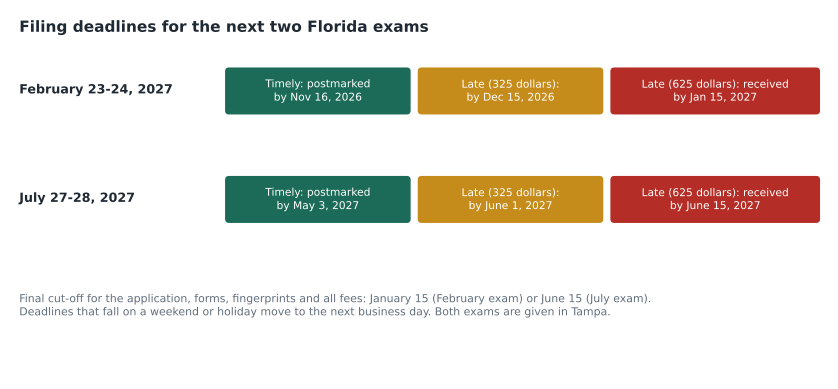
The Board publishes three deadlines for each exam. For the February 23 and 24, 2027 exam, an application is timely if it is postmarked or electronically filed by November 16, 2026. An application filed after that date but postmarked by December 15, 2026 is accepted with a late fee of 325 dollars. An application received by January 15, 2027 is accepted with a late fee of 625 dollars. For the July 27 and 28, 2027 exam, the matching dates are May 3, June 1 and June 15, 2027. When a deadline falls on a weekend or legal holiday, it moves to the end of the next business day.
The third date is also a hard cut-off for everything else. The Board's notice says that all applications, supporting forms, proof of fingerprinting, fees and any late fees must be received by January 15 for the February exam or June 15 for the July exam. Requests for testing accommodations follow the same timing, and there is no fee for a petition or for approved accommodations. A candidate who needs accommodations should file the petition with the application, not after.
| Exam | Timely filing | Late fee 325 dollars | Late fee 625 dollars (final) |
|---|---|---|---|
| February 23-24, 2027 | Postmarked by November 16, 2026 | Postmarked by December 15, 2026 | Received by January 15, 2027 |
| July 27-28, 2027 | Postmarked by May 3, 2027 | Postmarked by June 1, 2027 | Received by June 15, 2027 |
Fees
Florida's fees depend on who is applying and when. NCBE's published Florida information lists a fee of 1,000 dollars for a first-time, non-attorney applicant, fees ranging from 1,600 to 3,000 dollars for attorneys depending on how long they have been admitted elsewhere, a re-examination fee of 450 dollars, and a laptop fee of 125 dollars for applicants who use a computer for the essays. Students who registered early pay less at the application stage, because part of the cost was paid with the registration. The Board's fee schedule is set in its rules and changes from time to time, so the amount to pay should always be taken from the Board's current application, not from a friend's experience or an old guide.
Late fees are added to the regular fee, not substituted for it. A candidate who files on December 10 for the February exam pays the regular fee plus 325 dollars. Fees are generally not refundable, and the Board has separate fees for postponing to a later exam. Marchetti tells Yesenia to keep a folder with every receipt, because the Board may ask for proof of payment if a record goes missing.
The MPRE window
Florida requires a scaled MPRE score of 80. The Board's published instructions add a time limit: the score must be achieved within 25 months of passing the other parts of the bar exam. In practice, a candidate who takes the MPRE during law school and sits the exam soon after graduation is well within the window. A candidate who takes the MPRE early, postpones the bar exam several times and then passes it may need to take the MPRE again. Registration for the MPRE is through NCBE, not the Board, and NCBE does not allow late registration. The Board's notice for the next exam reminded candidates that registration for the March 2027 MPRE closes on January 21, 2027.
Laptops, admission tickets and the building
Most candidates write their Part A essays on a laptop using exam software the Board specifies, which requires registering the laptop and paying the laptop fee by the Board's deadline. Candidates who do not register a laptop handwrite the essays. Before the exam, the Board issues admission materials with the testing location, arrival time and building rules. The Board's typical schedule calls for arrival at 8:00 a.m., the first session from 9:30 a.m. to 12:30 p.m. and the second from 2:15 to 5:15 p.m. The rules on what may be brought into the room, including identification, medications and food, come from the Board's instructions, and they should be read the week the instructions arrive, not the night before.
Worked problem
Choosing a filing date
Andre graduated from an ABA-accredited law school in New Jersey in May 2026. He never registered with the Florida Board as a student. He decides on December 1, 2026 to sit the February 2027 Florida exam. What should he expect?
Show solution
- The timely deadline of November 16, 2026 has passed, so he can still file by December 15 with the 325 dollar late fee, or by January 15, 2027 with the 625 dollar late fee.
- Because he never registered as a student, the Board begins its entire background investigation now, and he pays the non-registrant fee.
- He must gather fingerprints, references and records quickly, because everything must be received by January 15.
- He should check his MPRE score: it must be 80 or more and within 25 months of passing the other parts.
Answer: Andre can sit in February if he files by the late deadlines, but his investigation will run during and after the exam, and his admission may take longer even if he passes.
Common mistakes
MistakeThe late deadlines are just a grace period with no cost.
InsteadEach late deadline adds a fee (325 dollars, then 625 dollars) on top of the regular fee.
MistakeAn LLM from an ABA school lets a foreign lawyer sit the Florida exam.
InsteadAn LLM alone does not qualify; foreign-educated applicants must meet separate rules.
MistakeFiling the application ends the duty to disclose.
InsteadApplicants must update their answers whenever information changes, until admission.
MistakeAny MPRE score of 80 works, no matter when it was earned.
InsteadThe score must be within 25 months of passing the other parts of the exam.
Practice problems
Work each problem on paper first, then reveal the answer to check.
Why might a student who registers with the Board in the first year be admitted sooner after passing than one who files in the third year?
Show answer
The background investigation has had years to run, so any issues have been resolved before results come out.
What is the last date to file for the February 2027 exam, and what does it cost?
Show answer
January 15, 2027 (received), with a 625 dollar late fee added to the regular fee.
A filing checklist
Marchetti gives Yesenia a one-page checklist to tape above her desk. It lists the date she registered as a student, the date she filed her application to sit for the February exam, the next fee deadline she must avoid, and the date by which the Board must receive any missing documents. It also lists the people who must send things to the Board on her behalf, such as her law school's dean's certificate after graduation, and the date she asked each of them. 'Most filing problems are not legal problems,' Marchetti says. 'They are calendar problems. A missing certificate or a late fee does not reflect on your character, but it can still keep you out of the exam you planned for.'
Yesenia adds one more line on her own: the date she last logged in to the Board's online portal to check for messages. The Board communicates with applicants through the portal, and a request for more information that sits unread for weeks can delay an investigation. She sets a weekly reminder to check it every Sunday evening until she is admitted.
Summary and key terms
- Since October 1, 2026, a law school may qualify through the ABA or another federally recognized accreditor approved by the Court; none other had been approved when the Court ruled.
- Florida gives the exam in February and July in Tampa and sets no limit on attempts.
- First-year student registration starts the background investigation early and costs less.
- For February 2027: timely by November 16, 2026; 325 dollar late fee by December 15; 625 dollar late fee by January 15, 2027.
- The MPRE score of 80 must fall within 25 months of passing the other parts.
- Registrant
- A law student who has registered with the Board during law school.
- Timely filing
- Filing an application by the first deadline, without a late fee.
- Conversion
- Turning a student registration into an application for a specific exam.
- Accommodations petition
- A request for changes to testing conditions, filed by the Board's deadline.
- SC2025-2064
- The 2026 Florida rules case that opened eligibility to other approved accreditors.
Lesson quiz · 5 questions
Score 60% or more to complete this lesson.
Create a free account to save your progress, take quizzes and earn a certificate.