
BAR-206 · Lesson 2 of 12 · 16 min
Eligibility, education, deadlines and fees
▶ Video coming soon A video version of this lesson is on the way.
At their second session, Marchetti asks Luke to open the February 2027 exam application instructions on his screen and read the eligibility section aloud. He gets two sentences in before she stops him. 'That cross-reference to Rule 203.4,' she says. 'That is where eligibility actually lives. The instructions tell you how to apply. The rule tells you whether you may. When they seem to differ, the rule controls, and you should ask the Office of Attorney Admissions before you assume anything.'
This lesson covers who may sit the Colorado bar exam, what the education requirement means for graduates of ABA-approved, state-accredited and foreign law schools, and the practical details of deadlines, fees, late filing, repeat filing and accommodations. It ends with a checklist that Luke uses to plan his filing.
The education requirement
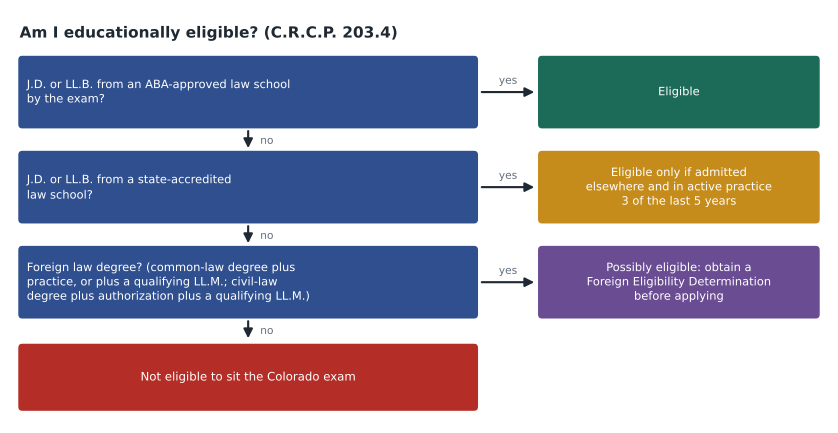
C.R.C.P. 203.4 sets the education requirement for admission by examination. The default route is simple: the applicant must hold a J.D. or LL.B. from a law school approved by the ABA, completed by the time of the exam. Most applicants meet the requirement this way, and most never need to read further.
The rule then opens two narrower doors. The first is for graduates of state-accredited law schools, meaning schools approved by a state authority but not by the ABA. A J.D. or LL.B. from such a school qualifies only if the applicant has already been admitted in another U.S. jurisdiction and has practiced actively for three of the five years before applying. In other words, Colorado does not let a new graduate of a state-accredited school sit its exam on that degree alone, but it does let an experienced lawyer with such a degree sit after proving years of practice elsewhere. California's state-accredited schools are the main source of such applicants.
The second door is for foreign-educated applicants. The rule describes three paths. An applicant may qualify with a foreign law degree based on English common law and roughly equivalent in length to a J.D., plus authorization to practice in that country and three of the last five years of substantial practice. An applicant with a common-law degree of similar length may instead qualify by adding a qualifying LL.M. from an ABA-accredited U.S. law school. And an applicant with a foreign degree from a system not based on English common law, such as a civil law system, may qualify with a degree of similar length, authorization to practice in that country, and a qualifying LL.M. A foreign degree earned mainly through distance learning does not count unless it meets the ABA's standards for distance education.
The qualifying LL.M. has its own detailed requirements under the rule. It must come from an ABA-accredited school and include at least 24 semester hours, completed within 24 months. It must include coursework in professional responsibility, legal research and writing, an introduction to U.S. law, and subjects tested on the UBE. Foreign-educated applicants must obtain a Foreign Eligibility Determination letter from the Office of Attorney Admissions before they submit an exam application, and the instructions warn that the determination can take up to a month. 'Do that first,' Marchetti tells foreign-trained candidates. 'Nothing else moves until you have that letter.'
Graduating before the exam
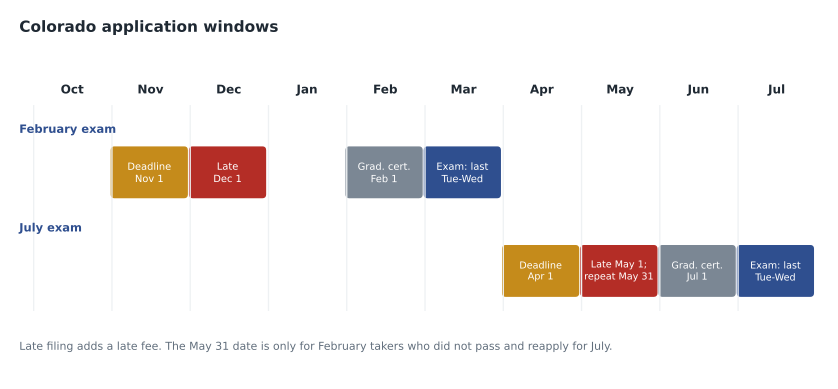
Colorado lets students apply before they graduate. The instructions require a Law School Graduation Certificate. If the degree will not be conferred before the filing deadline, the certificate is due later: by February 1 for the February exam and by July 1 for the July exam. If the degree will not be conferred before the exam itself, the applicant must ask the Office of Attorney Admissions for authorization before applying. That last situation is rare for J.D. students, but it matters for students who finish coursework in December or May and whose schools confer degrees on a later date.
Luke graduated in May 2026, so his degree was conferred before the November deadline. For him the certificate is a routine document. For a classmate who finishes law school in December 2026 and wants to sit in February 2027, the timing is tighter: she must file by November 1, before graduation, and her school must certify the degree by February 1.
Deadlines and late filing
Colorado's deadlines follow a two-step pattern. For the February exam, the regular deadline is November 1 and the late deadline is December 1. For the July exam, the regular deadline is April 1 and the late deadline is May 1. The instructions state that the electronic application and fees will not be accepted after the late deadline in any case. There is one more window for repeat takers: an applicant who sat the most recent February exam and did not pass may file for July until May 31.
Filing means submitting the electronic application with payment. To submit, the applicant must first upload a set of minimum documents: a signed fingerprint requirement information form, a photograph, a signed statement of verification, a signed authorization and release, and the personal question forms for any 'yes' answers to the character questions that require them. Other documents, such as driving records, certificates of good standing and letters from other jurisdictions, can follow after submission. Certificates of good standing and disciplinary letters must be dated no more than thirty days before they are submitted.
Fees
The fees in the instructions for the July 2026 exam were 710 dollars for an application filed by the regular deadline and an additional 200 dollars, for a total of 910 dollars, for an application filed by the late deadline. A reduced fee is available to applicants who sat the most recent Colorado exam and did not pass, and to applicants who withdrew in time and reapply for the next exam; it applies only to those who sat or were scheduled to sit in Colorado. If a payment is declined and resubmitted by the late deadline, the late fee and a service charge apply. All fees are nonrefundable and subject to change, so check the instructions for the exam you plan to take.
Other costs come on top of the application fee: the MPRE registration fee paid to NCBE, fingerprinting charges, the cost of the professionalism course, and any fees for documents from other jurisdictions. Applicants who type the exam on a laptop should check the instructions for software requirements and any related fee. Luke builds a small budget table in his notes so that none of these costs surprises him in January.
| Item | Amount or rule (July 2026 instructions) | Notes |
|---|---|---|
| Application filed by regular deadline | 710 dollars | November 1 (February) or April 1 (July) |
| Application filed by late deadline | 910 dollars (710 plus 200 late fee) | December 1 (February) or May 1 (July); nothing accepted after |
| Repeat applicant from Colorado's last exam | Reduced fee | Also for timely withdrawals reapplying for the next exam |
| Declined payment resubmitted | Late fee plus service charge | Must be resubmitted by the late deadline |
| Refunds | None | All fees nonrefundable and subject to change |
The NCBE number
Every applicant needs an NCBE number, obtained by creating an account on the NCBE website. The instructions require that the applicant's name, date of birth, Social Security number and NCBE number match exactly between the NCBE account and the Colorado online application profile. A mismatch can delay score reporting. Luke checks that his NCBE account shows the same middle name he uses on his Colorado application.
Accommodations
Applicants with disabilities may request testing accommodations. The instructions do not set a separate early deadline; instead they tell applicants not to delay and to submit the request together with the exam application. Requests for a non-standard schedule for other reasons, or to bring a medical aid or device, have separate instructions. Because accommodation requests often require documentation from a treating professional, applicants who need them should begin gathering that documentation months before the filing deadline.
Marchetti adds practical advice that applies everywhere. Ask for what you actually need, explain how the condition affects test-taking, and match the request to the documentation. If you received accommodations on the LSAT or in law school, say so and provide the records, but understand that the bar examiners make their own decision.
Counting attempts
Some jurisdictions limit how many times an applicant may sit the bar exam. The text of C.R.C.P. 203.4 as published does not set a limit on attempts. Applicants who have failed several times should still check the current rule and instructions, because the court can change this, and other jurisdictions where they may later seek admission may have limits of their own. Unsuccessful applicants may request copies of their essay answers on a form from the Office of Attorney Admissions; the rule says no other exam materials are available.
Worked problem
A December graduate's timeline
Imani finishes her J.D. coursework in December 2026 at an ABA-approved school that confers degrees on December 18. She wants to sit in February 2027 but has not yet applied on November 10. What are her options?
Show solution
- The regular deadline (November 1) has passed.
- The late deadline is December 1; she can still file, but she must pay the 200 dollar late fee on top of the 710 dollar application fee.
- Her degree will be conferred on December 18, after the filing deadline but before the exam, so her graduation certificate is due by February 1, 2027.
- She must upload the minimum documents to submit and complete fingerprinting through an approved vendor.
Answer: File by December 1 with the late fee; have the school certify the degree by February 1.
Common mistakes
MistakeAny J.D. qualifies for the Colorado exam.
InsteadA J.D. from an ABA-approved school qualifies; a state-accredited J.D. qualifies only with admission elsewhere and three of five years of active practice; foreign graduates need a determination letter and must meet one of three paths.
MistakeApplications postmarked by the late deadline are accepted.
InsteadColorado uses an electronic application; nothing is accepted after December 1 (February) or May 1 (July).
MistakeAccommodation requests are due a month after the application.
InsteadThe instructions say to submit accommodation requests with the application and not to delay.
MistakeSmall differences between the NCBE and Colorado profiles do not matter.
InsteadName, date of birth, Social Security number and NCBE number must match exactly.
Luke's filing checklist
Luke ends the session with a checklist. Confirm eligibility under Rule 203.4 (ABA-approved J.D. conferred May 2026). Create or check the NCBE account and match the profile. Gather ten years of employment history and residence history. Identify references and tell them to expect contact. Answer the character questions candidly and prepare the personal question forms for any 'yes' answers. Upload the minimum documents and submit with the 710 dollar fee by November 1. Book fingerprinting with an approved vendor. Order driving records and any letters from other jurisdictions. Calendar the professionalism course and the exam dates. Set a reminder to report any change within ten days.
'Most problems I see are not about law,' Marchetti says. 'They are about a missing form, a mismatched name or a deadline someone thought would bend. Colorado gives you a late window, which is generous, but it charges you for it and it gives you less time to fix mistakes. File early and file complete.'
When plans change after filing
Plans change. An applicant who files for February and then cannot sit, because of illness, a family emergency or a job change, should read the instructions on withdrawal carefully. The reduced fee for the next exam is available to applicants who withdraw in time and reapply for that exam, but not to those who simply fail to appear. Contact the Office of Attorney Admissions as soon as you know you will not sit, put the request in writing, and keep a copy of the response. An applicant who withdraws must still keep the application current until it is formally closed or transferred, including reporting any change within ten days.
A filing checklist
Marchetti gives every applicant the same short checklist for the weeks before a deadline. Confirm that your NCBE number appears correctly on every form. Gather addresses and dates for every job and residence the application asks about, and resolve gaps before you start typing. Ask your references early and tell them what the Office of Attorney Admissions may ask. Schedule fingerprinting so the results arrive in time. Order your law school's certificate of graduation, or confirm when the school will send it. Decide whether you need testing accommodations and, if so, assemble the supporting documents now, because the request travels with the application. Finally, file a few days early. Systems slow down near deadlines, and a late fee is an expensive way to learn that lesson.
Imani, who is working full time while she prepares, adds one item of her own: a folder, paper or electronic, holding a copy of everything she submits and every message she receives. When a follow-up question arrives months later, she can answer it from her own records in minutes.
Summary and key terms
- C.R.C.P. 203.4 requires an ABA-approved J.D. or LL.B. by the exam; state-accredited degrees qualify only with admission elsewhere and active practice three of the last five years.
- Foreign graduates qualify through one of three paths (common-law degree plus practice, common-law degree plus LL.M., or civil-law degree plus authorization plus LL.M.) and need a Foreign Eligibility Determination letter first.
- Deadlines: November 1 and December 1 (late) for February; April 1 and May 1 (late) for July; May 31 for February repeaters sitting in July.
- The July 2026 instructions set a 710 dollar fee and a 200 dollar late fee; fees are nonrefundable.
- Accommodation requests go in with the application; NCBE and Colorado profiles must match exactly.
- ABA-approved law school
- A law school approved by the American Bar Association's Council of the Section of Legal Education and Admissions to the Bar.
- State-accredited law school
- A law school approved by a state authority but not by the ABA.
- Foreign Eligibility Determination
- A letter from the Office of Attorney Admissions confirming that a foreign-educated applicant may apply; required before filing.
- Qualifying LL.M.
- A master of laws degree from an ABA-accredited school meeting C.R.C.P. 203.4's credit-hour and course requirements.
- Late deadline
- The final filing date, one month after the regular deadline, available with a late fee.
Lesson quiz · 5 questions
Score 60% or more to complete this lesson.
Create a free account to save your progress, take quizzes and earn a certificate.