
BAR-206 · Lesson 10 of 12 · 16 min
Colorado family law, wills and probate
▶ Video coming soon A video version of this lesson is on the way.
The first client Luke meets on his own is a woman in her sixties from Lakewood. She lived with her partner for twenty-two years, they held themselves out as married, filed joint tax returns for a decade and wore rings, but they never had a wedding or a license. He died in September without a will he could find, and his adult son from an earlier relationship has told her she has no rights to the house. She also found, in his desk, a handwritten page that seems to leave her the house. 'Is she his wife?' Luke asks Marchetti. 'Is that page a will? And who gets what if it is not?'
'Three questions, three bodies of Colorado law,' Marchetti answers. 'Common-law marriage, will formalities and intestate succession. None of them is tested on the current bar exam. All of them come up in a general practice office in the first year.' This lesson covers Colorado family law and the law of wills, intestacy and probate at the level a new lawyer needs.
Common-law marriage
Colorado is one of the few states that still recognizes common-law marriage. A common-law marriage is a valid marriage for every purpose, including divorce, inheritance and benefits, even though the couple never obtained a license or held a ceremony. The Colorado Supreme Court restated the test in In re Marriage of Hogsett and Neale, 2021 CO 1, updating the framework it had used since People v. Lucero in 1987. Under Hogsett, a common-law marriage is established by the mutual consent or agreement of the couple to enter the legal and social institution of marriage, followed by conduct manifesting that agreement. The court emphasized that the inquiry looks at the totality of the circumstances, and that traditional markers such as cohabitation, a shared surname, joint finances, rings and holding out as married remain relevant but must be assessed in light of how modern couples, including same-sex couples, actually live.
The court decided two companion cases the same day. In one, it held that same-sex couples could have entered valid common-law marriages in Colorado before same-sex marriage was legally recognized, because the earlier bar was unconstitutional. Colorado also offers civil unions, created by statute in 2013, as a separate legal status available to any two adults.
For Luke's client, the question is whether she and her partner mutually agreed to be married and then lived in a way that manifested that agreement. Joint tax returns as married, rings, introductions as spouses and a shared home over many years are strong evidence. If she proves a common-law marriage, she is his surviving spouse under the probate code, with all that follows.
Divorce in Colorado
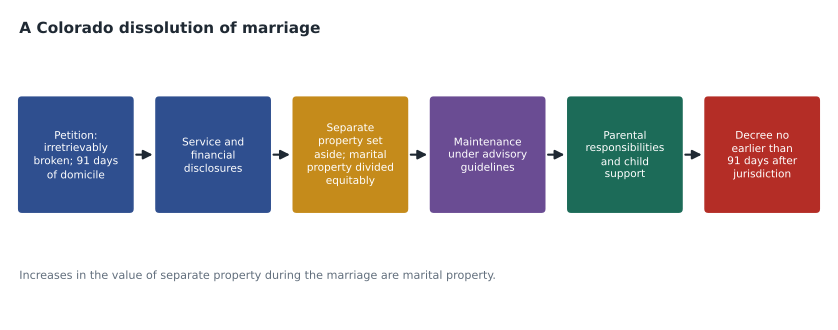
Colorado calls divorce dissolution of marriage. It is a no-fault state: the only ground is that the marriage is irretrievably broken, under C.R.S. 14-10-106. At least one party must have been domiciled in Colorado for ninety-one days before filing, and the court may not enter a decree until at least ninety-one days after it acquires jurisdiction over the respondent, typically by service or appearance. Legal separation is available on the same ground, and a legal separation decree can later be converted to a dissolution.
Colorado divides property by equitable distribution under C.R.S. 14-10-113, not by community property rules. The court first sets aside each spouse's separate property, which generally includes property acquired before the marriage and property acquired during the marriage by gift, bequest or inheritance. It then divides the marital property, which includes most property acquired during the marriage, in just proportions, considering factors such as each spouse's contribution, including as a homemaker, the value of the separate property set aside, and the economic circumstances of each spouse. An important Colorado rule: the increase in value of separate property during the marriage is generally treated as marital property subject to division.
Spousal support is called maintenance. Colorado's statute, C.R.S. 14-10-114, contains advisory guidelines for the amount and duration of maintenance for couples whose combined income falls below a statutory threshold, with the court required to make findings on income, property and other factors before awarding maintenance. Duration under the guidelines increases with the length of the marriage. Courts may depart from the guidelines with findings.
Children: parental responsibilities and support
Colorado does not use the words custody and visitation in its domestic relations statutes. Instead, the court allocates parental responsibilities under C.R.S. 14-10-124, divided into decision-making responsibility (major decisions about education, health care and religion) and parenting time. The court allocates both according to the best interests of the child, considering factors listed in the statute, including the child's relationship with each parent, each parent's ability to encourage the child's relationship with the other parent, and any history of domestic violence or child abuse, which receives special weight.
Child support is calculated under statutory guidelines in C.R.S. 14-10-115, based on the parents' combined income, the number of children and the number of overnights each parent has, with adjustments for health insurance, child care and other costs. Colorado also recognizes Colorado-specific procedures such as parenting coordinators and decision-makers, and the licensed legal paraprofessionals described in Lesson 11 may now assist clients in many domestic relations matters.
Wills: formalities, holographic wills and harmless error
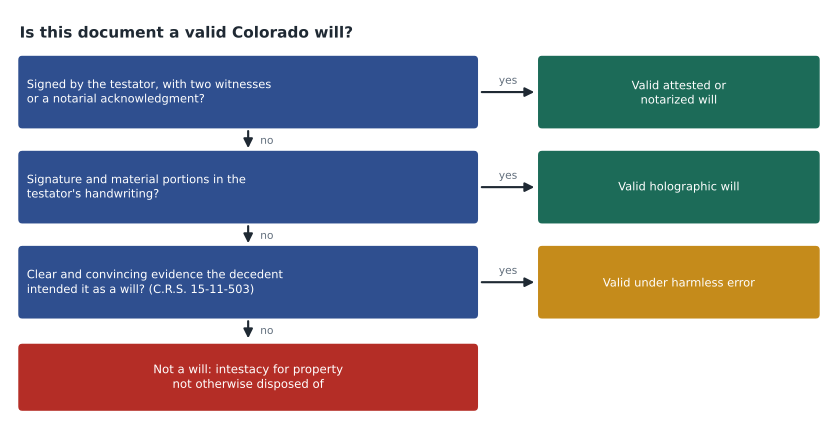
Colorado's probate code is based on the Uniform Probate Code. Under C.R.S. 15-11-502, a will is valid if it is in writing, signed by the testator (or by another person in the testator's presence and at the testator's direction), and either signed by at least two individuals who witnessed the signing or the testator's acknowledgment, or acknowledged by the testator before a notary public. The notary option is a Colorado feature drawn from the 2008 Uniform Probate Code revisions: a properly notarized will can be valid without two witnesses.
Colorado recognizes holographic wills. A will that does not meet the witness or notary requirement is valid as a holographic will if the signature and material portions of the document are in the testator's handwriting. The intent that the document be a will can be established by extrinsic evidence, including portions not in the testator's handwriting.
Colorado also adopted the Uniform Probate Code's harmless error rule. Under C.R.S. 15-11-503, a document that does not meet the formal requirements is treated as if it had been executed properly if the proponent establishes by clear and convincing evidence that the decedent intended the document to be the decedent's will. Colorado has also enacted legislation on electronic wills and remote witnessing, so a will no longer must be a paper document signed in one room; check the current statute for the requirements before relying on either.
Worked problem
The handwritten page
The page in the partner's desk says, in his handwriting, "I leave my house on Jay Street to Ellen, who has made it a home," and is signed with his full name at the bottom. It is not witnessed or notarized. Is it a valid will?
Show solution
- It is not valid as a formal attested will: it has neither two witnesses nor a notarial acknowledgment.
- It may be valid as a holographic will under C.R.S. 15-11-502 if the signature and material portions are in his handwriting; here both appear to be.
- Intent that the page operate as a will can be shown by extrinsic evidence, such as where it was kept and statements he made.
- If the holographic route failed, the proponent could still argue harmless error under C.R.S. 15-11-503 with clear and convincing evidence of testamentary intent.
Answer: It is likely valid as a holographic will, leaving the house to Ellen; harmless error is a backup argument.
The surviving spouse's elective share
A surviving spouse in Colorado cannot be completely disinherited. Under C.R.S. 15-11-201 and following, the surviving spouse may elect to take a share of the augmented estate, which includes not only the probate estate but also certain nonprobate transfers, such as property held in revocable trusts or in joint tenancy with others, and transfers made shortly before death. The percentage grows with the length of the marriage, reaching fifty percent of the augmented estate after ten years of marriage, under a schedule adapted from the Uniform Probate Code. The election must be made within the time the statute allows, and the spouse's own property and the property passing to the spouse are taken into account.
If Luke's client proves a common-law marriage of twenty-two years and the holographic will gives her the house, she may not need the elective share. But if the will had left her nothing, the elective share would give her a substantial claim against the augmented estate.
Intestate succession
When a person dies without a valid will, Colorado's intestacy statutes, also based on the Uniform Probate Code, determine who inherits. The surviving spouse's share depends on the family structure. If all of the decedent's descendants are also descendants of the surviving spouse, and the surviving spouse has no other descendants, the spouse takes the entire intestate estate. If the decedent had descendants who are not the surviving spouse's descendants, as with the partner's adult son in Luke's case, the spouse takes a fixed dollar amount plus a fraction of the rest, and the descendants take the remainder. The dollar amounts are adjusted for inflation over time, so check the current figures.
| Situation | Surviving spouse takes (Uniform Probate Code structure as adopted in Colorado) |
|---|---|
| No descendants and no surviving parent | The entire intestate estate |
| All descendants are also the spouse's, and the spouse has no other descendants | The entire intestate estate |
| No descendants, but a surviving parent | A fixed amount plus three-quarters of the balance; parent takes the rest |
| Decedent has descendants who are not the spouse's | A fixed amount plus half the balance; descendants take the rest |
| Spouse has descendants who are not the decedent's (all decedent's descendants are also spouse's) | A fixed amount plus half the balance; the decedent's descendants take the rest |
Probate and trusts
Colorado probate is relatively streamlined. Estates may be administered informally, without court hearings, when there is no dispute, or formally, under court supervision, when questions arise, such as the validity of a will or the existence of a common-law marriage. A personal representative is appointed to collect assets, pay debts and distribute the estate. Small estates below a statutory threshold, adjusted periodically, can often be collected by affidavit without opening a probate case. In Denver, probate matters go to the Denver Probate Court; elsewhere they are heard by district courts.
Colorado adopted the Uniform Trust Code in 2018, effective January 1, 2019, which governs the creation, modification and administration of trusts and the duties of trustees. Revocable living trusts are common estate planning tools in Colorado, as elsewhere, and assets held in such trusts pass outside probate, although they count toward the augmented estate for elective share purposes.
Common mistakes
MistakeColorado abolished common-law marriage.
InsteadColorado recognizes common-law marriage; In re Marriage of Hogsett and Neale, 2021 CO 1 restated the test.
MistakeColorado courts award custody and visitation.
InsteadColorado allocates parental responsibilities: decision-making responsibility and parenting time.
MistakeA Colorado will always needs two witnesses.
InsteadA will may instead be acknowledged before a notary, and holographic wills are valid.
MistakeIncreases in the value of separate property during the marriage stay separate.
InsteadUnder C.R.S. 14-10-113 the increase in value is generally marital property.
Planning conversations in a general practice
Luke's first months show him how often family law and probate questions arrive together. A client in a long unmarried relationship asks whether she needs a will. A divorcing client asks whether his will and beneficiary designations still name his spouse. A widow asks whether she must open a probate case to sell a car. Each question has a Colorado answer, and each has a planning answer: written agreements for unmarried couples, updated wills and beneficiary designations after a divorce, and simple estate plans that avoid uncertainty. Colorado's probate code revokes many provisions in favor of a former spouse automatically on divorce, but careful lawyers still update every document rather than rely on default rules.
Probate procedure in brief
Colorado offers informal and formal probate. Informal probate is handled largely by the court's registrar on paper, without a hearing, and suits most estates where the will is clear and no one objects. Formal probate involves a court hearing and suits contested estates or those with uncertain wills. Small estates below a statutory value may be collected by affidavit without opening a probate case at all. A personal representative must give notice to heirs, devisees and creditors, inventory the estate, pay valid claims, and distribute what remains. Each step has deadlines and forms, which the Colorado Judicial Branch publishes for people handling estates themselves.
For Ellen, these options matter. If her partner's handwritten will is admitted and no one objects, informal probate may be enough. If a relative challenges the will or her status as a common-law spouse, the matter will move to formal proceedings, where the evidence of their relationship and the will's material portions will be examined in court.
Summary and key terms
- Colorado recognizes common-law marriage; Hogsett (2021) requires mutual agreement to marry followed by conduct manifesting it, judged on the totality of circumstances.
- Dissolution is no-fault (irretrievable breakdown) with a ninety-one-day domicile requirement and a ninety-one-day waiting period.
- Property is divided equitably; increases in separate property during marriage are generally marital; maintenance follows advisory guidelines.
- Courts allocate parental responsibilities (decision-making and parenting time) by best interests; child support follows guidelines.
- Wills need two witnesses or a notary; holographic wills and harmless error are recognized; the elective share reaches half the augmented estate after ten years of marriage.
- Common-law marriage
- A valid marriage formed by mutual agreement to marry followed by conduct manifesting it, without a license or ceremony.
- Dissolution of marriage
- Colorado's term for divorce.
- Allocation of parental responsibilities
- Colorado's framework for decision-making responsibility and parenting time.
- Holographic will
- A will whose signature and material portions are in the testator's handwriting.
- Augmented estate
- The probate estate plus certain nonprobate transfers, used to compute the elective share.
Lesson quiz · 5 questions
Score 60% or more to complete this lesson.
Create a free account to save your progress, take quizzes and earn a certificate.