
BAR-206 · Lesson 11 of 12 · 15 min
Score transfer, admission on motion, new pathways and practice after admission
▶ Video coming soon A video version of this lesson is on the way.
Three people bring Luke questions in the same week. A friend from law school who passed the UBE in New Mexico in July 2025 with a 268 wants to work at the Denver District Attorney's office and asks whether she can transfer her score. A lawyer at a Utah firm who has practiced for six years asks how to become licensed in Colorado without taking another exam. And the paralegal who sits next to Luke, who has spent eight years on family law cases, asks about the new license that would let her represent clients in mediation. 'Admission is not one door,' Marchetti says. 'Colorado has several, and it keeps adding more. Learn them, because people will ask you about them for the rest of your career.'
This lesson covers the routes to admission other than taking the Colorado exam, the new supervised admission pilot, Colorado's licensed legal paraprofessionals, and the obligations that follow admission: the oath, registration, continuing legal education and the Colorado Rules of Professional Conduct.
Admission by transferred UBE score
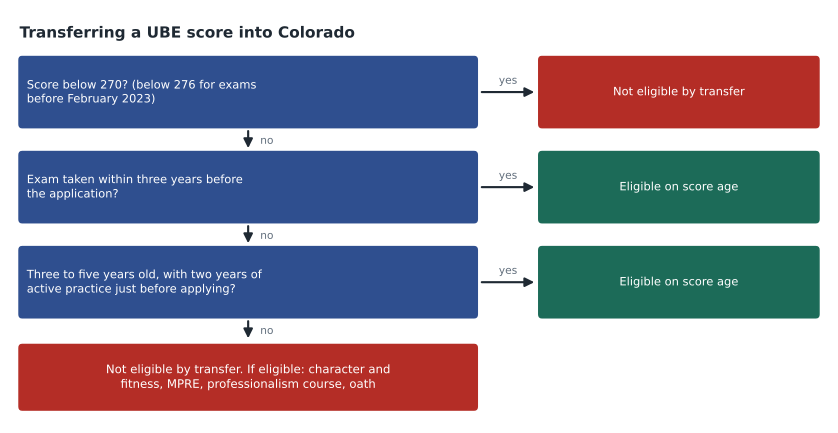
C.R.C.P. 203.3 allows an applicant who sat the UBE in another jurisdiction to apply for admission in Colorado based on that score. The score must be at least 270 for exams from February 2023 onward; scores from earlier exams must be at least 276, the passing score Colorado used before 2023. Timing matters. A score earned within three years before the application is filed qualifies on its own. A score earned between three and five years before filing qualifies only if the applicant also shows at least two years of active law practice immediately before applying, in a U.S. jurisdiction where the applicant was in good standing throughout. Colorado does not accept transferred MBE scores alone.
Transfer applicants must still meet Colorado's other requirements: character and fitness review, the MPRE, and the professionalism course, with an exemption for certain lawyers practicing under Colorado's temporary practice rules. NCBE must transmit the score to the Office of Attorney Admissions within forty-five days after the Colorado application is filed. After the supreme court approves the application, the applicant must take the oath within eighteen months.
Admission on motion
C.R.C.P. 203.2 allows experienced lawyers to be admitted without examination. The applicant must have been primarily engaged in the active practice of law in one or more U.S. jurisdictions for three of the five years immediately before filing; practice outside the United States does not count. The applicant must hold a J.D. or LL.B. from an ABA-approved law school, must have been admitted in another U.S. jurisdiction by examination (lawyers admitted only by diploma privilege are not eligible), and must be in good standing everywhere admitted, with no pending discipline. Lawyers disbarred or suspended elsewhere must first be readmitted or reinstated in that jurisdiction. The rule allows the court to require the MPRE, and applicants must complete the professionalism course unless an exemption applies.
Colorado does not require reciprocity. Some states admit lawyers on motion only from states that would admit their lawyers in return. Colorado's rule looks at the applicant's practice history, not at the rules of the applicant's home state. That makes Colorado an accessible destination for experienced lawyers. The Utah lawyer with six years of practice and an exam-based Utah admission meets the core requirements, assuming an ABA-approved degree and good standing.
| Route | Score or experience | Other key points |
|---|---|---|
| UBE score transfer (C.R.C.P. 203.3) | 270 or more (276 for exams before Feb 2023), earned within 3 years, or 3 to 5 years with 2 years of practice | NCBE transmits within 45 days of filing; oath within 18 months of approval |
| Admission on motion (C.R.C.P. 203.2) | Active practice three of the last five years in U.S. jurisdictions | ABA-approved degree; admitted elsewhere by exam; good standing; no reciprocity requirement |
| Supervised admission pilot (C.R.C.P. 203.6) | Passing UBE score elsewhere below 270, from an exam within 18 months | Public defender, district attorney or Colorado Legal Services employment; two years of supervised practice |
| Temporary and limited practice (C.R.C.P. 205 rules) | Varies by category | For certain out-of-state lawyers, in-house counsel and others; check the specific rule |
The supervised admission pilot
In October 2026 the Colorado Supreme Court adopted C.R.C.P. 203.6, a pilot program creating a path to supervised admission. The rule was adopted on October 8, 2026, took effect October 12, 2026, and accepts applications until July 1, 2029, unless the court extends or amends it. It is aimed at applicants who passed the UBE in another U.S. jurisdiction with a score below Colorado's 270 but who otherwise qualify for admission, and who want to work in public service in Colorado.
To qualify, an applicant needs a qualifying UBE score from another jurisdiction, from an exam taken within eighteen months before applying, a passing MPRE score, good standing, no pending discipline, and approval on character and fitness. The applicant must be employed full time by the Colorado Office of the Public Defender, a Colorado district attorney's office or Colorado Legal Services, under an approved supervising attorney who is authorized to practice in Colorado and who files the required certifications. The applicant must complete the professionalism course.
Admission under the pilot is restricted at first. The new lawyer takes the oath and practices under the program's conditions, must complete two years of qualifying employment within three years, and then files an affidavit to gain unrestricted authority to practice. Changes in employment must be reported within fourteen days. Authority to practice is suspended automatically in specified cases, such as leaving qualifying employment without starting another qualifying job within fourteen days, and admission is revoked if the two-year requirement is not met within three years and a twenty-eight-day cure period passes.
Worked problem
Luke's friend from New Mexico
Luke's friend sat the UBE in New Mexico in July 2025 and scored 268, which passed in New Mexico. In November 2026 she receives an offer from the Denver District Attorney's office. Can she use her score to practice in Colorado?
Show solution
- Under C.R.C.P. 203.3, a transferred score must be at least 270, so a 268 does not qualify for ordinary transfer.
- The 203.6 pilot is designed for applicants with a passing score elsewhere below 270 who work for a district attorney's office, the public defender or Colorado Legal Services.
- Her score must come from an exam within eighteen months before she applies; July 2025 to November 2026 is about sixteen months, so she must apply promptly.
- She must also meet the MPRE, good standing, fitness and professionalism course requirements, work full time under an approved supervisor, and complete two years of qualifying employment within three years.
Answer: She cannot transfer the 268 normally, but she may qualify for supervised admission under the pilot if she applies within the eighteen-month window.
Licensed legal paraprofessionals
Colorado has created a new category of licensed legal professional to improve access to legal help in family law. In March 2023, the Colorado Supreme Court approved licensed legal paraprofessionals (LLPs) through new rules in the 207 series of the Colorado Rules of Civil Procedure, and the first LLPs could be licensed in July 2024. LLPs may provide limited legal services in domestic relations matters, such as dissolution of marriage and allocation of parental responsibilities.
Within that scope, an LLP may, among other things, prepare and file standard pleadings, represent clients in mediation, and accompany clients to court to answer the court's factual questions. LLPs may not present oral argument or examine witnesses at a hearing. To be licensed, an applicant must meet education requirements (with an alternative for experienced family law paralegals), complete 1,500 hours of substantive law-related practical experience, including at least 500 hours in Colorado family law within the three years before the exam, pass a written LLP exam administered by the Office of Attorney Regulation Counsel, complete an ethics course and a professional conduct exam, and meet character and fitness standards. LLPs carry continuing education obligations and are subject to discipline much like lawyers. The court has continued to refine the LLP rules since 2023, so check the current rules for the exact scope.
For new lawyers, LLPs matter in two ways. They are colleagues and sometimes opposing representatives in family law matters, and lawyers who supervise or work alongside them must understand the limits of their license. Luke's paralegal colleague, with eight years of family law experience, may qualify through the experience alternative to the education requirement.
The oath and registration
After the supreme court approves an application, the applicant takes the oath of admission and is enrolled as an attorney. Every Colorado lawyer must register annually with the Office of Attorney Registration and pay an annual registration fee, which funds the regulatory system, including discipline, the lawyer assistance program and the client protection fund. Registration statements also collect information such as trust account details and whether the lawyer carries malpractice insurance. Failure to register leads to administrative suspension.
Continuing legal education
Colorado requires forty-five credit hours of continuing legal education every three years, including seven credits of professional responsibility. Within those seven, at least five must be in legal ethics and at least two must be in equity, diversity and inclusivity. A new lawyer's first compliance period starts on the date of admission and ends on December 31 of the third full calendar year after the year of admission. The professionalism course counts toward that first period if taken within the eighteen-month credit window. Compliance must be reported through the online system by the following January 31. Colorado does not allow carryover of excess credits.
Colorado Rules of Professional Conduct
The Colorado Rules of Professional Conduct follow the ABA Model Rules closely, and the MPRE preparation in BAR-140 covers most of what a new Colorado lawyer needs. A few Colorado provisions deserve special attention.
Marijuana. Colorado added a comment to Rule 1.2 recognizing that a lawyer may counsel and assist a client regarding conduct that the lawyer reasonably believes is permitted by Colorado's constitutional and statutory provisions on marijuana, and the regulations and orders implementing them, while also advising the client about related federal law and policy. The comment addresses the tension between Colorado's legalization and continuing federal prohibition, which would otherwise raise questions under Rule 1.2(d)'s bar on assisting criminal conduct.
Misconduct. Colorado's Rule 8.4 contains provisions that differ from the ABA model. Paragraph (g) prohibits a lawyer, in representing a client, from engaging in conduct that exhibits or is intended to promote bias or prejudice against a person on the basis of characteristics including race, gender, religion, national origin, disability, age, sexual orientation or socioeconomic status, with a comment confirming that legitimate advocacy is not a violation. Paragraph (h) prohibits conduct that directly, intentionally and wrongfully harms others and adversely reflects on fitness to practice. Paragraph (i) prohibits conduct the lawyer knows or reasonably should know constitutes sexual harassment in connection with the lawyer's professional activities. Paragraph (c) includes an exception allowing lawyers to advise or supervise others, including investigators, in lawful investigative activities.
Trust accounts. Colorado lawyers hold client funds in trust accounts under Colorado's version of Rule 1.15, and nominal or short-term client funds go into interest-bearing accounts whose interest supports legal aid through the Colorado Lawyer Trust Account Foundation (COLTAF). Trust account mistakes are among the most common sources of discipline for new lawyers, which is one reason the professionalism course spends time on them.
Common mistakes
MistakeA transferred UBE score of 266 earned in 2025 qualifies in Colorado.
InsteadOrdinary transfer requires 270 (276 before February 2023); the 203.6 pilot may help only applicants in qualifying public-service jobs.
MistakeColorado admits lawyers on motion only from states that admit Colorado lawyers.
InsteadColorado's admission on motion rule has no reciprocity requirement.
MistakeLicensed legal paraprofessionals may try contested family law hearings.
InsteadLLPs may prepare and file pleadings, represent clients in mediation and answer the court's factual questions, but may not present oral argument or examine witnesses.
MistakeColorado lawyers need fifteen CLE credits a year with carryover.
InsteadColorado requires forty-five credits every three years, including seven professional responsibility credits, with no carryover.
Getting help
Colorado offers confidential support for lawyers and law students facing stress, substance use, mental health concerns or other difficulties through the Colorado Lawyer Assistance Program. Seeking help is not itself a disciplinary matter, and the professionalism course introduces the program for that reason. New lawyers should know it exists before they need it.
Luke adds the program's number to the same calendar that holds his CLE deadlines and registration dates, a small step that his supervising attorney says every new lawyer should take.
Summary and key terms
- C.R.C.P. 203.3 allows UBE score transfer with 270 (276 before 2023) within three years, or three to five years with two years of practice.
- C.R.C.P. 203.2 admits lawyers on motion after three of five years of active U.S. practice, with an ABA degree and exam-based admission elsewhere, and no reciprocity requirement.
- C.R.C.P. 203.6, effective October 12, 2026, is a pilot allowing supervised admission for applicants with a passing UBE score elsewhere below 270 who work for public defenders, district attorneys or Colorado Legal Services.
- Licensed legal paraprofessionals, first licensed in July 2024, provide limited family law services.
- After admission: annual registration, forty-five CLE credits every three years (seven in professional responsibility, including two in equity, diversity and inclusivity), and Colorado-specific rules such as the Rule 1.2 marijuana comment and Rule 8.4(g) to (i).
- Score transfer
- Admission based on a UBE score earned in another jurisdiction.
- Admission on motion
- Admission without examination for lawyers with qualifying practice experience elsewhere.
- Supervised admission pilot
- C.R.C.P. 203.6, a 2026 program allowing restricted admission for qualifying public-service lawyers with passing UBE scores below 270.
- Licensed legal paraprofessional (LLP)
- A licensed non-lawyer who may provide limited legal services in Colorado domestic relations matters.
- COLTAF
- The Colorado Lawyer Trust Account Foundation, which receives interest on pooled client trust accounts to support legal aid.
Lesson quiz · 5 questions
Score 60% or more to complete this lesson.
Create a free account to save your progress, take quizzes and earn a certificate.