
BAR-206 · Lesson 12 of 12 · 15 min
Capstone: Colorado practice questions and an exam-day plan
▶ Video coming soon A video version of this lesson is on the way.
In late November, Marchetti sends Luke a capstone in two parts. Part A is ten questions on Colorado admission rules and Colorado law, drawn from the whole course. Part B is a thirty-minute essay built around a fictional Colorado client. 'This is not the bar exam,' her email says. 'The bar exam will test general law. This tests whether you can be a Colorado lawyer the week after you are sworn in. Take it closed book, time yourself, then grade yourself with the answers.' The last section of this lesson turns to the exam itself, with a plan for the final weeks and the two exam days.
All questions and the essay are original and written for this course. The facts are fictional. Answer each question before reading its explanation.
Part A: ten questions
Question 1. A May 2026 graduate of a California state-accredited law school, who has never been admitted anywhere, wants to sit the February 2027 Colorado exam. (A) She may sit; any J.D. qualifies. (B) She may sit after obtaining a Foreign Eligibility Determination. (C) She may not sit on that degree alone; a state-accredited degree qualifies only with admission elsewhere and three of five years of active practice. (D) She may sit if her MPRE score is at least 90.
Answer: C. C.R.C.P. 203.4 limits the state-accredited route to experienced lawyers admitted elsewhere. The Foreign Eligibility Determination is for foreign-educated applicants, and MPRE scores do not affect education eligibility.
Question 2. Luke's classmate files her February 2027 application on November 20, 2026. Which statement is correct? (A) Her application is rejected as late. (B) Her application is accepted with a late fee, because the late deadline is December 1. (C) Her application is accepted without a fee because she graduated in May. (D) She must wait for the July exam.
Answer: B. Colorado accepts applications after November 1 and until December 1 with a late fee; nothing is accepted after December 1.
Question 3. A candidate earns a scaled MBE score of 141 and a scaled written score of 127 on the February 2027 Colorado exam. What is the result? (A) She fails, because her written score is below 135. (B) She passes with a total of 268. (C) She fails with a total of 268. (D) She passes because her MBE is above 140.
Answer: C. The UBE is compensatory, so only the total matters: 141 plus 127 is 268, below Colorado's 270.
Question 4. In a Colorado negligence case against a single defendant, the jury finds the plaintiff 50 percent at fault and the defendant 50 percent at fault, with damages of 80,000 dollars. What does the plaintiff recover? (A) 40,000 dollars. (B) 80,000 dollars. (C) Nothing. (D) 40,000 dollars, reduced by any noneconomic damages cap.
Answer: C. Under C.R.S. 13-21-111, recovery is barred when the plaintiff's negligence is as great as the defendant's. On the MBE, by contrast, the default of pure comparative negligence would give 40,000 dollars.
Question 5. A cyclist is injured on a city bike path on March 3 when a city maintenance truck backs into her. On what date does her written notice of claim deadline under the Colorado Governmental Immunity Act fall, approximately? (A) Two years after March 3. (B) Thirty days after March 3. (C) About six months after the date she discovered the injury, at 182 days. (D) There is no notice requirement for vehicle accidents.
Answer: C. The CGIA requires a written notice of claim within 182 days after discovery of the injury. Operation of a motor vehicle by a public employee is one of the act's waivers, but the notice requirement still applies and is jurisdictional.
Question 6. A plaintiff's lawyer wants to seek exemplary damages for a drunk driver's conduct. When may the claim be included? (A) In the original complaint. (B) By amendment after the exchange of initial disclosures and a prima facie showing of a triable issue. (C) Only after the jury returns a verdict on compensatory damages. (D) Never, because exemplary damages are not available in Colorado.
Answer: B. C.R.S. 13-21-102 bars exemplary damages claims in the initial complaint and generally limits the award to the amount of actual damages, subject to the court's power to increase it in defined circumstances.
Question 7. A ranch owner with an 1898 irrigation right and a town with a 1972 municipal right both divert from the same creek. In a severe drought, there is enough water for only one of them. Under Colorado law, who receives water? (A) The town, because municipal use is preferred. (B) The ranch, because its right is senior. (C) They share equally. (D) Whoever owns more land along the creek.
Answer: B. Under prior appropriation, priority controls in shortages: the senior 1898 right is satisfied first. Article XVI, section 6 mentions preferences among uses, but those preferences do not simply override priority without compensation, and day-to-day administration follows priority.
Question 8. A seller deeds land to Ana, who does not record. The seller then deeds the same land to Ben, who pays value, has no notice of Ana's deed, and records. Ana then records. Who has priority under C.R.S. 38-35-109? (A) Ana, because her deed came first. (B) Ben, because he took for value without notice and recorded first. (C) Ana, because she recorded eventually. (D) Neither; the seller keeps title.
Answer: B. Colorado's race-notice statute protects a later purchaser for value without notice who records first.
Question 9. Two people in Fort Collins lived together for fifteen years, filed joint tax returns as married, wore rings and introduced each other as spouses, but never obtained a license. One dies without a will. Which statement best describes Colorado law? (A) They cannot be married without a license. (B) If they mutually agreed to be married and their conduct manifested that agreement, they have a common-law marriage, and the survivor is a surviving spouse. (C) Only opposite-sex couples can have common-law marriages. (D) Common-law marriage requires at least twenty years of cohabitation.
Answer: B. In re Marriage of Hogsett and Neale, 2021 CO 1 requires mutual agreement followed by conduct manifesting it, judged on the totality of the circumstances; same-sex couples can have common-law marriages, and there is no minimum duration.
Question 10. A lawyer who passed the UBE in New Mexico in July 2026 with a 264 receives an offer from a large private Denver law firm. Which statement is correct? (A) She may transfer her score to Colorado. (B) She may use the C.R.C.P. 203.6 pilot. (C) She cannot transfer a 264, and the pilot applies only to public defender, district attorney and Colorado Legal Services jobs; she would need to sit the Colorado exam or later qualify on motion. (D) She may be admitted on motion immediately.
Answer: C. Transfer requires 270; the pilot is limited to qualifying public-service employment; admission on motion requires three of five years of practice.
| Question | Answer | Topic |
|---|---|---|
| 1 | C | Education eligibility (C.R.C.P. 203.4) |
| 2 | B | Late filing period |
| 3 | C | Compensatory UBE scoring |
| 4 | C | Modified comparative fault |
| 5 | C | CGIA notice of claim |
| 6 | B | Exemplary damages |
| 7 | B | Prior appropriation |
| 8 | B | Race-notice recording |
| 9 | B | Common-law marriage |
| 10 | C | Score transfer and the 203.6 pilot |
Part B: a thirty-minute essay
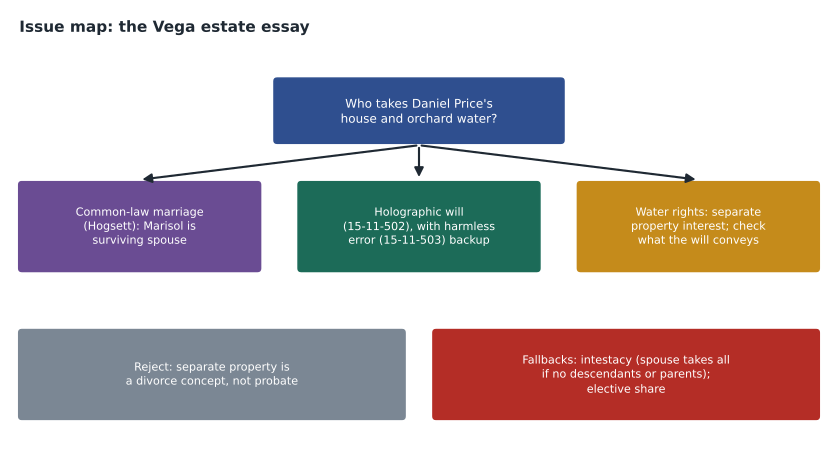
Facts. Marisol Vega and Daniel Price lived together in Grand Junction from 2009 until Daniel's death in October 2026. They never obtained a marriage license, but they filed joint federal and state tax returns as married filing jointly from 2014 on, Daniel listed Marisol as his wife on his employer's health insurance, and friends testified that the couple introduced each other as husband and wife. Daniel owned their house, which he bought in 2005, before they met; it was worth 300,000 dollars in 2009 and is worth 650,000 dollars today. Daniel also held water rights in a ditch company serving a small orchard behind the house. He left a one-page document entirely in his handwriting and signed, stating 'Marisol gets the house and the orchard water. Everything else to my brother Ray.' It was not witnessed or notarized. Daniel's brother Ray says Marisol is not a spouse and that the document is not a will. Ray also says that because the house was Daniel's before the relationship, Marisol has no claim to it. Discuss the issues Marisol's lawyer should raise under Colorado law.
Time yourself: thirty minutes. Then compare your answer with the model below.
Model answer. The first issue is whether Marisol was Daniel's spouse through a common-law marriage. Colorado recognizes common-law marriage. Under In re Marriage of Hogsett and Neale, 2021 CO 1, a common-law marriage is established by the parties' mutual agreement to enter the legal and social institution of marriage, followed by conduct manifesting that agreement, judged on the totality of the circumstances. Here, from at least 2014 the couple filed joint tax returns as married, Daniel listed Marisol as his wife for health insurance, and they held themselves out as husband and wife to friends. Those facts are strong evidence of both agreement and conduct manifesting it. Ray may argue that the years of cohabitation before 2014 show no agreement, but a common-law marriage need not date from the start of cohabitation; it is enough that it was formed at some point. Marisol likely proves a common-law marriage formed by 2014, making her Daniel's surviving spouse.
The second issue is whether the handwritten document is a valid will. Under C.R.S. 15-11-502, a will must be signed and either witnessed by two individuals or acknowledged before a notary, unless it qualifies as a holographic will. A document is a valid holographic will if the signature and material portions are in the testator's handwriting. Here the entire document is in Daniel's handwriting and signed, so it is likely a valid holographic will. Ray's objection that it was not witnessed fails because holographic wills need no witnesses. Even if a formal defect were found, Marisol could argue harmless error under C.R.S. 15-11-503, which requires clear and convincing evidence that Daniel intended the document to be his will; its dispositive language supports that intent.
The third issue is the effect of the will. If valid, it gives Marisol the house and 'the orchard water.' Water rights in Colorado are property interests that can be conveyed separately from land, and shares in a mutual ditch company are personal property representing the right to water delivered by the company. The lawyer should confirm what Daniel owned, whether a decreed water right or ditch company shares, and whether the will's description is sufficient; the context, the orchard behind the house, supports reading it as the shares or rights serving that orchard. The rest of the estate passes to Ray under the residuary clause.
The fourth issue is Ray's argument that the house was Daniel's separate property. That argument confuses divorce law with probate law. In a dissolution, C.R.S. 14-10-113 would treat property acquired before the marriage as separate, although the increase in value during the marriage would generally be marital. But Daniel died; there is no dissolution. At death, the question is what the will says and what rights a surviving spouse has. The will gives Marisol the house, so its character as premarital property does not matter.
The fifth issue is a fallback if the will were held invalid. Daniel would then die intestate, and Marisol, as surviving spouse, would take under Colorado's intestacy statutes. Daniel appears to have no descendants; the facts mention only a brother. If Daniel had no descendants and no surviving parent, the surviving spouse takes the entire intestate estate, and Ray takes nothing. Marisol could also consider the elective share, which after more than ten years of marriage reaches half of the augmented estate, but if the will is valid and gives her the house and water, or if intestacy gives her everything, she may not need it. Either way, the probate court, the Mesa County district court, would resolve the marriage and will questions, likely in a formal proceeding given the dispute.
Self-grading guide. A strong answer identifies common-law marriage and applies Hogsett to specific facts; recognizes the holographic will and mentions harmless error as a backup; addresses the water rights description; rejects the separate property argument as a divorce concept; and analyzes intestacy and the elective share as fallbacks. Give yourself one point for each, and a sixth point for clear organization with headings or issue sentences.
An exam-day plan
The capstone tests Colorado law, but the February exam tests general law. Marchetti closes the course with a plan Luke can follow from December through exam week.
From early December to the end of January, follow a weekly rhythm: about a hundred timed MBE questions spread across subjects, with a miss log that records why each answer was wrong; two timed MEE answers graded against model answers; and one full MPT under timed conditions. Take two full simulated exams on weekends in January and early February, on the real schedule: MPT and MEE on the first day, MBE on the second.
In the last two weeks, shift from learning new material to reviewing the miss log, rereading short outlines, and practicing timing. Keep the Colorado notebook closed; it belongs to practice, not to the exam. Confirm logistics from the Office of Attorney Admissions' exam-day instructions: the site, check-in time, identification, permitted items, laptop software and what to do in an emergency.
On the first day, use the MPT's ninety minutes per task strictly: spend roughly the first half reading the task memo, file and library, and the second half writing. On the MEE, allocate about thirty minutes per essay and stop when time is up, even if an answer feels incomplete. On the second day, pace the MBE at about 1.8 minutes per question, flag and move on from questions that stall, and answer every question, because there is no penalty for guessing. Sleep, eat and leave each session behind when it ends.
Luke finishes the capstone with nine of ten on Part A, missing only the CGIA question, where he confused the notice deadline with the limitation period, and five of six on the essay, missing the water rights point. 'Those are the two mistakes I would expect from a Colorado lawyer in his first month,' Marchetti says. 'Now go forget all of it until March, and learn the MBE.'
Summary and key terms
- Colorado admission questions turn on Rule 203.4 eligibility, the late filing period, compensatory UBE scoring and the transfer and pilot rules.
- Colorado law questions turn on modified comparative fault, the CGIA notice requirement, exemplary damages limits, prior appropriation, race-notice recording and common-law marriage.
- A strong Colorado essay applies Hogsett, the holographic will rule, harmless error, water rights as property, and intestacy and elective share fallbacks.
- For the exam itself, use general rules, a weekly practice rhythm, two simulated exams and strict timing on both days.
- Capstone
- A final exercise that combines the course's admission rules and Colorado law in questions and an essay.
- Miss log
- A record of wrong practice answers and why each was wrong, used to target review.
- Simulated exam
- A full practice exam taken on the real two-day schedule.
- Ditch company shares
- Shares in a mutual ditch company representing the right to water delivered by the company.
- Fallback analysis
- Discussing what happens if the primary argument fails, such as intestacy if a will is invalid.
Lesson quiz · 5 questions
Score 60% or more to complete this lesson.
Create a free account to save your progress, take quizzes and earn a certificate.