
BAR-120 · Lesson 8 of 12 · 22 min
Contracts and sales on the essay
▶ Video coming soon A video version of this lesson is on the way.
On Wednesday, November 4, 2026, Ngozi asks to start with the question that tripped her on a Saturday drill: a battle-of-the-forms problem where she applied the common law's last-shot rule to a sale of goods. 'On the essay that mistake would cost me the whole call,' she says. Marchetti agrees. 'The first sentence of almost every contracts essay should tell the grader which law governs: the common law or Article 2 of the Uniform Commercial Code. Get that right and the rest follows. Get it wrong and every rule after it is the wrong rule.'
This lesson gives an order of analysis for contracts and sales essays and reviews the rules that essays test most often. Contracts is one of the most frequently tested MEE subjects, and the questions reward candidates who move through the life of a contract in order: governing law, formation, defenses, terms, performance and breach, excuse, remedies and third parties. You will rarely need all of them in one answer, but you should always know where in that sequence each call falls.
Step one: which law governs
Article 2 governs transactions in goods, meaning things movable at the time of identification to the contract. The common law governs everything else: services, real estate, employment, construction and intellectual property licenses. When a contract mixes goods and services, most courts apply the predominant purpose test, asking whether the contract's main thrust is the sale of goods with services incidental, or the reverse, considering the contract's language, how the price is allocated, and the nature of the parties' businesses. Some courts instead apply Article 2 only to the goods part of the contract. A sentence on this issue is usually enough, unless the facts make the mix genuinely close.
Article 2 also has special rules for merchants, persons who deal in goods of the kind or hold themselves out as having knowledge or skill peculiar to the goods. Flag merchant status when it matters: for firm offers, for additional terms between merchants, for the merchant confirmation exception to the Statute of Frauds and for the implied warranty of merchantability.
Formation
A contract requires mutual assent, usually an offer and an acceptance, and consideration or a substitute. An offer is a manifestation of willingness to enter a bargain, made so that the offeree is justified in understanding that assent is invited and will conclude it. Advertisements are usually invitations to deal. An offer can be revoked any time before acceptance unless it is an option supported by consideration, a merchant's firm offer, or relied on in a way that makes it irrevocable. Under Article 2, a merchant's signed written offer that gives assurance it will be held open is irrevocable for the time stated or a reasonable time, not exceeding three months, even without consideration.
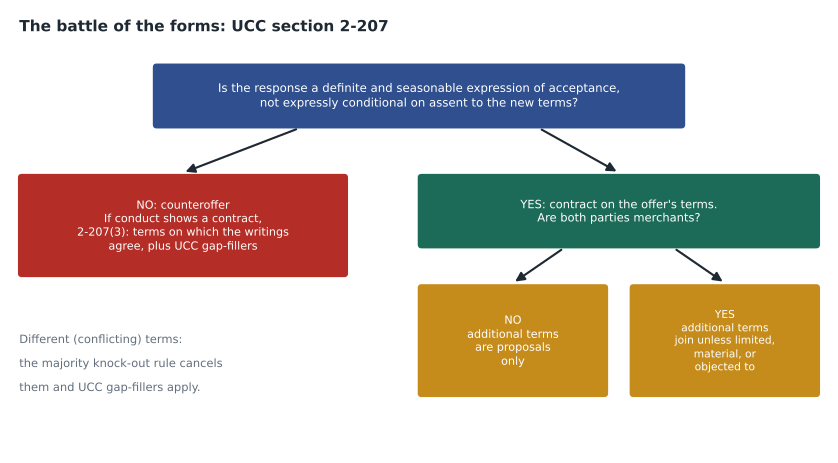
Acceptance at common law must mirror the offer: a response that adds or changes terms is a rejection and counteroffer. An acceptance is generally effective on dispatch under the mailbox rule, while revocations and rejections are effective on receipt. Under Article 2, section 2-207 changes the mirror image rule. A definite and seasonable expression of acceptance operates as an acceptance even if it states additional or different terms, unless acceptance is expressly made conditional on assent to those terms. Between merchants, additional terms become part of the contract unless the offer expressly limits acceptance to its terms, the terms materially alter the contract, or the offeror objects within a reasonable time. Different terms are handled differently by different courts; the majority knock-out rule cancels conflicting terms and fills the gap with Article 2's default rules. When the writings do not form a contract but the parties' conduct recognizes one, the contract consists of the terms on which the writings agree plus Article 2's gap-fillers.
Consideration is a bargained-for exchange of legal value. Past consideration and pre-existing duties are not consideration at common law, so a promise to pay more for work already required by contract is generally unenforceable, unless unforeseen difficulties make the modification fair. Under Article 2, a modification needs no consideration, only good faith. Promissory estoppel can substitute for consideration when a promisor should reasonably expect a promise to induce action or forbearance, it does, and injustice can be avoided only by enforcement, with the remedy limited as justice requires.
Defenses to formation and enforcement
The Statute of Frauds requires a signed writing for contracts for the sale of an interest in land, contracts that cannot be performed within one year, promises to answer for another's debt, promises in consideration of marriage, promises by executors to pay estate debts from their own funds, and, under Article 2, sales of goods for 500 dollars or more. Under section 2-201, the writing need only indicate a contract, be signed by the party against whom enforcement is sought, and state a quantity. Between merchants, a written confirmation sent within a reasonable time satisfies the statute against the recipient unless it objects within ten days. Other exceptions include specially manufactured goods, admissions in court and goods that have been paid for and accepted or received and accepted. At common law, full performance and part performance of a land contract can take a contract out of the statute.
Other defenses include incapacity (minors and persons who lack mental capacity), duress and undue influence, misrepresentation, mistake, unconscionability and illegality. A mutual mistake about a basic assumption that has a material effect on the exchange makes a contract voidable by the adversely affected party unless that party bore the risk. A unilateral mistake makes it voidable only if, in addition, enforcement would be unconscionable or the other party knew of or caused the mistake. Unconscionability requires both procedural unfairness in how the contract was formed and substantive unfairness in its terms, assessed at the time of formation.
Terms: parol evidence, interpretation and warranties
The parol evidence rule bars evidence of prior or contemporaneous agreements offered to contradict a final written agreement, and, if the writing is completely integrated, to add consistent terms. It does not bar evidence offered to show fraud, mistake, duress, a condition precedent to the agreement taking effect, or to interpret ambiguous language. Article 2's version, section 2-202, allows a final writing to be explained or supplemented by course of dealing, usage of trade and course of performance, and by consistent additional terms unless the writing was intended as a complete and exclusive statement.
Article 2 supplies warranties. An express warranty arises from an affirmation of fact or promise, a description of the goods or a sample, if it becomes part of the basis of the bargain. The implied warranty of merchantability, given by a merchant seller of goods of that kind, requires goods fit for their ordinary purposes. The implied warranty of fitness for a particular purpose arises when the seller has reason to know of the buyer's particular purpose and the buyer relies on the seller's skill. Merchantability may be disclaimed by language mentioning merchantability, which if written must be conspicuous; fitness may be disclaimed only by a conspicuous writing; and both may be excluded by expressions such as 'as is'.
Performance, breach and excuse
At common law, a party who substantially performs can enforce the contract, subject to the other party's claim for damages caused by any deviation. A material breach, judged by factors such as how much of the expected benefit the injured party loses, whether damages are adequate and the likelihood of cure, excuses the other party's performance. Express conditions must be strictly satisfied, although courts may excuse a condition to avoid forfeiture.
Under Article 2, the perfect tender rule lets a buyer reject goods that fail in any respect to conform to the contract, subject to important limits. The seller has a right to cure: if the time for performance has not expired, by notifying the buyer and making a conforming delivery within the contract time, and, if the seller had reasonable grounds to believe the tender would be acceptable, by a further reasonable time. In an installment contract, a buyer may reject an installment only if the nonconformity substantially impairs its value and cannot be cured, and may treat the whole contract as breached only if the defect substantially impairs the value of the whole. A buyer who accepts goods may revoke acceptance only if the nonconformity substantially impairs their value and acceptance was reasonable.
Anticipatory repudiation, an unequivocal statement or act showing that a party will not perform, allows the other party to treat the contract as breached, suspend performance and seek remedies, or await performance for a commercially reasonable time. When a party has reasonable grounds for insecurity, it may demand adequate assurance of performance in writing, and failure to provide assurance within a reasonable time, not over 30 days under Article 2, is a repudiation. Performance may be excused by impracticability, when an unforeseen event whose non-occurrence was a basic assumption makes performance impracticable, or by frustration of purpose, when such an event substantially destroys the value of performance to a party.
Risk of loss in sales disputes follows section 2-509 when neither party is in breach: in a shipment contract, risk passes when the seller duly delivers the goods to the carrier; in a destination contract, when the goods are tendered at the destination; and when no carrier is involved, risk passes on the buyer's receipt if the seller is a merchant and otherwise on tender. When a party is in breach, section 2-510 shifts risk against the breaching party.
Remedies
The basic remedy for breach is expectation damages: the amount that puts the injured party in the position it would have occupied had the contract been performed. Consequential damages are recoverable only if foreseeable at the time of contracting, under Hadley v. Baxendale, and must be proved with reasonable certainty. The injured party must take reasonable steps to mitigate. Alternatives include reliance damages, restitution of benefits conferred, and specific performance where damages are inadequate, as with land and unique goods. Liquidated damages clauses are enforceable if the amount was reasonable in light of anticipated or actual harm and damages were difficult to estimate; penalties are not.
Article 2 lists buyers' and sellers' remedies. A buyer who does not receive conforming goods may cover by buying substitutes in good faith and recover the difference between the cover price and the contract price, plus incidental and consequential damages, less expenses saved; or recover the difference between market price and contract price. A buyer who keeps accepted goods may recover damages for breach of warranty, usually the difference between the value of the goods as warranted and as accepted. A seller may resell and recover the difference between the contract price and the resale price, recover the difference between contract price and market price, or recover the price for accepted goods or goods that cannot reasonably be resold. A lost-volume seller, one who would have made both sales, may recover lost profit.
Worked problem
Computing cover damages
A bakery contracted to buy 2,000 pounds of flour from a mill at 0.60 dollars per pound, to be delivered March 1. On February 20, the mill told the bakery it would not deliver. The bakery promptly and in good faith bought 2,000 pounds from another supplier at 0.75 dollars per pound and paid 120 dollars more in shipping than the contract required. What can the bakery recover?
Show solution
- The mill's statement is an anticipatory repudiation, so the bakery may cover immediately.
- Cover damages are the cover price minus the contract price: 2,000 times 0.75 is 1,500 dollars; 2,000 times 0.60 is 1,200 dollars; the difference is 300 dollars.
- Incidental damages include commercially reasonable expenses of cover, such as the extra 120 dollars of shipping.
- No expenses were saved, and the facts show no consequential loss.
Answer: The bakery recovers 300 dollars plus 120 dollars in incidental damages, 420 dollars in total.
Third parties
An intended beneficiary, one whom the parties intended to benefit, may enforce a contract once her rights vest, which happens when she learns of and assents to the promise, sues on it, or materially changes position in reliance; an incidental beneficiary may not. Contract rights generally may be assigned unless the assignment would materially change the obligor's duty or risk, or the contract validly prohibits it, and duties may be delegated unless the obligee has a substantial interest in having the original promisor perform. A delegating party remains liable if the delegate does not perform.
Putting it together
Dana summarizes the evening's order on the shared screen: governing law, formation, defenses, terms, performance and breach, excuse, remedies, third parties. 'And on every call, use the numbers and the dates,' Marchetti adds. 'Contracts questions are full of them, and they are almost never decorative. A delivery date tells you whether the seller can still cure. A price tells you whether the Statute of Frauds applies. A quantity tells you whether the writing is good enough.'
Practice problems
Work each problem on paper first, then reveal the answer to check.
What test decides whether Article 2 governs a contract for goods and services?
Show answer
Most courts use the predominant purpose test.
Under section 2-207, when do additional terms become part of a contract between merchants?
Show answer
Unless the offer limits acceptance to its terms, the terms materially alter the contract, or the offeror objects in a reasonable time.
Does a modification of a sale of goods need consideration?
Show answer
No; under section 2-209 it needs only good faith.
What must a writing under section 2-201 contain?
Show answer
Enough to indicate a contract, the signature of the party to be charged, and a quantity term.
When may a seller cure after the time for performance has passed?
Show answer
If it had reasonable grounds to believe the tender would be acceptable, within a further reasonable time.
How are cover damages measured?
Show answer
Cover price minus contract price, plus incidental and consequential damages, minus expenses saved.
Common mistakes
MistakeApplying the mirror image rule to a sale of goods.
InsteadSection 2-207 governs acceptances with additional or different terms.
MistakeA modification of a goods contract requires new consideration.
InsteadUnder Article 2, good faith is enough.
MistakeA buyer can always reject an installment for any defect.
InsteadOnly for a substantial, uncurable impairment of that installment.
MistakeConsequential damages are recoverable whenever caused by the breach.
InsteadThey must be foreseeable at contracting and proved with reasonable certainty.
Summary and key terms
- Start every contracts essay by identifying the governing law: common law or Article 2.
- Formation: offer, acceptance (mirror image or 2-207), consideration or promissory estoppel.
- Defenses include the Statute of Frauds, mistake, misrepresentation, duress and unconscionability.
- Performance: substantial performance at common law; perfect tender with cure and installment limits under Article 2.
- Remedies aim at expectation, limited by foreseeability, certainty and mitigation; Article 2 adds cover, resale and lost volume.
- Predominant purpose test
- The test for whether a mixed goods-and-services contract is governed by Article 2.
- Firm offer
- A merchant's signed written offer assuring it will be held open, irrevocable for up to three months without consideration.
- Perfect tender rule
- The Article 2 rule letting a buyer reject goods that fail in any respect to conform, subject to cure and installment limits.
- Cover
- A buyer's good-faith purchase of substitute goods after the seller's breach.
- Anticipatory repudiation
- An unequivocal indication, before performance is due, that a party will not perform.
Lesson quiz · 5 questions
Score 60% or more to complete this lesson.
Create a free account to save your progress, take quizzes and earn a certificate.