
BAR-120 · Lesson 2 of 12 · 21 min
Reading the call and spotting issues
▶ Video coming soon A video version of this lesson is on the way.
On Wednesday, September 23, 2026, the group compares notes on the homework. Dana took four minutes to read her released question. Ngozi took six, because she read the facts twice before looking at what the question asked. 'That is the habit we are going to break tonight,' Marchetti says. 'Read the call first. Always. The call tells you what the facts are for.'
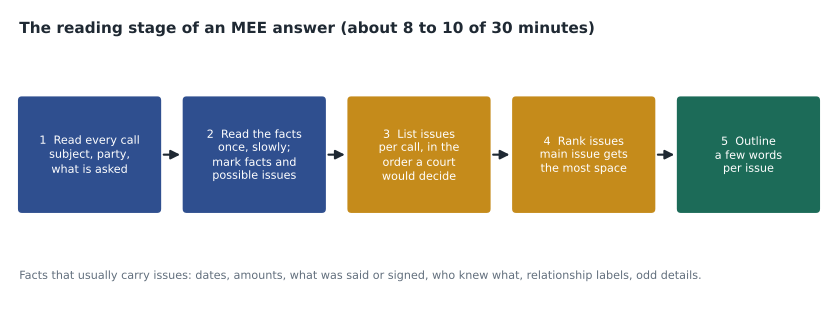
This lesson teaches the reading stage of an MEE answer: the first five to eight minutes, before you type a word of the answer itself. Most low essay scores are decided here. Candidates who misread the call answer a question nobody asked. Candidates who skim the facts miss the issue the drafters built the question around. Candidates who spot everything but fail to rank the issues spend ten minutes on a minor point and two on the main one. A disciplined reading routine prevents all three.
Step one: read the calls before the facts
Each MEE question ends with one or more numbered calls. Read them first, before the facts, and read every word. Calls vary in two important ways. Some are specific: 'Is Paula personally liable on the lease? Explain.' Others are broader: 'What claims does Paula have against the company, and what defenses can it raise? Explain.' A specific call limits your answer; a broad call asks you to find the claims yourself. Either way, the call tells you which subject is in play, whose perspective you are taking, and what kind of conclusion is wanted.
Notice the verbs and the qualifiers. 'Can the court exercise personal jurisdiction' is a different question from 'Should the court grant the motion to dismiss,' which may also raise service, venue or waiver. 'Was the evidence properly admitted' asks about rulings already made, which invites a discussion of the standard the trial court applied. 'Under the Model Business Corporation Act' or 'assume the jurisdiction follows the majority rule' tells you which law to use. And a call that asks about one party, 'Is Martin liable to the hospital?', excludes discussion of everyone else's liability, however tempting.
Ngozi asks what to do if a call seems to assume something she thinks is wrong. Marchetti's answer: 'Answer the call as asked, and if a premise matters, flag it in one sentence. If the call says the contract was valid, do not spend a paragraph arguing it was not.' Drafters build assumptions into calls precisely to keep the answer focused.
Step two: read the facts actively
With the calls in mind, read the facts slowly once. Read actively, which means asking of every sentence: why is this here? Facts in MEE questions are economical. A fact that seems random usually supports an issue or a counterargument. A date may matter for a statute of limitations, the timing of a notice, or whether an agent's authority had ended. A dollar amount may trigger the Statute of Frauds or the amount-in-controversy requirement. A statement of what a person knew or believed may turn on apparent authority, a recording act, or a defendant's mental state.
Mark the facts as you read. On a laptop, you can paste the facts into your answer window and annotate them, then delete them before the end; in other formats, use scratch paper. A simple system works best: underline each fact you plan to use, and write the issue it supports in two or three words beside it. 'Signed only by Ann: Statute of Frauds?' 'Told supplier she was a partner: partnership by estoppel?' 'Board did not meet: action without meeting?'
Pay attention to these recurring signals:
| Signal in the facts | Why the drafter included it | Likely issues |
|---|---|---|
| Exact dates, deadlines, time gaps | Timing changes the legal result | Limitations, notice, revocation, removal deadlines, authority ending |
| Amounts of money or value | Thresholds or remedies | Statute of Frauds (goods of 500 dollars or more), amount in controversy, damages |
| What a person said, wrote or signed | Formation, authority, admissions | Offer and acceptance, apparent authority, hearsay, parol evidence |
| Knowledge or belief of a party | Mental state or notice | Bona fide purchaser, apparent authority, mens rea, comparative fault |
| Relationship labels: officer, partner, member, employee | Authority and duty | Agency, fiduciary duty, respondeat superior |
| Odd or extra details | Usually a second issue or a counterargument | Exceptions, defenses, alternative theories |
Step three: build an issue list
After reading, make a short list of issues for each call. Start with the elements of each claim or rule the call puts in play. If the call asks whether a partnership exists, the issues are the definition of a partnership (an association of two or more persons to carry on as co-owners a business for profit) and the facts for and against co-ownership, such as profit sharing, shared control and contributions. If the call asks whether a director breached her duties, the issues are which duty (care or loyalty), the business judgment rule, any safe harbor for conflicting interest transactions, and remedies.
A useful discipline is to think in the order a court would: threshold issues first, then the merits, then defenses, then remedies. In civil procedure, jurisdiction comes before the merits of a motion. In evidence, relevance comes before any exclusionary rule. In contracts, formation comes before performance, breach and remedies. In business associations, the existence and type of the entity come before questions of authority, duty and liability. Following that order keeps you from discussing a remedy for a contract that may never have formed.
Then rank. Each call has a main issue, the one the drafters built most of the facts around, and usually one or two subsidiary issues. You can usually identify the main issue because it consumes the most facts and because it is the one a reasonable answer could resolve either way. Give it the most space. A subsidiary issue that is clearly resolved deserves a sentence or two: state the rule, cite the decisive fact, conclude and move on.
A worked example
Marchetti puts an original practice question on the shared screen. Read it the way you would on the exam: calls first.
Facts: Rosa and Theo agreed in March to open a food truck together. Rosa contributed her savings of 40,000 dollars to buy the truck, which was titled in her name. Theo, a trained chef, contributed no money but agreed to plan the menu and cook. They agreed that Rosa would be repaid her 40,000 dollars from the truck's earnings and that, after that, they would split profits equally. They never signed anything and never filed any document with the state. In June, Theo, without telling Rosa, signed a one-year contract with a supplier of specialty coffee for weekly deliveries totaling 18,000 dollars, signing as 'Theo, co-owner, Rolling Feast.' The supplier had seen Rosa and Theo working the truck together at a farmers market. In September, after a quarrel, Rosa told Theo she wanted out and that she was taking the truck. The supplier has not been paid for August and September.
Calls: (1) Did Rosa and Theo form a partnership? Explain. (2) Is Rosa liable to the supplier on the coffee contract? Explain. (3) What are the consequences of Rosa's statement in September that she wanted out? Explain.
Dana reads the calls first and immediately labels the question: business associations, agency and partnership. Call 1 is formation. Call 2 is authority and partner liability. Call 3 is dissociation and what follows. 'Three calls, three parts of the answer,' she says. 'And I already know the facts about money, title, profit sharing and the farmers market are going to matter.'
Now the facts. The group marks them together:
| Fact | Issue it supports |
|---|---|
| Agreed to open a food truck together; profits split equally after repayment | Partnership formation: co-ownership and profit sharing; intent to form a partnership is not required |
| Rosa contributed 40,000 dollars; truck titled in her name | Whether the truck is partnership property or Rosa's; repayment as a loan or a capital contribution |
| Theo contributed services only | Contributions can be services; does not defeat partnership |
| Never signed or filed anything | No formalities needed for a general partnership |
| Theo signed as co-owner of Rolling Feast for coffee | Partner's authority to bind: apparently carrying on in the ordinary course |
| Supplier saw them working together | Supplier's knowledge; no notice of any limit on Theo's authority |
| Rosa said she wanted out and was taking the truck | Dissociation by express will; partnership at will; possible dissolution and winding up; property issue |
| Supplier unpaid for August and September | Partners' joint and several liability for partnership obligations |
Then the issue list for each call, in order and ranked. For call 1, the main issue is whether the arrangement is an association of two or more persons to carry on as co-owners a business for profit; the sharing of profits creates a statutory presumption of partnership, and no intent to form a partnership or written agreement is required. The minor issue is whether the repayment arrangement suggests Rosa was a lender rather than a co-owner; the profit-sharing after repayment cuts against that.
For call 2, the main issue is whether Theo had authority to bind the partnership: each partner is an agent of the partnership for apparently carrying on in the ordinary course the partnership business, unless the partner lacked authority and the third party knew or had received a notification of that. Buying coffee for a food truck looks ordinary. The minor issues are that Rosa's lack of knowledge does not matter to the supplier, and that partners are jointly and severally liable for partnership obligations, although under the Revised Uniform Partnership Act a creditor generally must first exhaust partnership assets before reaching a partner's personal assets.
For call 3, the main issue is Rosa's dissociation: a partner has the power to dissociate at any time by express will, and in a partnership at will, that dissociation also causes dissolution and winding up. The minor issues are that she cannot simply take the truck if it is partnership property, which depends on whether it was acquired with partnership funds and for partnership purposes despite being titled in her name, and that she remains liable for partnership obligations incurred before dissociation, including the coffee contract.
Common reading mistakes
Marchetti lists the mistakes she saw most often as a grader. The first is answering the subject rather than the call: a call that asks whether a partnership exists is not an invitation to write everything you know about partnerships. The second is fighting the facts: if the facts say the supplier did not know of any restriction, do not speculate that perhaps it did. The third is missing a second issue hidden in an apparently minor fact, like the truck's title in Rosa's name. The fourth is failing to notice that a call is limited to one party or one claim.
The fifth mistake is subtler. Candidates sometimes recognize a famous issue and stop reading. A question with a hearsay statement may also involve a Confrontation Clause problem if the case is criminal. A question with an apparent partnership may also involve partnership by estoppel against someone who held himself out as a partner. The fix is the same: finish reading every fact before you decide what the question is about.
Issue checklists
Because the MEE uses only eight subject areas, you can carry a short mental checklist for each, a list of the issues that come up again and again. Checklists are not a substitute for reading the facts, but they help you see an issue the facts suggest. The checklists for each subject appear in Lessons 4 through 10. Here is the shape of one, for agency questions: Is there an agency relationship? What kind of authority did the agent have (actual, express or implied, or apparent)? Did the principal ratify? Is the principal liable in contract? Is the agent liable? Is the principal vicariously liable in tort? What duties did the agent owe?
Eddie points out that his Louisiana essays work the same way, with different law. 'Reading the call is reading the call,' he says. 'Whether the answer comes from the Civil Code or the common law, the grader still wants the issues in order.'
Timing the reading stage
Spend about a third of your time reading and outlining: roughly 8 to 10 minutes of the 30. That sounds like a lot, but answers written from a clear outline are shorter, better organized and finished on time. Candidates who start typing after two minutes often reorganize halfway through, repeat themselves and run out of time on the last call. Practice the reading stage separately: take a released question, give yourself eight minutes, and produce only an issue list and outline. Then compare it with NCBE's analysis. When your lists consistently match the analysis, you are ready to write under full timing.
Camila, whose Puerto Rico exam essays are written in Spanish, says the routine is helping her already. 'Calls first. Every fact has a reason. Order like a court. It is the same in any language.'
Practice problems
Work each problem on paper first, then reveal the answer to check.
Why read the calls before the facts?
Show answer
The calls tell you which subject, whose perspective and what conclusion are wanted, so you can read the facts with a purpose.
What does a specific call such as "Is Rosa liable to the supplier?" exclude?
Show answer
Discussion of other parties' liability or claims the call does not ask about.
In what order should issues usually be listed?
Show answer
The order a court would decide them: threshold issues, then the merits, then defenses and remedies.
How do you recognize the main issue in a call?
Show answer
It uses the most facts and could reasonably be resolved either way.
About how much of the 30 minutes should the reading and outlining stage take?
Show answer
About 8 to 10 minutes.
In the food truck problem, which fact suggests a property issue for call 3?
Show answer
The truck was titled in Rosa's name, although it may have been bought for the partnership.
Common mistakes
MistakeWrite everything you know about the subject the question names.
InsteadAnswer the specific calls; the call limits the answer.
MistakeStart writing as soon as you recognize the topic.
InsteadRead every fact first; hidden second issues are common.
MistakeSpend equal time on every issue.
InsteadRank issues and give the main issue most of the space.
MistakeQuestion the premises built into a call.
InsteadAccept the call's assumptions; flag one only if it truly matters.
Summary and key terms
- Read every call first: it identifies the subject, the party and what is being asked.
- Read the facts actively; dates, amounts, knowledge and odd details usually carry issues.
- List issues per call in the order a court would decide them, then rank them.
- Use subject checklists to see issues the facts suggest, but never ignore the facts.
- Spend about a third of the time reading and outlining.
- Specific call
- A call that asks one narrow question, limiting what the answer should cover.
- Broad call
- A call that asks the examinee to identify the claims or issues.
- Issue spotting
- Recognizing in the facts the legal questions a complete answer must address.
- Main issue
- The issue built around most of the facts, which deserves the most analysis.
- Issue checklist
- A short list of recurring issues in a subject, used to prompt recognition while reading.
Lesson quiz · 5 questions
Score 60% or more to complete this lesson.
Create a free account to save your progress, take quizzes and earn a certificate.