
BAR-120 · Lesson 3 of 12 · 22 min
Writing a structured answer
▶ Video coming soon A video version of this lesson is on the way.
On Wednesday, September 30, 2026, Marchetti shares two answers to the same practice call on the screen, side by side, with the names removed. Both reach the same conclusion. Both are about the same length. 'One of these got a 5 in my practice grading and the other got a 2,' she says. 'Tell me which, and why.' The group picks correctly in under a minute. The first answer has a heading, states the rule in one precise sentence, and then walks through the facts with the word 'because' in nearly every line. The second opens with a paragraph of history about partnership law, mentions three facts in passing and ends with 'Therefore, a partnership was likely formed.'
This lesson teaches how to write the answer once you have your outline: structure, rule statements, analysis, counterarguments and conclusions, plus the habits that make an answer easy to grade. None of it is complicated. All of it has to become automatic, because on exam day you will have about 20 minutes of writing time per question and no time to think about form.
Organize by call, then by issue
Use the calls as your main headings, in the order given: '1. Formation of a partnership', '2. Rosa's liability on the coffee contract', '3. Effect of Rosa's September statement'. Under each call, use a short subheading or a bolded phrase for each issue if there is more than one. Headings cost a second each and do two jobs at once: they show the grader you answered every call, and they let a grader who is looking for a particular point find it in seconds.
Do not merge calls, even when they overlap. If call 2 depends on your answer to call 1, say so in one sentence at the start of call 2: 'Because Rosa and Theo are partners (see Part 1), Theo is an agent of the partnership.' Graders often score with a checklist organized by call, and an analysis buried under the wrong heading may be missed.
The paragraph pattern: issue, rule, application, conclusion
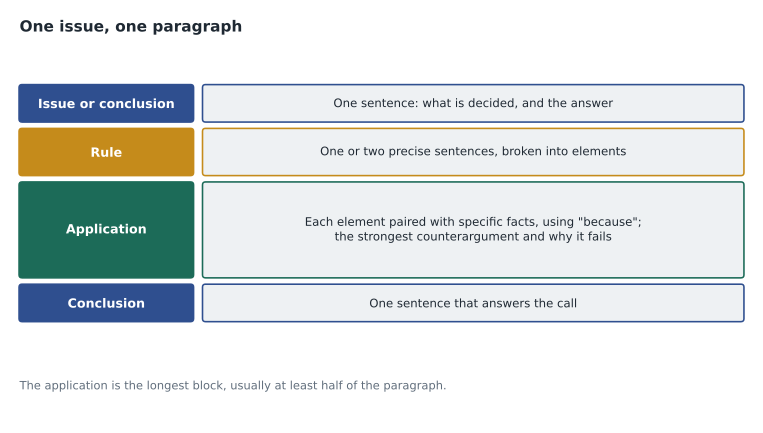
Within each issue, use the familiar four-part pattern. Different teachers use different names: IRAC (issue, rule, application, conclusion), CRAC (conclusion first), CREAC (adding an explanation of the rule). For the MEE, a compact version works best: one sentence that states the issue or your conclusion, one or two sentences of rule, several sentences applying the rule to the facts, and one sentence concluding. Many strong writers put the conclusion first, because it tells the grader where the paragraph is going: 'Rosa is personally liable to the supplier, because Theo bound the partnership and partners are jointly and severally liable for its obligations.'
Writing rule statements
The rule is where many candidates lose easy points. A good rule statement is accurate, complete enough to cover the elements in dispute, and short. It reads like a sentence from a treatise, not a vague gesture. Compare: 'Partners can bind the partnership in some situations' with 'Each partner is an agent of the partnership, and a partner's act for apparently carrying on in the ordinary course the partnership's business binds the partnership unless the partner had no authority and the third party knew or had received notification of that.' The second earns the rule points; the first earns nothing.
Break multi-part rules into their elements, because your application will follow the elements. Adverse possession is actual, open and notorious, exclusive, hostile and continuous possession for the statutory period. Personal jurisdiction requires minimum contacts with the forum such that the suit does not offend traditional notions of fair play and substantial justice, analyzed for specific jurisdiction through purposeful availment, relatedness and reasonableness. When the rule has a test, state the test; when the rule has exceptions, state the ones the facts raise.
Name the source when it matters and you know it: 'Under Federal Rule of Evidence 803(2)', 'Under the Revised Uniform Partnership Act', 'Under the Model Business Corporation Act'. You do not need case names. MEE grading analyses sometimes mention leading cases, but graders award points for the rule and its application, not for citations. A case name you misremember can only hurt you.
Applying the rule to the facts
Application is where scores are made. The test of good application is simple: every element of the rule should be paired with specific facts from the question, and the connection should be stated. The word 'because' is your best tool. 'The parties shared profits, because they agreed to split earnings equally after Rosa was repaid. Under the statute, receiving a share of profits creates a presumption of partnership, and the repayment term does not rebut it, because Rosa would continue to share profits after she was repaid, which a mere lender would not.'
Use the facts exactly as given, and use many of them. If the question says the supplier saw Rosa and Theo working the truck together at a farmers market, that fact is there for the apparent authority analysis, and your answer should use it. Do not invent facts. If something important is missing, say what turns on it: 'If the truck was bought with partnership funds for partnership use, it is partnership property despite being titled in Rosa's name; if it was Rosa's separate property lent to the business, she may reclaim it subject to any agreement.'
Make counterarguments when the facts support them, then resolve them. Graders reward answers that see the other side. 'Rosa may argue that she was only a lender, because the agreement called for her 40,000 dollars to be repaid. But the agreement also gave her half the profits after repayment, and she worked the truck alongside Theo, so she is more naturally a co-owner.' One or two sentences is enough. A counterargument the facts do not support is a waste of time.
Worked problem
Rewriting a weak paragraph
Sofia brings a paragraph from her July exam practice: "Hearsay is an out-of-court statement offered for its truth. Here the statement was made out of court. It is hearsay. But there may be an exception. The excited utterance exception may apply. Therefore the statement is admissible." The underlying facts: a bystander, seconds after a crash and still shaking, shouted, "That red truck just blew through the light!"
Show solution
- Start with a conclusion: "The bystander's statement is hearsay but admissible as an excited utterance."
- State the rules precisely: hearsay is a statement, other than one made while testifying at the current trial or hearing, offered to prove the truth of the matter asserted; Rule 803(2) excepts a statement relating to a startling event made while the declarant was under the stress of excitement it caused.
- Apply with facts: the statement is offered to prove the truck ran the light, so it is hearsay. A crash is a startling event; the bystander spoke seconds later while still shaking, which shows continuing stress; and the statement describes the event itself.
- Address the obvious counterpoint briefly: the declarant's availability does not matter under Rule 803.
- Conclude in one sentence.
Answer: The rewrite uses the same number of ideas but pairs each element with a fact and states the connection. It would score far higher.
Writing when you are unsure of the rule
Sooner or later, a call will raise a rule you cannot recall precisely. Do not leave it blank and do not panic. State the principle you do know, in sensible terms, and apply it carefully. Graders give substantial credit for good analysis under an imperfect rule statement, and they give nothing for silence. If you cannot recall whether a statute uses a 'reasonable person' test, you can still reason: 'A court is likely to ask whether a reasonable supplier in these circumstances would have believed Theo had authority to order supplies.' That sentence will earn some points even if your rule statement is incomplete.
Avoid reciting rules for issues that are not raised. Writing out every hearsay exception because a statement appears in the facts does not earn extra points and costs time you need. Graders look for the issues on their checklist; they do not deduct for omitting irrelevant law, but they cannot give points for it either.
Majority and minority rules
The MEE expects generally accepted principles unless a question specifies otherwise. When a rule genuinely differs across jurisdictions and the difference matters to the outcome, state the majority rule, apply it, and mention the minority rule in a sentence if you have time. Examples include contributory versus comparative negligence, the Uniform Partnership Act of 1914 versus the Revised Uniform Partnership Act, and the race, notice and race-notice recording acts. If the question tells you the jurisdiction has adopted a particular statute or rule, apply only that.
Style that helps the grader
Write short paragraphs, one issue each. Use plain words and active verbs. Use the parties' names, not 'plaintiff' and 'defendant', unless the call frames the question that way. Skip introductions and summaries: a sentence such as 'This question raises several interesting issues of partnership law' earns nothing. Do not restate the facts in a block at the start; use them in the analysis instead. Avoid hedging every sentence. 'Likely' is fine for a close conclusion, but an answer full of 'it could be argued that' reads as if the writer never decided anything.
Bullet points and fragments are risky. Some graders accept them; many read them as a sign that the analysis is thin. A tight sentence that connects a fact to an element takes almost no longer to type than a bullet and is always safe. The exception is when time is almost gone on the last call: a few bulleted lines of rule and key facts are better than nothing.
Budgeting the writing time
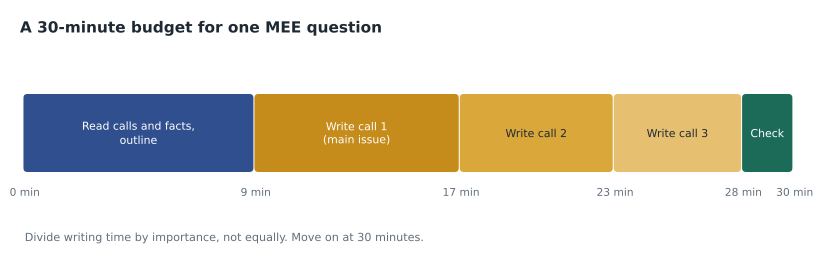
With 8 to 10 minutes spent reading and outlining, you have about 20 minutes to write. Divide them by call according to your ranking, not equally. If call 1 carries the main issue, it might take 9 minutes, call 2 seven and call 3 four. Watch the clock at the end of each call. When the 30 minutes are up, wrap up in one or two sentences and move on to the next question; the first points on a fresh question are far easier to earn than the last points on an old one.
A short model answer
Here is how the group's answer to call 2 of the food truck problem from Lesson 2 might look after the evening's practice. It is about 230 words, which is roughly what a strong answer to one of three calls looks like in seven minutes of typing.
2. Rosa's liability on the coffee contract. Rosa is liable to the supplier because Theo bound the partnership and partners are jointly and severally liable for partnership obligations. Under the Revised Uniform Partnership Act (RUPA), each partner is an agent of the partnership for the purpose of its business. A partner's act for apparently carrying on in the ordinary course the partnership's business binds the partnership unless the partner lacked authority and the third party knew or had received notification of that. Rosa and Theo did not discuss supply contracts, so Theo may have lacked actual authority. But ordering coffee for a food truck is apparently in the ordinary course of that business, and the supplier, who had seen Rosa and Theo running the truck together, had no notice of any limit. Theo's signature as 'co-owner, Rolling Feast' confirms he purported to act for the business. The partnership is therefore bound. Under RUPA, partners are jointly and severally liable for all obligations of the partnership, so Rosa is personally liable for the unpaid August and September deliveries. The supplier generally must first obtain a judgment against the partnership and exhaust partnership assets before levying on Rosa's personal assets. Between the partners, Theo may owe Rosa indemnity or contribution if he exceeded his actual authority.
Dana notices the shape at once. 'Conclusion, rule, facts with reasons, conclusion, and one more point at the end. No history, no throat-clearing.' Ngozi notices something else: the answer uses five specific facts from the question. 'That is what I keep forgetting to do,' she says. 'I explain the rule beautifully and then mention one fact.'
Self-review in the last two minutes
Save a minute or two at the end of each question for a quick check: Does every call have a heading? Does every issue paragraph have a rule and a conclusion? Did you answer the question actually asked? Fix a missing conclusion or a wrong party name; do not start rewriting. Spelling and grammar matter only insofar as they affect clarity. Graders forgive typos written under pressure; they do not forgive an answer that never reaches a conclusion on the call.
Practice problems
Work each problem on paper first, then reveal the answer to check.
What should the main headings of an MEE answer be?
Show answer
The calls, in the order given, with subheadings for separate issues.
Which part of the issue paragraph should be longest?
Show answer
The application of the rule to the facts.
Do MEE graders expect case citations?
Show answer
No. They award points for accurate rules and their application; case names are unnecessary.
What should you do if you cannot recall a rule precisely?
Show answer
State the principle you know in sensible terms and apply it carefully to the facts.
When should you mention a minority rule?
Show answer
When it would change the outcome, briefly, after applying the majority rule.
Why are headings worth the time?
Show answer
They show the grader every call was answered and make each point easy to find.
Common mistakes
MistakeOpen with an introduction summarizing the question.
InsteadStart with the first call's heading and a conclusion or issue sentence.
MistakeCopy the facts into a block before analyzing.
InsteadUse the facts inside the application, tied to elements.
MistakeRecite every rule in the subject to be safe.
InsteadDiscuss only issues the facts raise.
MistakeHedge every conclusion.
InsteadCommit to a conclusion on each call; use "likely" only for close points.
Summary and key terms
- Organize by call with clear headings; use subheadings for separate issues.
- Write each issue as conclusion or issue, rule, application, conclusion.
- State rules precisely by elements; name the source when it helps.
- Pair every element with facts and say why; address real counterarguments.
- Budget writing time by call according to importance and finish every question.
- IRAC
- Issue, rule, application, conclusion: the standard structure for analyzing one legal issue.
- CRAC
- A variant of IRAC that states the conclusion first.
- Rule statement
- A precise statement of the governing legal rule, broken into its elements.
- Application
- The part of the answer that connects each element of the rule to specific facts.
- Counterargument
- The strongest opposing argument the facts support, stated and resolved.
Lesson quiz · 5 questions
Score 60% or more to complete this lesson.
Create a free account to save your progress, take quizzes and earn a certificate.