
BAR-120 · Lesson 6 of 12 · 23 min
Civil procedure and evidence on the essay
▶ Video coming soon A video version of this lesson is on the way.
On Wednesday, October 21, 2026, the Wednesday sessions turn from business associations to the subjects the group has been drilling on Saturdays and Mondays. Marchetti starts with a warning. 'You all know these rules well enough to pick the right answer out of four. The essay is harder in one specific way: nobody gives you the four answers. You have to produce the rule, in order, in sentences, and then use the facts. The candidates who do well on civil procedure and evidence essays are the ones who have a fixed order of analysis and follow it every time.'
This lesson shows how civil procedure and evidence questions are built on the MEE and gives an order of analysis for each. The rules themselves were reviewed in BAR-110 and BAR-111; here the emphasis is on the structure an answer needs and the points graders look for. The Federal Rules of Civil Procedure and of Evidence, and Title 28 of the United States Code, are the default law unless a question says otherwise.
How civil procedure essays are built
A civil procedure essay usually tells a short story about a lawsuit: who sued whom, where, and what happened next, often a motion. The calls ask whether a court has jurisdiction, whether a case was properly removed, whether a motion should be granted, or whether a claim is precluded. Jurisdiction appears constantly, because it can be tested with a few facts about citizenship, amounts and contacts. The best answers follow the statute or rule step by step and say which fact satisfies each element.
Subject-matter jurisdiction: an order of analysis
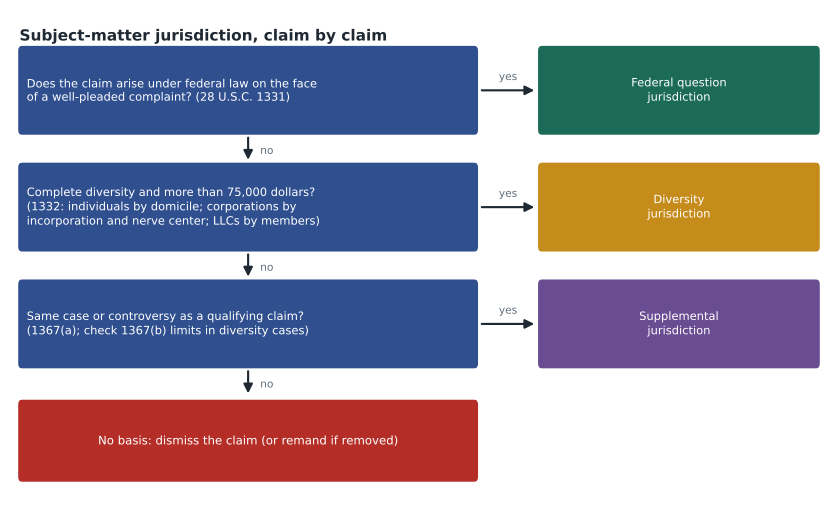
Start with whether the federal court has subject-matter jurisdiction over each claim. For federal question jurisdiction under 28 U.S.C. section 1331, the claim must arise under federal law, which under the well-pleaded complaint rule means the federal issue appears in the plaintiff's own claim, not in an anticipated defense. For diversity jurisdiction under section 1332, there must be complete diversity, meaning no plaintiff shares citizenship with any defendant, and the amount in controversy must exceed 75,000 dollars, exclusive of interest and costs.
Citizenship is where essay points hide. An individual is a citizen of the state where she is domiciled: physical presence plus intent to remain indefinitely. A corporation is a citizen of every state where it is incorporated and of the state where it has its principal place of business, which the Supreme Court has defined as its nerve center, the place where high-level officers direct and control its activities. An unincorporated association, including a partnership or an LLC, takes the citizenship of each of its members. Diversity is measured when the action is filed. For the amount in controversy, one plaintiff may aggregate all claims against a single defendant, but separate plaintiffs generally may not aggregate their claims, and the amount claimed in good faith controls unless it is legally certain the plaintiff cannot recover that much.
If one claim qualifies but another does not, turn to supplemental jurisdiction under section 1367. Claims that form part of the same case or controversy, meaning they arise from a common nucleus of operative fact, may come in. In a diversity case, however, section 1367(b) bars supplemental jurisdiction over claims by plaintiffs against persons made parties under Rules 14, 19, 20 or 24 when that would be inconsistent with the requirements of section 1332. And the court may decline supplemental jurisdiction when the state claim raises a novel issue, substantially predominates, or remains after all original-jurisdiction claims are dismissed.
Personal jurisdiction, venue and removal
Personal jurisdiction asks whether the forum may bind the defendant. Federal courts generally follow the long-arm statute of the state where they sit, subject to the Due Process Clause. General jurisdiction exists where the defendant is essentially at home: an individual's domicile, a corporation's state of incorporation and principal place of business. Specific jurisdiction requires that the defendant purposefully availed itself of the forum, that the claim arises out of or relates to those contacts, and that jurisdiction is reasonable. Physical presence and service in the forum, and consent, are traditional bases as well. A defendant waives a personal jurisdiction objection by omitting it from a Rule 12 motion or its first responsive pleading.
Venue in federal court is proper in a district where any defendant resides if all defendants reside in the same state, in a district where a substantial part of the events occurred, or, if neither applies, in any district where a defendant is subject to personal jurisdiction. A court may transfer a case to another proper district for convenience under section 1404(a), applying the original forum's choice-of-law rules, or transfer or dismiss a case filed in an improper venue under section 1406.
Removal allows a defendant to move a case from state court to the federal district embracing the place where it is pending, if the case could originally have been filed in federal court. All defendants who have been properly joined and served must consent. The notice of removal is due within 30 days after the defendant receives the initial pleading. A case removable only on diversity grounds cannot be removed if any properly joined and served defendant is a citizen of the forum state, the forum defendant rule, and cannot be removed more than one year after commencement unless the plaintiff acted in bad faith to prevent removal. A plaintiff challenging removal on a non-jurisdictional ground must move to remand within 30 days; lack of subject-matter jurisdiction may be raised at any time.
Erie, pleading, joinder and motions
In a diversity case, a federal court applies state substantive law and federal procedural law. If a Federal Rule of Civil Procedure directly covers the issue and is valid under the Rules Enabling Act, it applies. Otherwise, the court asks whether applying federal practice would affect the outcome in a way that would lead to forum shopping or inequitable administration of the laws, considering any countervailing federal interests. Statutes of limitations, burdens of proof and choice-of-law rules are substantive for these purposes.
Pleading questions usually involve Rule 8 and the plausibility standard: a complaint must contain enough factual matter, accepted as true, to state a plausible claim, and a Rule 12(b)(6) motion tests that. Joinder questions ask which rules allow the parties and claims: Rule 18 lets a party join any claims against an opponent; Rule 20 lets plaintiffs or defendants be joined if the claims arise from the same transaction or occurrence and share a common question; Rule 13 makes counterclaims arising from the same transaction compulsory; Rule 14 lets a defendant implead a third party who may be liable to it for the plaintiff's claim; Rule 19 governs required parties. Remember that every joined claim also needs its own basis for subject-matter jurisdiction.
Summary judgment under Rule 56 is proper when there is no genuine dispute as to any material fact and the movant is entitled to judgment as a matter of law. Judgment as a matter of law under Rule 50 applies the same standard during and after trial; a party must move before the case goes to the jury to preserve a renewed motion afterward. On preclusion, claim preclusion bars a later suit on the same claim between the same parties or those in privity after a final judgment on the merits; issue preclusion bars relitigation of an issue actually litigated, necessarily decided and finally determined, against a party who had a full and fair opportunity to litigate it. Federal courts give state judgments the preclusive effect the rendering state would.
How evidence essays are built
Evidence essays almost always take place at a trial. The facts describe the case and then list several items of evidence, typically testimony, a document or a recording, that a party offered and the other side objected to. The calls ask whether the court properly admitted or excluded each item. Organize the answer by item, in the order given, with a heading for each.
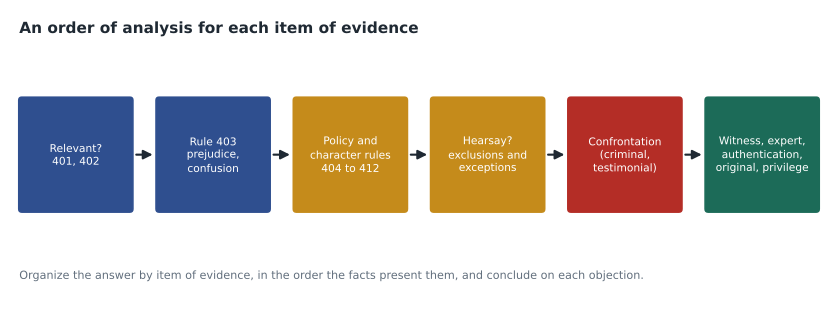
For each item, work through the same sequence. Is it relevant, meaning it has any tendency to make a fact of consequence more or less probable? Should it be excluded under Rule 403 because its probative value is substantially outweighed by the danger of unfair prejudice, confusion or waste of time? Does a specific exclusionary rule apply: character evidence, subsequent remedial measures, compromise offers, liability insurance, or a privilege? If it is an out-of-court statement, is it offered for its truth, and if so, is it excluded from the hearsay definition or covered by an exception? In a criminal case, does the Confrontation Clause bar a testimonial statement? Does a witness have personal knowledge or is the witness an expert qualified under Rule 702? Is a document authenticated, and does the original writing rule apply?
| Step | Question | Typical rules |
|---|---|---|
| 1 | Is the evidence relevant? | Rules 401 and 402 |
| 2 | Is it unfairly prejudicial or confusing? | Rule 403 |
| 3 | Does a policy exclusion or character rule apply? | Rules 404 to 412 |
| 4 | Is it hearsay, and if so, an exclusion or exception? | Rules 801 to 807 |
| 5 | In a criminal case, is it testimonial? | Sixth Amendment Confrontation Clause |
| 6 | Is the witness competent, or the expert qualified and reliable? | Rules 601, 602, 702 |
| 7 | Is a document authenticated; is the original needed? | Rules 901, 902, 1002 |
| 8 | Is a privilege claimed? | Rule 501 and federal common law |
Hearsay is the heart of most evidence essays. A strong answer defines hearsay precisely, explains whether the statement is offered for its truth, and, if so, works through the possible exclusions and exceptions that fit the facts. When a statement contains another statement inside it, each layer must be admissible. In criminal cases, add Confrontation analysis after the hearsay analysis: a testimonial statement, made primarily to establish past facts for later prosecution, is admissible against the accused only if the declarant testifies or is unavailable and the defendant had a prior opportunity for cross-examination.
Keep track of recent amendments. Amendments effective December 1, 2024 added Rule 107 on illustrative aids, required in Rule 613(b) that a witness generally be given a chance to explain or deny a prior inconsistent statement before extrinsic evidence is admitted, extended Rule 801(d)(2) to statements of a predecessor in interest, required courts applying Rule 804(b)(3) in criminal cases to consider the totality of circumstances and any corroborating evidence, and clarified in Rule 1006 that summaries are admissible whether or not the underlying evidence has been admitted. An amendment to Rule 801(d)(1)(A), adopted by the Supreme Court in April 2026 and effective December 1, 2026, removes the requirement that a testifying witness's prior inconsistent statement have been given under oath at a formal proceeding before it can be used substantively. Candidates sitting in February 2027 should know both versions and watch for NCBE guidance on which one the exam applies.
Worked problem
A two-part practice question
Facts: Ines, a citizen of Ohio, bought a heater from Grover Appliances, a corporation incorporated in Delaware with its headquarters and senior management in Pennsylvania. The heater caught fire in her Ohio home, causing 150,000 dollars in damage. Ines sued Grover and Kemp Hardware, Inc., the store that sold her the heater, which is incorporated in Ohio and has its only store and offices there, in Ohio state court for negligence and breach of warranty. Grover filed a notice of removal to federal court 20 days after being served; Kemp did not join the notice. At trial, Ines offers testimony from her neighbor that, as the smoke cleared, a firefighter at the scene said, "This model always overheats." The firefighter cannot be located. Calls: (1) Was removal proper? (2) Should the neighbor's testimony be admitted?
Show solution
- Call 1: removal requires original jurisdiction. Ines is an Ohio citizen; Kemp is incorporated in Ohio and has its principal place of business there, so it is an Ohio citizen. Complete diversity is lacking, so the case could not have been filed in federal court on diversity grounds, and no federal question is pleaded.
- Independently, Kemp, a properly joined and served defendant, did not consent, and the forum defendant rule bars diversity removal when a defendant is a citizen of the forum state.
- Removal was improper; the federal court must remand for lack of subject-matter jurisdiction.
- Call 2: the firefighter's statement is hearsay if offered to prove the model overheats. The firefighter is not a party or a party's agent, so Rule 801(d)(2) does not apply.
- Consider exceptions that fit the facts: a present sense impression requires describing an event while or immediately after perceiving it, but "always overheats" is a general claim about the model, not a description of the event. An excited utterance requires stress from a startling event, and the facts show none. The firefighter's unavailability matters only for Rule 804 exceptions, none of which fits.
Answer: Remand is required because diversity is incomplete; the statement is inadmissible hearsay unless another basis appears.
Marcus points out the trap in call 1. 'Grover is diverse from Ines, and the amount is fine. A rushed answer stops there. The Ohio store is the whole question.' Ngozi adds that the second call is really about recognizing that the statement is a general opinion about the product, which no immediacy exception covers. 'You have to read what the statement actually says,' she says.
Writing tips for both subjects
Quote or closely paraphrase the statute or rule when you can: '28 U.S.C. section 1332(a) requires complete diversity and more than 75,000 dollars.' Graders read for the elements. Conclude each item: 'The objection should be sustained.' And watch the call's framing. If it asks whether the trial court erred, discuss whether the ruling was correct; if it asks how the court should rule on a motion, state the standard for that motion and apply it.
Eddie, whose Louisiana evidence essays use a code closely modeled on the federal rules, says the structure is what helped him most. 'Relevance, 403, policy exclusions, hearsay, witnesses, documents, privilege. Once that list is in your head, every item takes two minutes to analyze.'
Practice problems
Work each problem on paper first, then reveal the answer to check.
What does complete diversity require?
Show answer
No plaintiff may be a citizen of the same state as any defendant.
Of which states is a corporation a citizen?
Show answer
Every state where it is incorporated and the state of its principal place of business, its nerve center.
How is an LLC's citizenship determined?
Show answer
By the citizenship of each of its members.
Within what time must a notice of removal be filed?
Show answer
Within 30 days after the defendant receives the initial pleading.
What is the first question for any item of evidence?
Show answer
Whether it is relevant.
When does the Confrontation Clause bar a hearsay statement?
Show answer
In a criminal case, when the statement is testimonial and the declarant does not testify, unless the declarant is unavailable and the defendant had a prior opportunity to cross-examine.
Common mistakes
MistakeAn LLC is a citizen of its state of organization and principal place of business.
InsteadAn LLC takes the citizenship of each member.
MistakeDiversity is enough even if one defendant shares the plaintiff's citizenship.
InsteadDiversity must be complete.
MistakeA statement is hearsay whenever it was made out of court.
InsteadIt is hearsay only if offered to prove the truth of what it asserts.
MistakeUnavailability helps any hearsay exception.
InsteadUnavailability matters only for the Rule 804 exceptions.
Summary and key terms
- Analyze subject-matter jurisdiction claim by claim: federal question, diversity, then supplemental jurisdiction.
- Citizenship rules for individuals, corporations and unincorporated associations decide many diversity issues.
- Removal requires original jurisdiction, consent of served defendants, timeliness and respect for the forum defendant rule.
- Analyze each item of evidence in a fixed order: relevance, 403, policy rules, hearsay, Confrontation, witnesses, documents, privilege.
- Know the December 2024 evidence amendments and the December 2026 change to Rule 801(d)(1)(A).
- Complete diversity
- The rule that no plaintiff may share state citizenship with any defendant.
- Nerve center
- A corporation's principal place of business: where its officers direct and control its activities.
- Forum defendant rule
- The bar on diversity removal when a properly joined and served defendant is a citizen of the forum state.
- Supplemental jurisdiction
- Federal jurisdiction over claims that share a common nucleus of operative fact with a claim within original jurisdiction.
- Testimonial statement
- A statement made primarily to establish past facts for later prosecution, governed by the Confrontation Clause.
Lesson quiz · 5 questions
Score 60% or more to complete this lesson.
Create a free account to save your progress, take quizzes and earn a certificate.