
AWS-122 · Lesson 3 of 12 · 19 min
Operating models and centers of excellence
▶ Video coming soon A video version of this lesson is on the way.
The readiness scorecard showed a thin bench: one contract data scientist, one developer, and a program lead who was also the operations manager for eleven clinics. Graham asked the obvious question. "Do we hire an AI team?" Noor's answer was that it depended on the operating model, and that choosing the operating model was one of the most important decisions in the whole transformation, because it decides who does AI work, who owns the results and how fast the organization can learn.
What an operating model is
An AI operating model describes how an organization is set up to deliver AI: where the people who build and run AI sit, who decides what gets built, who owns solutions after launch, which platforms and standards are shared, and how knowledge moves between teams. It is not an organization chart, although it affects one. Two organizations with the same number of data scientists can perform very differently depending on whether those people sit together, sit in the business units, or do both.
The exam guide asks you to establish AI centers of excellence and cross-functional collaboration mechanisms to support scaling, and to form cross-functional teams with clear accountability. Both are parts of an operating model. Most organizations choose among three broad patterns.
Three patterns
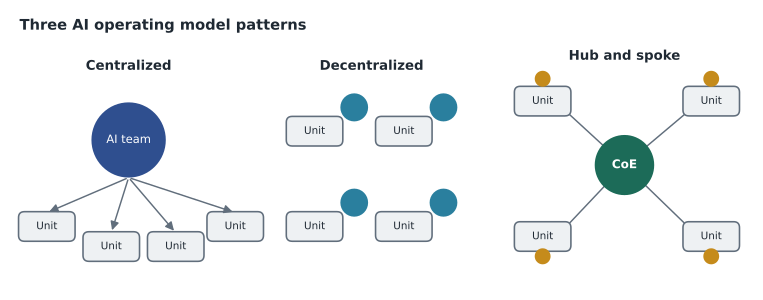
In a centralized model, one AI team serves the whole organization. Business units bring requests; the central team prioritizes, builds and often runs the solutions. The strengths are consistency, shared standards, efficient use of scarce experts and strong governance. The weaknesses are distance from the business, queues of requests, and solutions that the business does not feel it owns.
In a decentralized model, each business unit has its own AI capability and makes its own decisions. The strengths are speed and closeness to the work: the people building the tool sit beside the people who will use it. The weaknesses are duplication, inconsistent standards, uneven governance and data that stays in silos. Decentralized models often appear by accident, when enthusiastic teams buy tools on their own.
In a hub-and-spoke model, also called federated, a central hub sets standards, provides shared platforms and expertise, runs governance and helps with the hardest work, while people in the business units, the spokes, identify opportunities, own solutions and do much of the day-to-day work. It tries to combine the consistency of central control with the ownership and speed of local teams. Most organizations that scale AI successfully end up with some version of it, usually after starting more centralized.
| Centralized | Decentralized | Hub and spoke | |
|---|---|---|---|
| Who builds | Central AI team | Each business unit | Hub for shared and hard work; spokes for local work |
| Who owns after launch | Often the central team | The business unit | The business unit, with hub support |
| Standards and governance | Strong and consistent | Uneven | Set by the hub, applied by spokes |
| Speed and closeness to the work | Slower; can be distant | Fast and close | Close, with some coordination cost |
| Best suited to | Early stages; small organizations; high-risk domains | Large, independent units with mature skills | Scaling across many functions |
Maturity matters here too. An organization at the experimenting stage usually lacks the skills to spread across business units, so it starts with a small central capability. As it operationalizes and scales, it pushes ownership and some skills out to the business while keeping standards, platforms and governance at the center. Choosing a fully decentralized model at stage 2 tends to produce exactly the scattered, ungoverned tools that Hannah was already worried about.
Centers of excellence
A center of excellence (CoE) for AI is a small cross-functional group that helps the whole organization adopt AI well. It is usually the hub in a hub-and-spoke model. Its job is not to do all the AI work but to make everyone else's AI work better, faster and safer. Typical CoE responsibilities include:
- Setting standards and reusable patterns: approved services, integration patterns, evaluation methods, documentation templates.
- Running the intake and prioritization process for new ideas, using criteria such as those from the strategy course.
- Providing scarce expertise to initiatives: data science, machine learning operations, prompt and evaluation design.
- Supporting governance: preparing risk reviews, keeping the register of AI systems, tracking incidents.
- Building skills: AI literacy programs, communities of practice, champion networks.
- Measuring value across the portfolio and reporting to the steering group and board.
A CoE should be cross-functional. The exam guide names business, technical, legal and compliance roles among those that belong in cross-functional teams, and a CoE made only of technical staff tends to drift toward technology for its own sake. A CoE also needs a sponsor and a mandate: without authority to set standards, it becomes an advice desk that nobody is obliged to consult.
There are recognizable ways for a CoE to fail. It can become a bottleneck, where every idea waits months for review. It can become an ivory tower, producing frameworks no one uses. Or it can become a shadow IT department that builds everything itself and never hands anything over. A healthy CoE measures itself by how many initiatives the business owns and runs successfully, not by how many it built.
Choosing a model for Cascade Ridge
Andre and Noor sketched the options. A fully centralized model would mean hiring several AI specialists, which the budget could not support and the volume of work did not yet justify. A decentralized model was impossible: the clinics had no AI skills at all. The answer was a small hub with spokes in the business. The hub would be a part-time CoE; the spokes would be initiative owners and site champions.
| Role | Who | Time | Main responsibilities |
|---|---|---|---|
| CoE lead and program lead | Andre Leclerc | About half his time in 2027 | Portfolio, intake, reporting, change plan |
| Data science | Noor Siddiqui (contract) | Full time | Model design, evaluation, monitoring standards |
| Data analyst (planned hire, 2027) | To be recruited | Full time from the second quarter | Data foundations, dashboards, data quality |
| Integration and engineering | Kwame Asante | About a third of his time | Integration patterns, deployment, technical support |
| Privacy, security and governance | Hannah Weiss | About a fifth of her time | Risk reviews, policy, access, incident process |
| Clinical adviser | Dr. Simone Kaur | Two hours a week | Clinical safety, review of anything near clinical work |
| Finance partner | Lorraine Beaudry | Monthly | Business cases, cost tracking, benefit realization |
The spokes were the people who would own and use each initiative: the reception manager for the no-show reminders, the laboratory coordinator for lab-report extraction, Dr. Kaur and the emergency technician lead for the call-note summaries, and the client services manager for the client-support assistant, with the partner firm building it. At every site, one champion would be the local contact for every AI tool.
Graham asked who the CoE reported to. Noor recommended that Andre report on AI to Graham as sponsor, with the steering group above the CoE for decisions on priorities, risk and funding. Reporting into IT would have pulled the CoE toward technology; reporting into finance would have pulled it toward cost cutting. Reporting to the chief executive kept it focused on the business objectives.
What the hub-and-spoke model costs
Operating models have costs that business cases often forget, especially the time of people who keep their day jobs. The site champions were the clearest example. Andre planned one champion at each of the twelve sites, spending about two hours a week on AI work: helping colleagues, testing changes, collecting feedback and attending a monthly champions' call.
Worked problem
Estimating the cost of champion time
Twelve champions each spend about 2 hours a week on AI work for 46 working weeks in 2027. Their average loaded cost, including benefits, is about 38 dollars an hour. Estimate the hours and the cost of their time for the year.
Show solution
- Hours per champion: 2 hours × 46 weeks = 92 hours.
- Hours for all champions: 92 × 12 = 1,104 hours.
- \[1{,}104 \times 38 = 41{,}952\]
- About 41,950 dollars of staff time, or about 3,500 dollars per champion.
Answer: Champion time comes to about 1,104 hours and roughly 42,000 dollars in 2027. It is not new cash spending, because the champions are already on staff, but it is real capacity taken from other work. Site managers need to plan cover for it, and the program should report it alongside the cash budget.
Lorraine was glad to see this. "I'd rather know now," she said. The figure did not appear in the 450,000-dollar cash budget, but Andre added it to the roadmap as a resource commitment that each site manager had agreed to. Without that agreement, champions would be the first thing dropped on a busy week.
Cross-functional teams for each initiative
Inside the operating model, each initiative needs its own small team with clear accountability. The exam guide stresses cross-functional teams, meaning business, technical, legal and compliance roles working together, and named accountability for each initiative. A practical pattern is a two-in-a-box arrangement: a business owner accountable for the outcome and adoption, paired with a technical lead accountable for the solution working, plus advisers from privacy, clinical or legal as the risk requires.
| Initiative | Business owner (accountable for outcome) | Technical lead | Advisers |
|---|---|---|---|
| No-show reminders | Reception manager | Noor, then the data analyst | Hannah (privacy); two site champions |
| Lab-report extraction | Laboratory coordinator | Kwame | Hannah; one veterinarian reviewer |
| Call-note summaries | Dr. Kaur | Noor | Hannah; emergency technician lead |
| Client-support assistant | Client services manager | Partner firm, with Kwame | Hannah; Dr. Kaur for the clinical hand-off rule |
The exam often describes a scenario where an initiative is stalling because nobody in the business owns it, or because legal and compliance were brought in only at the end. The best answer usually assigns a business owner, forms a cross-functional team early and makes accountability explicit.
Collaboration mechanisms
Structure alone does not move knowledge. A hub-and-spoke model needs regular mechanisms that connect the hub, the spokes and the people on the front line. Cascade Ridge planned a short list: a monthly champions' call, an internal page listing every approved AI tool with its owner and rules of use, a shared channel for questions, a quarterly show-and-tell where each initiative team presented what it had learned, and a simple intake form for new ideas from any member of staff. Each was cheap; together they made it more likely that a lesson learned in Colorado Springs would reach Cheyenne before Cheyenne made the same mistake.
The intake form mattered more than it looked. It gave every staff member a legitimate route for an idea, which reduced the temptation to buy tools privately, and it gave the CoE a steady supply of ideas grounded in real work. Each idea would be screened with the same questions used in the strategy course, and the person who suggested it would hear back within a month, whatever the decision.
Evolving the model
An operating model should change as maturity grows. Andre wrote down how he expected Cascade Ridge's to evolve: in 2027 a small hub doing much of the technical work itself; in 2028, once the data analyst was established and initiative owners were confident, more of the day-to-day monitoring and improvement moving to the spokes; and later, possibly, a second data specialist inside the emergency hospital, where the volume of clinical AI work might justify one. Each step would be triggered by evidence, such as the number of initiatives in production and the skills of the owners, not by a date.
Operating model questions on the exam
Scenario questions on operating models usually describe symptoms and ask for a change. Long queues for a central team, frustrated business units and tools bought around the rules suggest a move toward hub and spoke, with ownership pushed to the business. Duplicate tools, inconsistent risk handling and data that cannot be combined suggest a need for a hub or CoE to set standards. A pilot that works but has no one to run it after launch points to missing business ownership. The best answers match the change to the organization's maturity: they strengthen the center when governance and skills are weak, and they distribute ownership when skills have grown and the center has become a bottleneck.
Watch also for answers that confuse a CoE with a governance board. The CoE does the enabling work: standards, support, skills and measurement. A steering group or governance committee makes decisions on priorities, funding and risk. The two work closely and may share members, as they do at Cascade Ridge, but a scenario that asks who approves a high-risk use is asking about the governance body, which lesson 9 covers.
Common mistakes
MistakeChoosing a decentralized model at an early maturity stage.
InsteadEarly on, a small central capability or hub keeps standards and governance consistent; push ownership out as skills grow.
MistakeMaking the CoE responsible for building and running everything.
InsteadA CoE enables the business; business owners own solutions after launch.
MistakeStaffing a CoE only with technical people.
InsteadInclude business, legal, compliance, privacy and domain experts.
MistakeForgetting the cost of part-time roles such as champions.
InsteadCount their hours, agree cover with managers and report it with the budget.
Summary and key terms
- An AI operating model describes who builds, who owns, which standards are shared and how knowledge moves.
- Centralized models give consistency but can be slow and distant; decentralized models are fast but duplicate effort and weaken governance; hub-and-spoke models combine central standards with business ownership and suit scaling.
- A center of excellence is a small cross-functional group that sets standards, supports initiatives, builds skills and measures value, without doing all the work itself.
- Each initiative needs a cross-functional team with a business owner accountable for the outcome.
- Collaboration mechanisms and an evolving model help knowledge spread as maturity grows.
- AI operating model
- How an organization is set up to deliver, own and govern AI.
- Centralized model
- One AI team serves the whole organization.
- Decentralized model
- Each business unit has its own AI capability.
- Hub and spoke
- A central hub sets standards and supports; business units own and deliver locally.
- Center of excellence (CoE)
- A small cross-functional group that helps the whole organization adopt AI well.
- Two-in-a-box
- A business owner and a technical lead jointly leading an initiative.
Practice problems
Work each problem on paper first, then reveal the answer to check.
Name one strength and one weakness of a centralized AI operating model.
Show answer
Strength: consistent standards and governance; weakness: distance from the business and queues of requests.
What should a CoE measure itself by?
Show answer
How many initiatives the business owns and runs successfully, not how many the CoE built itself.
Eight champions spend 3 hours a week for 40 weeks at 40 dollars an hour. What is the cost of their time?
Show answer
8 × 3 × 40 = 960 hours; 960 × 40 = 38,400 dollars.
Lesson quiz · 5 questions
Score 60% or more to complete this lesson.
Create a free account to save your progress, take quizzes and earn a certificate.