
AWS-122 · Lesson 2 of 12 · 18 min
Assessing organizational readiness
▶ Video coming soon A video version of this lesson is on the way.
Andre's first instinct was to start training people. Noor stopped him. "Training for what?" she asked. "You don't know yet where the gaps are. Maybe the managers understand AI better than you think and the real problem is data. Maybe it's the other way round. Measure first." The second Thursday session was about measuring readiness: where Cascade Ridge stood, where it needed to be by the end of 2027, and which gaps would block the roadmap if nobody closed them.
Why assess readiness
The exam guide asks you to evaluate business readiness for AI across key dimensions, to use AI maturity models to find where an organization stands, to identify capability gaps in people, process, technology and governance, and to prioritize investments and progression pathways that match the strategy and the current level of maturity. A readiness assessment does all four. It gives a baseline, so progress can be shown later. It points investment at the real constraints rather than the visible ones. And it protects the roadmap from initiatives that depend on capabilities the organization does not yet have.
An assessment also has a political use. People who are asked about readiness feel consulted, and their answers often reveal concerns that would otherwise surface only as resistance. Andre planned to interview each of the twelve site managers and to run a short survey for all staff, as well as reviewing systems and data with Kwame and Noor.
The dimensions in detail
Lesson 1 named the main dimensions. For an assessment, each needs a few specific questions and evidence, so that scores rest on more than impressions.
| Dimension | What to look for | Evidence to collect |
|---|---|---|
| Leadership alignment | Shared objectives for AI, a sponsor, agreed priorities, willingness to fund foundations | Board minutes, the roadmap, interviews with executives and site managers |
| Data | Quality, accessibility, ownership, silos, lawful use | Data inventory, quality checks, data owners named or not, privacy reviews |
| Culture and people | Openness to change, trust in management, fear of failure, existing digital skills | Staff survey, turnover and engagement data, interviews |
| Skills | AI literacy, data skills, product and change skills, technical depth | Skills inventory, training records, vacancies |
| Technology and infrastructure | Secure cloud environment, integration paths, identity, monitoring, cost controls | Architecture review, security findings, integration backlog |
| Governance | AI policy, risk process, approval path, roles, documentation | Policies, committee terms of reference, incident records |
Data deserves extra attention, because the exam guide gives it its own task: establishing data and infrastructure foundations. That task asks you to assess data quality and accessibility, the effect of data silos, and how data strategy, data ownership and data-sharing frameworks support AI. A silo is data held by one team or system in a way others cannot use. At Cascade Ridge, appointment data sat in the practice management system and was in good shape. Laboratory results arrived as PDF reports by email and were typed in by hand. Pharmacy stock was kept in a separate spreadsheet at each clinic, with different product names for the same drug. The no-show model could go ahead; the pharmacy forecast could not, until someone owned a master product list.
Maturity models
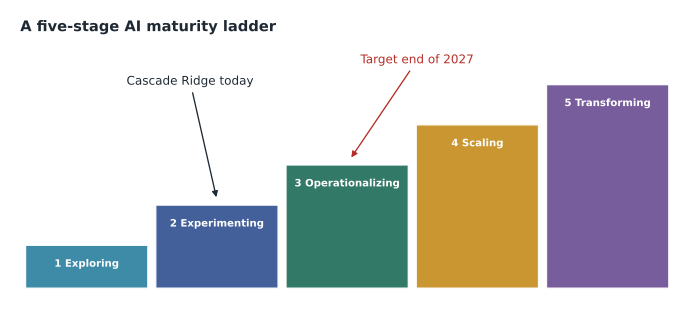
A maturity model describes stages an organization passes through as its AI capability grows. Many consulting firms, standards bodies and cloud providers publish one, including AWS, whose Cloud Adoption Framework for AI groups capabilities into business, people, governance, platform, security and operations perspectives. The stage names differ, but most models look roughly like this five-stage ladder.
| Stage | Typical signs |
|---|---|
| 1. Exploring | Interest and discussion; individual staff try public AI tools; no strategy, budget or policy |
| 2. Experimenting | A few pilots or proofs of concept; enthusiasm in pockets; little shared data or governance; results hard to repeat |
| 3. Operationalizing | Some AI in production with owners, monitoring and support; an AI policy and approval process; foundations being built |
| 4. Scaling | AI used across many functions; shared platforms and data; a center of excellence; value tracked across a portfolio |
| 5. Transforming | AI shapes strategy, products and business models; continuous improvement is routine; governance is mature and trusted |
A maturity model is useful for three things: describing the current position honestly, agreeing a realistic target, and showing what has to change between them. It is not a race. Jumping from experimenting to scaling without operationalizing first is a common cause of failure: models spread to many sites before anyone knows how to support, monitor or govern them. The exam guide's phrase, progression pathways aligned with strategic objectives and current maturity, captures the idea that the next step depends on where you stand.
Maturity can also differ by dimension. An organization can have mature technology and immature governance, or strong leadership alignment with poor data. Averages hide this, which is why a scorecard keeps the dimensions separate as well as combining them.
Building the scorecard
Andre and Noor agreed a scale of 1 to 5 for each dimension, using the maturity stages as anchors, and weights that reflected what mattered most for the 2027 roadmap. Leadership and data each carried 0.20, because without them nothing else would matter; culture, technology, governance and skills each carried 0.15.
After the interviews, the survey and the reviews, Andre scored each dimension and wrote one line of evidence beside it, so the board could see why.
| Dimension | Weight | Score (1 to 5) | Weighted | Evidence |
|---|---|---|---|---|
| Leadership alignment | 0.20 | 4 | 0.80 | Sponsor named; board approved direction; site managers keen but not yet involved |
| Data | 0.20 | 2 | 0.40 | Appointment data good; lab results on PDF; pharmacy data in twelve spreadsheets; no named owners |
| Culture and people | 0.15 | 3 | 0.45 | Survey shows interest and real worry about jobs and workload |
| Technology and infrastructure | 0.15 | 4 | 0.60 | New AWS environment with identity, logging and budgets in place |
| Governance | 0.15 | 2 | 0.30 | No AI policy; staff using public chat tools without guidance |
| Skills | 0.15 | 2 | 0.30 | One contract data scientist; one developer; little AI literacy elsewhere |
| Total | 1.00 | 2.85 |
Worked problem
Calculating the readiness score
Using the scorecard weights and scores, calculate the overall readiness score and say what stage it suggests.
Show solution
- Multiply each score by its weight: leadership 4 × 0.20 = 0.80; data 2 × 0.20 = 0.40; culture 3 × 0.15 = 0.45; technology 4 × 0.15 = 0.60; governance 2 × 0.15 = 0.30; skills 2 × 0.15 = 0.30.
- \[0.80 + 0.40 + 0.45 + 0.60 + 0.30 + 0.30 = 2.85\]
- Check the weights add to one: 0.20 + 0.20 + 0.15 + 0.15 + 0.15 + 0.15 = 1.00.
- A score of 2.85 sits just below the operationalizing anchor of 3, so overall Cascade Ridge is at stage 2, experimenting, with some dimensions ahead.
Answer: The overall score is 2.85: stage 2, experimenting. More useful than the total is the spread: three dimensions score 2 (data, governance and skills), and those are the gaps that would block the roadmap.
Lorraine questioned the precision. "Two point eight five sounds very exact for something based on interviews," she said. She was right, and Noor agreed: the total is a summary for discussion, not a measurement. Small differences mean little. What mattered was the pattern, which was clear without any decimals: strong leadership and technology, weak data, governance and skills.
From scores to gaps
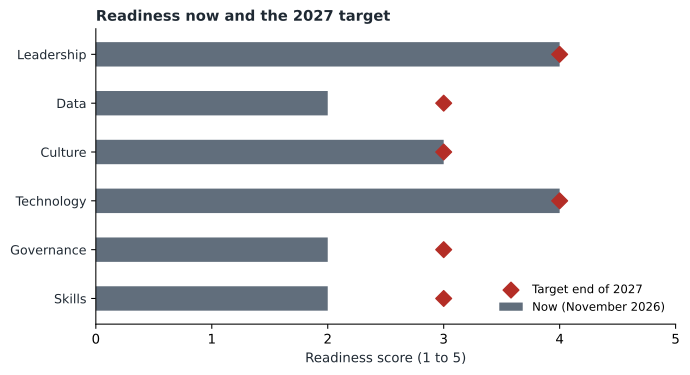
A capability gap is the difference between what a dimension needs to be for the strategy to work and what it is now. The target comes from the roadmap, not from the maturity model's top stage. Cascade Ridge did not need to be transforming by 2027; it needed to be operationalizing, with the no-show reminders, lab-report extraction and call-note summaries running safely in production.
| Dimension | Now | Target end of 2027 | Gap | What closes it |
|---|---|---|---|---|
| Leadership alignment | 4 | 4 | 0 | Keep site managers involved through the steering group and champions |
| Data | 2 | 3 | 1 | Data owners named; master product list; lab results extracted rather than typed |
| Culture and people | 3 | 3 | 0 | Honest communication about roles; champions at every site |
| Technology and infrastructure | 4 | 4 | 0 | Integration patterns reused across initiatives |
| Governance | 2 | 3 | 1 | AI policy, risk tiers, approval process and model documentation |
| Skills | 2 | 3 | 1 | AI literacy for all staff; deeper training for owners and champions; hire a data analyst |
Gaps can be described in the exam guide's four headings: people, process, technology and governance. At Cascade Ridge, the people gap was AI literacy and the thin bench behind Noor and Kwame. The process gap was the hand-typing of lab results and the lack of any routine for checking AI outputs. The technology gap was small. The governance gap was the largest in practice, even though it scored the same as data and skills, because staff were already using public chat tools on their phones to draft client emails, with nobody having said what was allowed.
That finding changed Andre's first step. Before any pilot, Cascade Ridge needed a short interim guideline on public AI tools: no client or patient details, no clinical advice to clients without a veterinarian's review, and a named person to ask. It took a week to agree and cost almost nothing. It was the cheapest risk reduction in the whole plan.
Prioritizing investments
The exam guide asks you to prioritize development investments and build progression pathways that line up with strategic objectives and current maturity. In practice that means three rules. Fund the gaps that block the highest-value initiatives first. Prefer investments that close several gaps at once. And sequence them so that each step makes the next one possible.
For Cascade Ridge, AI literacy training closed part of the skills gap and part of the culture gap, because people fear less what they understand. Naming data owners closed part of the data gap and part of the governance gap, because owners are also the people who approve uses of their data. The AI policy and risk tiers had to come before the call-note summaries, which handle clinical information, but could follow the start of the no-show pilot, which uses only appointment data and sends reminders through an existing channel.
Reassessing
A readiness assessment is a snapshot. Andre planned to repeat the scorecard every six months, using the same questions and the same scale, so that the board would see movement rather than opinions. He also planned to add the survey questions on worry and trust to the quarterly staff pulse survey, because culture changes fastest and is easiest to lose. If a pilot went badly, or a news story about AI frightened staff, the pulse would show it within weeks.
There is a trap in reassessment: people learn what the scorer wants to hear. Keeping the evidence column, and asking for documents and examples rather than opinions, makes scores harder to inflate. So does involving someone outside the program team. Hannah agreed to review the governance score each time, since she would be the first to know if the policy was being ignored.
Reading readiness scenarios on the exam
Exam scenarios about readiness often describe an organization that wants to scale AI quickly and give clues about its weak points: data spread across systems with no owner, staff who distrust management, no policy for approving tools, or leaders who disagree about the purpose of AI. The question then asks what the organization should do first. The best answer usually addresses the gap that blocks the stated goal, using evidence rather than assumption. Answers that buy more technology when the gap is data ownership, or that launch training when the gap is leadership alignment, are typical distractors.
Two other patterns are worth recognizing. When a scenario describes successful pilots that never spread, the gap is usually ownership, operational readiness or governance, not model quality. When it describes enthusiastic adoption with no oversight, such as staff using public tools on sensitive data, the gap is governance, and the right first step is a clear, quick guideline rather than a ban or a long study. In both cases the answer names the gap, closes it in proportion to the risk, and keeps the strategy moving.
Common mistakes
MistakeStarting with training before knowing where the gaps are.
InsteadAssess readiness first, then invest where the gaps block the strategy.
MistakeTreating the top maturity stage as the target.
InsteadSet targets from the roadmap; most organizations need to operationalize before they can scale.
MistakeReporting only the overall readiness score.
InsteadKeep the dimensions separate; the pattern of gaps matters more than the average.
MistakeIgnoring staff use of public AI tools.
InsteadUnmanaged use is a governance gap that needs an interim guideline straight away.
Summary and key terms
- A readiness assessment scores leadership alignment, data, culture and people, skills, technology and governance using evidence, not impressions.
- Maturity models describe stages from exploring to transforming; the next step depends on the current stage.
- Data readiness includes quality, accessibility, silos, ownership and data-sharing arrangements.
- Capability gaps are the difference between the current state and what the strategy needs, described across people, process, technology and governance.
- Invest first in gaps that block the highest-value initiatives, prefer investments that close several gaps, and reassess regularly with the same method.
- Readiness assessment
- An evidence-based review of how prepared an organization is to adopt AI.
- Maturity model
- A set of stages describing how AI capability grows, from exploring to transforming.
- Capability gap
- The difference between the current state and what the strategy requires.
- Data silo
- Data held by one team or system in a way others cannot use.
- Data owner
- The person accountable for a data set's quality and for approving its uses.
- Progression pathway
- A sequence of investments that moves an organization from one maturity stage to the next.
Practice problems
Work each problem on paper first, then reveal the answer to check.
A readiness dimension scores 3 with a weight of 0.25. What does it contribute to the weighted total?
Show answer
3 × 0.25 = 0.75.
Why should the 2027 target not simply be the top maturity stage?
Show answer
Because the target should match what the strategy needs and what is achievable next; skipping stages is a common cause of failure.
Give an example of a data silo at Cascade Ridge and its effect.
Show answer
Pharmacy stock kept in separate spreadsheets with different product names; it blocks a pharmacy demand forecast until a master product list exists.
Lesson quiz · 5 questions
Score 60% or more to complete this lesson.
Create a free account to save your progress, take quizzes and earn a certificate.