
AWS-109 · Lesson 6 of 12 · 22 min
Domain 3 review: databases, networking and other services
▶ Video coming soon A video version of this lesson is on the way.
The second half of the Domain 3 review covers the services that store structured data, connect everything together, and add analytics, artificial intelligence and integration on top. Kwame is more at home here than Mateo: BookVet talks to a database, sends confirmation emails and will soon need a queue for reminder messages. Gwen asks him to explain to Mateo what the booking app does when a client books an appointment, and then names the AWS service that would handle each step. By the end of the walkthrough the whiteboard has a dozen service names on it, and Mateo has a page of one-line definitions in his study log.
Databases
Task statement 3.4 is about choosing database services. A relational database stores data in tables with rows and columns and uses SQL; it suits structured data with relationships, such as clients, pets and appointments. Amazon RDS is a managed relational database service that supports several engines, including MySQL, PostgreSQL, MariaDB, Oracle and Microsoft SQL Server, and handles tasks such as backups, patching and Multi-AZ standby copies. Amazon Aurora is AWS's own relational engine, compatible with MySQL and PostgreSQL, designed for high performance and availability. Running a database yourself on EC2 gives full control but means you manage everything: installation, patching, backups and high availability. The exam often contrasts these: a question asking to reduce administrative effort for a relational database points to RDS or Aurora rather than EC2.
Non-relational, or NoSQL, databases suit other data shapes. Amazon DynamoDB is a fully managed key-value and document database that delivers single-digit millisecond performance at any scale and is serverless. Amazon ElastiCache and Amazon MemoryDB provide in-memory data stores for caching and very fast access. Amazon DocumentDB stores JSON-style documents and is compatible with MongoDB. Amazon Neptune is a graph database for highly connected data, such as social networks or fraud detection. For migrations, AWS Database Migration Service moves data between databases with minimal downtime, and the AWS Schema Conversion Tool converts schemas when changing engines.
| Need | Database service |
|---|---|
| Managed relational database with a common engine | Amazon RDS |
| High-performance relational database compatible with MySQL or PostgreSQL | Amazon Aurora |
| Serverless key-value lookups at any scale | Amazon DynamoDB |
| In-memory cache to speed up reads | Amazon ElastiCache |
| Graph of highly connected data | Amazon Neptune |
| Document database compatible with MongoDB | Amazon DocumentDB |
| Move a database to AWS with minimal downtime | AWS Database Migration Service |
Networking and content delivery
Amazon Virtual Private Cloud, Amazon VPC, gives you a logically isolated network in AWS. A VPC is divided into subnets, each in one Availability Zone. Public subnets have a route to an internet gateway, which connects the VPC to the internet; private subnets do not. A NAT gateway lets resources in private subnets reach the internet for updates without accepting incoming connections. Route tables decide where traffic goes. Security groups and network ACLs, reviewed in lesson 4, control access. Cascade Ridge's plan puts the BookVet load balancer in public subnets and the application servers and RDS database in private subnets, the standard layered design.
Several services connect AWS to the outside world. Amazon Route 53 is AWS's domain name system service, which translates names such as the booking site's address into IP addresses and can route users based on health or location. Amazon CloudFront is a content delivery network that caches content at edge locations close to users. AWS Global Accelerator improves the performance of applications for global users by routing traffic over the AWS network. For connections to on-premises networks, AWS Site-to-Site VPN creates an encrypted tunnel over the internet, which is quick to set up, while AWS Direct Connect provides a dedicated private connection with more consistent performance, which takes longer to arrange. AWS Transit Gateway connects many VPCs and on-premises networks through a central hub. AWS Client VPN gives individual users secure remote access.
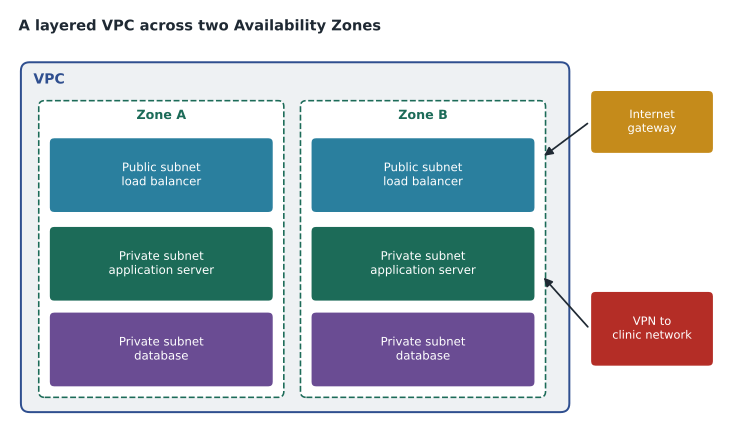
| Need | Networking service |
|---|---|
| Isolated private network in AWS | Amazon VPC |
| Connect a VPC to the internet | Internet gateway |
| Let private resources reach the internet outbound only | NAT gateway |
| Domain names and DNS routing | Amazon Route 53 |
| Cache content near users worldwide | Amazon CloudFront |
| Encrypted tunnel to an office over the internet | AWS Site-to-Site VPN |
| Dedicated private link to AWS | AWS Direct Connect |
| Hub connecting many VPCs and networks | AWS Transit Gateway |
Analytics
Task statement 3.7 covers analytics services. Amazon Athena runs SQL queries directly on data in S3 without loading it into a database, and you pay per query. AWS Glue discovers, prepares and transforms data, and keeps a data catalog. Amazon Redshift is a data warehouse for fast analytics on large structured data sets. Amazon EMR runs big data frameworks such as Apache Spark. Amazon Kinesis collects and processes streaming data in real time, such as clickstreams or sensor readings. Amazon OpenSearch Service supports search and log analytics. Amazon QuickSight builds dashboards and visualizations; AWS now offers it as part of the broader Amazon Quick Suite, so you may see either name. Lorraine wants a monthly dashboard of appointments and revenue by clinic; Gwen sketches Glue to prepare the exports, Athena or Redshift to query them, and QuickSight for the dashboard.
Artificial intelligence and machine learning
AWS offers AI at three levels, and the exam asks you to recognize which level fits a need. At the top are ready-made AI services that solve one task through an API, with no machine learning expertise needed. Amazon Rekognition analyses images and video. Amazon Comprehend finds meaning in text, such as sentiment or key phrases. Amazon Transcribe turns speech into text, and Amazon Polly turns text into speech. Amazon Translate translates text. Amazon Textract extracts text and data from documents and forms. Amazon Lex builds chatbots. Amazon Kendra provides intelligent search across documents. In the middle, Amazon Bedrock gives access to foundation models from several providers for generative AI applications, and Amazon Q provides generative AI assistants for business and development work. At the base, Amazon SageMaker AI lets data scientists build, train and deploy their own machine learning models.
A practice question might describe the reception team wanting phone calls transcribed so they can search them later: that is Transcribe, perhaps with Comprehend to find topics. Scanning paper intake forms from new clients into the practice system is Textract. A chatbot on the booking site that answers questions about opening hours is Lex, or a generative AI assistant built with Bedrock. Training a custom model to predict which appointments are likely to be missed, using the clinic group's own history, is SageMaker AI.
| Need | AI service |
|---|---|
| Detect objects or text in images | Amazon Rekognition |
| Understand sentiment and topics in text | Amazon Comprehend |
| Convert speech to text | Amazon Transcribe |
| Convert text to lifelike speech | Amazon Polly |
| Extract data from scanned forms | Amazon Textract |
| Build a conversational chatbot | Amazon Lex |
| Build generative AI apps with foundation models | Amazon Bedrock |
| Build, train and deploy custom ML models | Amazon SageMaker AI |
Other in-scope service families
Task statement 3.8 lists several more categories. Application integration services connect parts of an application. Amazon Simple Queue Service, SQS, is a message queue that decouples components so one part can work at its own pace; BookVet's reminder messages can wait in a queue until a worker sends them. Amazon Simple Notification Service, SNS, sends messages to many subscribers at once, such as email or text alerts. Amazon EventBridge routes events between services and applications. AWS Step Functions coordinates multi-step workflows. Business applications include Amazon Connect, a cloud contact center, and Amazon Simple Email Service, SES, for sending email such as booking confirmations.
Developer tools include AWS CodeBuild, which compiles and tests code, AWS CodePipeline, which automates release pipelines, and AWS X-Ray, which traces requests through an application to find problems. End-user computing includes Amazon WorkSpaces, which provides virtual desktops, and Amazon AppStream 2.0, which streams applications to a browser. Front-end and mobile services include AWS Amplify for building and hosting web and mobile apps. Internet of Things services include AWS IoT Core for connecting devices; Mateo jokes that the kennel temperature sensors could report there. Management and governance services include AWS CloudFormation, AWS Config, AWS Systems Manager for managing fleets of servers, AWS Organizations for managing multiple accounts, and AWS Health Dashboard for service events that affect your account.
Managed versus self-managed: the thread through Domain 3
One idea runs through almost every Domain 3 question about databases, analytics and integration: how much does the customer have to manage? Gwen draws a sliding scale on the whiteboard. At one end is running software yourself on EC2: you install the database, patch it, back it up, configure replication and plan for failure. In the middle are managed services such as Amazon RDS, where AWS handles installation, patching, backups and standby copies, and you handle the schema, the data and access. At the far end are serverless services such as DynamoDB, Athena, Lambda and SQS, where there are no servers to size or patch at all and you pay for what you use.
Questions that include phrases such as "least operational overhead", "minimize administration" or "the team has little database experience" are pointing along that scale toward managed or serverless options. Questions that mention a need for full control of the operating system, a database engine version AWS does not offer, or software that must be installed in a particular way are pointing back toward EC2. Neither end is always right. The exam rewards matching the option to the stated priority.
Kwame uses the scale to sort the BookVet roadmap. Phase 1 keeps the app on EC2 because it is the fastest way to move it unchanged. Phase 2 moves the booking logic to Lambda, the appointment records to DynamoDB, the reminder queue to SQS and the confirmation emails to SES, sliding each part toward the serverless end. The application does the same job, but there are far fewer servers for him to look after at three in the morning, and the bill follows the number of bookings rather than the size of the servers.
Mateo's one-line definitions page ends up being one of his most useful study tools. He reads it on the train and quizzes himself by covering the right-hand column, a habit that lesson 8 builds into a full method for confused pairs.
Worked problem
Following one booking through the services
Kwame describes what happens when a client books an appointment in the future version of BookVet. Name an AWS service for each step: the client types the booking site's address; the page loads quickly from a nearby location; the booking request runs some code; the appointment is stored; a confirmation email is sent; and a reminder is queued for the day before.
Show solution
- The address is resolved by Amazon Route 53.
- Static parts of the page are delivered from a CloudFront edge location close to the client.
- The booking request triggers code in AWS Lambda, through an API.
- The appointment is stored in a database: Amazon RDS if it joins VetLedger's relational data, or DynamoDB if it is a simple key-value record.
- The confirmation email is sent with Amazon SES.
- The reminder waits in an Amazon SQS queue, or is scheduled with EventBridge, until it is due.
Answer: Route 53, CloudFront, Lambda, RDS or DynamoDB, SES, and SQS or EventBridge. One user action can touch half a dozen services, which is why Domain 3 is so large.
Common mistakes
MistakeChoosing EC2 for a relational database when the question asks to reduce administration.
InsteadChoose Amazon RDS or Aurora for managed relational databases.
MistakeTreating DynamoDB as a relational database.
InsteadDynamoDB is a serverless key-value and document database.
MistakeConfusing Site-to-Site VPN with Direct Connect.
InsteadVPN is an encrypted tunnel over the internet; Direct Connect is a dedicated private link.
MistakeMixing up SQS and SNS.
InsteadSQS queues messages for a consumer to pull; SNS pushes messages to many subscribers.
MistakeChoosing SageMaker AI for a ready-made task.
InsteadUse a purpose-built AI service when one fits; SageMaker AI is for custom models.
Summary and key terms
- RDS and Aurora are managed relational databases; DynamoDB is serverless NoSQL; ElastiCache speeds reads.
- A VPC has public and private subnets; internet and NAT gateways control internet access.
- Route 53 handles DNS, CloudFront caches content at the edge, VPN and Direct Connect link on-premises networks.
- Athena queries S3 with SQL, Redshift is a data warehouse, Glue prepares data, Kinesis handles streams.
- AI comes in three levels: ready-made services, Bedrock and Amazon Q for generative AI, and SageMaker AI for custom models.
- SQS, SNS, EventBridge and Step Functions integrate applications; WorkSpaces, Amplify and IoT Core cover other families.
- Amazon RDS
- A managed relational database service supporting several engines.
- Amazon DynamoDB
- A serverless key-value and document database with very low latency at scale.
- Subnet
- A range of addresses in a VPC, located in one Availability Zone.
- NAT gateway
- Lets resources in private subnets make outbound internet connections.
- Amazon Athena
- A serverless service for querying data in S3 with SQL.
- Amazon SQS
- A message queue that decouples parts of an application.
Practice problems
Work each problem on paper first, then reveal the answer to check.
Which service gives a managed relational database with a choice of engines?
Show answer
Amazon RDS.
Which database is serverless key-value at any scale?
Show answer
Amazon DynamoDB.
What connects a VPC to the internet?
Show answer
An internet gateway.
Which service is a content delivery network?
Show answer
Amazon CloudFront.
Which gives a dedicated private connection to AWS?
Show answer
AWS Direct Connect.
Which service queries data in S3 with SQL without loading it?
Show answer
Amazon Athena.
Which AI service extracts data from scanned forms?
Show answer
Amazon Textract.
Lesson quiz · 5 questions
Score 60% or more to complete this lesson.
Create a free account to save your progress, take quizzes and earn a certificate.