
AWS-109 · Lesson 1 of 12 · 24 min
How the CLF-C02 exam works
▶ Video coming soon A video version of this lesson is on the way.
On the second Monday of November 2026, Gwen Halvorsen books the small meeting room beside the pharmacy at Cascade Ridge Veterinary Partners in Denver and writes four words across the whiteboard: concepts, security, technology, billing. Mateo Ruiz, the group's practice systems coordinator for six years, has spent the autumn working beside Gwen on the move to AWS. He has finished the first four courses of the Cloud Practitioner program and plans to sit the exam in February 2027. Kwame Asante, the developer who wrote the BookVet booking app, has come along too. He wants the certification before he starts on the AWS Certified Developer path next year. "Before we review a single service," Gwen says, "you need a map of the exam itself. If you know how it is built and how it is scored, you will spend your study time where it counts and stop worrying about things that do not matter." This course is that map, followed by a structured review of everything the exam can ask.
AWS-109 is the final course of the Cloud Practitioner program on this site. AWS-101 covered cloud concepts and the AWS global infrastructure. AWS-102 covered security, identity and compliance. AWS-103 toured the core services: compute, storage, databases, networking and the rest. AWS-104 covered billing, pricing and support. This course does three jobs. It explains how the CLF-C02 exam works and how to book and sit it. It reviews each of the four exam domains with original practice scenarios, built around the Cascade Ridge migration you already know. And it helps you plan the last weeks before the exam and handle exam day calmly.
What the certification is for
AWS sorts its certifications into levels. Foundational certifications check broad understanding. Associate certifications check that you can build and operate solutions in a role such as solutions architect, developer or administrator. Professional certifications check advanced design and operations skill, and specialty certifications go deep in one area. AWS Certified Cloud Practitioner is foundational. It is aimed at people in technical, managerial, sales, purchasing and financial roles who work with the AWS Cloud, and at newcomers starting a cloud career. AWS describes the target candidate as someone with up to about six months of exposure to AWS design, implementation or operations. The exam does not ask you to write code or configure services. It asks whether you can explain what AWS services do, why an organization would choose one approach over another, how security responsibility is shared, and how AWS pricing and support work.
That focus shapes how you study. Mateo has run servers and backups for years, so he is tempted to go deep on details such as instance sizes and subnet masks. Kwame writes code every day, so he assumes the exam will be easy and plans to skim the billing material. Gwen tells them both the same thing: the exam lives in the middle. You need to recognize the main services by name and purpose, understand the core ideas well enough to explain them to Lorraine in finance, and choose the option that best fits a short business scenario. Mateo will need to resist going too deep. Kwame will need to take the business and billing domains seriously, because they carry real marks.
The four domains and their weights
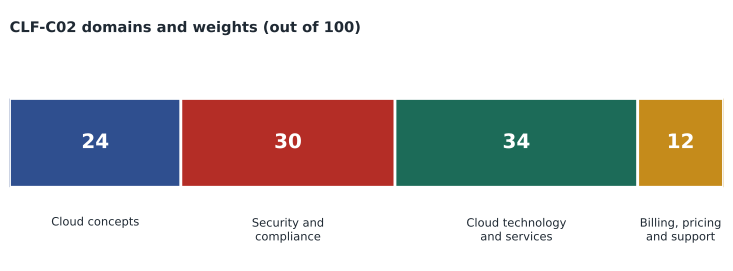
AWS publishes an exam guide for every certification, and the guide is the most important document in your preparation. The CLF-C02 guide divides the exam into four content domains, each with a weight that tells you roughly what share of the scored questions comes from it. Domain 1, cloud concepts, carries a weight of 24. Domain 2, security and compliance, carries 30. Domain 3, cloud technology and services, carries 34. Domain 4, billing, pricing and support, carries 12. The weights add up to 100, so you can read them as "about 24 out of every 100 scored questions" and so on.
Each domain is broken into task statements, and each task statement lists the knowledge and skills it covers. Domain 1 covers the benefits of the AWS Cloud, the design principles of the Well-Architected Framework, the benefits and strategies of migration, and the economics of the cloud. Domain 2 covers the shared responsibility model, security, governance and compliance concepts, access management, and the components and resources for security. Domain 3 covers ways to deploy and operate in the cloud, the global infrastructure, and the main service families: compute, databases, networking, storage, artificial intelligence and machine learning, analytics, and other in-scope service categories. Domain 4 covers pricing models, billing and cost management resources, and technical resources and support options.
| Domain | Weight | Main ideas | Covered in | Review lesson |
|---|---|---|---|---|
| 1. Cloud concepts | 24 | Benefits; Well-Architected; migration; cloud economics | AWS-101 | Lesson 3 |
| 2. Security and compliance | 30 | Shared responsibility; governance; IAM; security services | AWS-102 | Lesson 4 |
| 3. Cloud technology and services | 34 | Deployment; global infrastructure; compute, storage, databases, networking, AI, analytics | AWS-101, AWS-103 | Lessons 5 and 6 |
| 4. Billing, pricing and support | 12 | Pricing models; billing tools; support plans and resources | AWS-104 | Lesson 7 |
The weights tell you something important: no domain is optional. Domain 4 is the smallest, but 12 out of 100 is still a meaningful share, and the exam uses compensatory scoring, which we explain below. Domain 3 is the largest because it covers the most services. Domain 2 is close behind, which surprises many candidates. Security questions are common because shared responsibility and identity are at the heart of how AWS works.
The exam at a glance
The AWS Certified Cloud Practitioner page and the CLF-C02 exam guide, checked for this course in November 2026, describe the exam as follows. It lasts 90 minutes. It contains 65 questions, of which 50 are scored and 15 are unscored. The unscored questions are ones AWS is testing for future use, and they are not marked, so you cannot tell which they are. The registration fee is 100 US dollars, and the page notes that foreign exchange rates and taxes may apply. You can take the exam at a Pearson VUE testing center or online with a remote proctor. The exam is offered in several languages, including English, French, Spanish, Japanese, Korean, Portuguese, Chinese and Arabic. A certification is valid for three years.
| Item | What AWS's pages said in November 2026 |
|---|---|
| Exam code | CLF-C02 |
| Length | 90 minutes |
| Questions | 65: 50 scored and 15 unscored |
| Question types | Multiple choice and multiple response |
| Score | Scaled from 100 to 1,000; minimum passing score 700 |
| Fee | 100 US dollars, plus exchange and taxes where they apply |
| Delivery | Pearson VUE testing center or online proctored |
| Validity | Three years |
Facts like these change over time. Older blog posts mention an earlier exam version, CLF-C01, with different domains and weights, and some list fees or languages that are no longer current. That is normal: certification programs evolve, and summaries go out of date. Throughout this course, when we state a fact about the exam we say when we checked it, and we ask you to confirm it on AWS's own pages before you book. At the time of writing, CLF-C02 was still the current version, and AWS had not announced a replacement on its certification page. If AWS announces a new version, its page will show the last date for the old one, and the review lessons here will still cover most of the same ideas.
How scoring works
Your result is reported as a scaled score from 100 to 1,000, and the minimum passing score is 700. A scaled score is not a simple count of questions right. AWS converts your raw result onto the scale so that different forms of the exam, with slightly different questions, are treated fairly. That means you cannot say "700 means 35 of 50 correct". What you can say is that a comfortable margin of correct answers is needed, and that you should aim well above the line rather than at it.
The exam uses compensatory scoring. You do not need to pass each domain separately; you need to pass the exam overall. A strong result in one domain can make up for a weaker one. That sounds comforting, but Gwen points out the other side: because the passing score applies to the whole exam, a domain you skip entirely can drag you below the line even if you are strong elsewhere. Your score report shows how you did in each domain, using descriptions rather than numbers, so a report after a failed attempt tells you where to focus.
Two more rules matter for strategy. First, there is no penalty for guessing. A wrong answer and an unanswered question both score zero, so you should never leave a question blank. Second, unanswered questions count as incorrect. If time runs out with questions untouched, you lose those marks for certain. Lesson 10 builds a timing plan so that never happens.
# Average time per question for CLF-C02
minutes = 90
questions = 65
seconds = minutes * 60 / questions
print("Average per question:", round(seconds), "seconds")
# Keeping a 10-minute review reserve at the end
reserve = 10
print("With a reserve:", round((minutes - reserve) * 60 / questions), "seconds each")Average per question: 83 seconds With a reserve: 74 seconds each
What this code does
It divides the exam's 90 minutes by its 65 questions to get the average time available per question, about 83 seconds. It then repeats the calculation keeping 10 minutes in reserve for review at the end. That leaves about 74 seconds per question on the first pass, a useful pacing target.
The numbers above are a first look at pacing. You have a little under a minute and a half for each question, which is generous for a foundational exam. But scenario questions take longer to read than simple recall questions, multiple-response questions take longer still, and nerves eat time. Lesson 10 turns these numbers into a plan with checkpoints.
Who the candidates are
Two candidates appear throughout this course. Mateo Ruiz has been the practice systems coordinator at Cascade Ridge for six years. He looks after the VetLedger practice system, the file shares, the network at eleven clinics and the help desk. He now works with Gwen on the move to AWS and plans to take the exam at a Pearson VUE testing center in Denver in February 2027. Kwame Asante wrote BookVet, the clinic group's online booking app, and maintains the public website. He plans to take the exam online from home in late January 2027, before the migration pilot is in full swing. Between them they show two common kinds of Cloud Practitioner candidate: the operations generalist moving into the cloud, and the developer who knows code but not the business side of AWS.
Their strengths and risks differ. Mateo knows infrastructure well and can picture what a virtual machine, a database or a backup does, but he sometimes chooses the answer that matches how things worked in the server room rather than the managed AWS option the question is pointing to. Kwame learns service names quickly and thinks in terms of automation, but he tends to rush, misses words such as "most cost-effective" or "least operational effort", and has paid little attention to pricing and support. Lessons 9 and 10 build a plan for each of them, and you can borrow whichever parts suit you.
Worked problem
Turning a task statement into study questions
Mateo reads task statement 1.3 in the exam guide, "Understand the benefits of and strategies for migration to the AWS Cloud", and asks what he should actually study. Gwen asks him to turn it into concrete questions he could answer out loud. What might those questions be?
Show solution
- Start with the benefits: What does a migration change for Cascade Ridge? Faster provisioning, less hardware to maintain, the chance to scale with demand and pay for what is used.
- Then the frameworks: What is the AWS Cloud Adoption Framework for, and what are its six perspectives? Which perspective would Lorraine care about, and which would Hannah care about?
- Then the strategies: What do rehost, replatform, refactor, repurchase, retain, retire and relocate mean? Which one did the group choose for VetLedger, for the imaging archive and for the old intranet wiki?
- Finally the tools that appear in migration questions: What is AWS Database Migration Service used for? When would a physical data transfer device make sense instead of the network?
Answer: A good study task is a question you can answer in your own words. Turning each task statement into a few plain questions gives you a checklist that tests readiness better than rereading notes.
Gwen finishes the session by circling the four words on the whiteboard. "Every question on the exam comes from one of these," she says. "Learn what each domain means, learn the services that live in it, and practice choosing between them. The rest of this course is about getting you from here to exam day without surprises." Mateo takes a photo of the board. It becomes the first page of his study log.
Common mistakes
MistakeStudying deep configuration details for a foundational exam.
InsteadFocus on what each service does, when it is chosen and how it is priced and secured.
MistakeTreating the scaled score as a raw count of correct answers.
InsteadThe 700 passing score is on a 100 to 1,000 scale; aim well above it.
MistakeAssuming each domain must be passed separately.
InsteadScoring is compensatory across the whole exam, but a skipped domain can still sink the result.
MistakeLeaving hard questions blank.
InsteadThere is no penalty for guessing, and blanks count as wrong; always choose an answer.
MistakeRelying on old blog posts for exam facts.
InsteadCheck AWS's certification page and the current exam guide; programs change.
Summary and key terms
- AWS Certified Cloud Practitioner is the foundational AWS certification, exam code CLF-C02.
- The exam has four domains: cloud concepts (24), security and compliance (30), cloud technology and services (34), and billing, pricing and support (12).
- In November 2026 AWS listed 90 minutes, 65 questions (50 scored, 15 unscored), a 100 US dollar fee and three-year validity.
- Scores are scaled from 100 to 1,000 with a minimum pass of 700, and scoring is compensatory across the exam.
- There is no penalty for guessing, and unanswered questions are marked wrong.
- Check the certification page and the current exam guide before you plan or book.
- CLF-C02
- The exam code for the current AWS Certified Cloud Practitioner exam.
- Exam guide
- AWS's published document listing the domains, task statements and in-scope services for an exam.
- Domain
- One of the four content areas of the exam, each with a published weight.
- Task statement
- A numbered item within a domain describing what a candidate should understand.
- Scaled score
- A result converted onto a 100 to 1,000 scale so that different exam forms are scored fairly.
- Compensatory scoring
- A scoring approach where you pass on the whole exam rather than on each domain separately.
- Unscored question
- A question AWS is trialling for future exams; it does not count toward your score.
Practice problems
Work each problem on paper first, then reveal the answer to check.
How many domains does CLF-C02 have?
Show answer
Four.
Which domain carries the largest weight?
Show answer
Domain 3, cloud technology and services, with 34.
How many of the 65 questions are scored?
Show answer
50.
What is the minimum passing scaled score?
Show answer
700 on a scale of 100 to 1,000.
Is there a penalty for a wrong answer compared with a blank one?
Show answer
No; both score zero, so always answer.
How long is the certification valid?
Show answer
Three years.
Why does Gwen warn Kwame about the billing domain?
Show answer
Because it carries a weight of 12 and he planned to skim it; compensatory scoring cannot rescue a domain left unstudied.
Lesson quiz · 5 questions
Score 60% or more to complete this lesson.
Create a free account to save your progress, take quizzes and earn a certificate.