
AWS-101 · Lesson 1 of 12 · 19 min
What cloud computing is
▶ Video coming soon A video version of this lesson is on the way.
Mateo Ruiz has kept Cascade Ridge Veterinary Partners' computers running for six years. He knows every cable in the small server room behind the emergency hospital pharmacy in Denver: the two Windows servers that run VetLedger, the practice management system used at all twelve locations; the storage array that holds 38 terabytes of radiographs and ultrasound images; the tape drive that writes a backup every night; and the wall-mounted air conditioner that failed twice in the summer of 2026. On July 18 the room reached a temperature the servers would not tolerate, VetLedger shut itself down for three hours, and the emergency hospital checked in patients on paper while a surgeon waited for a dog's previous radiographs.
In September the board approved a move to Amazon Web Services (AWS). Lorraine Beaudry, the chief financial officer, signed a twelve-month contract with Gwen Halvorsen, an independent cloud architect, to plan the migration and to teach Mateo enough to run the new environment himself. Gwen's first condition was that Mateo would study for the AWS Certified Cloud Practitioner exam, CLF-C02, along the way. "Not because the badge matters," she told him, "but because the exam guide is a good map of what every person who touches an AWS account should understand."
This course follows Mateo through his first six weeks with Gwen, from late September to early November 2026. It covers the first domain of the Cloud Practitioner exam, cloud concepts: what the cloud is, why organizations use it, how AWS is built around the world, how to design for it, how to plan a migration and how to reason about cost. AWS-102 continues with security and compliance, AWS-103 with the core services, AWS-104 with billing, pricing and support, and AWS-109 prepares for the exam itself.
A definition worth memorizing
Cloud computing is the on-demand delivery of computing resources over the internet with pay-as-you-go pricing. The resources include servers, storage, databases, networking, analytics, machine learning and finished software. Instead of buying hardware, installing it and running it in a building the organization controls, the customer asks a cloud provider for what it needs, uses it for as long as it needs it, and pays for what it used.
Gwen asks Mateo to unpack each part of that sentence. On demand means the customer does not file a purchase order and wait weeks; a request through a web page or a program is answered in seconds or minutes. Over the internet means the resources live in the provider's facilities and are reached across a network. Pay as you go means the bill follows use: a server that runs for ten hours is billed for ten hours, and storage is billed for the amount actually stored over the month.
The definition used most often in textbooks and exams comes from the US National Institute of Standards and Technology (NIST). It lists five essential characteristics that separate true cloud computing from simply renting a server in someone else's building.
| Characteristic | Meaning | Cascade Ridge example |
|---|---|---|
| On-demand self-service | The customer provisions resources without human interaction at the provider | Mateo starts a test server from the AWS Management Console in two minutes |
| Broad network access | Resources are reached over the network from many kinds of device | Reception staff use VetLedger from clinic desktops and vets from tablets |
| Resource pooling | The provider serves many customers from shared, isolated pools of hardware | Cascade Ridge never knows which physical machine stores its images |
| Rapid elasticity | Capacity grows and shrinks quickly, sometimes automatically | BookVet adds servers during the spring vaccination rush and removes them in summer |
| Measured service | Use is metered and reported to the customer | Lorraine sees what each clinic system cost last month |
How Cascade Ridge buys computing today
Mateo describes the last server purchase. In 2021 the practice system needed more memory and faster disks. He wrote a business case, collected three quotes, waited five weeks for delivery, installed the server over a weekend and migrated the database overnight. The machine cost about the same as a new ultrasound unit, and it was sized for the busiest morning Mateo expected over the next five years. On a typical Tuesday afternoon it runs at a small fraction of its capacity.
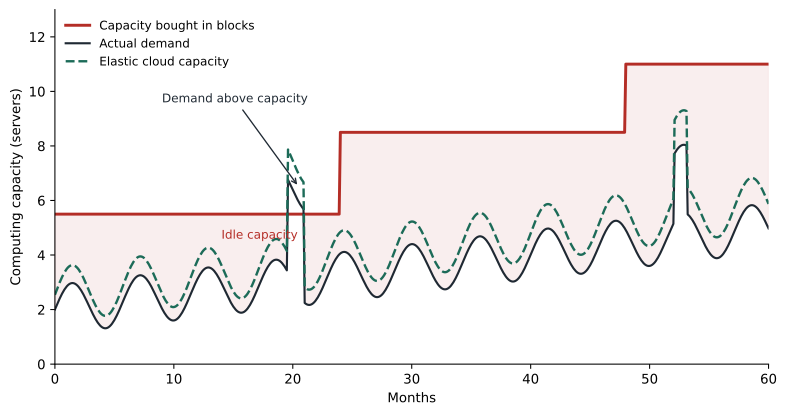
Gwen draws two lines on the whiteboard. One is the demand for computing, rising slowly and wobbling with seasons and busy mornings. The other is the capacity Mateo bought: flat for years, then jumping up when a new server arrives. Wherever the capacity line sits above demand, Cascade Ridge has paid for equipment that does nothing. Wherever demand pokes above capacity, staff wait, and on the worst days the system falls over. "The cloud lets you draw the capacity line much closer to the demand line," she says, "and move it whenever the demand moves."
Capital expense and operating expense
Lorraine cares about the same picture from the finance side. Buying a server is a capital expenditure (CapEx): a large payment up front for an asset that is used, and depreciated, over several years. Paying a cloud bill is an operating expenditure (OpEx): a recurring cost that appears in the month the service is used. The CLF-C02 exam guide asks candidates to distinguish fixed costs, which stay the same whatever the use, from variable costs, which rise and fall with use. Owned servers, the server room lease and the support contracts are largely fixed. Cloud resources are largely variable.
The shift from fixed to variable has real benefits. Cash is not tied up in equipment, spending can follow the business, and an experiment that fails can be switched off without a write-down. But Gwen is careful to add that variable costs are not automatically lower costs. A server left running all weekend for no reason is billed all weekend. Lesson 10 returns to cloud economics, and AWS-104 covers the pricing models in detail.
# Compare buying capacity for the peak with paying for what is used.
# All figures are illustrative, in one currency unit per hour of server use.
hours_per_month = 730
peak_servers = 6           # servers needed on the busiest mornings
average_servers = 2.2      # servers actually needed on average
owned_cost_per_server_hour = 0.55   # owned hardware, power, space, support
cloud_cost_per_server_hour = 0.70   # on-demand price for a similar server

owned = peak_servers * hours_per_month * owned_cost_per_server_hour
cloud = average_servers * hours_per_month * cloud_cost_per_server_hour
print("Owned, sized for the peak:", round(owned))
print("Cloud, sized to demand:   ", round(cloud))
print("Cloud as a share of owned:", round(cloud / owned, 2))Owned, sized for the peak: 2409 Cloud, sized to demand: 1124 Cloud as a share of owned: 0.47
What this code does
It compares two ways of paying for servers over a month of 730 hours, using illustrative prices. Owning means buying enough servers for the busiest mornings and paying for them every hour; the cloud means paying a higher hourly price but only for the servers actually needed on average. The printout shows the cloud option costs a little under half as much, because most owned capacity would sit idle.
In this illustrative case each cloud server hour costs more than an owned one, yet the monthly total is lower because Cascade Ridge pays for an average of 2.2 servers instead of six. If demand were flat and high every hour of the year, the comparison could go the other way. That is why cloud economics depends on the shape of demand and on discipline in switching things off.
Service models: how much the provider manages
Cloud services are grouped into three classic service models, according to how much of the technology stack the provider runs. Infrastructure as a service (IaaS) supplies virtual servers, storage and networks; the customer manages the operating system and everything above it. On AWS, Amazon EC2 (Elastic Compute Cloud) virtual servers are the standard example. Platform as a service (PaaS) also manages the operating system and runtime, so the customer supplies code or data and configuration; AWS Elastic Beanstalk and Amazon RDS (Relational Database Service) are examples. Software as a service (SaaS) delivers complete applications that the customer simply uses; Cascade Ridge's Microsoft 365 email and its hosted phone system are SaaS.
Lesson 3 explores the three models and the deployment models in depth. For now, Gwen wants Mateo to notice that Cascade Ridge already uses the cloud. Its email has lived in a provider's facilities for years. What is changing is that the practice system, the images and the booking app, the systems Mateo has always run himself, are moving too.
Why AWS, and what AWS is
AWS is the cloud computing division of Amazon. It began offering storage and compute services to the public in 2006 and now provides more than two hundred services from data centers in many parts of the world. The services range from basic virtual servers and storage to managed databases, analytics, machine learning, internet of things, media and contact center tools. Customers include start-ups, governments, banks, hospitals and, soon, a veterinary group in Colorado.
The board compared AWS with other large providers before deciding. Gwen is clear that the main ideas in this course apply to every major public cloud; the names change, but on-demand resources, regions and zones, shared responsibility and pay-as-you-go pricing are universal. The exam, however, uses AWS names, and so does Cascade Ridge's new environment, so the course uses them too.
Using AWS: a first look
Every action in AWS is ultimately a call to an AWS API (application programming interface). The AWS Management Console is a web interface that makes those calls when someone clicks; the AWS Command Line Interface (AWS CLI) makes them from a terminal; the AWS SDKs make them from program code; and infrastructure-as-code tools make them from templates. Lesson 11 covers each one. Mateo's first exercise is to sign in to a sandbox account Gwen created, look at the list of Regions, and run one read-only command.
aws sts get-caller-identity
aws ec2 describe-regions --query "Regions[].RegionName" --output text
The first command answers a question Mateo will ask hundreds of times: who am I signed in as, and in which account? The second shows that an AWS account is not tied to one place. Lesson 4 explains what a Region is and why the list matters.
Common mistakes
MistakeCalling any rented server 'the cloud'.
InsteadCloud computing means self-service, on-demand, elastic and metered resources. A server leased by the year and set up by phone call is hosting, not cloud.
MistakeAssuming the cloud is always cheaper.
InsteadIt changes fixed costs into variable ones. It saves money when capacity follows demand and unused resources are turned off.
MistakeThinking the move to the cloud is all or nothing.
InsteadMost organizations move system by system. Cascade Ridge already uses SaaS email and will keep some equipment in the clinics.
MistakeBelieving the provider takes over all responsibility.
InsteadAWS runs the facilities, hardware and its services. The customer still controls who has access, how resources are configured and what data is stored.
Cloud computing and the exam
Gwen points out that the Cloud Practitioner exam rarely asks for a definition word for word. Instead it describes a situation, such as a company that wants to stop buying servers for its busiest week, and asks which cloud concept applies. Knowing the five characteristics, the difference between fixed and variable costs and the three service models by name makes those questions quick to answer, because each situation usually points to exactly one of them.
Worked problem
Spotting the five characteristics
Kwame describes a test he ran: he created three servers for BookVet from a web page, used them for an afternoon to load-test the app, deleted them, and the next morning saw a charge for exactly four hours of each server. Which NIST characteristics did he use?
Show solution
- Creating servers from a web page without contacting anyone is on-demand self-service.
- Reaching them from his laptop over the internet is broad network access.
- Adding three servers for one afternoon and removing them is rapid elasticity.
- Seeing a charge for exactly the hours used is measured service.
- Resource pooling is also present, because the servers ran on shared AWS hardware he never saw.
Answer: All five characteristics appear, which is what separates cloud computing from traditional hosting.
By the end of the first morning Mateo has a page in his notebook headed What is the cloud, with five characteristics, three service models and one sentence underlined twice: the bill follows use. Lesson 2 turns to the six advantages AWS uses to explain why organizations make the move.
Summary and key terms
- Cloud computing is the on-demand delivery of computing resources over the internet with pay-as-you-go pricing.
- The NIST definition lists five characteristics: on-demand self-service, broad network access, resource pooling, rapid elasticity and measured service.
- Owned servers are capital expenditure and largely fixed cost; cloud resources are operating expenditure and largely variable cost.
- IaaS, PaaS and SaaS describe how much of the stack the provider manages.
- Every AWS action is an API call, whether made from the console, the CLI, an SDK or a template.
- Cloud computing
- On-demand delivery of computing resources over the internet with pay-as-you-go pricing.
- CapEx
- Capital expenditure: up-front spending on assets used over several years.
- OpEx
- Operating expenditure: recurring spending on services in the period they are used.
- Fixed cost
- A cost that stays the same regardless of use.
- Variable cost
- A cost that rises and falls with use.
- IaaS
- Infrastructure as a service: virtual servers, storage and networks.
- PaaS
- Platform as a service: the provider also manages the operating system and runtime.
- SaaS
- Software as a service: complete applications delivered over the internet.
- API
- Application programming interface: the programmatic entry point for every AWS action.
Practice problems
Work each problem on paper first, then reveal the answer to check.
Why did Cascade Ridge pay for idle capacity before the move?
Show answer
Servers were bought in large blocks sized for the busiest expected day, so most of the time capacity sat well above demand.
Is a monthly cloud bill a fixed or variable cost?
Show answer
Mostly variable: it rises and falls with how much is used.
Which NIST characteristic describes seeing the exact hours each server ran on the bill?
Show answer
Measured service.
Lesson quiz · 5 questions
Score 60% or more to complete this lesson.
Create a free account to save your progress, take quizzes and earn a certificate.