
AUTO-420 · Lesson 6 of 12 · 20 min
Lane keeping, blind spot and cross-traffic systems
Harold Kemp's SUV came in on a wet Thursday with the right side mirror's blind spot light dark and a message on the dash: "Blind spot assist unavailable, service required." Harold had a theory. "It started after I had a hitch put on for the new trailer. The left one still works." The same afternoon, Ines called to ask why her car's lane keeping kept switching itself off on her early runs to the airport, and whether that had anything to do with her new windshield appointment the following week.
This lesson covers the lateral driver assistance features: lane departure warning, lane keeping assist and lane centering, which use the forward camera to watch the lane markings, and the blind spot, lane change and rear cross-traffic features, which use the rear corner radars to watch the lanes beside and behind the vehicle. It explains how each works, what limits it and how Kiran handled the two calls.
Finding the lane
The forward camera's software looks for lane markings in each image: painted lines, raised markers, and on many systems road edges, curbs and the boundary between pavement and gravel or grass. It fits a model of each lane boundary, typically a curve described by its distance from the vehicle, its angle, its curvature and the rate at which the curvature changes, and it estimates the vehicle's position and heading within the lane. It also rates its confidence in each boundary. Faded paint, snow, slush, glare from a low sun on wet pavement, tar seams that look like lines, construction zones with old and new markings, and merges where lines split or end all reduce that confidence.
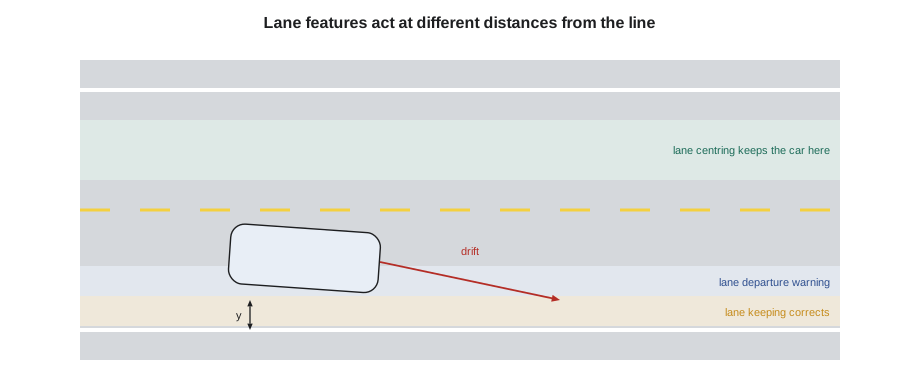
From the lane model and the vehicle's speed and yaw rate, the module calculates how far the vehicle is from each boundary and how soon it will cross it at its current heading. That time to line crossing, together with whether the turn signal is on and whether the driver is steering actively, decides what the lane features do.
# Time to line crossing for a vehicle drifting toward the lane edge
import math
lane_w = 12.0        # lane width
car_w = 6.1         # vehicle width
for v_in in (37, 62):
    v = v_in * 1.4667
    for drift_deg in (0.5, 1.0, 2.0):
        y = (lane_w - car_w) / 2        # distance from the tire to the line when centered
        t = y / (v  * math.sin(math.radians(drift_deg)))
print(f"{v_in:2} mph, drifting {drift_deg:3.1f} deg: line crossed in {t:4.1f} s")37 mph, drifting 0.5 deg: line crossed in 6.2 s 37 mph, drifting 1.0 deg: line crossed in 3.1 s 37 mph, drifting 2.0 deg: line crossed in 1.6 s 62 mph, drifting 0.5 deg: line crossed in 3.7 s 62 mph, drifting 1.0 deg: line crossed in 1.9 s 62 mph, drifting 2.0 deg: line crossed in 0.9 s
Lane departure warning, lane keeping and lane centering
The three lane features build on each other. Lane departure warning, the simplest, alerts the driver when the vehicle is about to cross a lane boundary without the turn signal on, with a chime, a flashing symbol, a vibration in the steering wheel or seat, or a rumble-strip sound from the side the vehicle is drifting toward. Lane keeping assist goes one step further: it applies a small steering torque through the electric power steering to nudge the vehicle back into the lane, and some systems also brake one wheel lightly to create a yaw. It acts only near the boundary, and the driver can override it easily. Lane centering, the level 2 feature, steers continuously to keep the vehicle near the middle of the lane, usually only with adaptive cruise active and above a minimum speed, and it requires the driver to keep hands on the wheel, or, on hands-free systems, eyes on the road as watched by the driver monitoring camera.
All three depend on the electric power steering accepting torque requests from the driver assistance module, on a correct steering angle sensor, and on the vehicle going straight when the steering is straight. That last point matters to an alignment shop: if the thrust angle, the direction the rear wheels point the vehicle, is off, or the steering wheel is off center, the camera sees the vehicle angled in the lane even when the driver thinks it is straight, and lane keeping may push constantly to one side. The alignment and calibration lessons return to this.
Why Ines's lane keeping switched off
Ines's early airport runs started before sunrise on roads that had been sanded and salted after an overnight snowfall. Kiran asked her three questions: what the message said, whether the car showed the lane lines in gray or in color on the cluster when it happened, and what the road looked like. The message said lane keeping was temporarily unavailable, the cluster showed the lines in gray, meaning not detected, and the road was white with slush and sand where the paint should have been. Then the car had been doing what it should: it could not see the lane boundaries, so it switched lane keeping off and said so.
Kiran still checked the car, because a camera with a dirty or fogged view, or a failing self-calibration, could show the same symptom. The camera area of the windshield was clean, the light shield was secure after the repair in the cameras lesson, and the camera's codes and self-calibration status were normal. She explained the result to Ines and added one more point: the new windshield the following week would need a camera calibration, and Ridgeline would do it in the new calibration area, with a road test on a well-marked road afterward.
Blind spot and lane change assistance
Blind spot warning uses the two rear corner radars to watch the zones beside and just behind the vehicle that the mirrors do not cover. When a vehicle is in or entering one of those zones, the system lights a symbol in or near the side mirror; if the driver signals a lane change toward it, the symbol flashes and a chime sounds. Lane change assist extends the zone rearward to warn of vehicles approaching quickly from behind in the adjacent lane, using the radars' measurement of closing speed. Some vehicles add an active intervention that steers or brakes gently to keep the vehicle in its lane if the driver starts to move over into a vehicle alongside.
The zones are defined in the software from the radars' positions and aim. A corner radar that has been knocked, or a bumper cover replaced with one that sits differently, shifts the zone, and the system may miss vehicles in part of it or warn for vehicles two lanes over. Most blind spot radars check their own alignment against passing traffic, as the forward radar does, and set a code if it drifts too far.
# Is a target in the blind spot zone? (zone relative to the rear bumper corner, illustrative)
zone = {"lat_min": 1.6, "lat_max": 13.1, "long_min": -9.8, "long_max": 49.0}
targets = [("car alongside", (5.9, 6.6)), ("car two lanes over", (18.4, 13.1)), ("car far behind", (6.6, 131.0)), ("guardrail", (1.0, 16.4))]
for name, (lat, lng) in targets:
    inside = zone["lat_min"] <= lat <= zone["lat_max"] and zone["long_min"] <= lng <= zone["long_max"]
print(f"{name:20} lateral ft {lat:5.1f}, behind ft {lng:5.1f}: {'warn' if inside else 'ignore'}")car alongside lateral ft 5.9, behind ft 6.6: warn car two lanes over lateral ft 18.4, behind ft 13.1: ignore car far behind lateral ft 6.6, behind ft 131.0: ignore guardrail lateral ft 1.0, behind ft 16.4: ignore
Rear cross-traffic alert
Rear cross-traffic alert uses the same rear corner radars while the vehicle is in reverse. Pointed sideways as well as backward, they can see vehicles, and on some systems pedestrians and cyclists, approaching from either side as the vehicle backs out of a parking space, often before the driver or the rear camera can. The system warns with a chime and a symbol, often on the camera display, and on vehicles with rear automatic braking it may brake if the driver keeps reversing into the path of the crossing vehicle. In a crowded parking lot or a driveway beside a busy street, it is one of the features customers appreciate most, and they notice quickly when it stops working.
Harold's blind spot
The scan of Harold's SUV showed the right rear corner radar with a code for lost communication, and the left radar reporting the right one missing, which is why the system switched the whole blind spot and cross-traffic feature off. The right radar was not responding at all. Kiran checked power, ground and the private network the two radars share before suspecting the radar. With the right rear wheel liner and bumper cover edge pulled back, the cause was obvious: the hitch installer had routed the trailer wiring harness along the frame and secured it with a cable tie around the radar's harness as well, and a self-tapping screw for the hitch wiring's ground had gone through the radar harness, shorting the radar's power feed to the body. The radar's fuse had blown.
The repair was a section of the radar harness repaired with the maker's approved method, the trailer harness rerouted, a new fuse, a check that the radar's bracket had not been disturbed, and a scan. With power back, the radar came online, its self-alignment status was good, and a road test on the ring road showed the blind spot light working on both sides. Kiran wrote up the cause in plain terms for Harold and gave him the hitch installer's details from his receipt, because a second customer with the same kind of hitch had come in the month before with a similar fault.
| Feature | Sensor | Works when | Typical limits |
|---|---|---|---|
| Lane departure warning | Forward camera | Lines visible, above a minimum speed, no turn signal | Faded or covered lines, glare, construction zones |
| Lane keeping assist | Forward camera, power steering | As above, driver not steering actively | Small correction only; driver can override |
| Lane centering | Forward camera, radar, power steering | Adaptive cruise on, lines visible, hands on or eyes on road | Sharp curves, merges, poor lines |
| Blind spot warning | Rear corner radars | Above a low speed | Very fast vehicles, unusual zones, blocked radars |
| Rear cross-traffic alert | Rear corner radars | In reverse | Obstructed view, blocked radars, angled parking |
Worked problem
How much warning does a drifting car get?
On a 12 ft lane, a 6.1 ft wide car is centered and starts to drift at 1 degree at 62 mph. How long until the tire touches the line?
Show solution
- Space to the line: (12 − 6.1) ÷ 2 = 2.95 ft.
- Sideways speed: 91 ft/s × sin 1° = 1.59 ft/s.
- Time: 2.95 ÷ 1.59 = about 1.9 s.
Answer: About 1.9 seconds, which is why lane departure warnings come early and lane keeping acts gently but promptly.
Settings and sensitivity
Most vehicles let the driver adjust the lane and blind spot features: lane departure warning on or off, the warning as a chime, a vibration or both, lane keeping as warning only or with steering, its sensitivity as early or late, and blind spot warning brightness and chime. Many vehicles also switch lane keeping back on at every start, by design, because the maker considers it a safety feature. Customers who dislike the steering nudge often switch it off and forget, then report the feature broken a week later; others find it switches itself back on and report that as a fault.
Kiran's routine on any lane or blind spot complaint begins in the driver's seat with the customer: which feature, which setting, which driver profile, and what the cluster shows when it happens. She also checks the steering wheel's position on a straight road, because a wheel that sits off center is the first sign of an alignment problem that will make lane keeping behave oddly. Only then does she connect the scan tool. On Ines's car, that order saved time: the settings and the cluster told most of the story before the scan confirmed it.
A short road test on a well-marked road ends every lane or blind spot job. Kiran watches the cluster's lane display turn from gray to colored as the lines are detected, lets the vehicle drift gently toward each line in turn on an empty stretch, and checks the blind spot lights with a second vehicle passing on each side.
Common mistakes
MistakeTreating "lane keeping unavailable" on snowy roads as a fault.
InsteadCheck what the cluster shows; covered lines switch the feature off by design.
MistakeReplacing a blind spot radar that does not communicate.
InsteadCheck its power, ground and network wiring first.
MistakeIgnoring aftermarket hitch, light or accessory installations.
InsteadThey often disturb corner radar wiring and mounting.
MistakeForgetting the steering and alignment in lane keeping complaints.
InsteadThrust angle and steering angle sensor errors make the vehicle look angled in the lane.
MistakeTesting lane features on an unmarked or snowy road.
InsteadRoad test on clear, well-marked roads.
Summary and key terms
- The forward camera fits models of the lane boundaries and estimates the vehicle's position and heading.
- Time to line crossing decides when lane departure warning alerts and lane keeping corrects.
- Lane centering is a level 2 feature that steers continuously with adaptive cruise active.
- Lane features depend on electric power steering, the steering angle sensor and a correct thrust angle.
- Rear corner radars provide blind spot, lane change assist and rear cross-traffic alert.
- Covered or faded lines and blocked radars switch features off by design.
- Aftermarket installations near the bumper corners often damage radar wiring or mounting.
- Lane departure warning
- An alert when the vehicle is about to cross a lane line without signaling.
- Lane keeping assist
- A steering correction that nudges the vehicle back into its lane near the line.
- Lane centering
- Continuous steering to keep the vehicle near the middle of the lane.
- Time to line crossing
- The time until the vehicle crosses a lane boundary at its current heading.
- Blind spot warning
- An alert for vehicles in the zones beside and behind the vehicle that mirrors miss.
- Rear cross-traffic alert
- A warning of vehicles crossing behind a reversing vehicle.
Practice problems
Work each problem on paper first, then reveal the answer to check.
Why did Ines's lane keeping switch off on early runs?
Show answer
Slush and sand covered the lane lines, so the camera could not see them.
What had the hitch installer done to Harold's radar?
Show answer
Driven a ground screw through the radar harness, shorting its power and blowing the fuse.
Which sensors provide rear cross-traffic alert?
Show answer
The rear corner radars.
Why can a wrong thrust angle cause lane keeping complaints?
Show answer
The camera sees the vehicle angled in the lane, so the system keeps correcting.
Lesson quiz · 5 questions
Score 60% or more to complete this lesson.
Create a free account to save your progress, take quizzes and earn a certificate.