
AUTO-420 · Lesson 10 of 12 · 20 min
ADAS after collisions, glass replacement and alignments
In August a delivery truck backed into the right rear corner of courier van 3 in a loading lane. The body shop Hal uses replaced the van's rear bumper cover and the right corner radar bracket, refinished the cover, and sent the van to Ridgeline with a note: "Blind spot radar needs calibrating, we don't have the equipment." Kiran's pre-scan found more than a radar to calibrate. The right corner radar had a misalignment code, as expected, but the forward camera also had a code for a calibration not performed, and the steering angle sensor reported an offset. The body shop's repair order showed why: during the repair, the van's rear suspension had been checked on the frame machine and a bent rear toe link replaced, and nobody had aligned the van afterward.
This lesson covers the three biggest sources of ADAS calibration work in an ordinary shop: collision repairs, glass replacement and wheel alignments, along with suspension and ride height changes. It covers what each does to the sensors, how to decide what calibrations a job needs, and how the jobs must be ordered.
Why repairs disturb sensors
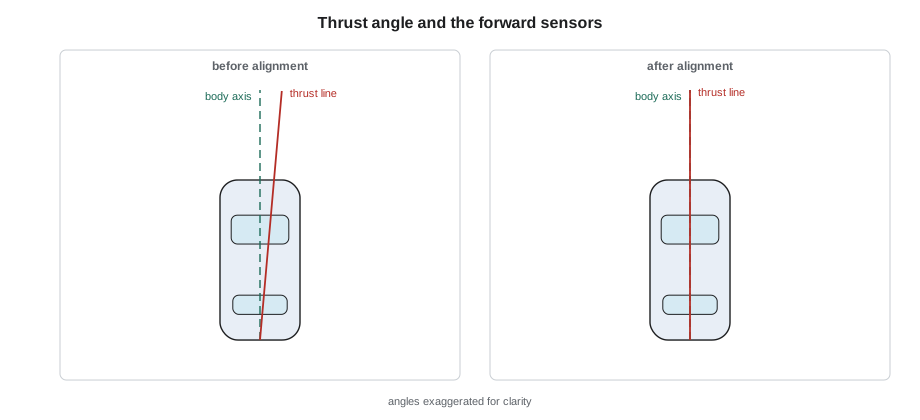
Driver assistance sensors are aimed relative to the vehicle's body and thrust line, and they look through or sit behind the parts that collision, glass and suspension work replaces or moves. A collision can bend a sensor's bracket or the structure it mounts to, even when the cover in front shows only a scuff. A replaced bumper cover, grille or emblem changes the material the radar looks through and can sit a few millimeters differently. A replaced windshield moves the camera's bracket and changes the glass in its view. A wheel alignment changes the thrust line that the forward sensors use as straight ahead. A suspension repair or a new set of springs changes the ride height and so the sensors' pitch. And replacing a sensor or its module, or updating its software, usually erases or invalidates its stored calibration.
Not every one of those events requires a calibration on every vehicle. The vehicle maker decides, in position statements and in the service procedures for each repair. Many makers state that a calibration is required after any windshield replacement, any removal of the sensor or its bracket, any collision near a sensor, and any alignment that changes the thrust angle; some require a calibration after any alignment at all. Kiran's rule is that the maker's documents decide, and that a scan, before and after, finds what the documents might not mention.
Pre-repair and post-repair scans
A pre-repair scan, done before work begins, records every code in every module, including codes that were there before the damage and codes set by the damage itself. It tells the shop what systems are affected, what calibrations may follow, and what was wrong before the vehicle arrived. A post-repair scan, done after the repair and any calibrations, confirms that no codes remain and that each calibration status reads complete. Many makers now require both on collision repairs, and insurers increasingly expect them.
Van 3's pre-scan was a good example. The corner radar's misalignment code came from the collision and the new bracket. The steering angle sensor's offset came from the toe link replacement: with the rear toe changed, the van had a thrust angle, and the steering wheel sat off center when the van went straight, which the stability system had noticed. The forward camera's code was set by the body shop's own scan tool, which had cleared a list of codes at the end of the repair and in doing so reset the camera's calibration status on this model. Each needed its own fix, in the right order.
# Which calibrations does a job need? A simple trigger matrix (illustrative; the maker's documents decide)
triggers = {
    "windshield replaced":        ["forward camera"],
    "front bumper cover replaced": ["forward radar"],
    "rear bumper cover replaced":  ["rear corner radars", "parking sensors check"],
    "corner radar bracket replaced": ["that corner radar"],
    "alignment: thrust angle changed": ["steering angle sensor", "forward camera", "forward radar"],
    "rear toe link replaced":      ["alignment"],
    "side mirror replaced":        ["surround view"],
    "ride height changed":         ["forward camera", "forward radar", "headlamp aim"],
}
job = ["rear bumper cover replaced", "corner radar bracket replaced", "rear toe link replaced",
       "alignment: thrust angle changed"]
needed = []
for event in job:
    for item in triggers[event]:
        if item not in needed:
            needed.append(item)
print("work needed, in the order found:")
for k, item in enumerate(needed, 1):
print(f"{k}. {item}")work needed, in the order found: 1. rear corner radars 2. parking sensors check 3. that corner radar 4. alignment 5. steering angle sensor 6. forward camera 7. forward radar
Putting the work in order
Calibrations depend on each other and on the vehicle's mechanical condition, so the order matters. The usual sequence is: mechanical repairs first, including suspension and structural repairs; then the wheel alignment, with the thrust angle set within specification; then the steering angle sensor calibration, so that the stability system and lane features know where straight ahead is; then the forward sensor calibrations, which use the thrust line as their reference; then the other sensor calibrations; and finally the post-repair scan and a road test. Some makers add specific orders, for example calibrating the radar before the camera, or the camera before the surround view.
Van 3 went through in that order. Kiran aligned the van, setting the rear toe on the new link and the front toe with the steering wheel straight, which brought the thrust angle from 0.42 degrees to 0.03 degrees. She calibrated the steering angle sensor with the scan tool. Then she ran the forward camera's dynamic calibration on her highway route, which completed in fourteen minutes. Last, she calibrated the right rear corner radar with the maker's static procedure: a radar target on a stand at a specified distance and angle from the rear corner, positioned using the van's centerline and rear axle as references. The post-scan was clean, and on a road test with Theo in a shop car the blind spot lights came on as he passed on either side.
# Thrust angle: how far the vehicle's travel drifts from a sensor aimed along the centerline
import math
for thrust_deg in (0.05, 0.15, 0.30, 0.42):
    for d in (165, 330):
        off = d * math.tan(math.radians(thrust_deg))
        print(f"thrust angle {thrust_deg:4.2f} deg: {d:3} ft ahead, {off:4.1f} ft off the centerline")
print()thrust angle 0.05 deg: 165 ft ahead, 0.1 ft off the centerline thrust angle 0.05 deg: 330 ft ahead, 0.3 ft off the centerline thrust angle 0.15 deg: 165 ft ahead, 0.4 ft off the centerline thrust angle 0.15 deg: 330 ft ahead, 0.9 ft off the centerline thrust angle 0.30 deg: 165 ft ahead, 0.9 ft off the centerline thrust angle 0.30 deg: 330 ft ahead, 1.7 ft off the centerline thrust angle 0.42 deg: 165 ft ahead, 1.2 ft off the centerline thrust angle 0.42 deg: 330 ft ahead, 2.4 ft off the centerline
Glass replacement
Windshield replacement is the single most common event requiring a forward camera calibration. Beyond the calibration itself, the glass must be right. The replacement windshield must be the correct part for the vehicle's equipment: a vehicle with a camera needs glass with the camera bracket in the correct place, the correct frit and viewing area, the correct thickness and optical quality in the camera's view, and often a heated area, an acoustic layer, a rain sensor pad and a head-up display zone. Many makers specify their own glass or glass meeting their specifications, and some warn that aftermarket glass may not allow the camera to calibrate or may calibrate but perform poorly. The bracket must be bonded in exactly the right place, so many replacement windshields come with the bracket already attached at the factory.
Ridgeline does not install glass, but it calibrates after glass shops do, and Kiran checks the glass before every calibration: the part markings in the corner of the glass identify the maker and model; the bracket position and the camera's seating are compared with the service information; and the camera's view through the glass is checked for distortion, haze or debris trapped in the bracket area. A calibration that fails repeatedly with angles outside the module's range on a newly replaced windshield usually points to the glass or the bracket, not the camera.
Alignments, ride height and suspension
Every alignment at Ridgeline now starts with a question: does this vehicle have forward sensors, and what does the maker say about calibration after an alignment? Some makers require a steering angle sensor reset after any alignment, and a camera or radar calibration only if the thrust angle changed by more than a set amount; others require the full set after any alignment. The alignment printout, saved with the repair order, shows the thrust angle before and after, which is the evidence the calibration decision rests on.
Ride height changes count too. A lift kit, a leveling kit, new springs, worn springs replaced on one axle, air suspension faults or a heavy permanent load such as a service body or a plow mount all change the angle at which the forward camera and radar look at the road. Gord's question about a leveling kit for his new pickup got a careful answer: the maker's procedure would require a forward camera and radar calibration after the kit, the headlamps would need re-aiming, and some kits move the vehicle outside the calibration routine's allowed range altogether.
| Event | Sensors usually affected | Why |
|---|---|---|
| Windshield replacement | Forward camera | Bracket and glass in the camera's view change |
| Front bumper, grille or emblem replacement | Forward radar, front parking sensors, front camera | Material and position in front of the sensors change |
| Rear bumper or quarter repair | Rear corner radars, parking sensors, rear camera | Brackets and covers near the sensors |
| Wheel alignment | Steering angle sensor, forward camera and radar | The thrust line is the reference for straight ahead |
| Suspension or ride height change | Forward camera and radar, headlamp aim | Sensor pitch changes |
| Mirror, tailgate or camera replacement | Surround view, rear camera | Camera position and angle change |
| Sensor or module replacement or update | That sensor and often others | Stored calibration erased or invalid |
Working with body and glass shops
Many of Ridgeline's calibrations come from vehicles repaired elsewhere, and the van 3 job showed how information gets lost between shops. Kiran's intake for a vehicle arriving for calibration after outside repairs now asks for the other shop's repair order or a list of the operations performed: which parts were replaced or repaired, whether the vehicle was on a frame machine, whether suspension parts were replaced, whether the bumper cover was refinished over a radar area and to what paint thickness, and which codes were cleared. She also asks for the glass part number after a windshield job. The answers decide whether an alignment is needed first, which sensors to inspect and calibrate, and whether the repaired parts are fit to calibrate at all.
Worked problem
Is the thrust angle small enough?
Before alignment, van 3's rear toe readings were left +0.118 in toe-in and right −0.307 in toe-out, measured over a 29.1 in reference diameter. Estimate the thrust angle.
Show solution
- Convert each toe reading to an angle: arctan(toe ÷ reference diameter).
- Left: arctan(0.118 ÷ 29.1) = +0.23 degrees. Right: arctan(−0.307 ÷ 29.1) = −0.60 degrees.
- Thrust angle = (left − right) ÷ 2 = (0.23 − (−0.60)) ÷ 2 = 0.42 degrees.
Answer: About 0.42 degrees, matching the alignment machine and far outside a typical 0.1 degree limit, so the alignment came first.
Estimating calibration work
Simone's estimates for jobs that may trigger calibrations now list them before the work begins. A windshield job includes the forward camera calibration; an alignment on a vehicle with forward sensors includes the steering angle sensor calibration and, if the maker requires it, the forward camera and radar calibrations; a bumper repair includes the sensors behind it. She also warns customers that dynamic calibrations depend on the weather and road conditions, so a vehicle may need to stay longer in winter, and that a calibration can fail because of a part supplied by someone else, such as glass with a misplaced bracket, in which case the cause must be fixed first. Customers who hear this at the estimate rarely object; customers who hear it at pickup often do.
Common mistakes
MistakeCalibrating a radar or camera before the alignment.
InsteadDo mechanical repairs, alignment and steering angle calibration first.
MistakeClearing all codes at the end of a repair without checking.
InsteadClearing codes can reset calibration status on some vehicles; post-scan and read every module.
MistakeAccepting any windshield that fits the opening.
InsteadCheck the part, the bracket and the camera's view before calibrating.
MistakeSkipping the question of calibration on every alignment.
InsteadCheck the maker's requirements and save the thrust angle readings.
MistakeIgnoring ride height changes from kits, springs or loads.
InsteadThey change sensor pitch and may require calibration or be outside its range.
Summary and key terms
- Collisions, bumper and grille work, glass replacement, alignments, ride height changes and sensor replacement can all require calibration.
- The maker's position statements and procedures decide what each job needs.
- Pre-repair and post-repair scans find affected systems and confirm the repair is complete.
- Order the work: mechanical repairs, alignment, steering angle sensor, forward sensors, other sensors, post-scan, road test.
- Forward sensors are calibrated to the thrust line, so a thrust angle must be corrected first.
- Replacement glass must match the camera's requirements, and the bracket must be correctly placed.
- Vehicles repaired elsewhere need the other shop's repair details before calibration.
- Pre-repair scan
- A scan of all modules before work begins, recording existing and damage-related codes.
- Post-repair scan
- A scan after the repair and calibrations, confirming no codes remain.
- Thrust angle
- The angle between the thrust line and the geometric centerline of the vehicle.
- Steering angle sensor calibration
- Teaching the sensor the steering position that makes the vehicle go straight.
- Camera bracket
- The mount bonded to the windshield that holds the forward camera.
- Repair sequence
- The order in which repairs, alignment and calibrations are done.
Practice problems
Work each problem on paper first, then reveal the answer to check.
Why did van 3's forward camera have a code?
Show answer
The body shop's scan tool had cleared codes, resetting the camera's calibration status.
Why did van 3 need an alignment before any calibration?
Show answer
A replaced rear toe link left a thrust angle, which is the reference for the forward sensors.
What should Kiran ask a glass shop after a windshield job?
Show answer
The glass part number, and she checks the bracket position and the camera's view.
Why might a leveling kit be a problem for calibration?
Show answer
It changes sensor pitch and may move the vehicle outside the routine's allowed range.
Lesson quiz · 5 questions
Score 60% or more to complete this lesson.
Create a free account to save your progress, take quizzes and earn a certificate.