
AUTO-420 · Lesson 12 of 12 · 20 min
Capstone: windshield replacement and a lane-keeping complaint
Ines Moreau's hybrid came back to Ridgeline in November with a new windshield and two problems. The glass shop had replaced the cracked windshield the week before and sent her to Ridgeline for the camera calibration, as Kiran had arranged. And Ines had a complaint she had been living with for a while. "Since that pothole in the spring, the lane keeping pulls me toward the left line on the highway. It's gentle, but I can feel it fighting me, and on long airport runs it's tiring. I thought it was the old windshield. Maybe the calibration will fix it?"
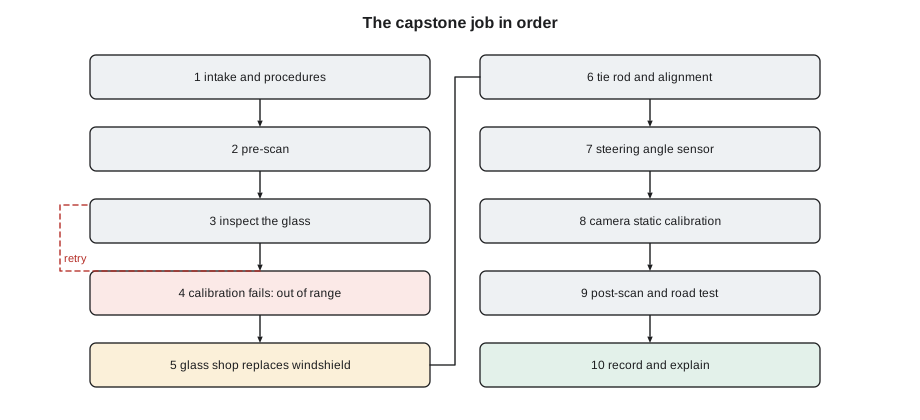
This capstone follows the whole job, which Kiran ran with Marty checking her work at each stage: the intake and the information, the pre-scan, the inspection of the glass, a failed first calibration, the diagnosis of the lane-keeping complaint, the alignment and steering work, the calibrations, the verification, the record and the conversation with Ines. It draws on every lesson in the course.
Intake and information
Simone's intake notes captured the essentials: the windshield replaced the previous Tuesday by an outside glass shop, the glass shop's invoice with the part number, the lane-keeping complaint with its history since the spring pothole, and Ines's description of the feel. Kiran added the vehicle's details from the build data: forward camera behind the windshield, forward radar behind the grille emblem, lane keeping assist and lane centering with adaptive cruise, automatic emergency braking with pedestrian detection, and no corner radars. The previous visits in the shop's records added two more facts: the camera light shield repair in April, and struts and a camber correction bolt on the front from the suspension course work the year before.
The maker's service information for the model listed the forward camera calibration as static, with the maker's target, after any windshield replacement; a steering angle sensor calibration after any alignment or steering component replacement; and a forward camera calibration after any alignment that changed the thrust angle or toe. Kiran printed the procedures and attached them to the repair order. The estimate Simone gave Ines covered the calibration and a diagnostic hour for the lane-keeping complaint, with a note that alignment or steering repairs might follow.
Pre-scan and inspection
The pre-scan showed the forward camera with a code for calibration not performed, expected after a windshield replacement, and nothing else in the camera or radar. The steering system had no codes, but the steering angle sensor's live data read 5.8 degrees to the left with the steering wheel held so that the car's front wheels pointed straight ahead on the alignment rack's turn plates. The stability system had no codes, but a history note recorded a stored plausibility event between the steering angle and yaw rate months earlier.
The glass came next. The part markings identified an aftermarket windshield listed for the model, and the camera bracket was bonded in place. But when Kiran compared the bracket's position with the service information's dimensions from the top edge and the centerline of the glass, the bracket sat 0.16 in lower than specified and slightly rotated. The camera's view through the glass looked clear, without distortion or haze. She photographed the bracket with a steel rule in place before going further.
The first calibration
Kiran ran the static calibration anyway, partly to see what the module would say, with the car prepared, the floor and lighting checked and the target set at the specified distance and height. The routine failed with a message that the camera's pitch was outside the allowed range. The bracket's low, rotated position tilted the camera down and to one side beyond what the module could correct electronically. That is not a calibration problem; it is a parts problem.
She called the glass shop with the photographs and the routine's result. The glass shop's manager agreed to replace the windshield at their cost with glass meeting the maker's specification, with the bracket installed at the factory, and brought the car back to their shop the next morning. It returned that afternoon. The new glass's bracket position matched the specification within 0.02 in.
The lane-keeping complaint
Kiran did not assume the windshield caused the pull. The steering angle reading of 5.8 degrees with the wheels straight was the first clue: the steering wheel sat off center when the car went straight, so the lane keeping system, which uses the steering angle and the camera's view of the lane, thought the driver was steering left whenever she drove straight, and its corrections and centering target were off. The second clue was the spring pothole. On the alignment rack, the readings showed it.
| Reading | Specification | Before | After |
|---|---|---|---|
| Front camber, left / right | −0.5° ± 0.5° | −0.6° / −0.4° | −0.6° / −0.5° |
| Front toe, left / right | +0.05° ± 0.10° | +0.42° / −0.12° | +0.05° / +0.05° |
| Rear toe, left / right | +0.15° ± 0.15° | +0.17° / +0.11° | +0.17° / +0.11° |
| Thrust angle | 0.00° ± 0.10° | +0.03° | +0.03° |
| Steering wheel angle with wheels straight | 0° ± 2° | 5.8° left | 0.3° left |
The rear was within specification and the thrust angle was small, but the front toe was split badly between the two sides and the steering wheel was well off center. Kiran checked the steering components before adjusting anything, because adjusting toe to hide a bent part leaves the steering geometry wrong. The left outer tie rod was bent, visibly so once she sighted along it against a straight edge, almost certainly from the pothole. With Ines's approval by phone, Ridgeline replaced the left outer tie rod, set the toe on both sides with the steering wheel locked straight, and centered the wheel.
# Steering wheel offset from a toe split (approximation): how far off center the wheel sits
ratio = 21.5                 # overall steering ratio, steering wheel degrees per road wheel degree
toe_l, toe_r = 0.42, -0.12  # front toe, degrees per wheel, before
split = (toe_l - toe_r) / 2
print(f"toe split between the wheels: {split:.2f} degrees of road wheel angle")
print(f"steering wheel off center by about {split * ratio:.1f} degrees")
toe_l2, toe_r2 = 0.05, 0.05
print(f"after: split {(toe_l2 - toe_r2) / 2:.2f} degrees, wheel off by about {(toe_l2 - toe_r2) / 2 * ratio:.1f} degrees")toe split between the wheels: 0.27 degrees of road wheel angle steering wheel off center by about 5.8 degrees after: split 0.00 degrees, wheel off by about 0.0 degrees
The calibrations in order
With the mechanical work done, the order followed the course: alignment complete, then the steering angle sensor calibration, then the forward camera calibration. The steering angle sensor routine took two minutes on the scan tool with the wheels straight and the vehicle stationary, and afterward the live reading was 0.3 degrees left with the wheels straight, inside the ±2 degree specification. Kiran then reset the car on the calibration area: tire pressures at the placard, a full tank, the cargo area emptied of Ines's rideshare water bottles and phone chargers, the battery support unit connected, the bay door closed and the lighting even.
The target went at the specified distance from the front wheel centers and the specified height, centered on the thrust line with the rear-wheel lasers and squared until the distances from the front hubs to the frame ends agreed within 0.08 in. The routine passed, reporting pitch, yaw and roll angles close to the middle of their allowed ranges, a good sign that the camera and the new bracket sat where the maker intended.
# Final verification checklist for the job
checks = [
    ("post-scan: no codes in any module", True),
    ("forward camera calibration status complete", True),
    ("steering angle within 2 degrees with wheels straight", True),
    ("lane lines detected on the cluster on a marked road", True),
    ("lane keeping corrects equally toward both lines", True),
    ("lane centering holds the center without pulling, 20 minutes", True),
    ("adaptive cruise follows a lead vehicle and shows it", True),
    ("vehicle tracks straight with the steering wheel straight", True),
]
for item, ok in checks:
    print(f"[{'x' if ok else ' '}] {item}")
print("job complete" if all(ok for _, ok in checks) else "job not complete")[x] post-scan: no codes in any module [x] forward camera calibration status complete [x] steering angle within 2 degrees with wheels straight [x] lane lines detected on the cluster on a marked road [x] lane keeping corrects equally toward both lines [x] lane centering holds the center without pulling, 20 minutes [x] adaptive cruise follows a lead vehicle and shows it [x] vehicle tracks straight with the steering wheel straight job complete
Verification
The post-scan showed no codes in any module, with the camera's calibration status complete. Kiran's road test used the same highway route she uses for dynamic calibrations, on a dry afternoon with fresh markings. With the steering wheel straight, the car tracked straight. Lane keeping corrected gently and equally when she let the car drift toward each line, and lane centering with adaptive cruise held the middle of the lane for twenty minutes without the left-hand pull Ines had described. Adaptive cruise followed a lead vehicle and the cluster showed it. She recorded the results, the route, the weather and the time.
One item she could not verify directly was automatic emergency braking. As always, she confirmed its status was ready, that the forward collision display showed the vehicle ahead, and that the system reported no faults, and she noted that on the record.
The record and the invoice
The repair order told the whole story in order: the complaint and history, the maker's procedures with their sources, the pre-scan report, the glass inspection with photographs and the measured bracket position, the failed first calibration and its message, the glass shop's replacement of the windshield, the alignment readings before and after, the bent tie rod and its replacement, the steering angle sensor calibration and its result, the calibration area check and vehicle preparation, the camera calibration and its angles, the post-scan, and the road test notes. Bev reviewed it as the shop's first complete capstone-style ADAS job and used it as the template for the ADAS log.
# The invoice for Ridgeline's part of the job (rates and times illustrative)
rate = 155
lines = [
    ("diagnose lane-keeping complaint", 1.0, 0.0),
    ("replace left outer tie rod, align", 1.6, 64.0),
    ("steering angle sensor calibration", 0.3, 0.0),
    ("forward camera static calibration (second attempt)", 1.0, 0.0),
]
labor = sum(h for _, h, _ in lines) * rate
parts = sum(p for _, _, p in lines)
for name, h, p in lines:
    print(f"{name:52} {h:3.1f} h  parts {p:7.2f}")
tax = 0.0915 * parts
print(f"labor {labor:8.2f}  parts {parts:7.2f}  sales tax {tax:7.2f}")
print(f"total USD {labor + parts + tax:8.2f}")
print("first calibration attempt and glass replacement: covered by the glass shop")diagnose lane-keeping complaint 1.0 h parts 0.00 replace left outer tie rod, align 1.6 h parts 64.00 steering angle sensor calibration 0.3 h parts 0.00 forward camera static calibration (second attempt) 1.0 h parts 0.00 labor 604.50 parts 64.00 sales tax 5.86 total USD 674.36 first calibration attempt and glass replacement: covered by the glass shop
The first calibration attempt was not charged to Ines, because it failed for a reason outside her control, and the glass shop agreed to pay for Ridgeline's time on it. The invoice showed the diagnosis, the tie rod and alignment, the steering angle sensor calibration and the camera calibration.
Explaining it to Ines
Kiran explained the job to Ines in plain terms, with the alignment printout and the photographs. The new windshield's camera mount had been in the wrong place, so the camera could not be calibrated; the glass shop had replaced the windshield, and the camera was now calibrated and working. The lane-keeping pull had nothing to do with the windshield. The pothole in the spring had bent a steering part, which left her steering wheel turned when the car went straight, and the lane keeping had been fighting that ever since. With the part replaced, the alignment set and the systems recalibrated in the right order, the car went straight with the wheel straight, and lane keeping worked equally both ways.
Ines asked what she should watch for. Kiran's answer covered the course in four lines: a message that a feature is unavailable deserves attention; any windshield, bumper or alignment work should end with the calibrations the maker requires, done in the right order; a hard pothole is worth an alignment check on a car that steers itself; and the systems help her but do not replace her attention, especially on snowy roads where they cannot see the lines.
Worked problem
How long was the lane keeping fighting the steering?
On a 2.5 hour round trip to the airport at 62 mph, the lane centering applied a small steady torque to correct the off-center steering. If the driver felt and resisted it about once every 1.2 miles, how many corrections did Ines feel on each trip?
Show solution
- Distance: 2.5 h × 62 mph = 155 miles.
- Corrections: 155 ÷ 1.2 = 129.
- That is well over a hundred small corrections each trip.
Answer: Over a hundred noticeable corrections per trip, which is why she found the long runs tiring, and why the real cause was worth finding rather than living with.
Common mistakes
MistakeAssuming the windshield caused every camera-related complaint.
InsteadCheck the steering angle, alignment and history as well.
MistakeRepeating a failed calibration without finding why it failed.
InsteadOut-of-range angles point to the glass, the bracket or the vehicle's condition.
MistakeAdjusting toe to hide a bent steering part.
InsteadInspect and replace bent components before setting the alignment.
MistakeCalibrating the camera before the steering angle sensor.
InsteadFollow the order: mechanical work, alignment, steering angle, then the camera.
MistakeLeaving out what could not be verified.
InsteadRecord each feature's status and any limits on the repair order.
Summary and key terms
- The capstone combined a windshield calibration with a lane-keeping complaint caused by something else.
- The pre-scan, history and steering angle reading pointed to the steering and alignment.
- A misplaced camera bracket on aftermarket glass made the first calibration fail out of range.
- A bent tie rod from a pothole left the steering wheel off center when the car went straight.
- The work followed the order: tie rod, alignment, steering angle sensor, camera calibration.
- Verification included a post-scan and a road test of lane keeping, centering and adaptive cruise.
- The record, the invoice and the explanation to the customer completed the job.
- Steering angle offset
- The steering wheel angle reported when the vehicle travels straight; ideally close to zero.
- Toe split
- A difference in toe between the left and right wheels that turns the steering wheel off center.
- Bracket position
- The camera bracket's location on the windshield, which must match the maker's dimensions.
- Out-of-range result
- A calibration result in which the measured angles exceed what the module can correct.
- ADAS log
- Ridgeline's record of every driver assistance job, scan, calibration and road test.
- Verification road test
- A drive that confirms each affected feature works correctly after the repair.
Practice problems
Work each problem on paper first, then reveal the answer to check.
Why did the first camera calibration fail?
Show answer
The aftermarket windshield's bracket was 0.16 in low and rotated, so the camera's pitch was out of range.
What clue in the pre-scan pointed to the steering?
Show answer
The steering angle sensor read 5.8 degrees left with the wheels straight.
What part did the pothole damage?
Show answer
The left outer tie rod, which was bent.
In what order was the work done?
Show answer
Tie rod, alignment, steering angle sensor calibration, camera calibration, post-scan and road test.
Lesson quiz · 5 questions
Score 60% or more to complete this lesson.
Create a free account to save your progress, take quizzes and earn a certificate.