
AUTO-420 · Lesson 3 of 12 · 20 min
Radar: long-range, corner and short-range
The first heavy snow of the season fell on a Tuesday, and by Wednesday morning Hal Osei had called twice. Two of his gas courier vans had shown "front radar blocked, cruise and collision assist unavailable" on the morning route, and one driver had pulled over to scrape a fist-sized cake of slush off the front of the van. On the third van, Leah Mercer's, the message stayed on even after she cleaned the bumper. Hal wanted to know whether he had three problems or one.
He had two. Kiran's road test of Leah's van with the bumper clean still showed the message, and the scan showed a misalignment code set the previous week, the day Leah had bumped a loading dock bollard. The other two vans had nothing wrong at all: their radars had been doing exactly what they were designed to do in heavy wet snow. This lesson explains how automotive radar works, the long-range, corner and short-range radars used for driver assistance, what blocks and misaims them, and how a technician inspects them.
How automotive radar works
Radar sends out radio waves and measures the echoes that come back from objects. Automotive radars for driver assistance work in the 76 to 81 gigahertz band, where the wavelength is about four millimeters. That short wavelength allows small antennas, built as patterns on a circuit board, and fine resolution. Most automotive radars use frequency-modulated continuous waves: the transmitter sweeps its frequency up and down in rapid ramps, and the receiver compares the frequency of each echo with the frequency being transmitted at that moment. The difference depends on how long the echo took to return, which gives the range, and on the object's speed toward or away from the radar, through the Doppler shift, which gives the relative speed directly.
Several receiving antennas side by side let the radar measure the angle to each echo by comparing when the wave arrives at each one. Newer imaging radars use many more antennas and can also measure elevation, which helps them tell a stopped car from an overhead sign or a bridge.
# Radar range from echo time, and Doppler shift from relative speed
c = 299_792_458.0          # m/s
f0 = 77e9                  # Hz
for t_ns in (200, 667, 1334):
    r = c * t_ns * 1e-9 / 2
    print(f"echo after {t_ns:5} ns: target at {r * 3.281:6.0f} ft")
for dv in (6, 30, 60):
    v = dv * 0.44704
    fd = 2 * v * f0 / c
print(f"closing speed {dv:3} mph: Doppler shift {fd / 1000:.1f} kHz")echo after 200 ns: target at 98 ft echo after 667 ns: target at 328 ft echo after 1334 ns: target at 656 ft closing speed 6 mph: Doppler shift 1.4 kHz closing speed 30 mph: Doppler shift 6.9 kHz closing speed 60 mph: Doppler shift 13.8 kHz
Radar's strengths are the opposite of a camera's weaknesses. It works in darkness, glare, fog and most rain and snow, and it measures distance and relative speed directly and precisely. Its weaknesses are classification and resolution: a radar sees a stopped car, a steel plate on the road and a metal sign as similar echoes, and it struggles to tell two objects close together apart. That is why most forward systems combine a radar with a camera.
Long-range, corner and short-range radars
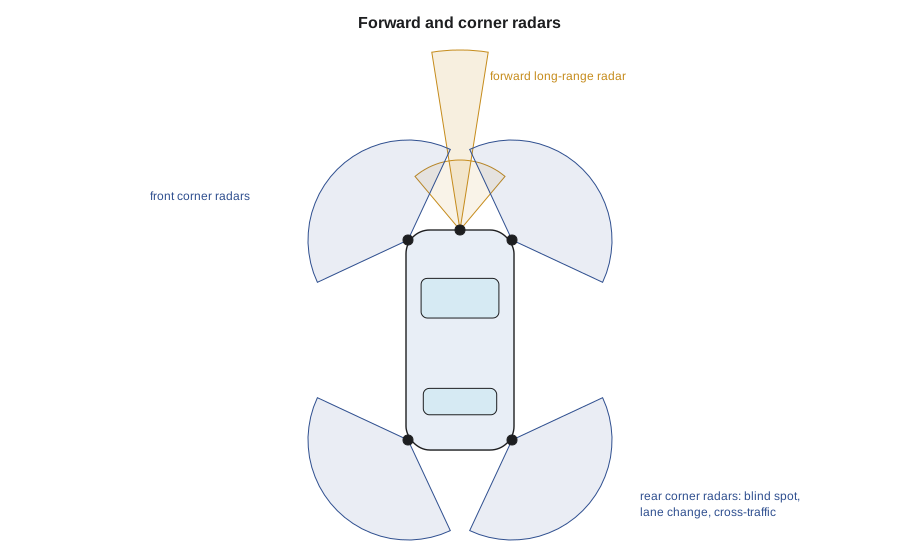
The forward, long-range radar sits behind the grille emblem, behind a flat area of the front bumper cover or low in the lower grille. It looks straight ahead in a beam that is narrow at long range and wider close to the vehicle, and it sees vehicles 150 to 250 meters away. Adaptive cruise control and automatic emergency braking depend on it. The bumper cover or emblem in front of it is designed to be nearly transparent to radar: it has a controlled thickness and a paint or plating system chosen for radar, which is why many makers forbid painting over the radar area, adding stickers or fitting an aftermarket emblem or grille guard.
Corner radars sit behind the four corners of the bumper covers. The rear pair power blind spot warning, lane change assist and rear cross-traffic alert; the front pair, on vehicles that have them, add front cross-traffic alert and help automatic emergency braking at intersections. They have wide fields of view, typically 120 to 150 degrees, and shorter range. Because they sit right behind the corners of the bumpers, they are the sensors most often disturbed by minor collisions, parking bumps and bumper repairs.
Short-range radars, sometimes called ultra-short-range, are used on some vehicles for parking and low-speed maneuvering in place of or alongside ultrasonic sensors. Inside the cabin, some vehicles use a small radar to detect a child or pet left in a rear seat.
| Radar | Usual position | Typical range | Field of view | Features |
|---|---|---|---|---|
| Forward long-range | Behind the emblem, grille or front bumper | 150 to 250 m (500 to 820 ft) | About 10 to 20 degrees far; wider near | Adaptive cruise, AEB, forward collision warning |
| Front corner | Front bumper corners | Up to about 80 m (260 ft) | 120 to 150 degrees | Front cross-traffic, intersection AEB |
| Rear corner | Rear bumper corners | Up to about 80 m (260 ft) | 120 to 150 degrees | Blind spot, lane change assist, rear cross-traffic |
| Short-range | Bumper covers | A few meters | Wide | Parking, low-speed maneuvering |
What blocks a radar
Radar passes through plastic and paint, but not through everything. Water absorbs millimeter waves strongly, so a film of slush, a cake of wet snow or ice on the bumper cover in front of the radar blocks it. Mud, road salt crust and a layer of insects can do the same. Metal reflects radar completely, so a metal license plate frame in the wrong place, a winter grille cover, a bull bar, a bike rack or an aftermarket emblem with metallic paint can blind it. And because the bumper cover is part of the radar's path, a repaired cover with too much filler or several layers of paint, or a cover from a different model, can distort or weaken the beam.
The radar knows when it is blocked. If it sees almost no echoes, or echoes that do not change as the vehicle moves, or a sudden drop in signal strength from objects it should see, it decides it is blocked and disables the features that depend on it, with a message to the driver. That is what Hal's two vans did. Once the snow was cleared, or melted, the messages went away. Kiran told Hal that a soft brush in each van's door pocket would do more good than any repair.
Leah's van was different. Its message stayed on with a clean bumper, and the code was not a blockage code but a misalignment code. The radar had decided that its aim had changed.
Misalignment
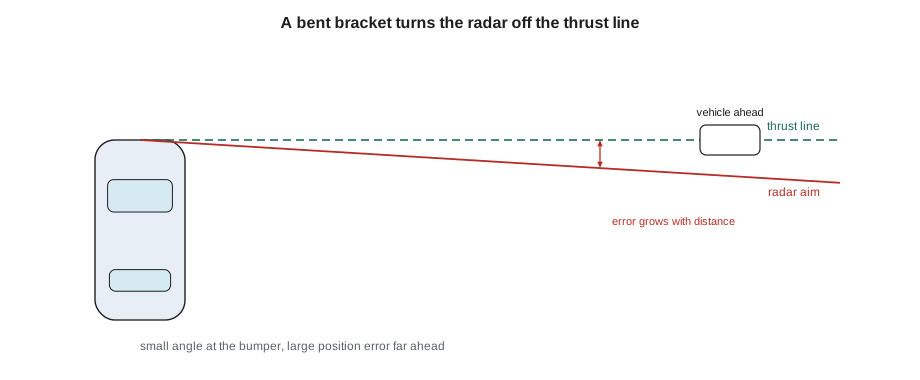
A radar is mounted on a bracket bolted to the bumper reinforcement or the bumper cover, and it is aimed during manufacture to point straight along the vehicle's thrust line, with a set vertical angle. Many radars also monitor their own aim while driving. As the vehicle passes roadside objects, guardrails and other vehicles, the radar compares the paths of those echoes with the path the vehicle is taking. If the objects consistently seem to drift to one side, the radar concludes that it is aimed off by some angle. Small errors it can correct on its own, within a window set by the maker. Larger ones it flags with a code and disables its features until it is realigned.
On Leah's van, the bumper had touched the bollard on the right side. The bumper cover showed only a scuff, but behind it the radar bracket had bent a few degrees, and the radar now pointed slightly to the left. Its own measurement, read on the scan tool, put its horizontal misalignment at 2.8 degrees, outside its 2.0 degree self-correction window. The repair was a new bracket and a static radar alignment, which the calibration lessons cover. Kiran wrote up one more item: the van's driver had reported the bump, and nobody had connected it to the radar until the message appeared a week later.
# Radar horizontal misalignment from a measured offset (static check with a reflector)
import math
dist = 6.56          # distance from the radar to the reflector
offset = 0.32        # sideways offset of the strongest return from the thrust line, same units
ang = math.degrees(math.atan(offset / dist))
print(f"misalignment: {ang:.2f} degrees")
limit = 2.0
print("within self-correction window" if abs(ang) <= limit else "outside window: replace bracket if bent, then align")
for d in (165, 330, 490):
print(f"at {d:3} ft that error places a target {d * math.tan(math.radians(ang)):.1f} ft to the side")misalignment: 2.79 degrees outside window: replace bracket if bent, then align at 165 ft that error places a target 8.0 ft to the side at 330 ft that error places a target 16.1 ft to the side at 490 ft that error places a target 23.9 ft to the side
A radar can also be misaligned vertically, for example after a front-end collision pushes the bumper reinforcement up or down, or after a suspension change alters the vehicle's ride height. A radar aimed too high may miss low obstacles and see bridges as obstacles; one aimed too low may react to the road surface, manhole covers or expansion joints. Vertical aim is usually set mechanically with an adjusting screw and checked with a level or the maker's alignment tool.
Inspecting radars
Kiran's radar inspection follows the same order as for cameras: view, mounting, connections, data. The view is the bumper cover, emblem or grille area in front of the radar: clean, undamaged, original or a correct replacement, unpainted or correctly refinished within the maker's limits, and free of plates, guards, racks and stickers. The mounting is the radar and its bracket: tight, undamaged, with no broken tabs and no sign that the bracket has been bent back by hand. The connections are the connector and wiring, which on corner radars are often routed along the bumper cover and get pinched or stretched in bumper repairs. The data includes codes, alignment status, the radar's own misalignment estimates and, on some makes, its blockage counters and temperature.
Bumper repairs deserve special care. Many makers limit the paint thickness in front of a radar, specify which repairs are allowed in the radar area, and forbid filler or plastic repair there altogether. A body shop that repairs a bumper cover over a corner radar may need the maker's paint film thickness limit, and Ridgeline's checks on returning collision-repaired vehicles include asking which bumper repairs were done.
Worked problem
Is the radar aimed correctly?
During a static check, the strongest return from a reflector placed 9.84 ft in front of a radar on the thrust line appears 0.26 ft to the left. What is the horizontal misalignment?
Show solution
- Angle = arctan(offset ÷ distance).
- 0.26 ÷ 9.84 = 0.0264.
- arctan(0.0264) = 1.5 degrees, to the left.
Answer: About 1.5 degrees to the left, inside a 2.0 degree self-correction window but worth checking the bracket for damage before relying on the radar to correct it.
Radars and the customer
Kiran's notes for radar complaints include what to tell the customer, because most radar visits start with a message on the dash. A blockage message that clears when the bumper is cleaned is the system protecting itself, and the fix is a soft brush, not a part. A message that stays on after cleaning, or that appeared after a bump, a bumper repair or an accessory installation, needs an inspection. And any change in front of the radar, such as a new emblem, a winter grille cover, a plate frame or a bull bar, deserves a question before it is fitted. Hal's drivers now carry a brush in each van, and his fleet sheet lists the radar area as a check on the morning walk-around in winter.
She also records the radar's own data on every visit, even when nothing is wrong: the self-alignment angles, the blockage counters and the software level. A trend of slowly growing misalignment on a van that has not been in a collision points to a loose bracket or a mounting that is settling, and a record from a healthy visit makes the next diagnosis faster.
Common mistakes
MistakeReplacing a radar for a blockage message in snow.
InsteadClean the bumper and road test; blockage messages often mean the system is working correctly.
MistakeIgnoring a parking bump or minor collision on a vehicle with corner radars.
InsteadInspect the brackets and check alignment status.
MistakePainting or filling the bumper area in front of a radar.
InsteadFollow the maker's limits on repairs and paint thickness there.
MistakeBending a radar bracket back into shape.
InsteadReplace a damaged bracket, then align the radar.
MistakeFitting metal plate frames, grille covers or emblems in front of a radar.
InsteadKeep the radar's path clear of metal and non-approved parts.
Summary and key terms
- Automotive radars work at 76 to 81 GHz and measure range from echo timing and relative speed from the Doppler shift.
- Radar works in darkness and most weather but classifies objects poorly, so it is usually paired with a camera.
- The forward long-range radar sees 150 to 250 m ahead; corner radars cover the sides and rear with wide beams.
- Water, slush, ice, mud and metal block radar; a blocked radar disables its features until it clears.
- Radars monitor their own aim and correct small errors; larger errors set codes and require alignment.
- Minor bumps can bend radar brackets without visible bumper damage.
- Inspection covers the cover or emblem in front, the bracket, the wiring and the radar's own data.
- FMCW radar
- Frequency-modulated continuous wave radar, which sweeps its frequency to measure range and speed.
- Doppler shift
- The change in an echo's frequency caused by the target's relative speed.
- Corner radar
- A wide-angle radar behind a bumper corner, used for blind spot and cross-traffic features.
- Radar blockage
- A condition in which snow, ice, dirt or metal stops the radar from seeing, so its features switch off.
- Radar misalignment
- A difference between the radar's actual aim and the aim the module expects.
- Radome
- The cover, emblem or bumper area in front of a radar that radio waves pass through.
Practice problems
Work each problem on paper first, then reveal the answer to check.
Why did two of Hal's vans lose cruise and collision assist in heavy snow?
Show answer
Wet snow on the bumper blocked their radars; the system switched the features off as designed.
Why did Leah's van keep its message with a clean bumper?
Show answer
A bumped bollard had bent the radar bracket, misaligning the radar by 2.8 degrees.
What does a radar measure directly that a single camera cannot?
Show answer
Distance and relative speed.
Name three things that can block a radar.
Show answer
Slush or ice, mud or salt crust, and metal parts such as plate frames or grille covers.
Lesson quiz · 5 questions
Score 60% or more to complete this lesson.
Create a free account to save your progress, take quizzes and earn a certificate.