
AUTO-310 · Lesson 7 of 12 · 22 min
Automatic transmission service and diagnosis
Gord Haney's pickup is the first job on Kiran's list. He describes the trip carefully. Pulling his landscape trailer with a skid steer on it, he climbed the long grade of I-70 toward the Eisenhower Tunnel on a 90 °F day. About halfway up the dashboard showed a transmission temperature warning. He pulled over, let it cool, and finished the climb slowly. Since then the truck has a smell like hot oil after a drive, and at around 45 to 55 mph on light throttle it shudders, "like driving over the rumble strips". There are no warning lights now. Gord's question is the one every customer asks: "Is the transmission done?"
This lesson follows Kiran through a complete automatic transmission diagnosis on Gord's truck: verifying the complaint, checking fluid level and condition, reading codes and data, looking for known fixes, judging whether the problem is inside or outside the transmission, and servicing it. It also covers automatic transmission fluids, leaks, and how heat shortens a transmission's life.
A diagnostic order that saves transmissions
Marty's order for any automatic transmission complaint is always the same, and it starts with the cheapest and most likely causes. First, verify the complaint: drive the vehicle under the conditions the customer describes and feel it for yourself, with a scan tool recording. Second, check the fluid level and condition correctly. Third, read trouble codes, including history codes, from every module, and look at the transmission data. Fourth, check for technical service bulletins and software updates. Fifth, decide whether the problem is in the engine or its controls, in the transmission's electrical system, in its hydraulics or in its mechanical parts. Only then does anyone remove a pan, test pressures or talk about replacing a transmission. Many transmissions have been replaced for a misfire, a low fluid level, a faulty speed sensor or a software problem that a bulletin already described.
Kiran verifies Gord's complaint on the I-25 frontage roads with the scan tool recording. At 48 mph in fifth gear at light throttle, with the converter clutch commanded into controlled slip, she feels the shudder clearly, a vibration at about 10 to 12 cycles per second that goes away the moment she presses harder on the pedal or lifts off. The data shows why. The commanded converter clutch slip is a steady 40 rpm, but the actual slip is swinging between about 10 and 110 rpm several times a second. The clutch is grabbing and slipping, and that stick-slip is the shudder.
# Converter clutch shudder: actual slip swinging around the commanded slip (scan data, 20 ms samples)
import statistics
commanded = 40
samples = [38, 72, 108, 66, 12, 34, 90, 104, 48, 10, 44, 96, 110, 58, 14, 30, 88, 106, 52, 12]
mean = statistics.mean(samples)
swing = max(samples) - min(samples)
crossings = sum(1 for a, b in zip(samples, samples[1:]) if (a - commanded) * (b - commanded) < 0)
freq = crossings / 2 / (0.02 * (len(samples) - 1))
print(f"commanded {commanded} rpm, mean actual {mean:.0f} rpm, swing {swing} rpm")
print(f"about {freq:.0f} cycles per second: {'stick-slip shudder' if swing > 50 else 'steady control'}")commanded 40 rpm, mean actual 60 rpm, swing 100 rpm about 11 cycles per second: stick-slip shudder
Checking the fluid correctly
Fluid level matters so much in an automatic that the way it is checked is part of the design. Older transmissions have a dipstick and are checked with the engine idling, the transmission in park or neutral, and the fluid at normal operating temperature, with a hot and a cold range marked. Many newer ones, including Gord's, have no dipstick. The level is checked at a check plug or standpipe in the pan with the engine running, the vehicle level on a hoist, and the fluid within a specific temperature window, read on the scan tool, because the fluid expands as it warms. Fluid is added through a fill port until it just begins to drip from the check hole. A level checked outside the temperature window can be wrong by a quart or more, enough to cause slipping if low or foaming and leaks out of the vent if high.
Gord's fluid level is correct, but its condition is not. New fluid of this type is red and clear. His is dark brown and smells burnt, a sharp varnish smell different from the sweet smell of healthy fluid. A drop on a white paper towel spreads into a dark ring with a brown center. Fluid that has been seriously overheated loses the friction modifiers that let the converter clutch apply smoothly; the plates begin to grab and release, which is the shudder. The question now is whether the clutch plates themselves are damaged, or only the fluid.
# Automatic transmission fluid life against temperature (illustrative rule of thumb)
base_temp, base_life = 175, 100000     # fluid life at a normal operating temperature
halving_step = 20                    # life roughly halves for every step above base
for t in (175, 195, 212, 230, 250, 270):
    life = base_life / 2 ** ((t - base_temp) / halving_step)
print(f"fluid at {t} F: roughly {life:8,.0f} miles of life")fluid at 175 F: roughly 100,000 miles of life fluid at 195 F: roughly 50,000 miles of life fluid at 212 F: roughly 27,739 miles of life fluid at 230 F: roughly 14,865 miles of life fluid at 250 F: roughly 7,433 miles of life fluid at 270 F: roughly 3,716 miles of life
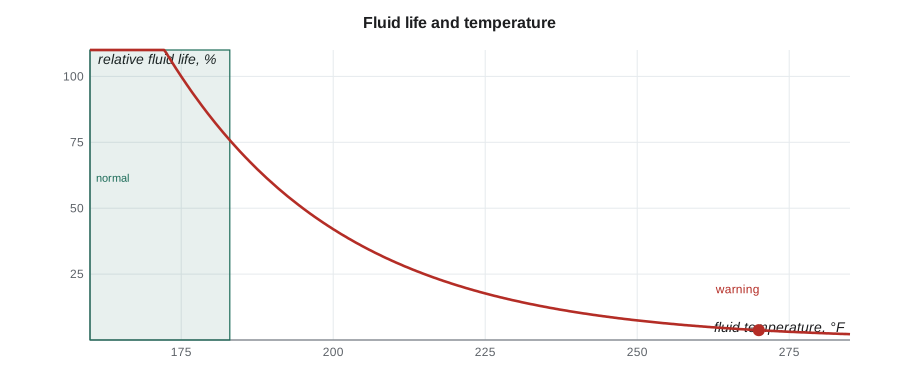
The rule of thumb behind that calculation, that fluid life halves for roughly every 20 °F above normal operating temperature, is an industry approximation rather than a law of nature, but it explains a great deal. At 270 °F, where Gord's warning came on, the fluid oxidizes so fast that its whole life would be used up in roughly 3,700 miles at that temperature, instead of the 100,000 miles it would last at normal temperature. The clutch friction material also suffers: its resin binder glazes and chars, and the plates can warp.
Codes, data and known fixes
Gord's truck has no active trouble codes, but the transmission computer holds a history record of an over-temperature event, and its data shows the converter clutch slip pattern and normal shift times in every gear. Every gear ratio is correct within tolerance, so no clutch or brake inside is slipping. The pressure control and converter clutch solenoid circuits pass their tests. Kiran searches for bulletins and finds one from the maker for converter clutch shudder on this transmission family: it describes the symptom exactly and calls for a complete fluid exchange with the current specification fluid, a road test, and a second exchange if the shudder remains, before any parts are replaced. It also notes that a converter clutch damaged by severe overheating may not respond.
Marty points out what the data has already told them. A transmission whose clutches were badly damaged would show ratio errors, flare, or long shift times; this one does not. The shudder is a converter clutch friction problem, and the most likely cause is degraded fluid, with possibly some glazing of the converter clutch. Either way the fluid must be replaced first. If the shudder survives two exchanges, the next step is a replacement torque converter, which means removing the transmission, and the pan and filter would be inspected first for evidence of internal damage.
Fluid types and fluid service
There is no such thing as just transmission fluid. Each maker's transmissions are designed around a fluid with a specific viscosity and friction behavior, identified by a specification name: Dexron VI for many General Motors transmissions of the last fifteen years, Dexron ULV for some of their newer eight- and ten-speeds, Mercon LV and Mercon ULV for Ford's, ATF+4 for many Stellantis transmissions, and dozens of others for European and Asian makers. Continuously variable and dual-clutch transmissions use fluids that are entirely different again. Low-viscosity and ultra-low-viscosity fluids improve efficiency and cold-weather shifting but are not interchangeable with older fluids. Multi-vehicle fluids that claim to meet many specifications exist, but Ridgeline uses the maker's specified fluid or a fluid that is officially licensed to that specification, because the friction behavior of a clutch is exactly what the wrong fluid changes. The vans' ten-speed uses an ultra-low-viscosity fluid; Gord's six-speed uses Dexron VI.
Fluid can be replaced in two ways. Dropping the pan, replacing the filter and refilling replaces only the fluid in the pan, often only a third to a half of the total, because the converter, cooler and passages stay full. A fluid exchange uses a machine connected to the cooler lines that replaces the old fluid with new as the transmission's own pump circulates it, and changes nearly all of it. Both have a place. Many technicians prefer to drop the pan first when they want to see the debris and replace the filter, then exchange. Some makers specify one method or the other, and on a high-mileage transmission that has never been serviced some shops are cautious about exchanges, because fresh fluid with new detergents can change clutch friction in a worn unit. On Gord's truck, Kiran drops the pan first.
The pan tells a story. A fine gray paste on the magnet is normal wear. A thin layer of dark, fine friction material in the bottom of the pan is consistent with the converter clutch and the clutch plates being heated; chunks of friction material, bronze-colored bushing material or large steel pieces would mean real internal damage. Gord's pan has the fine dark layer and normal paste, no chunks. Kiran replaces the filter and pan gasket, refills, then exchanges the fluid with the machine, sets the level at the check plug in the temperature window, and resets the transmission adapts as the bulletin requires.
Was the trailer too heavy?
Before Gord takes the truck back to the mountains, Marty wants to know whether the rig was within the truck's ratings. A truck has several weight ratings on its door label and in its owner's information. The gross vehicle weight rating is the most the loaded truck itself may weigh, including the trailer's tongue load on the hitch. The gross combined weight rating is the most the truck and trailer together may weigh, and it is the rating most often tied to the powertrain's ability to climb grades and cool itself. The maximum trailer weight is usually the combined rating minus the truck's weight. Many makers now publish towing ratings determined by the SAE J2807 procedure, which includes a sustained climb on a long, hot desert grade at a minimum speed, so a rig within its rating should be able to climb a mountain grade without overheating if it is driven properly and the cooling system is healthy.
# Is the rig within its ratings? (Gord's truck and trailer as weighed at a scale)
truck_loaded = 5560     # truck with driver, tools and fuel, without the trailer
trailer = 8600        # trailer with skid steer and attachments
tongue = trailer * 0.11    # tongue load on the hitch, about 11 % of trailer weight
gvwr, gcwr, max_trailer = 7000, 15000, 9500
truck_on_axles = truck_loaded + tongue
combined = truck_loaded + trailer
for name, value, limit in (("truck with tongue load (GVWR)", truck_on_axles, gvwr),
                           ("truck plus trailer (GCWR)", combined, gcwr),
                           ("trailer (maximum trailer weight)", trailer, max_trailer)):
print(f"{name:<34} {value:7,.0f} of {limit:7,.0f} lb = {100 * value / limit:5.1f} %")truck with tongue load (GVWR) 6,506 of 7,000 lb = 92.9 % truck plus trailer (GCWR) 14,160 of 15,000 lb = 94.4 % trailer (maximum trailer weight) 8,600 of 9,500 lb = 90.5 %
The rig was legal, but at about 94 percent of the combined rating on a hot day at altitude. Marty points out two more facts. The truck's engine, like every naturally aspirated engine, makes around a tenth less power at Denver's altitude than at sea level, and much less again near the top of a high pass, so the truck had to work harder to hold speed. And Gord had been driving in drive with the transmission choosing sixth and fifth gear, letting the converter clutch release and the converter slip on the grade, which turns power directly into heat in the fluid. In tow/haul mode, or with the transmission held in a lower gear, the converter clutch stays applied and the fluid stays far cooler.
The advice Simone writes on the repair order is specific: use tow/haul mode whenever the trailer is attached, choose a lower gear on long grades and accept a lower speed, watch the transmission temperature display and back off before it reaches the warning, and service the fluid on the severe-duty schedule. Marty also recommends a larger auxiliary transmission cooler, an air-to-oil cooler mounted in front of the radiator, which Gord approves. Kiran installs it in series with the original cooler, return side, following the cooler maker's directions.
Leaks and external problems
Not every automatic transmission problem is inside it. Fluid leaks are common and are found by cleaning the area, adding a fluorescent dye if needed, and driving: the cooler lines and their fittings, the pan gasket, the converter seal at the front of the case, which leaks into the bell housing and drips from its lower edge, the output or axle seals, the range sensor and shift shaft seals, and electrical connector seals where the harness enters the case. A transmission that is low because of a leak will slip on turns and hills, overheat and, eventually, fail; fixing the leak and the level often cures it. External problems that cause shift complaints include engine misfires, which the driver feels as a shudder that is easy to blame on the converter clutch; faulty wheel speed or output speed sensors, which confuse shift timing; a misadjusted range selector cable, which can leave the range sensor between positions; low battery voltage; and engine torque calculation errors that the transmission computer uses to set pressures.
Worked problem
Shudder or misfire?
A truck shudders at 50 mph on light throttle. How can a technician tell a converter clutch shudder from an engine misfire with a scan tool?
Show solution
- Record converter clutch commanded state and slip, engine speed and misfire counters together.
- A converter clutch shudder appears only when the clutch is applying or in controlled slip, and the actual slip swings around the commanded value.
- A misfire appears in the misfire counters, and the shudder often continues with the converter clutch released.
- Commanding the converter clutch off with the scan tool, where possible, should stop a converter shudder but not a misfire.
Answer: Record both and watch which one tracks the shudder before blaming the transmission.
Gord's road test after the service settles it. At 48 mph in fifth with the converter clutch in controlled slip, the actual slip now sits steadily within about 10 rpm of the command, and there is no shudder. Kiran repeats the test several times over the next fifty miles before releasing the truck, and Simone books a follow-up check in two weeks. The transmission was not done; its fluid was.
Common mistakes
MistakeChecking fluid level without the temperature window or the check plug procedure.
InsteadFollow the maker's method; a wrong level causes slipping or foaming.
MistakeUsing a universal fluid when the maker specifies a fluid.
InsteadUse the specified fluid or one licensed to that specification.
MistakeCondemning the transmission for a shudder.
InsteadCheck fluid, bulletins and data; most converter clutch shudder is fluid-related.
MistakeLetting a trailer pull the truck up a grade in top gear.
InsteadUse tow/haul mode or a lower gear so the converter clutch stays applied.
MistakeIgnoring a misfire as the cause of a shudder.
InsteadCheck misfire counters and converter clutch data together.
Summary and key terms
- Diagnose in order: verify, fluid, codes and data, bulletins, then decide where the fault is.
- Check fluid level by the maker's method, often a check plug at a specified temperature.
- Dark, burnt-smelling fluid has lost its friction modifiers and can cause converter clutch shudder.
- Fluid life falls rapidly with temperature, roughly halving for every 20 °F above normal.
- Use the exact fluid specification; fluids are not interchangeable.
- Check towing ratings, use tow/haul mode and lower gears on grades, and add cooling for heavy use.
- Leaks, misfires, sensors and cable adjustment can all cause transmission complaints.
- Check plug
- A plug or standpipe in the pan used to set the fluid level at a specified temperature.
- Friction modifier
- An additive that controls how clutch plates grip and release in the fluid.
- Fluid exchange
- Replacing nearly all the fluid using a machine connected to the cooler lines.
- GVWR
- Gross vehicle weight rating: the most the loaded vehicle may weigh.
- GCWR
- Gross combined weight rating: the most the vehicle and trailer together may weigh.
- Tow/haul mode
- A shift program that holds gears longer and uses grade braking when towing.
- Shudder
- A vibration caused by a clutch alternately gripping and slipping.
Practice problems
Work each problem on paper first, then reveal the answer to check.
Why must many transmissions be checked within a temperature window?
Show answer
The fluid expands as it warms, so the level at the check plug is correct only at the specified temperature.
What does a fine dark layer of friction material in the pan, with no chunks, suggest?
Show answer
Heat-related wear of the friction surfaces, not major internal damage.
A rig weighs 13,700 lb and the GCWR is 15,000 lb. What percentage is that?
Show answer
About 91 percent of the rating.
Name three external causes of transmission complaints.
Show answer
Engine misfire, faulty speed sensors, misadjusted range cable, low voltage, fluid leaks.
Lesson quiz · 5 questions
Score 60% or more to complete this lesson.
Create a free account to save your progress, take quizzes and earn a certificate.