
AUTO-310 · Lesson 10 of 12 · 21 min
Differentials and final drives
Van 2's driver reports a whine from the back of the van that comes and goes. "It's loudest when I let off the gas on the highway," he tells Simone, "and it's been getting worse for a month." Hal also mentions an oily patch on the floor of the van's parking spot. When Kiran puts the van on the hoist, the underside of the rear axle housing is wet around the pinion, the driveshaft flange has flung a ring of oil onto the floor pan, and the fill plug, when she removes it, shows the fluid level well below the bottom of the hole.
This lesson explains why vehicles need differentials and how an open differential works, how limited-slip and locking differentials and electronic traction control overcome its weakness, how the ring and pinion final drive is set up, and how to diagnose differential noise and leaks. It follows van 2 from whine to repair.
Why a differential is needed
When a vehicle turns, its outer wheels travel farther than its inner wheels, because they follow a larger circle. If both rear wheels were fixed to one solid axle, one tire would have to skid or scrub on every turn, which would wear tires, make the vehicle hard to steer and stress the axle. The differential lets the two driven wheels on one axle turn at different speeds while still delivering torque to both. A vehicle with drive to all four wheels needs this between the front and rear axles too, since the front wheels travel farther than the rear wheels in a turn; that is the job of the center differential or coupling in Lesson 11.
# Wheel speeds in a turn: why the outer wheel must turn faster
import math
track = 5.68          # ft between the rear tire centers
tire_circ = 7.34       # ft per wheel revolution
speed = 18.6            # mph at the center of the axle
for radius in (26, 82, 656):   # turn radius to the axle center, ft
    v = speed * 5280 / 3600                 # ft per second
    inner = v * (radius - track / 2) / radius
    outer = v * (radius + track / 2) / radius
    rpm_in, rpm_out = inner / tire_circ * 60, outer / tire_circ * 60
    ring_rpm = (rpm_in + rpm_out) / 2
print(f"radius {radius:>4} ft: inner {rpm_in:5.1f} rpm, outer {rpm_out:5.1f} rpm, carrier {ring_rpm:5.1f} rpm, difference {rpm_out - rpm_in:4.1f} rpm")radius 26 ft: inner 198.6 rpm, outer 247.4 rpm, carrier 223.0 rpm, difference 48.7 rpm radius 82 ft: inner 215.3 rpm, outer 230.7 rpm, carrier 223.0 rpm, difference 15.4 rpm radius 656 ft: inner 222.0 rpm, outer 224.0 rpm, carrier 223.0 rpm, difference 1.9 rpm
The calculation shows the principle behind the gearing. The average of the two wheel speeds always equals the speed of the differential case, which is driven by the ring gear. In a straight line the wheels and the case all turn together. In a turn one wheel speeds up by exactly as much as the other slows down.
How an open differential works
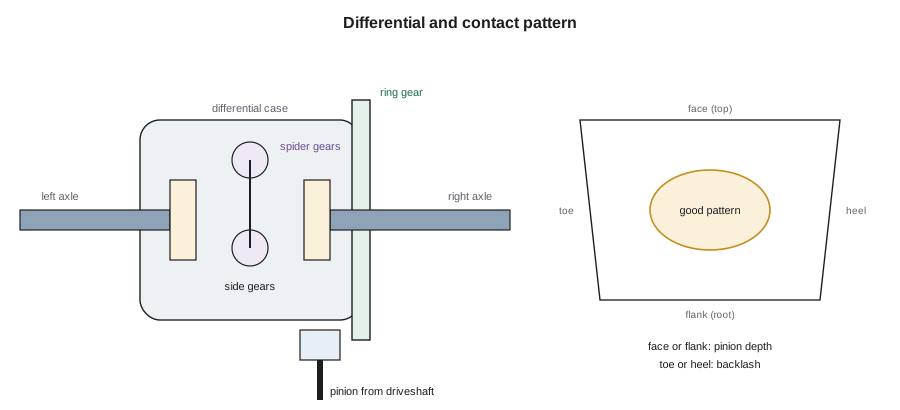
The ring gear is bolted to the differential case. Inside the case, two small bevel gears called pinion gears or spider gears turn on a cross shaft that is fixed in the case, and they mesh with two side gears, which are splined to the axle shafts. When the vehicle goes straight, the case turns, carrying the cross shaft and spider gears around with it, and the spider gears push both side gears around at the same speed without turning on their shaft. In a turn, the outer side gear needs to turn faster than the case and the inner side gear slower, and the spider gears begin to rotate on their cross shaft, letting one side gear advance while the other falls back.
The open differential's weakness follows from its geometry. The spider gears push equally on both side gears, so an open differential always divides torque equally between the two wheels. That is ideal on a dry road. But if one wheel is on ice, it can only take a small torque before it spins, and because the torque is equal, the wheel on dry pavement gets the same small torque. The spinning wheel turns at twice the case speed while the other stands still, and the vehicle goes nowhere. This is why Gord's empty pickup can sit with one rear wheel spinning on an icy patch at the bottom of his driveway.
# Torque to each wheel: open differential against a limited-slip unit with one wheel on ice
grip_ice, grip_dry = 185, 1770          # lb ft each tire can take before it spins
needed = 1030                           # lb ft total needed to climb the driveway
def open_diff():
    t = min(grip_ice, grip_dry)           # equal torque, limited by the slippery wheel
    return t, t
def limited_slip(bias):                    # torque bias ratio: high-side torque / low-side torque
    low = grip_ice
    high = min(grip_dry, low * bias)
    return low, high
for name, (a, b) in (("open differential", open_diff()), ("limited slip, bias 2.5", limited_slip(2.5)), ("limited slip, bias 5", limited_slip(5.0))):
    total = a + b
print(f"{name:<23} ice wheel {a:5.0f}, dry wheel {b:5.0f}, total {total:5.0f} lb ft -> {'climbs' if total >= needed else 'stuck'}")open differential ice wheel 185, dry wheel 185, total 370 lb ft -> stuck limited slip, bias 2.5 ice wheel 185, dry wheel 462, total 648 lb ft -> stuck limited slip, bias 5 ice wheel 185, dry wheel 925, total 1110 lb ft -> climbs
Limited-slip, locking and electronic solutions
A limited-slip differential adds friction or gearing that resists the difference in speed between the two side gears, so that when one wheel starts to spin, more torque goes to the wheel that has grip. Clutch-type units have small clutch packs between the side gears and the case, preloaded by springs; they need a gear oil with a friction modifier, or a separate additive, or the clutches chatter on turns. Gear-type or torque-sensing units use worm or helical gears whose friction creates the bias, and are described by their torque bias ratio, the largest ratio of torque between the two sides. Viscous units use a silicone fluid between perforated plates. A locking differential goes further and locks the two sides together, either automatically, when a speed difference is sensed, or on the driver's command with an air, electric or hydraulic actuator. A locked differential has no differential action at all, so it is only for low-traction surfaces; on dry pavement it scrubs tires and makes the vehicle hard to turn.
Most vehicles now achieve a similar result electronically. Traction control uses the antilock brake system's wheel speed sensors to detect a wheel spinning faster than the others and gently applies that wheel's brake. Braking the spinning wheel lets the open differential send more torque across to the wheel with grip, because the brake gives the spinning wheel something to push against. Many systems also reduce engine torque. Some performance and all-wheel-drive vehicles have active torque vectoring: electronically controlled clutches in the rear drive unit that can send more torque to the outer wheel in a corner to help the vehicle turn. Dr. Singh's electric car, with one motor at the rear, has an open differential in its reduction unit and relies on very fast motor torque control and brake-based traction control.
The ring and pinion
In a rear axle, the pinion gear, driven by the driveshaft, meshes with the ring gear bolted to the differential case. The pair turns the drive through 90 degrees and gives the final reduction: van 2's ring gear has 41 teeth and its pinion 11, a ratio of 3.73:1. The gears are hypoid, as Lesson 2 explained, and their tooth contact depends on three settings that must be correct for the gears to be quiet and to last. Pinion depth is how far the pinion sits into the ring gear, set with shims behind the pinion head or its bearing. Backlash is the small clearance between ring and pinion teeth, set by moving the differential case sideways with shims or threaded adjusters. Bearing preload, on the pinion bearings and the case bearings, holds everything firmly in position under load; pinion preload is usually set by a crushable spacer, a crush sleeve, that is compressed as the pinion nut is tightened, or by a solid spacer and shims.
Setup is checked in two ways. A dial indicator measures backlash at the ring gear teeth, at several points around the gear, to see both the amount and any variation, which would point to ring gear runout. And a gear-marking compound brushed on the teeth, with the gears turned under light load, shows the contact pattern on both the drive side and the coast side of the teeth. A correct pattern is centered on the tooth; one toward the top of the tooth, the face, or toward the bottom, the flank, shows pinion depth is wrong; one toward the toe or heel shows backlash is wrong.
Diagnosing van 2
Differential noise has to be separated from tire noise and bearing noise first. Kiran drives van 2 on a smooth road and listens through the speed range under drive, under float, with just enough throttle to hold speed, and on coast with the throttle closed. The whine is clearly present from about 50 to 62 mph on coast and much quieter under drive. Tire noise would change with road surface and would not change between drive and coast. A wheel bearing would change when the van is swerved gently left and right, loading one side and then the other. A ring and pinion whine, by contrast, changes between drive and coast, because each condition loads a different side of the teeth: the drive side under power, the coast side on deceleration. A whine on coast points to the coast side of the gears, often from too much backlash or a pinion that has moved.
On the hoist, Kiran grips the driveshaft flange at the pinion and tries to move it up and down and in and out. It moves. A pinion with play has lost its bearing preload, and a moving pinion destroys its seal, which is why the seal is leaking, and changes its depth and the backlash under load, which is why the coast side whines. The low fluid, about 0.85 qt short, will have made it worse. Ridgeline sends axle rebuilds to a driveline specialist across town, and Bev arranges it. The specialist reports back that the ring and pinion teeth show slight scoring on the coast side but are serviceable, and replaces the pinion bearings, the crush sleeve and the seal, sets pinion depth, preload and backlash, and confirms the contact pattern. The specialist also sends Kiran the measurements, which Marty uses to show her how setup is recorded.
# Ring and pinion setup record against specification (values from the specialist's sheet)
backlash = [0.007, 0.008, 0.0075, 0.0068]       # in, measured at four points around the ring gear
spec_low, spec_high, max_variation = 0.005, 0.01, 0.002
preload = 20                            # lb in pinion turning torque, new bearings
pre_low, pre_high = 15, 25
ok_range = all(spec_low <= b <= spec_high for b in backlash)
variation = max(backlash) - min(backlash)
print("backlash", ", ".join(f"{b:.4f}" for b in backlash), "in:", "in range" if ok_range else "OUT OF RANGE")
print(f"variation {variation:.4f} in:", "OK" if variation <= max_variation else "too much: check ring gear runout")
print(f"pinion preload {preload} lb in:", "OK" if pre_low <= preload <= pre_high else "out of range")backlash 0.0070, 0.0080, 0.0075, 0.0068 in: in range variation 0.0012 in: OK pinion preload 20 lb in: OK
Kiran refills the axle with the specified gear oil, a synthetic 75W-85 GL-5 for this axle, to the bottom of the fill hole with the van level, and road tests it. The whine is gone. She notes for Hal that the axle fluid on the vans should be checked at every service, because these vans run heavy and hot, and that the leak could have been caught months earlier with a look at the pinion seal.
Fluid, noises and other checks
Axle fluid is a hypoid gear oil, usually a GL-5 grade such as 75W-90 or 75W-85, and in many newer axles a low-viscosity synthetic specified for efficiency. Limited-slip axles may need a friction modifier. Front-wheel-drive transaxles share the transmission's fluid for their final drive, and electric drive units have their own specified fluid. The fluid level is checked at the fill plug with the vehicle level. Some trucks and vans specify severe-service changes when towing. A milky fluid means water has entered, often through a vent after the axle was submerged or washed with a pressure washer; it must be changed at once, and the vent checked.
A clunk when the driver engages drive or reverse, or changes from drive to coast, is driveline backlash. Every gear mesh and spline contributes a little, and Kiran learns to measure the total by holding one wheel and turning the driveshaft, then the backlash of each part separately: the ring and pinion, the side gears and spider gears, the axle splines and the U-joints. A bearing noise is a growl or rumble that rises with speed, present on drive and coast, and on axle shaft bearings it changes when the load shifts in a turn. A noise that appears only in turns, a chatter or groan, is often the limited-slip clutches lacking their friction modifier, or worn spider gears and cross shaft in an open differential.
Worked problem
How much faster does the spinning wheel turn?
An open differential's case turns at 300 rpm. One wheel is stopped on dry pavement with its brake applied and the other is on ice. How fast does the wheel on ice turn?
Show solution
- The average of the two wheel speeds equals the case speed.
- (0 + n) ÷ 2 = 300 rpm, so n = 600 rpm.
- The wheel on ice turns at twice the case speed.
Answer: 600 rpm: which is why a spinning wheel on ice spins so fast, and why traction control brakes it.
Common mistakes
MistakeBlaming the differential for every rear whine.
InsteadCheck tires and wheel bearings first; differential whine changes between drive and coast.
MistakeFilling a limited-slip axle with plain gear oil.
InsteadUse the specified oil or friction modifier, or the clutches chatter.
MistakeIgnoring a leaking pinion seal.
InsteadCheck for pinion play; a seal leaks because the pinion moves, and low fluid damages the gears.
MistakeDriving a locked differential on dry pavement.
InsteadLocked axles cannot differentiate; use them only on loose or slippery surfaces.
MistakeReusing a crush sleeve or overtightening the pinion nut and backing it off.
InsteadReplace the crush sleeve and set preload by the procedure.
Summary and key terms
- A differential lets driven wheels on one axle turn at different speeds while both receive torque.
- The average of the two wheel speeds equals the differential case speed.
- An open differential divides torque equally, so the wheel with least grip limits both.
- Limited-slip and locking differentials, traction control and torque vectoring overcome that weakness.
- Ring and pinion setup requires correct pinion depth, backlash and bearing preload, checked with a dial indicator and contact pattern.
- Differential whine changes between drive and coast; bearings growl on both; tires change with the road.
- Use the specified gear oil and check axle fluid and seals at every service on working vehicles.
- Differential
- A gear set that allows two wheels to turn at different speeds while both are driven.
- Spider gears
- The small bevel gears on a cross shaft inside the differential case.
- Side gears
- The differential gears splined to the axle shafts.
- Limited-slip differential
- A differential that resists speed difference to send torque to the wheel with grip.
- Torque bias ratio
- The largest ratio of torque between two sides a limited-slip unit can sustain.
- Crush sleeve
- A collapsible spacer that sets pinion bearing preload when the pinion nut is tightened.
- Contact pattern
- The marked area of tooth contact that shows whether gear setup is correct.
Practice problems
Work each problem on paper first, then reveal the answer to check.
A ring gear has 41 teeth and its pinion 11. What is the ratio?
Show answer
41 ÷ 11 ≈ 3.73:1.
Why does an open differential leave a vehicle stuck with one wheel on ice?
Show answer
It divides torque equally, so the dry wheel gets only as much torque as the ice wheel can take.
A rear whine is loud on coast and quiet under power. What does that suggest?
Show answer
Contact on the coast side of the ring and pinion teeth, often from excess backlash or a moving pinion.
What does milky axle fluid indicate?
Show answer
Water contamination, often through the vent; change the fluid and check the vent.
Lesson quiz · 5 questions
Score 60% or more to complete this lesson.
Create a free account to save your progress, take quizzes and earn a certificate.