
AUTO-310 · Lesson 5 of 12 · 22 min
Automatic transmission fundamentals: torque converters and planetary gears
Ridgeline does not rebuild automatic transmissions; when one needs internal repair, Bev sends it to a specialist rebuilder or replaces it with a remanufactured unit. But Marty insists that every technician in the shop understands what is inside one. "Half the automatic transmissions that come in here with a complaint don't need to come apart at all," he says. "They need fluid, a software update, a relearn, or a repair to something outside them. You can only tell which half you're looking at if you know how the inside works." For training he keeps an old four-speed automatic on a stand, sectioned so its converter, planetary gear sets and clutches can be seen, and a cut-open torque converter on the shelf above it.
This lesson explains how a torque converter connects the engine to an automatic transmission and multiplies torque, how planetary gear sets produce several ratios on one centerline, how clutches, brakes and one-way clutches hold and drive the planetary members, and how the hydraulic system applies them. Lessons 6 and 7 build on this to explain electronic control and diagnosis.
The torque converter
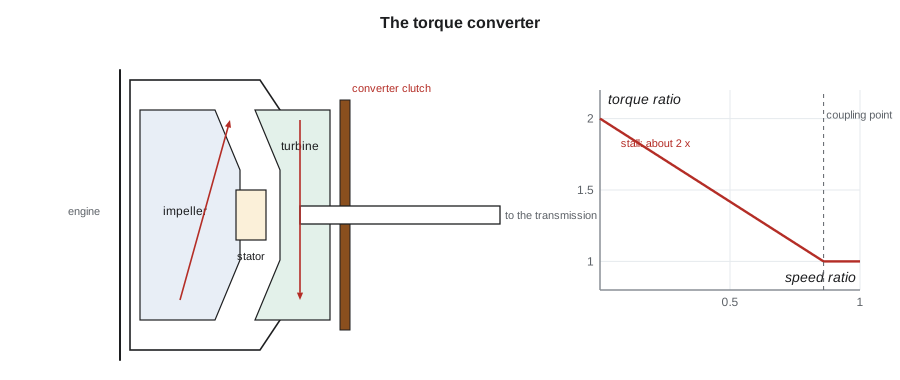
A conventional automatic transmission is connected to the engine by a torque converter instead of a clutch. It is a sealed, fluid-filled housing bolted to the engine's flexplate, and it has three main elements. The impeller, or pump, is part of the housing and turns with the engine; its curved vanes fling fluid outward and forward. The turbine faces the impeller and is splined to the transmission input shaft; the moving fluid strikes its vanes and turns it. Between them, near the center, is the stator, a small vaned wheel mounted on a one-way clutch on a stationary shaft from the transmission.
At idle with the vehicle stopped in gear, the impeller turns slowly and the fluid it moves is too weak to turn the turbine against the brakes, so the engine idles while the vehicle stands still, with a slight creep. As the driver presses the accelerator, the impeller speeds up and the turbine begins to turn. Fluid leaving the turbine is flowing in a direction that would oppose the impeller, but the stator's vanes, held still by the one-way clutch, redirect it so that it strikes the impeller's vanes helpfully. That redirection is what lets a converter multiply torque: at stall, with the turbine held still and the engine at full throttle, a typical converter delivers about two times the engine's torque to the turbine. As the turbine speeds up toward the impeller's speed, the multiplication falls, until at the coupling point, roughly 85 to 90 percent of impeller speed, the fluid strikes the back of the stator vanes, the one-way clutch freewheels, and the converter acts as a simple fluid coupling with a torque ratio of 1.
# Torque converter: torque ratio and slip against speed ratio (simple illustrative model)
stall_ratio, coupling = 2.0, 0.86
def torque_ratio(speed_ratio):
    if speed_ratio >= coupling:
        return 1.0
    return stall_ratio - (stall_ratio - 1.0) * speed_ratio / coupling
for engine_rpm, turbine_rpm in ((2400, 0), (2400, 1200), (2600, 2050), (2600, 2340), (2000, 1980)):
    sr = turbine_rpm / engine_rpm
    slip = 100 * (engine_rpm - turbine_rpm) / engine_rpm
    tr = torque_ratio(sr)
print(f"engine {engine_rpm}, turbine {turbine_rpm:4d}: speed ratio {sr:.2f}, slip {slip:5.1f} %, torque x {tr:.2f}")engine 2400, turbine 0: speed ratio 0.00, slip 100.0 %, torque x 2.00 engine 2400, turbine 1200: speed ratio 0.50, slip 50.0 %, torque x 1.42 engine 2600, turbine 2050: speed ratio 0.79, slip 21.2 %, torque x 1.08 engine 2600, turbine 2340: speed ratio 0.90, slip 10.0 %, torque x 1.00 engine 2000, turbine 1980: speed ratio 0.99, slip 1.0 %, torque x 1.00
A fluid coupling always slips a little, about 2 to 5 percent at cruise, and slip turns power into heat in the fluid and wastes fuel. Modern converters therefore contain a torque converter clutch, often called the lock-up clutch: a friction disc between the turbine and the front of the converter housing that, when applied by fluid pressure, locks the turbine to the impeller so the engine drives the transmission directly. Early converter clutches were either on or off. Modern ones are controlled to a small, deliberate slip, perhaps 20 to 50 rpm, during part of their operation, which damps engine vibration while saving most of the loss, and fully locked at steady cruise. A converter clutch that shudders as it applies, a vibration like driving over rumble strips at 60 to 55 mph, is one of the most common automatic transmission complaints, and Gord's pickup has exactly that. Lesson 7 follows it.
Checking a converter: the stall test
A stall test holds the turbine still, with the brakes firmly applied and the transmission in gear, while the engine is briefly brought to full throttle, and reads the engine speed it reaches. That speed depends on the engine's torque and the converter's design, and the service information gives a range. A stall speed below the range points to an engine making too little power or a converter whose stator one-way clutch is slipping, so it no longer multiplies torque; a speed above the range points to slipping clutches or bands inside the transmission. Because the test puts large amounts of heat into the fluid in a few seconds and stresses the drivetrain, many makers now advise against it or restrict it to a few seconds with cooling time in between, and some newer transmissions limit engine torque during a stall so the test is meaningless. Kiran learns it as a concept and to follow the maker's direction.
Altitude matters again. A naturally aspirated engine at Denver's 24.6 inHg makes noticeably less power than at sea level, and the converter's stall speed rises roughly with the square root of the engine torque applied to it, so a healthy transmission will stall at a lower speed than a specification written at sea level.
# Stall test interpretation with an altitude correction (illustrative specification)
import math
spec_low, spec_high = 2200, 2500       # rpm, sea-level stall range for this example
baro_ratio = 24.6 / 29.92             # local pressure / sea-level pressure
torque_ratio = baro_ratio               # naturally aspirated engine: torque roughly follows air density
k = math.sqrt(torque_ratio)
lo, hi = spec_low * k, spec_high * k
print(f"local pressure is {100 * baro_ratio:.0f} % of sea level; corrected range {lo:.0f} to {hi:.0f} rpm")
for measured in (1850, 2150, 2700):
    if measured < lo:
        v = "low: engine power or stator one-way clutch"
    elif measured > hi:
        v = "high: slipping clutch or band in the transmission"
    else:
        v = "within range"
print(f"stall at {measured} rpm -> {v}")local pressure is 82 % of sea level; corrected range 1995 to 2267 rpm stall at 1850 rpm -> low: engine power or stator one-way clutch stall at 2150 rpm -> within range stall at 2700 rpm -> high: slipping clutch or band in the transmission
The planetary gear set
Instead of pairs of gears on parallel shafts, a conventional automatic uses planetary gear sets, each with three members on one centerline. The sun gear is in the middle. The planet gears, usually three or four, mesh with the sun and turn on pins fixed to the planet carrier. The ring gear, with internal teeth, surrounds the planets and meshes with them. Every gear is always in mesh, so shifts happen by holding one member still and driving another, with no gears sliding into or out of mesh.
Holding one member and driving another produces six possible combinations. Driving the sun with the ring held gives the largest reduction. Driving the ring with the sun held gives a smaller reduction. Driving the carrier gives overdrives. Holding the carrier makes the planets act as idlers, so the output turns backward: reverse. Locking any two members together locks the whole set and gives direct drive, 1:1. And if no member is held, the set freewheels and transmits nothing, which is neutral. The relationship between the three speeds is the Willis equation, in which S and R are the numbers of teeth on the sun and ring gears.
# Planetary gear set: the six held/driven combinations (sun 30 teeth, ring 72 teeth)
S, R = 30, 72
def output_speed(held, driven):
    speed = {held: 0.0, driven: 1.0}
    free = ({"sun", "ring", "carrier"} - {held, driven}).pop()
    s, r, c = speed.get("sun"), speed.get("ring"), speed.get("carrier")
    if free == "sun":
        return (c * (S + R) - r * R) / S
    if free == "ring":
        return (c * (S + R) - s * S) / R
    return (s * S + r * R) / (S + R)
for held, driven in (("ring", "sun"), ("sun", "ring"), ("sun", "carrier"), ("ring", "carrier"), ("carrier", "sun"), ("carrier", "ring")):
    out = output_speed(held, driven)
    ratio = 1 / out
    kind = "reverse" if ratio < 0 else ("overdrive" if ratio < 1 else "reduction")
    print(f"hold {held:<7} drive {driven:<7} -> ratio {ratio:6.3f}:1  {kind}")
print("lock any two members together -> 1.000:1 direct drive")hold ring drive sun -> ratio 3.400:1 reduction hold sun drive ring -> ratio 1.417:1 reduction hold sun drive carrier -> ratio 0.706:1 overdrive hold ring drive carrier -> ratio 0.294:1 overdrive hold carrier drive sun -> ratio -2.400:1 reverse hold carrier drive ring -> ratio -0.417:1 reverse lock any two members together -> 1.000:1 direct drive
One simple gear set gives one useful low gear, one second gear, direct and reverse at best, and with awkward steps. Real transmissions combine two to four gear sets, sharing members between them, so that a few clutches and brakes can produce six, eight, nine or ten forward speeds with good steps. Classic combinations have names. A Simpson gear set uses two sets with a common sun and gave most three-speed automatics their ratios. A Ravigneaux set has two suns, two sets of planets and one ring in a compact package. A Lepelletier arrangement combines a simple set with a Ravigneaux set to give six speeds with only five shifting elements. Gord's six-speed and the vans' ten-speed are built from these ideas, and the ten-speed's four gear sets and six shifting elements give its ten ratios and reverse.
Ines Moreau's hybrid uses a single planetary set differently. In its power-split transaxle, the engine drives the carrier, one electric motor-generator is connected to the sun and the ring drives the wheels together with a second motor. By controlling the sun gear motor's speed, the computer can run the engine at any speed it chooses for a given road speed, which makes the gear set behave like a continuously variable transmission. Lesson 8 returns to it.
Clutches, brakes and one-way clutches
The members are held and driven by three kinds of device. A multiple-plate clutch, sometimes called a clutch pack, has alternating steel plates and friction plates splined to two different members; when fluid pressure pushes a piston against the stack, the two members turn together. It drives one rotating member from another. A brake is the same kind of stack with one side splined to the transmission case, so applying it holds a member stationary. Older transmissions used bands, a steel strap lined with friction material wrapped around a drum and tightened by a servo piston. A one-way clutch, either a sprag clutch or a roller clutch, locks in one direction and freewheels in the other, so it can hold a member automatically when torque tries to turn it backward and release it when the next gear takes over. One-way clutches made shift timing much easier in older designs; modern electronically controlled transmissions often replace them with clutches whose apply and release are timed precisely, called clutch-to-clutch shifts.
Every gear in a given transmission uses a particular combination of applied elements, shown in the service information as a clutch application chart. The chart is a powerful diagnostic tool. If a transmission slips in first, second and third but not in fourth, the element common to the slipping gears and not used in fourth is the suspect.
# Using a clutch application chart to find a slipping element (illustrative four-speed)
chart = {   # gear: elements applied
    "1st": {"forward clutch", "low one-way clutch"},
    "2nd": {"forward clutch", "2-4 band"},
    "3rd": {"forward clutch", "direct clutch"},
    "4th": {"direct clutch", "2-4 band", "overdrive clutch"},
    "reverse": {"reverse clutch", "low-reverse brake"},
}
def suspects(slipping, good):
    common = set.intersection(*(chart[g] for g in slipping))
    for g in good:
        common -= chart[g]
    return common
print("slips in 1st, 2nd and 3rd, fine in 4th and reverse ->", suspects(["1st", "2nd", "3rd"], ["4th", "reverse"]))
print("slips in 2nd and 4th only ->", suspects(["2nd", "4th"], ["1st", "3rd", "reverse"]))slips in 1st, 2nd and 3rd, fine in 4th and reverse -> {'forward clutch'}
slips in 2nd and 4th only -> {'2-4 band'}Hydraulics: the fluid does the work
The transmission's fluid is its blood. A pump driven by the converter housing, so it runs whenever the engine runs, draws fluid from the pan through a filter and pressurizes it. A pressure regulator sets the line pressure, which rises with engine torque so that clutches clamp hard enough under heavy load but not so hard at light load that shifts are harsh. The valve body, a maze of passages, valves and in modern units solenoids, directs pressure to the clutches and brakes to make each shift, and feeds the converter, the cooler and the lubrication circuit. Fluid that returns from the converter is hot; it is sent through the cooler, usually in the radiator tank and sometimes with an extra air-to-oil cooler in front, before returning to lubricate the gears and bearings.
Because the same fluid lubricates, cools, transmits torque in the converter, carries hydraulic pressure and sets the friction characteristics of every clutch, its condition and level matter more in an automatic than in any other part of the car. Low fluid lets the pump draw air, which makes pressure drop and clutches slip, especially on turns, hills and hard stops when the fluid sloshes away from the pickup. Fluid of the wrong type changes the friction between clutch plates, which can cause shudder and harsh or slipping shifts. Oxidized, overheated fluid loses its friction modifiers. Lesson 7 covers checking and servicing it.
Worked problem
A planetary ratio
A gear set has a 34-tooth sun and an 86-tooth ring. The ring is held and the sun is driven. What is the ratio, and what is it if the sun is held and the carrier is driven?
Show solution
- With the ring held, the Willis equation gives n_s × 34 = n_c × 120, so the ratio n_s ÷ n_c = 120 ÷ 34 ≈ 3.53:1.
- With the sun held and the carrier driven, n_r × 86 = n_c × 120, so the output, the ring, turns 120 ÷ 86 ≈ 1.40 times as fast as the carrier.
- The ratio n_c ÷ n_r is 86 ÷ 120 ≈ 0.72:1, an overdrive.
Answer: About 3.53:1 reduction in the first case and 0.72:1 overdrive in the second.
Common mistakes
MistakeThinking the torque converter is a clutch that wears like a manual one.
InsteadIt transmits torque through fluid; only its lock-up clutch has friction material.
MistakeRunning a long stall test.
InsteadFollow the maker: many restrict or prohibit it because it overheats the fluid quickly.
MistakeForgetting altitude when judging stall speed.
InsteadEngines make less torque at altitude, so stall speeds are lower.
MistakeGuessing which clutch slips.
InsteadUse the clutch application chart: find the element common to the slipping gears.
MistakeTreating fluid as a lubricant only.
InsteadIt also carries pressure, transmits torque in the converter and sets clutch friction.
Summary and key terms
- A torque converter has an impeller, a turbine and a stator on a one-way clutch; it multiplies torque at low speed and couples near 1:1 at speed.
- The converter clutch locks the turbine to the housing to eliminate slip; modern ones are controlled to a small slip.
- A stall test reveals converter and internal slip problems but heats fluid quickly; many makers restrict it.
- A planetary set has a sun, planets on a carrier and a ring; holding one member and driving another gives reductions, overdrives or reverse.
- Locking two members gives direct drive; the Willis equation relates the three speeds.
- Clutches drive members, brakes hold them, and one-way clutches hold in one direction only.
- The clutch application chart points to the element common to all slipping gears.
- Impeller
- The converter element attached to the housing that is driven by the engine and moves the fluid.
- Turbine
- The converter element driven by the fluid and splined to the transmission input shaft.
- Stator
- The converter element on a one-way clutch that redirects fluid to multiply torque.
- Coupling point
- The speed ratio at which the stator freewheels and the converter acts as a fluid coupling.
- Torque converter clutch
- A friction clutch that locks the turbine to the converter housing.
- Planetary gear set
- A sun gear, planet gears on a carrier and a ring gear on a common centerline.
- Clutch application chart
- A table showing which clutches and brakes are applied in each gear.
Practice problems
Work each problem on paper first, then reveal the answer to check.
What does the stator do when the converter reaches the coupling point?
Show answer
Its one-way clutch freewheels, so it no longer redirects fluid and the torque ratio is about 1.
Which planetary member must be held to get reverse?
Show answer
The carrier.
A transmission slips only in gears that use the forward clutch. Which element is suspect?
Show answer
The forward clutch.
Why does low fluid cause slipping on turns and hills?
Show answer
The fluid moves away from the pump pickup, the pump draws air and pressure drops.
Lesson quiz · 5 questions
Score 60% or more to complete this lesson.
Create a free account to save your progress, take quizzes and earn a certificate.