
AUTO-310 · Lesson 2 of 12 · 20 min
Gears, ratios and torque multiplication
On Kiran's second morning, Marty puts a cut-away manual gearbox on the bench in the training corner, a donated unit with windows cut into its case so the gears can be seen turning. Beside it sits a reduction unit removed from a wrecked electric car, and a rear axle center section from a pickup. "Every transmission you will ever work on is gears, shafts, bearings and something that chooses which gears carry the power," he says. "Before we talk about clutches and computers, I want you to be able to look at two gears and tell me the ratio, the direction, and what happens to the torque."
This lesson covers the gears used in drivetrains, how tooth counts set ratios, how gears in series combine, how torque and speed change through a gear train, and why transmissions have the number and spacing of ratios they do. It ends with what happens to a vehicle's effective gearing when an owner fits larger tires, a question Gord Haney asks while his pickup is in the shop.
Kinds of gears
Spur gears have straight teeth parallel to the shaft. They are simple, efficient and cannot push sideways on their shafts, but their teeth engage all at once across the full width, which makes them noisy at speed. In cars they are mostly found as the reverse idler in older manual transmissions, which is why reverse whines. Helical gears have teeth cut at an angle around the gear. Several teeth share the load at any moment and engage gradually, so helical gears are quieter and stronger for their size, which is why they are used for nearly every forward gear. Their angled teeth push the gear along its shaft, a thrust load that the bearings and thrust washers must carry.
Bevel gears transmit power between shafts at an angle, usually 90 degrees. The ring and pinion in a rear axle are a special form called hypoid gears: the pinion's centerline is offset below the ring gear's center, which lowers the driveshaft, lets larger pinion teeth carry more load, and makes the teeth slide against each other as they mesh. That sliding is why hypoid gears need gear oil with extreme-pressure additives. Planetary gear sets, which have a sun gear, planet gears on a carrier and an internally toothed ring gear all on the same centerline, are the heart of conventional automatic transmissions and are covered in Lesson 5. A worm and wheel, a screw meshing with a gear, gives a large reduction in one step and is used in some steering gears and in older elevator machines, but its sliding contact makes it too inefficient for a main drivetrain.
Ratio from tooth counts
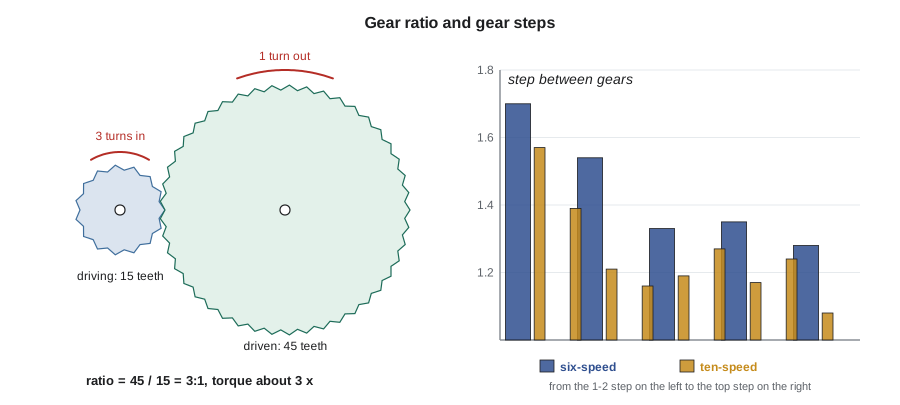
When two gears mesh, their teeth pass the contact point at the same rate. A gear with 15 teeth driving a gear with 45 teeth must turn three times to turn the larger gear once, so the ratio is 45 ÷ 15 = 3:1. The rule is always driven teeth divided by driving teeth. A ratio greater than 1 is a reduction: the output turns slower than the input with more torque. A ratio less than 1 is an overdrive.
Two external gears in mesh turn in opposite directions. Adding a third gear between them, an idler, makes the output turn the same way as the input but does not change the ratio, because the idler's teeth cancel out: it is driven by the first gear and drives the third. That is how reverse works in a simple manual gearbox: an idler gear slides in between two gears that are not otherwise in mesh, and the output shaft turns backward.
When gears are arranged in series, with a pair of gears on an intermediate shaft, the ratios multiply. A manual transmission's countershaft is driven from the input shaft by one pair of gears, and each forward gear is a second pair from the countershaft to the output shaft, so each gear's ratio is the product of two pairs. Dr. Singh's electric car does the same thing in its single-speed reduction: one pair reduces the motor speed by about 3.1 and a second pair reduces it again by 2.9, for about 9.0:1 overall, with the differential built into the final gear.
# Gear ratios from tooth counts, single pairs and two pairs in series
def ratio(driving, driven):
    return driven / driving
pairs = {
    "simple pair, 15 driving 45": [(15, 45)],
    "EV reduction, two stages": [(18, 56), (20, 58)],
    "manual 3rd gear: input pair then 3rd pair": [(21, 34), (29, 34)],
}
for name, stages in pairs.items():
    overall = 1.0
    for a, b in stages:
        overall *= ratio(a, b)
    detail = " x ".join(f"{b}/{a}" for a, b in stages)
    print(f"{name:<44} {detail:>15} = {overall:.3f}:1")
motor_rpm = 7380
print(f"EV motor at {motor_rpm} rpm -> wheels at {motor_rpm / (56/18 * 58/20):.0f} rpm")simple pair, 15 driving 45 45/15 = 3.000:1 EV reduction, two stages 56/18 x 58/20 = 9.022:1 manual 3rd gear: input pair then 3rd pair 34/21 x 34/29 = 1.898:1 EV motor at 7380 rpm -> wheels at 818 rpm
Torque and speed through a gear train
Power is torque multiplied by rotational speed. A gear set cannot create power, so if it divides speed by three it must multiply torque by three, less the friction loss. A good pair of helical gears in a bath of oil loses only about 1 to 2 percent of the power passing through it; a hypoid ring and pinion loses a little more because of its sliding contact. The losses add up through a whole drivetrain, which is why Lesson 1 used an overall efficiency of about 90 percent.
In that formula T is torque, i is the ratio and η, the Greek letter eta, is the efficiency as a decimal. The output speed is the input speed divided by the ratio. Kiran works Gord's truck through all six gears at the engine's peak torque, 383 lb ft at 4,100 rpm, and tabulates the torque and speed at the transmission's output shaft.
# Torque and speed at the transmission output in each gear (efficiency per gear assumed)
engine_torque = 383        # lb ft
engine_rpm = 4100
gears = [4.027, 2.364, 1.532, 1.152, 0.852, 0.667]
for n, g in enumerate(gears, 1):
    eff = 0.97 if g != 1.0 else 0.99
    out_t = engine_torque * g * eff
    out_rpm = engine_rpm / g
print(f"gear {n} ({g:.3f}:1): output {out_t:6.0f} lb ft at {out_rpm:5.0f} rpm")gear 1 (4.027:1): output 1496 lb ft at 1018 rpm gear 2 (2.364:1): output 878 lb ft at 1734 rpm gear 3 (1.532:1): output 569 lb ft at 2676 rpm gear 4 (1.152:1): output 428 lb ft at 3559 rpm gear 5 (0.852:1): output 317 lb ft at 4812 rpm gear 6 (0.667:1): output 248 lb ft at 6147 rpm
The output torque in first is about four times the engine's, which is why first gear can start a loaded truck and trailer up a hill. In sixth, the output shaft turns faster than the engine and carries less torque than the engine makes. A transmission's case, bearings and shafts are designed for the torque in first gear and reverse, which is far higher than anything in top gear, and that is why towing-related failures concentrate in the low gears and in the parts that carry the most torque.
How many gears, and how far apart
Two numbers describe a transmission's set of ratios. The ratio spread is the lowest gear divided by the highest: Gord's six-speed has 4.027 ÷ 0.667, about 6.0, and the courier vans' ten-speed has 4.696 ÷ 0.636, about 7.4. A wider spread lets the engine start a heavy load in a very low first gear and still cruise slowly in top. The step between neighboring gears is the ratio of one gear to the next. When the steps are small, the engine speed drops only a little on each upshift and stays near its most efficient or most powerful speed, at the cost of more shifts and more parts. That is why transmissions grew from four speeds in the 1990s to six, eight, nine and ten: smaller steps and a wider spread both help fuel economy and performance.
Designers usually make the steps a little larger in the low gears and smaller in the high gears, because in the low gears the vehicle accelerates quickly and the engine soon climbs back up, while at highway speed a small step keeps the engine in a narrow, economical band. Kiran checks this by calculating the steps for both transmissions.
# Ratio spread and steps between gears
boxes = {
    "Gord's six-speed": [4.027, 2.364, 1.532, 1.152, 0.852, 0.667],
    "vans' ten-speed": [4.696, 2.985, 2.146, 1.769, 1.520, 1.275, 1.000, 0.854, 0.689, 0.636],
}
for name, g in boxes.items():
    spread = g[0] / g[-1]
    steps = [g[i] / g[i + 1] for i in range(len(g) - 1)]
    print(f"{name}: spread {spread:.2f}")
    print("   steps " + "  ".join(f"{s:.2f}" for s in steps))
    drop = [round(4500 / s) for s in steps]
print(" rpm after an upshift from 4500 rpm: " + " ".join(str(d) for d in drop))Gord's six-speed: spread 6.04 steps 1.70 1.54 1.33 1.35 1.28 rpm after an upshift from 4500 rpm: 2642 2916 3384 3328 3523 vans' ten-speed: spread 7.38 steps 1.57 1.39 1.21 1.16 1.19 1.27 1.17 1.24 1.08 rpm after an upshift from 4500 rpm: 2860 3235 3709 3867 3775 3529 3843 3631 4154
Backlash, noise and wear
Gear teeth are never made to mesh with zero clearance. A small gap, called backlash, leaves room for an oil film, for thermal expansion and for small manufacturing errors. Too little backlash and the teeth bind, run hot and fail; too much and the drivetrain clunks when the driver changes from drive to coast or from drive to reverse, and the gears can be noisy. Backlash also accumulates through the driveline: every gear mesh, spline and joint contributes a little, so a truck with a two-speed transfer case, a long driveshaft and a rear axle can have a lot of total free play between the engine and the wheels. When a customer complains of a clunk on engagement, Kiran will learn in Lesson 10 to measure each source separately rather than blaming the first one she finds.
Gear noise has a pattern. A whine that changes pitch with road speed and is loudest under load or on coast points to a particular gear mesh, often the ring and pinion. A noise that is present in only one gear points to that gear pair in the transmission. A noise in every gear that changes with engine speed rather than road speed is usually not a gear at all. Worn bearings make a rumbling or growling that changes with load less than gear whine does. Gear teeth also wear in recognizable ways: polishing, then pitting where the surface fatigues, then chipping and broken teeth. Metal particles in the oil, collected on the magnetic drain plug, are an early warning; a coating of fine gray paste on the magnet is normal wear, while flakes and chunks are not.
Bigger tires and effective gearing
While his truck waits for its transmission repair, Gord asks Simone whether he can fit larger tires for the gravel sites he works on, going from 265/70R17 to 285/75R17. Marty uses it as a lesson. A larger tire travels farther per turn, so it acts like a numerically lower, taller, axle ratio: the engine turns slower at a given road speed, the truck has less torque at the ground in every gear, and the speedometer and odometer, which count turns of the output shaft or the wheels, read low. The transmission's shift points, which the computer bases on output shaft speed, also move. Some makers allow the tire size to be reprogrammed in the computer; others do not. Either way, the change in effective gearing is the same.
# Effect of larger tires on effective axle ratio and speedometer reading
import math
def diameter_mm(w, a, r):
    return 2 * w * a / 100 + r * 25.4
old = diameter_mm(265, 70, 17)
new = diameter_mm(285, 75, 17)
change = new / old
axle = 3.42
print(f"diameter {old / 25.4:.1f} in -> {new / 25.4:.1f} in: {100 * (change - 1):.1f} % larger")
print(f"effective axle ratio {axle} -> {axle / change:.2f}")
indicated = 60
print(f"speedometer shows {indicated} mph when the truck is really doing {indicated * change:.1f} mph")
print(f"torque at the ground in every gear falls by {100 * (1 - 1 / change):.1f} %")diameter 31.6 in -> 33.8 in: 7.0 % larger effective axle ratio 3.42 -> 3.20 speedometer shows 60 mph when the truck is really doing 64.2 mph torque at the ground in every gear falls by 6.6 %
The new tires would be about 7 percent larger in diameter. At an indicated 60 mph Gord would really be doing 64 mph, and with a trailer behind him the truck would lose about 6.6 percent of its pulling torque in every gear and shift down more often on grades. Marty's advice is not to fit them unless the speedometer can be recalibrated and Gord accepts the loss in towing performance; the change also affects the antilock brake and stability systems, which use wheel speed. Simone notes the conversation on the repair order.
Worked problem
Choosing an axle ratio
A truck with 31.6 in tires and a 0.667:1 top gear cruises at 62 mph. What engine speed results with a 3.42:1 axle, and with an optional 3.73:1 axle?
Show solution
- Wheel speed at 62 mph = 5,468 ft/min ÷ (π × 31.6 ÷ 12 ft) ≈ 661 rpm.
- With 3.42: 661 × 0.667 × 3.42 ≈ 1,508 rpm.
- With 3.73: 661 × 0.667 × 3.73 ≈ 1,645 rpm.
- The 3.73 axle gives about 9 percent more torque at the wheels in every gear for towing, at the cost of about 140 rpm more at cruise.
Answer: About 1,510 rpm with 3.42 and 1,645 rpm with 3.73: the numerically higher ratio trades fuel economy for pulling power.
Common mistakes
MistakeDividing driving teeth by driven teeth.
InsteadRatio is driven teeth divided by driving teeth.
MistakeThinking an idler gear changes the ratio.
InsteadAn idler only reverses the direction of rotation.
MistakeAdding ratios of gears in series.
InsteadRatios in series multiply.
MistakeIgnoring metal on the drain plug magnet.
InsteadFine paste is normal; flakes and chunks mean damage.
MistakeFitting larger tires without considering gearing.
InsteadLarger tires reduce torque at the ground and make the speedometer read low.
Summary and key terms
- Helical gears are quiet and strong but create thrust; spur gears are simple but noisy; hypoid gears turn the drive through a right angle with sliding contact.
- Ratio equals driven teeth divided by driving teeth; above 1 is a reduction, below 1 an overdrive.
- An idler gear reverses direction without changing the ratio; ratios in series multiply.
- Torque out equals torque in times ratio times efficiency; speed out equals speed in divided by ratio.
- Ratio spread is lowest gear divided by highest; smaller steps keep the engine in a narrow speed band.
- Backlash is necessary, but excess backlash causes clunks; gear whine varies with road speed and load.
- Larger tires act like a taller axle ratio and make the speedometer read low.
- Helical gear
- A gear with teeth cut at an angle, quieter and stronger than a spur gear.
- Hypoid gear
- A bevel gear set with the pinion offset below the ring gear center, used in drive axles.
- Idler gear
- A gear between two others that reverses rotation without changing the ratio.
- Countershaft
- An intermediate shaft in a manual transmission that carries gears driven from the input.
- Ratio spread
- The lowest gear ratio divided by the highest.
- Backlash
- The small clearance between meshing gear teeth.
- Effective gearing
- The overall gearing as changed by tire size.
Practice problems
Work each problem on paper first, then reveal the answer to check.
A 12-tooth gear drives a 41-tooth gear. What is the ratio?
Show answer
41 ÷ 12 ≈ 3.42:1, a common axle ratio.
Two pairs in series have ratios 2.5 and 1.6. What is the overall ratio?
Show answer
2.5 × 1.6 = 4.0:1.
Engine torque is 300 units, the gear is 2.0:1 and efficiency is 97 percent. What is the output torque?
Show answer
300 × 2.0 × 0.97 = 582 units.
Why do newer transmissions have more gears?
Show answer
Smaller steps and a wider spread keep the engine near its best speed for economy and performance.
Lesson quiz · 5 questions
Score 60% or more to complete this lesson.
Create a free account to save your progress, take quizzes and earn a certificate.