
AUTO-310 · Lesson 4 of 12 · 22 min
Manual transmissions and transaxles
When Theo picks up his car with its new clutch, he mentions something he had been living with for months. "It grinds going into second if I shift fast," he says. "If I go slow it's fine." Kiran had noticed it on her road test and written it on the repair order as a separate concern, which is what Marty taught her to do: one complaint, one line, one diagnosis. Now she gets to chase it. Theo's car has a six-speed manual transaxle, and a grind on one gear only, on a fast shift only, is a very specific clue.
This lesson explains how a manual transmission and a manual transaxle are built, how a synchronizer lets the driver shift without grinding, how the shift mechanism selects gears and keeps two gears from engaging at once, what manual transmissions need for lubrication, and how to diagnose the common complaints: grinding, hard shifting, jumping out of gear and noise.
Shafts and gears
In a classic rear-wheel-drive manual transmission, the input shaft enters from the clutch and carries one gear, which drives a gear on the countershaft below it. The countershaft carries a cluster of gears, one for each forward speed, that are in constant mesh with gears on the mainshaft, the output shaft. The mainshaft gears turn freely on bearings until a synchronizer locks one of them to the shaft. Fourth gear in many older designs is direct drive: the synchronizer locks the input shaft straight to the output shaft, a ratio of exactly 1:1, with no gear mesh losses at all.
A front-wheel-drive transaxle like Theo's is arranged differently because it must fit across the engine bay and drive the differential directly. The input shaft carries the driving gears, and one or two output shafts parallel to it carry the driven gears and the synchronizers. Each output shaft ends in a small pinion that drives the differential's ring gear, which is a helical gear rather than a hypoid one because the shafts are parallel. Each gear's ratio is a single pair, input to output, multiplied by the final drive pair. Because there is no countershaft and no direct drive, every gear passes through two meshes, which is one reason transaxles have slightly higher losses in top gear than a rear-drive transmission in direct.
# Theo's six-speed transaxle: gear ratios from tooth counts, and the overall ratios
pairs = {1: (13, 46), 2: (19, 39), 3: (29, 40), 4: (37, 38), 5: (40, 34), 6: (43, 34)}
final_pinion, final_ring = 15, 61
final = final_ring / final_pinion
print(f"final drive {final_ring}/{final_pinion} = {final:.3f}:1")
prev = None
for g, (drive, driven) in pairs.items():
    r = driven / drive
    step = f"step {prev / r:.2f}" if prev else ""
    print(f"gear {g}: {driven}/{drive} = {r:.3f}:1, overall {r * final:6.2f}:1  {step}")
prev = rfinal drive 61/15 = 4.067:1 gear 1: 46/13 = 3.538:1, overall 14.39:1 gear 2: 39/19 = 2.053:1, overall 8.35:1 step 1.72 gear 3: 40/29 = 1.379:1, overall 5.61:1 step 1.49 gear 4: 38/37 = 1.027:1, overall 4.18:1 step 1.34 gear 5: 34/40 = 0.850:1, overall 3.46:1 step 1.21 gear 6: 34/43 = 0.791:1, overall 3.22:1 step 1.07
All the forward gears are helical and in constant mesh, which means every gear pair is turning all the time the input shaft turns. Selecting a gear does not slide gears into mesh, as in very old gearboxes and in heavy trucks' crash boxes; it locks one free-turning gear to its shaft. Reverse is the exception in many designs. A straight-cut reverse idler slides into mesh between a gear on the input shaft and the reverse gear, which reverses the direction of the output. That is why reverse whines and why it must only be selected with the vehicle stopped. Some newer transmissions use a synchronized reverse with helical gears.
How a synchronizer works
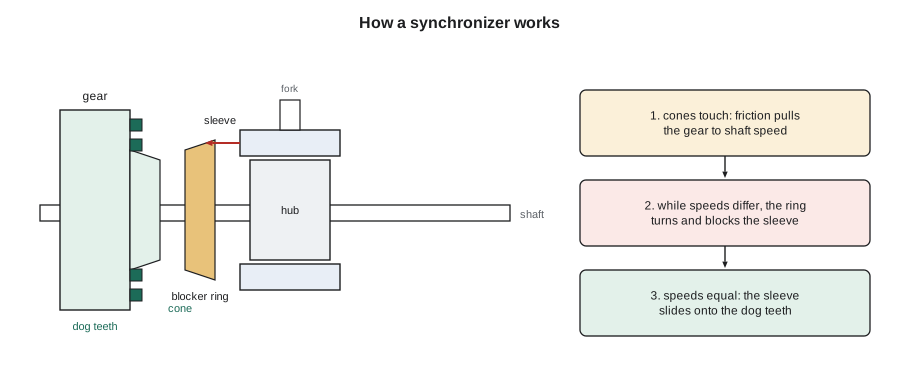
To lock a gear to its shaft, the two must be turning at exactly the same speed; otherwise the locking teeth would clash and grind. A synchronizer brings them to the same speed first. It has three main parts. The hub is splined to the shaft and turns with it. The sleeve slides on the hub, moved by the shift fork, and has internal teeth that will eventually engage the dog teeth on the side of the gear. Between them is the blocker ring, also called a synchronizer ring or baulk ring, a brass or carbon-lined ring with an internal cone that fits over a matching cone on the gear.
When the driver moves the shift lever, the fork pushes the sleeve toward the gear. Spring-loaded struts or keys push the blocker ring onto the gear's cone, and friction between the cones starts to bring the gear to the speed of the shaft. While there is a speed difference, the friction drag rotates the blocker ring slightly so that its own teeth block the sleeve's teeth, chamfer against chamfer, and the sleeve cannot pass. The harder the driver pushes, the harder the cones are pressed together and the faster they synchronize. Once the speeds are equal, the friction drag disappears, the blocker ring can turn back, and the sleeve slides through its teeth and onto the gear's dog teeth, locking the gear to the shaft. Second-gear synchronizers, which see the largest speed change on the frequent 1-2 upshift, are often double or triple cone designs with more friction area.
Why Theo's second gear grinds
On a 1-2 upshift, the car's speed hardly changes during the shift, so the transmission output shaft keeps turning at the same speed. The second-gear synchronizer has to slow the input shaft, the clutch disc and every gear turning with them from first-gear speed to second-gear speed. If the shift takes longer than the synchronizer needs, there is no grind. If the driver shifts faster than the synchronizer can match the speeds, the sleeve forces past the blocker ring before the speeds are equal and the teeth clash. A worn blocker ring, with its cone friction surface polished or its fine grooves worn away, produces less friction for the same shift force and takes longer to synchronize, so the grind appears first on fast shifts.
# Synchronizer time on a 1-2 upshift: new and worn blocker ring (illustrative values)
import math
inertia = 0.012                     # kg m2, input shaft, clutch disc and gears it drives
rpm_before = 5000
rpm_after = rpm_before * (39 / 19) / (46 / 13)    # input speed needed in second
dw = (rpm_before - rpm_after) * 2 * math.pi / 60
F, r, cone_angle = 300, 0.033, math.radians(6.5)  # axial force N, cone radius m
for name, mu in (("new ring", 0.10), ("worn ring", 0.06)):
    torque = mu * F * r / math.sin(cone_angle)
    t = inertia * dw / torque
    print(f"{name}: cone torque {torque:.1f} N m, input must drop {rpm_before} -> {rpm_after:.0f} rpm, time {t:.2f} s")
print("a quick shift allows about 0.35 s: the new ring finishes in time, the worn ring does not")new ring: cone torque 8.7 N m, input must drop 5000 -> 2900 rpm, time 0.30 s worn ring: cone torque 5.2 N m, input must drop 5000 -> 2900 rpm, time 0.50 s a quick shift allows about 0.35 s: the new ring finishes in time, the worn ring does not
Kiran checks other causes first, because a grind can also come from a clutch that does not fully release, which would make every gear grind, or from the wrong fluid, which changes cone friction in all the synchronizers. The new clutch releases fully. The grind happens only into second and only on fast shifts, and the other gears are clean. The fluid drained from the transaxle is the correct type but is dark and smells burnt, and the drain plug magnet carries fine brass-colored paste along with the normal gray steel paste. Brass is what blocker rings are made of.
Marty agrees with her diagnosis and explains the choice to Theo: the transaxle must come out again and be opened to replace the second-gear synchronizer rings, and it is cheaper to have done it while the clutch was out. Theo decides to live with it for now and shift more slowly, and to have it done at the next clutch job. Simone writes the recommendation and the decision on the repair order, and Kiran changes the fluid with fresh fluid of the specified type, which sometimes improves a marginal synchronizer slightly.
The shift mechanism
The driver's lever is connected to the transmission by rods or, in most front-wheel-drive cars, by two cables: one moves forward and back to select the gear, the other side to side to choose the gate. Inside the transmission, the lever's motion moves shift rails or a shift shaft, and forks on the rails ride in grooves in the synchronizer sleeves. Spring-loaded balls dropping into notches in the rails, called detents, give the lever its positive feel and hold the selected gear. An interlock, a set of pins or a plate between the rails, makes it impossible to move two rails at once, which would engage two gears and lock the transmission solid. A reverse lockout, a lift collar or a push-down knob, keeps reverse from being selected by accident.
Most shifting complaints that are not synchronizers are in this mechanism. Stretched or misadjusted cables and worn bushings at the shifter or the transmission levers cause sloppy shifts, missed gates and the inability to fully engage a gear. A broken engine or transmission mount lets the powertrain rock and pull on the cables, which can make the car jump out of gear on acceleration or deceleration. Inside the transmission, worn detent springs, worn fork pads or worn dog teeth on the gear or sleeve, which become tapered or rounded, let a gear walk out of engagement under load.
Lubrication
Manual transmissions are lubricated by splash: the gears dip into the oil and fling it onto the bearings and synchronizers. The oil must protect the gear teeth under pressure, but it must also give the synchronizer cones the right friction. Too slippery and they cannot match speeds; too grippy and they grab and shift notchily. That is why makers specify particular fluids, often called manual transmission fluid, with their own specification numbers, and why the wrong fluid can cause hard shifting or grinding even in a healthy transmission. Some manual transmissions and transaxles use gear oil, some a specific manual transmission fluid, and some even automatic transmission fluid or engine oil. Some extreme-pressure additives used in rear axle hypoid oils, the GL-5 category, can attack the brass in synchronizer rings, which is why many manual transmissions require GL-4 oils or a dedicated fluid. The service information always decides.
The fluid level is usually checked at the fill plug on the side of the case: the oil should be level with the bottom of the fill hole, with the vehicle level on the hoist. Kiran learns to loosen the fill plug before the drain plug, so she never drains a transmission she cannot refill. A level that is low means a leak, typically at an axle seal, the input seal, the shift shaft seal or a gasket, or occasionally from a blocked vent that lets pressure build up as the transmission warms.
Diagnosing manual transmission complaints
Marty's way to approach a manual transmission complaint is to ask three questions. Which gears? A problem in one gear points to that gear's synchronizer, gear or fork; a problem in all gears points to something shared: the clutch release, the fluid, the input shaft bearing, or the shift mechanism. When? Noise in neutral with the clutch engaged that disappears when the pedal is pressed comes from the input shaft and countershaft, often a bearing; noise only in gear and under load comes from the gear pair or the output shaft bearings; noise only on coast points to gear tooth wear patterns or loose preload. Under what load? Jumping out of gear on acceleration or deceleration points to mounts, cables and worn dog teeth.
# A first-pass guide: symptom pattern to likely causes (Marty's three questions)
def likely(symptom, gears, condition):
    if symptom == "grind" and gears == "all":
        return "clutch not fully releasing, wrong fluid"
    if symptom == "grind" and gears == "one":
        return "worn synchronizer or blocker ring for that gear" + (" (worse on fast shifts)" if condition == "fast shift" else "")
    if symptom == "jumps out":
        return "engine or transmission mount, cable adjustment, worn dog teeth or detent"
    if symptom == "noise" and condition == "neutral, pedal up":
        return "input shaft or countershaft bearing (quiet when the pedal is pressed)"
    if symptom == "noise" and condition == "in gear, under load":
        return "gear pair or output shaft bearing for that gear"
    return "gather more information"
for case in (("grind", "one", "fast shift"), ("grind", "all", "any"), ("jumps out", "one", "deceleration"),
             ("noise", "all", "neutral, pedal up"), ("noise", "one", "in gear, under load")):
print(f"{case[0]:<9} {case[1]:<4} {case[2]:<20} -> {likely(*case)}")grind one fast shift -> worn synchronizer or blocker ring for that gear (worse on fast shifts) grind all any -> clutch not fully releasing, wrong fluid jumps out one deceleration -> engine or transmission mount, cable adjustment, worn dog teeth or detent noise all neutral, pedal up -> input shaft or countershaft bearing (quiet when the pedal is pressed) noise one in gear, under load -> gear pair or output shaft bearing for that gear
When a transmission is opened, the inspection is systematic. Blocker rings are checked by pressing each one onto its gear cone and measuring the gap between the ring and the gear's dog teeth with a feeler gauge; a gap below the minimum means the cone is worn and the ring must be replaced. Shift fork pads are measured against the sleeve groove width. Gears are examined for chipped, pitted or tapered dog teeth, bearings for roughness and pitting, and shafts for end play, which is set with selective snap rings or shims to the specified range. New seals, gaskets and snap rings are fitted as a matter of course.
Worked problem
Blocker ring gap
A second-gear blocker ring pressed onto its cone measures 0.022 in from the dog teeth. The service information gives 0.039 to 0.055 in new and a minimum of 0.024 in. What does the measurement mean?
Show solution
- The ring sits closer to the dog teeth than the minimum allows.
- As the cone wears, the ring slides further onto it, reducing the gap.
- With less gap, the ring bottoms on the gear before it can generate full friction, so synchronizing is slow.
Answer: The ring is worn past its limit and must be replaced; the gear's cone should also be checked for wear.
Common mistakes
MistakeAssuming every grind is the clutch.
InsteadA grind in one gear only points to that gear's synchronizer.
MistakeFilling a manual transmission with whatever gear oil is on the shelf.
InsteadUse the specified fluid; some GL-5 oils harm brass synchronizers and the wrong friction causes grinding.
MistakeRemoving the drain plug before the fill plug.
InsteadLoosen the fill plug first so the unit can be refilled.
MistakeShifting into reverse while rolling.
InsteadMost reverse gears are unsynchronized and will clash.
MistakeOverlooking engine and transmission mounts on a jump-out complaint.
InsteadA broken mount lets the powertrain move and pull the shift linkage.
Summary and key terms
- A rear-drive manual transmission uses an input shaft, countershaft and mainshaft; a transaxle uses parallel input and output shafts and drives the differential directly.
- Forward gears are in constant mesh; synchronizers lock the selected gear to its shaft.
- A synchronizer uses cone friction to match speeds; the blocker ring stops the sleeve until they are equal.
- A worn blocker ring synchronizes slowly and causes grinding on fast shifts in that gear.
- Detents hold gears, an interlock prevents two gears at once, and a lockout guards reverse.
- Manual transmissions need the specified fluid for both gear protection and synchronizer friction.
- Diagnose by which gears, when, and under what load the problem occurs.
- Countershaft
- An intermediate shaft with a cluster of gears in constant mesh with the output shaft gears.
- Constant mesh
- A design in which gear pairs are always engaged and selected by locking them to their shaft.
- Synchronizer
- A device that matches the speed of a gear and its shaft before locking them together.
- Blocker ring
- The ring with an internal friction cone that blocks the sleeve until speeds match.
- Dog teeth
- The small teeth on the side of a gear that the synchronizer sleeve engages.
- Detent
- A spring-loaded ball and notch that holds a shift rail in position.
- Interlock
- A device that prevents two shift rails from moving at once.
Practice problems
Work each problem on paper first, then reveal the answer to check.
A transaxle's third gear is 40 teeth driven by 29 teeth, and the final drive is 4.07. What is the overall ratio?
Show answer
40 ÷ 29 × 4.07 ≈ 5.61:1.
Every gear grinds on every shift, even slow ones. What should be checked first?
Show answer
Clutch release: a clutch that does not fully release drags the input shaft.
Why do second-gear synchronizers often have several cones?
Show answer
The 1-2 shift has the largest speed change and is used most often, so it needs the most friction area.
A car jumps out of third on deceleration. Name two likely causes.
Show answer
A broken engine or transmission mount, worn dog teeth or detent, or a misadjusted shift cable.
Lesson quiz · 5 questions
Score 60% or more to complete this lesson.
Create a free account to save your progress, take quizzes and earn a certificate.