
AUTO-310 · Lesson 3 of 12 · 21 min
Clutches and dual-mass flywheels
Theo Banks drives a ten-year-old compact hatchback with a six-speed manual transmission, the same car whose plug wire Kiran found arcing in the spring. After a weekend trip with friends up I-70 into the mountains, he comes in on Monday unhappy. "On the long climbs in sixth, I put my foot down and the revs went up but the car didn't," he says. "Then there was a smell like burnt toast." Marty grins. "You've just described a slipping clutch better than most customers," he says. "Kiran, it's yours. Prove it's the clutch before anybody orders a part."
This lesson explains how a clutch connects a manual transmission to the engine, how much torque it can carry and why it slips, how the release system works, and why many modern cars use a dual-mass flywheel. It follows Kiran through confirming the slip, removing the transmission and deciding which parts to replace.
What a clutch does
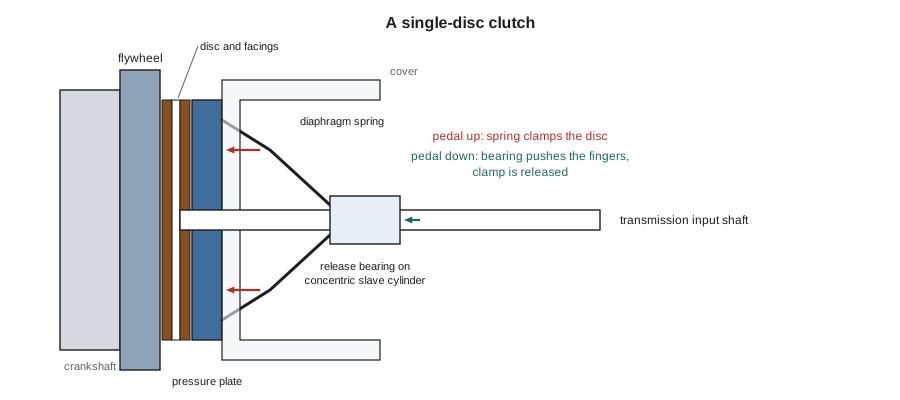
The clutch is a friction coupling between the engine's flywheel and the transmission input shaft. When the pedal is up, a strong spring in the pressure plate clamps a friction disc between the flywheel and the pressure plate, and the disc, splined to the input shaft, turns with the engine. When the driver presses the pedal, the release system pushes on the pressure plate's diaphragm spring fingers, the clamp load is released, and the disc can stop while the engine keeps turning. Letting the pedal up gradually lets the disc slip at first and then grip, which is how a manual car starts from rest without stalling: the slipping clutch makes up the difference between engine speed and road speed.
A clutch has three main parts. The flywheel, bolted to the crankshaft, provides one friction face and carries the starter ring gear. The friction disc has a facing of woven or molded friction material riveted to both sides of a steel plate, a splined hub, and usually a set of coil springs around the hub, the torsional damper, that soften engagement and absorb engine vibration. The pressure plate assembly, bolted to the flywheel, contains the diaphragm spring that provides the clamp load and the steel pressure plate that presses on the disc. The release bearing presses on the diaphragm fingers when the pedal is down.
How much torque a clutch can carry
A clutch transmits torque by friction, so its capacity depends on four things: the clamp force from the diaphragm spring, the friction coefficient of the facings, the average radius at which the friction acts, and the number of friction faces, which is two for a single-disc clutch because the disc is gripped on both sides. Designers give the clutch a reserve: a new clutch can carry perhaps 1.3 to 1.8 times the engine's maximum torque, so that it holds firmly even as the facings wear and in hot conditions.
In this formula μ (mu) is the friction coefficient, about 0.25 to 0.35 for organic facings in good condition, F is the clamp force, r_m is the mean radius of the facing, and n is the number of friction faces. Anything that lowers one of these factors lowers the torque the clutch can carry. Worn facings let the diaphragm spring extend past its designed position, which on most designs reduces clamp force. Oil or grease on the facings, from a leaking crankshaft rear main seal or transmission input seal, drops the friction coefficient sharply. Overheating glazes the facings into a hard, shiny surface with less friction. And a release system that does not let the bearing fully back off, from a misadjusted cable or a hydraulic fault, leaves the clutch partly released all the time.
# Clutch torque capacity, new and as found on Theo's car (values illustrative)
def capacity(mu, clamp_N, r_outer_mm, r_inner_mm, faces=2):
    r_mean = (r_outer_mm + r_inner_mm) / 2 / 1000
    return mu * clamp_N * r_mean * faces
engine_max = 200               # N m, Theo's 2.0 L engine
cases = {"new clutch": (0.30, 5500), "as found": (0.22, 4300)}
for name, (mu, F) in cases.items():
    T = capacity(mu, F, 114, 75)
    reserve = T / engine_max
    verdict = "holds" if reserve >= 1.0 else "SLIPS at full torque"
print(f"{name:<11} mu {mu:.2f}, clamp {F / 4.448:.0f} lbf -> {T * 0.7376:5.0f} lb ft, reserve {reserve:.2f}: {verdict}")new clutch mu 0.30, clamp 1237 lbf -> 230 lb ft, reserve 1.56: holds as found mu 0.22, clamp 967 lbf -> 132 lb ft, reserve 0.89: SLIPS at full torque
The calculation shows why Theo's clutch held perfectly around town and slipped only on the climbs. In normal driving the engine seldom makes more than half its maximum torque, well within even a worn clutch's capacity. Full throttle in a high gear at moderate engine speed, which is exactly what a long climb in sixth demands, asks for full torque, and the worn, glazed clutch could carry only about 90 percent of it.
Confirming the slip
Kiran confirms the complaint with data rather than feel. A slipping clutch shows up as engine speed that is higher than the road speed and gear ratio can account for. She drives the car with a scan tool connected, in sixth gear, on the long incline of the I-25 on-ramp near the shop, and records engine speed and vehicle speed while applying full throttle briefly. The car's sixth gear is 0.79:1, its final drive 4.07:1, and its tires 205/55R16. At 62 mph the engine should be turning about 2,700 rpm. Under full throttle on the incline it climbs to 3,050 rpm while the speed stays the same.
# Is the clutch slipping? Compare engine speed with the speed the gear ratio allows
import math
tire_d_mm = 2 * 205 * 0.55 + 16 * 25.4
gear, final = 0.79, 4.07
speed = 62.14                         # mph, steady on the incline
kmh = speed * 1.609344
wheel_rpm = kmh * 1000 / 60 / (math.pi * tire_d_mm / 1000)
expected = wheel_rpm * gear * final
for label, measured in (("light throttle", 2710), ("full throttle", 3050)):
    slip = 100 * (measured - expected) / measured
    note = "clutch holding" if slip < 2 else "clutch SLIPPING"
print(f"{label:<14} expected {expected:.0f} rpm, measured {measured} rpm, slip {slip:4.1f} % -> {note}")light throttle expected 2700 rpm, measured 2710 rpm, slip 0.4 % -> clutch holding full throttle expected 2700 rpm, measured 3050 rpm, slip 11.5 % -> clutch SLIPPING
With slip of more than 11 percent under full throttle, the clutch is confirmed. Kiran also checks the things that can make a good clutch slip. The car has a hydraulic release system with a concentric slave cylinder inside the bell housing, so there is no free play to adjust, but she confirms that the pedal returns fully and that the clutch fluid reservoir is not overfilled, since an overfilled reservoir or a swollen seal can hold the slave cylinder partly applied. The pedal feels normal. She looks under the car with a light at the gap between the engine and the transmission and sees an oily stain on the bottom of the bell housing. A leak there means the crankshaft rear main seal or the transmission input shaft seal, and either one will contaminate a new clutch if it is not fixed.
The release system
Older cars used a cable from the pedal to a release fork, which pivots in the bell housing and pushes the release bearing; cables stretch, so they need periodic adjustment or a self-adjusting mechanism. Most modern cars use hydraulics: a master cylinder at the pedal and a slave cylinder at the transmission, connected by a line and filled with brake fluid, often from the brake master cylinder reservoir. An external slave cylinder pushes a fork; a concentric slave cylinder, like Theo's, is a ring-shaped cylinder around the input shaft with the release bearing built into it, which saves space and parts but means the transmission must come out to replace it.
Hydraulic release faults show up as a pedal that sinks or feels spongy, a clutch that will not fully release, so the gears grind and the car creeps when stopped in gear, or, less often, a clutch that will not fully engage. Air in the system is removed by bleeding, and many concentric slave cylinders need a specific bleeding procedure or a pressure bleeder. Brake fluid absorbs water over time, so the clutch hydraulics should be flushed when the brake fluid is changed if they share a reservoir.
Dual-mass flywheels
A four-cylinder engine delivers its power in pulses, two per crankshaft revolution, and modern engines make high torque at low speeds where the pulses are strongest. Those pulses travel into the transmission and can make gears rattle at idle, cause a boom in the body, and wear parts. A single-mass flywheel relies on the disc's damper springs to absorb them. A dual-mass flywheel splits the flywheel into two masses, one bolted to the crankshaft and one carrying the clutch, joined by long arc springs and a bearing. The secondary mass isolates the transmission from the engine's pulses much better than a disc damper can, which is why diesel cars and many small turbocharged gasoline engines use one.
Dual-mass flywheels wear. The arc springs and their grease dry out, the bearing wears, and the two masses develop excessive free play and rock against each other. Symptoms include a knock or rattle at idle that disappears when the clutch pedal is pressed, a clunk when the engine is started or stopped, and vibration when pulling away. Their friction surface also cannot normally be machined, because the surface is thin and machining changes the clutch's geometry. Manufacturers publish checks: the free rotation of the secondary mass relative to the primary, measured in degrees or in teeth of the starter ring gear, and the side-to-side rock, both compared with limits.
# Clutch and dual-mass flywheel inspection against service limits (illustrative limits)
checks = [
    # (item, measured, limit, "max" or "min", unit)
    ("disc thickness", 0.272, 0.26, "min", "in"),
    ("rivet head depth below facing", 0.008, 0.012, "min", "in"),
    ("flywheel free rotation", 21, 18, "max", "ring gear teeth"),
    ("flywheel rock (tilt)", 0.094, 0.063, "max", "in"),
]
replace = []
for item, m, lim, kind, unit in checks:
    ok = m >= lim if kind == "min" else m <= lim
    print(f"{item:<30} {m:>6} {unit:<15} limit {kind} {lim:<6} {'OK' if ok else 'OUT OF LIMIT'}")
    if not ok:
        replace.append(item)
print("replace:", ", ".join(replace) if replace else "nothing")disc thickness 0.272 in limit min 0.26 OK rivet head depth below facing 0.008 in limit min 0.012 OUT OF LIMIT flywheel free rotation 21 ring gear teeth limit max 18 OUT OF LIMIT flywheel rock (tilt) 0.094 in limit max 0.063 OUT OF LIMIT replace: rivet head depth below facing, flywheel free rotation, flywheel rock (tilt)
The repair
With the transmission out, the evidence is clear. The friction facings are worn close to the rivets, glazed and dark on the flywheel side, with an oily crescent along the lower half. The crankshaft rear main seal is weeping. The dual-mass flywheel rocks more than its limit and rotates freely by more teeth than allowed, and its friction face shows blue heat spots. The pressure plate's diaphragm fingers show uneven wear where the release bearing has been touching them. Marty explains the rule: replace a clutch as a set, disc, pressure plate and release bearing, and in this car the concentric slave cylinder too, because it is inside the bell housing and the labor to reach it is the expensive part. The dual-mass flywheel is out of limits, so it is replaced as well. Kiran replaces the rear main seal, checks the input shaft seal and the pilot bearing in the end of the crankshaft, and cleans the oil from the bell housing.
Reassembly has its own rules. The new disc must go in the right way round, marked flywheel side or with its damper hub facing the transmission, and must be centered with an alignment tool so the input shaft splines can enter the disc and the pilot bearing. The pressure plate bolts are tightened evenly in a cross pattern to the specified torque so the cover is not distorted, and new flywheel bolts are used where the maker specifies. The input shaft splines get a thin film of the grease the maker specifies, not a heavy coat that would fling onto the facings. After installation, Kiran bleeds the hydraulic release, confirms the clutch releases fully with the engine running, and runs the maker's procedure for the clutch position sensor, which on Theo's car is used by the engine computer for start enable and idle control.
Marty finishes with advice for Theo about the new clutch: avoid slipping it hard for the first few hundred miles while the facings bed in, do not rest a foot on the pedal, and on long climbs shift down to a gear where the engine is not laboring at full throttle. "You burned the old one up a mountain in sixth," he says. "Fifth would have got you there just as fast."
Worked problem
Will the new clutch hold a tuned engine?
A customer with a modified version of the same engine claims 192 lb ft of torque. The new clutch has μ = 0.30, a clamp force of 1,236 lbf and a mean facing radius of 3.72 in. Will it hold with the usual reserve?
Show solution
- Capacity = 0.30 × 1,236 lbf × 0.310 ft × 2 faces ≈ 230 lb ft.
- Reserve = 230 ÷ 192 = 1.2, below the usual 1.3 to 1.8.
- It will hold when new, but as it wears and heats it will soon slip.
Answer: Marginal: a clutch with more clamp force or a higher-friction disc would be needed, and the repair order should say so.
Common mistakes
MistakeReplacing only the disc.
InsteadReplace the disc, pressure plate and release bearing together, and fix any oil leak.
MistakeInstalling a new clutch without fixing a leaking rear main seal.
InsteadOil on the new facings will make it slip again.
MistakeMachining a dual-mass flywheel like a single-mass one.
InsteadMost cannot be machined; check the maker's inspection limits and replace if out.
MistakePacking the input splines with grease.
InsteadUse a thin film of the specified grease so none reaches the facings.
MistakeRiding the clutch on long climbs.
InsteadChoose a gear where the engine is not at full throttle at low speed.
Summary and key terms
- A clutch clamps a friction disc between the flywheel and the pressure plate; the release bearing lifts the clamp.
- Clutch capacity equals friction coefficient times clamp force times mean radius times the number of faces.
- Wear, oil contamination, glazing and incomplete release reduce capacity and cause slip.
- Confirm slip by comparing engine speed with the speed the gear ratio allows.
- Hydraulic release systems need correct fluid and bleeding; concentric slave cylinders sit inside the bell housing.
- Dual-mass flywheels isolate engine pulses but wear; check free play and rock against the maker's limits.
- Replace the clutch as a set, center the disc, torque the cover evenly and relearn the clutch position sensor if required.
- Pressure plate
- The assembly bolted to the flywheel that clamps the disc using a diaphragm spring.
- Friction disc
- The disc with friction facings, splined to the transmission input shaft.
- Release bearing
- The bearing that pushes on the diaphragm spring fingers to release the clutch.
- Concentric slave cylinder
- A ring-shaped hydraulic cylinder around the input shaft with a built-in release bearing.
- Dual-mass flywheel
- A flywheel in two parts joined by springs to isolate engine pulses from the transmission.
- Torsional damper
- Springs in the clutch disc hub that soften engagement and absorb vibration.
- Clutch slip
- A difference between engine speed and input shaft speed while the clutch should be fully engaged.
Practice problems
Work each problem on paper first, then reveal the answer to check.
A clutch has μ = 0.28, clamp force 1,350 lbf, mean radius 0.33 ft and two faces. What is its capacity?
Show answer
0.28 × 1,350 × 0.33 × 2 ≈ 249 lb ft.
Why does a worn clutch often slip only at full throttle in a high gear?
Show answer
That is when the engine makes full torque at low speed; part-throttle torque is within the worn capacity.
What symptom suggests a worn dual-mass flywheel?
Show answer
A rattle at idle that stops when the clutch pedal is pressed, or a clunk at start and stop.
Why replace a concentric slave cylinder with the clutch?
Show answer
It is inside the bell housing, so replacing it later means removing the transmission again.
Lesson quiz · 5 questions
Score 60% or more to complete this lesson.
Create a free account to save your progress, take quizzes and earn a certificate.