
AUTO-310 · Lesson 11 of 12 · 21 min
Transfer cases, AWD and 4WD systems
Two four-wheel-drive problems arrive on the same Thursday. Gord Haney's pickup, back for its two-week transmission follow-up, now has a second complaint: on a muddy job site his four-wheel-drive indicator flashed and the truck stayed in two-wheel drive, and he had to be pulled out. And Harold Kemp's luxury SUV, with its full-time all-wheel drive, is showing a drivetrain service warning and "feels like it's dragging its feet" in tight parking lot turns. Harold mentions, almost as an afterthought, that he had one tire replaced after a puncture the week before, at a tire shop near his cabin.
This lesson explains the difference between part-time four-wheel drive, full-time four-wheel drive and all-wheel drive, how transfer cases and couplings divide torque between the axles, why axles must be allowed to turn at different speeds on pavement, why tire matching matters so much on all-wheel-drive vehicles, and how to diagnose engagement faults and driveline binding.
Part-time four-wheel drive
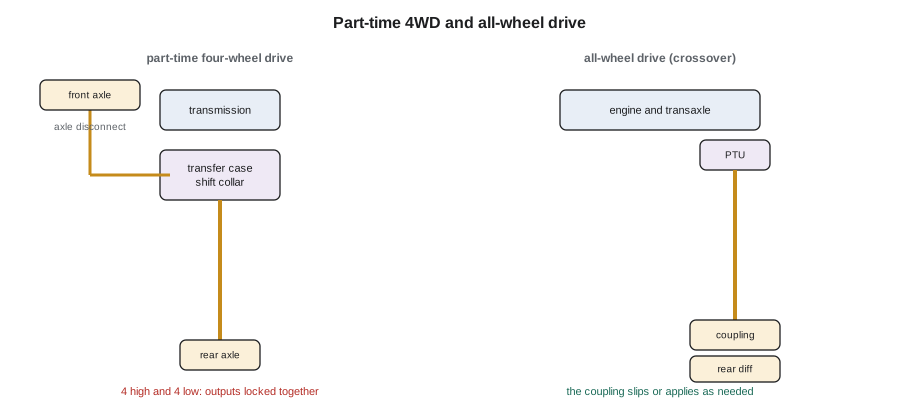
Gord's truck has a part-time system, the classic truck design. A transfer case bolted behind the transmission has one input and two outputs: a rear output that always drives the rear axle and a front output, driven through a chain or gears, that can be engaged or disengaged. In two-wheel drive high, only the rear output is driven. In four-wheel drive high, a sliding collar locks the front output to the rear output, so the front and rear driveshafts turn at exactly the same speed. In four-wheel drive low, a planetary reduction gear set in the transfer case is engaged, multiplying torque by about 2.7 for crawling, climbing and pulling on loose ground. Neutral disconnects both outputs, which is used for flat-towing some trucks.
Because four-wheel drive high locks the axles together, it must not be used on dry pavement. In a turn, the front wheels travel a larger arc than the rear wheels, so the front driveshaft needs to turn slightly faster than the rear one. With the axles locked, that difference can only be absorbed by the tires slipping. On loose surfaces, mud, gravel or snow, the tires slip easily and no harm is done. On dry pavement they grip, the difference winds up the driveline like a spring, steering becomes heavy, the tires scrub and hop, and the transfer case, U-joints and axles are loaded far beyond their normal stress. The driver may also find the truck will not shift out of four-wheel drive until it is backed up a little to release the wind-up.
# Driveline wind-up in a turn with the axles locked together
import math
wheelbase = 12.0                 # ft
for rear_radius in (26, 66, 328):   # turn radius at the rear axle center, ft
    front_radius = math.hypot(rear_radius, wheelbase)
    diff = 100 * (front_radius / rear_radius - 1)
    extra = (front_radius - rear_radius) * math.pi / 2
print(f"rear radius {rear_radius:>4} ft: front axle radius {front_radius:5.1f} ft, front must turn {diff:5.2f} % faster, {extra:.2f} ft more in a quarter turn")rear radius 26 ft: front axle radius 28.6 ft, front must turn 10.14 % faster, 4.14 ft more in a quarter turn rear radius 66 ft: front axle radius 67.1 ft, front must turn 1.64 % faster, 1.70 ft more in a quarter turn rear radius 328 ft: front axle radius 328.2 ft, front must turn 0.07 % faster, 0.34 ft more in a quarter turn
Many part-time systems also disconnect the front axle when not in use so that the front driveshaft, differential and axle shafts do not turn and waste energy. Older trucks used locking hubs at the front wheels, either manual hubs turned by hand or automatic hubs that engaged when torque was applied. Newer trucks, including Gord's, use an axle disconnect: a sliding collar in the front axle, moved by an electric or vacuum actuator, that connects one axle shaft to the differential. When the driver selects four-wheel drive, the transfer case shift motor moves the transfer case collar and, at the same time, the axle actuator connects the front axle.
# Four-wheel drive low: overall crawl ratio, speed and wheel torque (Gord's truck)
import math
first, axle, low = 4.027, 3.42, 2.72
tire_d_mm = 802.8
torque = 383                    # lb ft from the engine near peak
eff = 0.85                      # transmission, transfer case and axles in low range, illustrative
for name, tc in (("4 high", 1.0), ("4 low", low)):
    ratio = first * tc * axle
    rpm = 1000
    speed_kmh = rpm / ratio * math.pi * tire_d_mm / 1e6 * 60
    wheel = torque * ratio * eff
print(f"{name}: overall {ratio:5.1f}:1, at {rpm} rpm {speed_kmh * 0.621371:4.1f} mph, torque at the wheels {wheel:6.0f} lb ft")4 high: overall 13.8:1, at 1000 rpm 6.8 mph, torque at the wheels 4484 lb ft 4 low: overall 37.5:1, at 1000 rpm 2.5 mph, torque at the wheels 12195 lb ft
Gord's four-wheel drive will not engage
Kiran starts with the scan tool. The transfer case control module has stored two trouble codes for the shift motor position sensor circuit, both history codes, intermittent. The data shows the position sensor's reading, which should step through fixed values for two-wheel high, four high, neutral and four low, jumping erratically when she wiggles the harness at the transfer case. Under the truck, the shift motor's connector, sitting low on the side of the transfer case where it gets every splash of salt water through the winter, has green corrosion on two of its terminals and a cracked seal.
The repair follows Marty's rule for corroded connectors: replace what is corroded rather than cleaning it and hoping, because corrosion wicks up inside the wire insulation. Kiran replaces the connector pigtail with the maker's repair kit, using sealed crimp splices, and applies the dielectric grease the maker specifies to the new seal. She also checks the front axle actuator, which has its own connector, and confirms with the scan tool that it moves and reports its position. On the road test on the gravel lot behind the shop, the truck shifts into four high and four low and back to two high cleanly, and the position sensor reads steadily. She adds a note for Gord: engage four-wheel drive briefly once a month, even in summer, to keep the shift mechanism and axle collar moving, which most truck makers recommend.
All-wheel drive and full-time four-wheel drive
A full-time system drives both axles all the time and must therefore allow them to turn at different speeds on pavement. Traditional full-time four-wheel-drive transfer cases do it with a center differential, a planetary or bevel differential between the front and rear outputs, often with a lock for loose ground. All-wheel-drive systems on most cars and crossovers do it differently. A front-wheel-drive transaxle carries a power take-off unit, a small right-angle gearbox that drives a rear driveshaft, and the rear drive unit contains an electronically controlled multi-plate clutch, the coupling, ahead of the rear differential. When the coupling is open, the vehicle is front-wheel drive. The control module applies the coupling partly or fully according to throttle, wheel slip, steering angle and temperature, sending anywhere from none to around half of the torque to the rear. Harold's SUV uses an active transfer case: rear-wheel drive with an electronically controlled clutch pack that sends torque to the front axle.
These couplings are designed to slip a little in normal turns, but they are not designed to slip continuously. If the front and rear axles are forced to turn at different speeds all the time on a straight road, the coupling either slips constantly and overheats, or the module, sensing the mismatch, applies it and winds up the driveline. Most systems protect themselves by detecting the overheating or the persistent speed difference and reducing or disabling all-wheel drive, often with a warning to the driver. Constant speed difference between axles has one common cause: tires that are not the same size.
Harold's mismatched tire
The scan tool on Harold's SUV shows a stored code for front-rear speed difference and a history of the transfer case clutch over-temperature protection. The wheel speed data on a straight, level road at a steady speed shows the left rear wheel turning a little slower than the other three. On the hoist, Kiran finds the replacement tire: same size designation, a different brand, and with full tread depth, while the other three, original equipment, are about half worn. A new tire is larger in diameter than a worn one, so it turns more slowly. The difference looks small on paper, but on a vehicle whose axles are linked through a clutch, it is a continuous speed difference that the clutch must absorb at every moment.
# Tire mismatch: how a new tire among worn ones makes the axles turn at different speeds
import math
nominal_d = 30.9                     # in, diameter of the size when new
worn_loss = 0.2                     # tread lost on the three old tires, in of depth
d_new = nominal_d
d_old = nominal_d - 2 * worn_loss     # tread is lost on both sides of the diameter
diff_pct = 100 * (d_new - d_old) / d_old
print(f"new tire {d_new:.1f} in, worn tires {d_old:.1f} in: {diff_pct:.2f} % difference in diameter")
speed_kmh = 100.0
wheel_old = speed_kmh * 1000 / 60 / (math.pi * d_old * 0.0254)
wheel_new = speed_kmh * 1000 / 60 / (math.pi * d_new * 0.0254)
rear_axle = (wheel_old + wheel_new) / 2          # the rear differential averages the two rear wheels
front_axle = wheel_old
print(f"at {62} mph: front axle {front_axle:.1f} rpm, rear axle {rear_axle:.1f} rpm")
print(f"the coupling must slip about {abs(front_axle - rear_axle) * 3.31:.1f} rpm at the driveshaft, continuously")
limit = 0.5
print(f"maker's limit about {limit} % between tires: {'within limit' if diff_pct <= limit else 'EXCEEDS the limit'}")new tire 30.9 in, worn tires 30.5 in: 1.31 % difference in diameter at 62 mph: front axle 684.8 rpm, rear axle 680.4 rpm the coupling must slip about 14.7 rpm at the driveshaft, continuously maker's limit about 0.5 % between tires: EXCEEDS the limit
Tread depth makes the difference: 6/32 in of tread worn from the three old tires reduces their diameter by twice that, about 1.3 percent. Many all-wheel-drive makers set a limit on tire differences, sometimes as a difference in circumference, sometimes as a tread depth difference of a few thirty-seconds of an inch, and require that all four tires be the same make, model and size. The fix is to make the tires match. Harold's options, which Simone explains, are to replace all four tires, to replace the other three to match the new one, or, where the maker allows it, to have the new tire shaved by a tire shop to match the tread depth of the others. Harold chooses four new tires, as his old ones were due within the year anyway. Kiran clears the codes, confirms the wheel speeds now agree within a fraction of a percent on the road test, and performs the transfer case clutch relearn the maker specifies after a tire change.
Marty adds two more warnings about all-wheel-drive vehicles that come up in the shop. First, never test an all-wheel-drive or full-time four-wheel-drive vehicle on a two-wheel dynamometer or let it idle in gear on a hoist with only one axle's wheels turning, because the driveline will try to drive the stationary axle; makers give specific procedures, which may involve disabling the system or removing a fuse or driveshaft. Second, flat-towing and towing with two wheels on the ground are restricted or prohibited on many of these vehicles, and the owner's information must be checked before a customer's car goes on a tow dolly.
Servicing transfer cases and couplings
Transfer cases have their own fluid, often a specific automatic transmission fluid or a dedicated transfer case fluid, and electronic clutch couplings and power take-off units have theirs. The power take-off unit on a transverse all-wheel-drive car is small and sits close to the exhaust, so its gear oil runs hot; many have short severe-service intervals, and neglected ones are a common source of whine and failure. Coupling fluid also degrades with heat, and some couplings need a relearn after fluid service. Chain-driven transfer cases wear their chains over time; a stretched chain slaps against the case and makes a rattle or knock when the truck is driven in four-wheel drive, and can eventually jump teeth.
Diagnosis follows the same order as any driveline problem. Verify the complaint, including whether it happens in two- and four-wheel drive. Read codes from the transfer case, all-wheel-drive and antilock brake modules, since the wheel speed sensors are shared. Check tire sizes and pressures before anything else on an all-wheel-drive binding complaint. Check fluid levels and condition. Then test the electrical parts, shift motors, actuators, coupling solenoids or pumps, against their specifications, and only then condemn the mechanical parts.
Worked problem
Will a tire shop's new spare do?
An all-wheel-drive car's maker limits tire diameter differences to 0.5 percent. The original tires are 26.0 in in diameter when new and have lost 4/32 in of tread. A new tire of the same size replaces a damaged one. Is it within the limit?
Show solution
- The worn tires are about 26.0 − 2 × 0.125 = 25.75 in in diameter.
- Difference = (26.0 − 25.75) ÷ 25.75 ≈ 0.92 percent.
- That is nearly twice the limit.
Answer: No: the new tire must be shaved to match, or the tires replaced in a matching set.
Common mistakes
MistakeDriving in locked four-wheel drive on dry pavement.
InsteadLocked modes wind up the driveline; use them only on loose or slippery surfaces.
MistakeReplacing one tire on an all-wheel-drive vehicle without checking the others.
InsteadMismatched diameters make the coupling slip constantly; match the tires.
MistakeCleaning a badly corroded connector and refitting it.
InsteadReplace corroded terminals with the maker's repair kit and seal them.
MistakeRunning an all-wheel-drive car on a two-wheel dynamometer.
InsteadFollow the maker's procedure; the driveline will try to drive the stationary axle.
MistakeIgnoring the power take-off unit's fluid.
InsteadIt runs hot; service it on the severe schedule.
Summary and key terms
- Part-time four-wheel drive locks the front and rear outputs together and adds a low range for loose surfaces.
- Locked axles wind up on dry pavement because the front wheels travel farther in a turn.
- Front axles are connected by hubs or an axle disconnect actuated with the transfer case.
- All-wheel drive lets the axles differ through a center differential or an electronically controlled coupling.
- Couplings protect themselves by reducing torque when they overheat or see constant speed difference.
- Mismatched tire diameters, often from one new tire among worn ones, cause constant speed difference and binding.
- Check tires first, then codes, fluids and actuators, before condemning mechanical parts.
- Part-time four-wheel drive
- A system that locks the front and rear axles together when selected, for loose surfaces only.
- Transfer case
- The gearbox that divides power between the front and rear driveshafts.
- Low range
- A reduction gear in the transfer case for crawling and pulling.
- Axle disconnect
- A collar in the front axle that connects and disconnects an axle shaft.
- Power take-off unit
- A right-angle gearbox on a transaxle that drives the rear driveshaft in all-wheel drive.
- Coupling
- An electronically controlled clutch that sends torque to the second axle.
- Wind-up
- Torsional stress built up in a locked driveline when the axles must turn at different speeds.
Practice problems
Work each problem on paper first, then reveal the answer to check.
Why does a part-time truck bind in tight turns on dry pavement in four-wheel drive?
Show answer
The front axle must turn faster than the rear in a turn, but the transfer case locks them together.
A transfer case low range is 2.72:1, first gear 4.03:1 and the axle 3.42:1. What is the crawl ratio?
Show answer
2.72 × 4.03 × 3.42 ≈ 37.5:1.
Why does one new tire among three worn ones cause problems on an all-wheel-drive car?
Show answer
Its larger diameter makes its axle turn at a different speed, so the coupling slips constantly or winds up.
What should be checked first on an all-wheel-drive binding complaint?
Show answer
Tire sizes, makes and tread depths, and pressures.
Lesson quiz · 5 questions
Score 60% or more to complete this lesson.
Create a free account to save your progress, take quizzes and earn a certificate.