
AUTO-310 · Lesson 1 of 12 · 22 min
How a drivetrain transmits power
Summer is towing season at Ridgeline. Landscapers haul skid steers and sod, families pull trailers into the mountains, and every week a vehicle arrives with a complaint that starts behind the engine: a shift that feels wrong, a clunk when the driver backs out of the driveway, a hum that rises with road speed. Kiran Dhaliwal begins her drivetrain term on a Monday when three of them are parked in the lot. Gord Haney's pickup came back from a job up the I-70 corridor west of Denver with a transmission that "smells hot and shudders". One of Hal Osei's courier vans shifts harshly. Dr. Amara Singh wants to know why her electric car has "no transmission at all" and whether that means there is nothing to service.
Marty Kowalchuk tells her that all three questions have the same starting point. "Every one of these vehicles has the same job to do," he says. "Take the power the engine or motor makes, change its speed and torque so the wheels can use it, and get it to the tires that touch the road, while letting the wheels turn at different speeds in a corner. The parts look different. The job doesn't. Learn the job first and the parts make sense."
This lesson follows power from the crankshaft or motor shaft to the tire contact patch. It introduces the parts of the drivetrain, explains why engines need a transmission at all, compares front-wheel, rear-wheel, all-wheel and four-wheel drive layouts, and works through how engine speed, gear ratio and tire size together set road speed. The rest of the course takes each part in turn.
What the drivetrain has to do
An engine makes useful torque only over part of its speed range. Gord's 5.3 liter V8 idles at about 600 rpm, makes its peak torque around 4,100 rpm and is limited to about 6,000 rpm. The wheels, on the other hand, have to turn from zero, when the truck starts from rest with a loaded trailer behind it, to around 900 rpm at highway speed. If the engine were connected straight to the wheels it could not start the truck moving, could not climb a grade, and at highway speed would have to run at a fraction of its speed with almost no torque to spare. The drivetrain solves four problems at once.
- It disconnects the engine from the wheels so the engine can idle while the vehicle is stopped, and connects it smoothly when the vehicle starts moving. A clutch does this in a manual transmission and a torque converter does it in a conventional automatic.
- It multiplies torque and reduces speed. Gears trade speed for torque: a 4:1 reduction turns 100 units of torque into roughly 400, at a quarter of the speed.
- It provides several ratios, so the engine can stay in a useful speed range from a standing start to highway cruise, and a reverse.
- It lets the drive wheels turn at different speeds in a corner, through the differential, while still driving both of them.
Electric motors make full torque from zero speed and run happily to 15,000 rpm or more, so most electric vehicles need only one fixed reduction and a differential. That is why Dr. Singh's car has "no transmission". It still has a gearbox, a single-speed reduction unit filled with fluid, and that fluid has a service interval in her owner's information, even though it is long. Marty tells her so, and Simone adds the inspection to her next visit. High-voltage drive units are covered in AUTO-410; in this course electric drives appear only for comparison.
The parts of the drivetrain
Power leaves the engine at the crankshaft. Bolted to the crankshaft is either a flywheel and clutch, for a manual transmission, or a flexplate and torque converter, for an automatic. Behind that is the transmission, which selects the ratio. In a rear-wheel-drive vehicle, a driveshaft, also called a propeller shaft, carries the power from the transmission to the rear axle, where a ring and pinion gear set turns the drive through a right angle and gives a final reduction, and the differential divides it between two axle shafts. In a front-wheel-drive vehicle, the transmission and the final drive and differential are combined in one housing called a transaxle, and short half-shafts with constant-velocity joints carry the drive to the front wheels, which also steer.
Four-wheel-drive and all-wheel-drive vehicles add a way to send power to the second axle. On a truck like Gord's that is a transfer case behind the transmission, with a front driveshaft to a front differential. On a car-based all-wheel-drive vehicle it is usually a power take-off unit on the transaxle and a driveshaft to a rear drive unit with an electronically controlled clutch. The parts are summarized in the figure, and each has its own lesson later in the course: clutches in Lesson 3, manual transmissions in Lesson 4, automatics in Lessons 5 to 7, CVTs and dual-clutch transmissions in Lesson 8, shafts and joints in Lesson 9, differentials in Lesson 10 and transfer cases and all-wheel drive in Lesson 11.
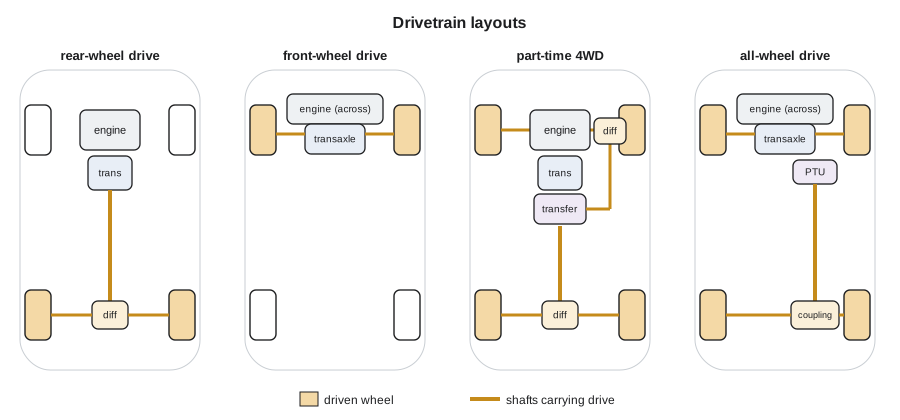
Front-wheel, rear-wheel, all-wheel and four-wheel drive
Rear-wheel drive is the traditional layout for trucks, vans and many larger cars. It separates the jobs of steering and driving, puts more weight on the drive wheels when the vehicle is loaded or towing, which is exactly when traction matters most, and allows a strong, simple rear axle. Its weaknesses are packaging, because the driveshaft needs a tunnel through the floor, and traction on slippery roads when the vehicle is empty. Gord's pickup and Hal's vans are rear-wheel drive, and both lose traction easily on ice with an empty box.
Front-wheel drive puts the engine, transmission and final drive in one compact unit across the front of the car. That frees space for passengers, saves weight and puts the engine's weight over the drive wheels, which helps traction in snow. It also makes the front tires both steer and drive, which limits how much power the layout can handle, and the half-shafts must swing through the steering angle, which is why front-wheel-drive cars use constant-velocity joints. The Lindqvists' minivan, Ines Moreau's hybrid and most compact cars are front-wheel drive.
All-wheel drive drives all four wheels all the time, or engages the second axle automatically within a fraction of a second when the primary axle slips. It is designed for paved roads and changing traction, with a center differential or a clutch coupling that allows the front and rear axles to turn at slightly different speeds, which they must do in every turn. Four-wheel drive, in the traditional sense, is a driver-selected system on trucks and off-road vehicles: in four-wheel drive high, the front and rear driveshafts are locked together in the transfer case, which gives maximum traction on loose surfaces but binds on dry pavement, and four-wheel drive low adds a reduction gear for crawling and pulling. Many modern trucks have both: an automatic mode that behaves like all-wheel drive and a locked mode for loose ground. Lesson 11 explains why using a locked mode on dry pavement damages parts.
Gear ratio, torque and speed
A gear ratio is the number of turns of the input for one turn of the output. A ratio of 4:1, written simply as 4.0, means the input turns four times for each turn of the output. Speed is divided by the ratio and torque is multiplied by it, less a small loss to friction. A transmission's ratio in each gear multiplies with the final drive ratio in the axle or transaxle to give the overall ratio. Gord's six-speed automatic has a first gear of 4.03:1 and a sixth gear of 0.67:1, and his rear axle ratio is 3.42:1, so the overall ratio is 13.77:1 in first and 2.28:1 in sixth. A sixth gear below 1:1 is an overdrive: the transmission output turns faster than its input, which lets the engine turn slowly at highway speed.
The tire finishes the job. Every turn of the wheel moves the vehicle forward by about one tire circumference, slightly less in practice because the loaded tire is flattened at the bottom. A tire size such as 265/70R17 gives the section width in millimeters, 265; the aspect ratio, 70, meaning the sidewall height is 70 percent of the width; and the wheel diameter in inches, 17. The overall diameter is twice the sidewall height plus the wheel diameter, about 31.6 in for Gord's tires. With the engine speed, the overall ratio and the tire size, Kiran can calculate road speed in any gear, and the reverse: the engine speed needed for a given road speed.
# Road speed from engine speed, gear ratio and tire size
import math
def tire_diameter_mm(width, aspect, rim_in):
    return 2 * width * aspect / 100 + rim_in * 25.4
gears = [4.027, 2.364, 1.532, 1.152, 0.852, 0.667]   # Gord's six-speed automatic
final = 3.42                                        # rear axle ratio
d = tire_diameter_mm(265, 70, 17)
circ_m = math.pi * d / 1000
rpm = 2000
print(f"tire 265/70R17: diameter {d / 25.4:.1f} in, one turn = {circ_m / 0.3048:.2f} ft")
for n, g in enumerate(gears, 1):
    overall = g * final
    wheel_rpm = rpm / overall
    speed = wheel_rpm * circ_m * 60 / 1000 * 0.621371
print(f"gear {n}: overall {overall:5.2f}:1, at {rpm} rpm the truck does {speed:5.1f} mph")tire 265/70R17: diameter 31.6 in, one turn = 8.27 ft gear 1: overall 13.77:1, at 2000 rpm the truck does 13.7 mph gear 2: overall 8.08:1, at 2000 rpm the truck does 23.3 mph gear 3: overall 5.24:1, at 2000 rpm the truck does 35.9 mph gear 4: overall 3.94:1, at 2000 rpm the truck does 47.7 mph gear 5: overall 2.91:1, at 2000 rpm the truck does 64.5 mph gear 6: overall 2.28:1, at 2000 rpm the truck does 82.4 mph
The calculation shows why the engine needs six gears with a trailer behind it. In first, 2,000 rpm moves the truck at walking-to-jogging speed, 13.7 mph, with enormous torque at the wheels. In sixth, the same engine speed would be 82.4 mph. At a steady 62 mph in sixth, the engine turns about 1,510 rpm, which saves fuel on a level road, but on a long mountain grade with a trailer the engine has too little torque at that speed and the transmission must shift down to fourth or third. How a transmission decides when to shift is the subject of Lesson 6.
Where the power goes
No drivetrain is perfectly efficient. Gears mesh with a little sliding friction, bearings and seals drag, the fluid that lubricates and cools the gears is churned, and a torque converter that is not locked up slips and turns some of the power into heat. A healthy manual transmission and axle might pass on around 90 to 95 percent of the engine's power to the wheels; an automatic with an unlocked converter in a low gear passes on less, and the difference becomes heat in the transmission fluid. That heat matters on a hot day with a trailer on a long grade, which is exactly where Gord's truck was when it started to smell hot. Lesson 7 deals with his transmission, but Marty wants Kiran to understand the physics now: power lost in the drivetrain does not disappear, it heats the fluid, and fluid that runs hot wears out quickly.
# Torque at the wheels and the drivetrain's heat load (illustrative efficiency)
engine_torque = 383          # lb ft, near peak torque
gears = [4.027, 2.364, 1.532, 1.152, 0.852, 0.667]
final = 3.42
efficiency = 0.90             # transmission, axle and bearings together, unlocked converter not included
for n, g in enumerate(gears, 1):
    wheel = engine_torque * g * final * efficiency
    print(f"gear {n}: torque at the axle shafts about {wheel:6.0f} lb ft (both wheels together)")
power = 200                   # hp being sent through the drivetrain on a grade
loss = power * (1 - efficiency)
print(f"at {power} hp through the drivetrain, about {loss:.0f} hp becomes heat")gear 1: torque at the axle shafts about 4747 lb ft (both wheels together) gear 2: torque at the axle shafts about 2787 lb ft (both wheels together) gear 3: torque at the axle shafts about 1806 lb ft (both wheels together) gear 4: torque at the axle shafts about 1358 lb ft (both wheels together) gear 5: torque at the axle shafts about 1004 lb ft (both wheels together) gear 6: torque at the axle shafts about 786 lb ft (both wheels together) at 200 hp through the drivetrain, about 20 hp becomes heat
Fifteen kilowatts, or twenty horsepower, is the output of a large space heater going into the drivetrain's fluid and air, continuously, for as long as the climb lasts. Most of it is carried away by the transmission cooler in the radiator and the air flowing past the axle. When the cooler is small, partly blocked, or overwhelmed by a heavy trailer, slow speed and hot air, the fluid temperature climbs.
Torque, traction and the tire
The final link is the tire. Torque at the axle becomes a pushing force at the contact patch equal to the torque divided by the tire's rolling radius. That force can never be larger than the grip between tire and road allows: on dry asphalt the friction coefficient is roughly 0.8 to 1.0, on packed snow perhaps 0.2 to 0.3, and on wet ice less than 0.1. When the driving force exceeds the grip, the tire spins and the force drops. A drivetrain cannot create traction; it can only deliver torque that the tires either use or waste. That is why Gord's empty pickup spins its rear tires on an icy hill even though first gear gives it far more torque than it needs, and why traction control, Lesson 10, and four-wheel drive, Lesson 11, exist.
Worked problem
Engine speed on the highway
Hal Osei's courier vans have a ten-speed automatic with a tenth gear of 0.636:1, a 3.73:1 axle and 235/65R16 tires. Estimate the engine speed at 62 mph in tenth gear.
Show solution
- Tire diameter = 2 × 235 × 0.65 ÷ 25.4 + 16 ≈ 28.0 in, so one turn moves the van about 7.34 ft.
- At 62 mph (100 km/h) the van covers 5,468 ft per minute. Wheel speed = 5,468 ÷ 7.34 ≈ 745 rpm.
- Overall ratio = 0.636 × 3.73 ≈ 2.37.
- Engine speed = 745 × 2.37 ≈ 1,770 rpm.
Answer: About 1,770 rpm, which is why the vans cruise quietly but shift down for every long grade with a full load.
Common mistakes
MistakeThinking an electric vehicle has no gearbox to service.
InsteadIt has a reduction gear and differential in a fluid-filled housing; check the maker's schedule.
MistakeTreating gear ratio and overall ratio as the same thing.
InsteadMultiply the transmission ratio by the final drive ratio to get the overall ratio.
MistakeExpecting more torque to cure wheelspin.
InsteadTraction is limited by the tire and road; more torque only spins the tire faster.
MistakeUsing four-wheel drive high, locked, on dry pavement.
InsteadLocked modes bind the driveline in turns; they are for loose or slippery surfaces.
MistakeForgetting that lost power becomes heat.
InsteadEvery percent lost in the drivetrain heats the fluid and the parts.
Summary and key terms
- The drivetrain disconnects the engine, multiplies torque, provides several ratios and lets the wheels turn at different speeds.
- Engines make useful torque over a limited speed range, so they need a transmission; electric motors usually need only one reduction.
- Rear-wheel drive separates steering and driving; front-wheel drive combines the transmission and final drive in a transaxle.
- All-wheel drive works on pavement with a coupling or center differential; part-time four-wheel drive locks the axles together.
- Overall ratio is the gear ratio times the final drive ratio; speed divides by it and torque multiplies by it.
- Road speed follows from engine speed, overall ratio and tire circumference.
- Power lost in the drivetrain becomes heat in the fluid; traction is limited by the tire.
- Drivetrain
- The parts that carry power from the engine or motor to the driven wheels.
- Transaxle
- A transmission combined with the final drive and differential in one housing.
- Final drive
- The last reduction gear set, in the axle or transaxle, usually a ring and pinion.
- Overall ratio
- The transmission gear ratio multiplied by the final drive ratio.
- Overdrive
- A gear ratio below 1:1, in which the output turns faster than the input.
- Transfer case
- A gearbox behind the transmission that sends power to the front axle on a four-wheel-drive vehicle.
- Contact patch
- The part of the tire touching the road, where driving force is transferred.
Practice problems
Work each problem on paper first, then reveal the answer to check.
A gear of 2.36:1 and a final drive of 3.42:1. What is the overall ratio?
Show answer
2.36 × 3.42 ≈ 8.07:1.
Why do most electric vehicles use a single fixed reduction?
Show answer
Electric motors make full torque from zero speed and run to very high speeds, so one ratio covers the whole speed range.
What is the difference between all-wheel drive and part-time four-wheel drive?
Show answer
All-wheel drive allows a speed difference between axles and is used on pavement; part-time four-wheel drive locks the axles together for loose surfaces.
Where does the power lost in a drivetrain go?
Show answer
It becomes heat, mostly in the fluid, which the cooler and the air must carry away.
Lesson quiz · 5 questions
Score 60% or more to complete this lesson.
Create a free account to save your progress, take quizzes and earn a certificate.