
AUTO-230 · Lesson 7 of 12 · 19 min
Spark plugs and ignition diagnosis
Gord Haney's pickup has had a long year at Ridgeline: suspension, brakes, a cylinder-deactivation lifter, a ground eyelet and a starter cable. Now it is back with its check-engine lamp flashing. Gord was towing his landscaping trailer up a long grade on a drizzly morning when the truck began to buck and shudder; he eased off, the flashing stopped, and the lamp stayed on. The codes are P0300, random or multiple cylinder misfire, and P0307, misfire on cylinder 7. Marty tells Kiran that a flashing lamp is the engine computer shouting. "It means misfires bad enough to damage the catalyst," he says. "Gord did the right thing by backing off. Now find out why."
This lesson covers spark plugs, how the engine computer detects misfires, how misfire data is read, and a diagnostic process that separates ignition, fuel and mechanical causes. It builds on the coils and ignition systems of Lesson 6 and the compression and leak-down testing of AUTO-120.
The spark plug
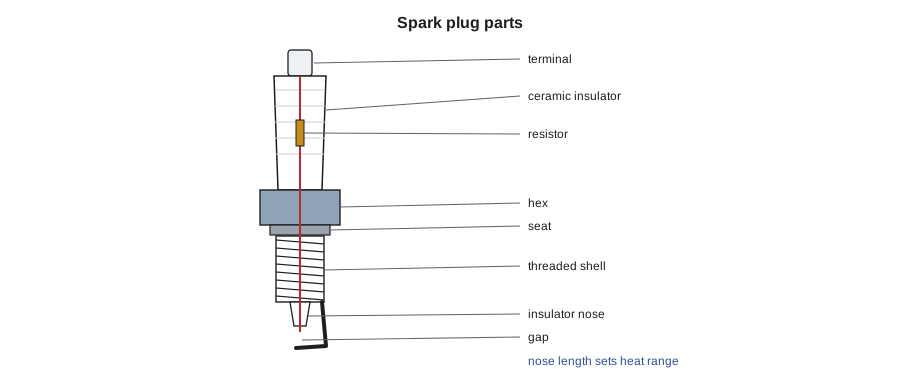
A spark plug has a threaded steel shell that screws into the cylinder head, a ceramic insulator of aluminum oxide, a center electrode running through the insulator, and a ground electrode welded to the shell. The gap between the two electrodes is set by the manufacturer for the engine, typically about 0.028 to 0.044 in on modern engines. Most modern plugs have fine-wire center electrodes tipped with iridium or platinum, which resist erosion so well that replacement intervals are often 100,000 mi or more. Many also have a built-in resistor that suppresses radio interference.
The heat range of a plug describes how quickly it carries heat from its firing tip to the cylinder head. A hot plug has a long insulator nose and runs hotter; a cold plug has a short nose and runs cooler. The tip has to run hot enough, above about 840 °F, to burn off carbon and stay clean, but cool enough, below about 1,560 °F, that it does not glow and ignite the mixture before the spark, which is called pre-ignition and can melt a piston. The manufacturer chooses the heat range for the engine, and it is not changed without reason.
Removing, reading and fitting plugs
Plugs are removed with the engine cold, because aluminum cylinder heads expand when hot and threads can strip. The plug wells are blown clean with compressed air first, so that dirt does not drop into the cylinder. Coil-on-plug boots are twisted gently to free them before they are pulled. Each plug is kept in order, because the condition of its firing end tells a story about its cylinder.
A normal plug has a light tan or gray deposit on the insulator nose and little wear on the electrodes. Dry, black, sooty deposits mean carbon fouling: a rich mixture, a weak spark, a plug too cold for the use, or lots of short trips. Wet, black, oily deposits mean oil getting into the cylinder past rings or valve seals. White, blistered insulators or melted electrodes mean overheating, from a lean mixture, over-advanced timing, a plug too hot for the engine, or a plug that was not tightened enough to transfer heat. Fine specks of metal or a cracked insulator nose suggest detonation. A gap much wider than specification means the plug is simply worn out: the electrodes have eroded, the firing voltage has risen, and the ignition reserve is gone. Carbon tracks down the outside of the insulator, under the boot, show where high voltage leaked to ground.
New plugs are checked with a wire-type gap gauge, not a flat feeler, because fine-wire tips are easily damaged; many iridium and platinum plugs are set at the factory and should not be regapped, and the gap is never adjusted by pressing on the center electrode. Plugs are started by hand to avoid cross-threading and torqued to the manufacturer's specification, typically about 11 to 18 lb·ft for tapered-seat and small gasket plugs in aluminum heads. Many plugs now have a plated shell that does not need anti-seize, and using it anyway can lead to over-tightening, because it changes the torque; the plug maker's instructions decide.
# Plug gap wear: how far past specification are the removed plugs?
spec = 0.040             # in, new gap
limit = 0.047             # in, replace above this (illustrative)
removed = {1: 0.062, 3: 0.061, 5: 0.063, 7: 0.065}
for cyl, gap in removed.items():
    growth = (gap - spec) / spec * 100
print(f"cylinder {cyl}: gap {gap:5.3f} in ({growth:+4.0f} %)" + (" worn: replace" if gap > limit else ""))cylinder 1: gap 0.062 in ( +55 %) worn: replace cylinder 3: gap 0.061 in ( +52 %) worn: replace cylinder 5: gap 0.063 in ( +57 %) worn: replace cylinder 7: gap 0.065 in ( +62 %) worn: replace
How the engine computer detects misfires
Every time a cylinder fires, it gives the crankshaft a small push, and the crankshaft speeds up slightly before slowing again as the next cylinder approaches compression. The engine computer measures the time between teeth on the crankshaft reluctor wheel for every firing event. When a cylinder misfires, there is no push, and the crankshaft slows during that cylinder's power stroke. The computer compares each cylinder's acceleration with the others, filters out the effects of rough roads and gear changes, and counts misfires for each cylinder. Some engines, especially those with ion-sensing ignition or cylinder pressure sensors, detect misfires directly.
Under OBD-II rules, the misfire monitor runs continuously and looks for two levels of misfire. The first, often called type A, is a rate high enough, within a window of 200 crankshaft revolutions, to overheat and damage the catalytic converter. When it is detected, the malfunction indicator lamp flashes while the misfire continues, and the computer may shut off fuel to the misfiring cylinder to protect the catalyst. The second, type B, is a lower rate, judged over 1,000 revolutions, that is enough to raise emissions beyond the allowed limit; it lights the lamp steadily, usually after the fault is seen on two drive cycles. A code of P0301 to P0312 names the misfiring cylinder; P0300 means random or multiple cylinders.
Most scan tools show misfire counters for each cylinder, current and historical, and the generic OBD-II test results area, often called Mode 6, holds the computer's own misfire counts for the last drive cycles. Those counters are often the fastest way to find a misfire that does not happen while the technician is watching. Misfire counts also tell the technician when the misfire happens: only cold, only under load, only at idle, or only in the rain.
# Misfire counter analysis: counts per cylinder over 1,000 crankshaft revolutions under load
counts = {1: 2, 2: 0, 3: 5, 4: 1, 5: 8, 6: 1, 7: 46, 8: 3}
revs = 1000
fires_per_cyl = revs / 2                # each cylinder fires once every two revolutions
total = sum(counts.values())
rate = total / (revs / 2 * len(counts)) * 100
print(f"total misfires {total}, overall rate {rate:4.2f} % of firings")
for cyl, n in sorted(counts.items(), key=lambda kv: -kv[1]):
    pct = n / fires_per_cyl * 100
    flag = "  <- main suspect" if n > 3 * (total - n) / (len(counts) - 1) else ""
print(f"cylinder {cyl}: {n:3d} misfires ({pct:4.1f} % of its firings){flag}")total misfires 66, overall rate 1.65 % of firings cylinder 7: 46 misfires ( 9.2 % of its firings) <- main suspect cylinder 5: 8 misfires ( 1.6 % of its firings) cylinder 3: 5 misfires ( 1.0 % of its firings) cylinder 8: 3 misfires ( 0.6 % of its firings) cylinder 1: 2 misfires ( 0.4 % of its firings) cylinder 4: 1 misfires ( 0.2 % of its firings) cylinder 6: 1 misfires ( 0.2 % of its firings) cylinder 2: 0 misfires ( 0.0 % of its firings)
A misfire diagnostic process
A cylinder misfires for one of three reasons: no spark or a weak one, the wrong amount of fuel, or a mechanical problem that stops the cylinder making compression. Kiran learns a process that separates them quickly. First, the conditions. When does the misfire happen, on which cylinders, and how often? A misfire on one cylinder under load on a damp day points toward ignition; random misfires on several cylinders at idle point toward something they share, such as a vacuum leak or fuel quality; a misfire that never goes away on one cylinder, hot or cold, points toward a mechanical fault or a dead injector or coil.
Second, the swap. On a coil-on-plug engine, swapping the suspect cylinder's coil with a neighbor, and then its plug, shows whether the fault moves. If it moves with the coil or plug, that part is the fault. If it stays, the injector is next: a noid light shows whether the computer is pulsing it, and on port injection a balance test shows whether it flows. Third, if spark and fuel are both good, compression: a compression test and a cylinder leak-down test, as AUTO-120 taught, find burnt valves, worn rings, a failed head gasket or, on Gord's engine last term, a collapsed lifter. Fourth, fuel trims and other scan data: lean trims with random misfire point to a vacuum leak or fuel supply problem, and misfire on one bank with a lean trim on that bank points to something that bank does not share.
Throughout, the technician remembers what a misfire does to the catalyst. Unburned mixture from a misfiring cylinder burns in the catalytic converter, which can raise its temperature above 1,800 °F and melt the substrate. A vehicle with a flashing lamp should not be driven under load, and after any repair of a significant misfire, the catalyst's condition is checked, as Lesson 9 explains.
Gord's misfire
Kiran starts with the history. Gord's service records show the plugs were last replaced at about 93,000 mi; the truck is now at 195,000 mi, well past the replacement interval. The misfire counters stored from the tow show cylinder 7 with 46 misfires and the others with a few each, all under heavy load. At idle in the bay there are none. She removes the plugs from the cold engine. All eight have gaps grown to about 0.063 in against a specification of 0.040 in, a wear of more than 50 percent, and cylinder 7's plug has a carbon track running down the insulator under the boot. The cylinder 7 boot has a matching dark line inside it.
Marty explains the chain of events. Worn plugs need a much higher firing voltage, especially at the high cylinder pressure of towing up a grade, so every cylinder's ignition reserve had shrunk. Cylinder 7's boot had a weak spot, and on a damp morning the high voltage found it easier to track down the insulator to the shell than to jump the wide gap. The other cylinders were close to the edge too, which is why the computer also counted random misfires. Kiran fits eight new plugs of the specified type, gapped correctly and torqued to specification, a new boot on cylinder 7 and, because the coil's tower showed slight burning, a new coil there too. Before returning the truck, she checks the catalyst monitor results and the downstream oxygen sensor's behavior, which look healthy. A road test with the trailer, after a rinse of the engine bay at the wash bay to simulate rain, shows no misfires on any cylinder.
Worked problem
Is it the coil or the plug?
A V6 misfires on cylinder 4 under load. Swapping the cylinder 4 coil with cylinder 2 moves nothing: the misfire stays on cylinder 4. Swapping the plugs between 4 and 2 moves the misfire to cylinder 2. What is the fault, and what else should be checked?
Show solution
- The coil swap did not move the misfire, so the coil is not the cause.
- The plug swap moved the misfire, so the cylinder 4 plug is faulty.
- Inspect the plug: a cracked insulator, a fouled tip or a wide gap.
- Find out why it failed: oil fouling, overheating or carbon fouling point to other faults, and check the other plugs' condition and age.
Answer: The cylinder 4 spark plug; read it to find out why it failed.
Common mistakes
MistakeDriving under load with a flashing malfunction lamp.
InsteadA flashing lamp means catalyst-damaging misfire; reduce load and repair promptly.
MistakeRemoving plugs from a hot aluminum head.
InsteadLet the engine cool to avoid stripping threads.
MistakeRegapping fine-wire iridium plugs by bending the center electrode.
InsteadCheck with a wire gauge, and follow the maker's instructions; many are not regapped.
MistakeReplacing one plug when all are worn out.
InsteadReplace the set; worn plugs reduce the ignition reserve of every cylinder.
MistakeAssuming a single-cylinder misfire must be ignition.
InsteadSwap, then test the injector and compression before deciding.
Summary and key terms
- Spark plug gap and heat range are set by the engine manufacturer.
- Reading plug tips shows rich running, oil, overheating, detonation and wear.
- Worn, wide gaps raise firing voltage and use up the ignition reserve.
- The computer detects misfire from changes in crankshaft speed between firings.
- A flashing MIL means catalyst-damaging misfire; a steady MIL means an emissions-level misfire.
- Misfire counters and Mode 6 data show which cylinder misfires and when.
- Diagnose misfires in order: conditions, swaps, injector, compression and scan data.
- Heat range
- How quickly a spark plug carries heat away from its firing tip.
- Carbon fouling
- Dry black soot on a plug, from rich running, weak spark or short trips.
- Pre-ignition
- Ignition of the mixture by a hot spot before the spark occurs.
- Misfire monitor
- The OBD-II test that detects misfires from crankshaft speed changes.
- Type A misfire
- A misfire rate high enough to damage the catalyst, which flashes the MIL.
- Mode 6
- The OBD-II on-board test results, including misfire counts and monitor data.
- Ignition reserve
- The extra voltage a system can supply beyond what the spark needs.
Practice problems
Work each problem on paper first, then reveal the answer to check.
A plug's insulator is white and blistered. What could cause this?
Show answer
Overheating: a lean mixture, over-advanced timing, a plug too hot, or a plug not tightened enough.
The MIL flashes during a hard acceleration and then stays on steadily. What happened?
Show answer
A catalyst-damaging misfire occurred during the acceleration and then stopped.
Misfire counters show random misfires on all cylinders at idle only, with lean trims. What is a likely cause?
Show answer
A vacuum leak, which affects idle most and every cylinder.
Why are plugs kept in cylinder order when removed?
Show answer
So each plug's condition can be matched to its cylinder.
Lesson quiz · 5 questions
Score 60% or more to complete this lesson.
Create a free account to save your progress, take quizzes and earn a certificate.