
AUTO-230 · Lesson 3 of 12 · 20 min
Port and direct fuel injection
Erik Lindqvist calls on a Monday morning about the family's 2017 minivan. After a short drive and a stop of half an hour or so, it cranks for several seconds before it starts, runs rough for a moment, and smells of fuel. Cold starts are normal. Simone books it in, and Kiran remembers the example from the last lesson: a system that loses pressure after shutdown. "Good," Marty says when she tells him. "Now find out where the fuel is going. Most of the time a hot-soak hard start is either pressure leaking back to the tank or an injector dripping into a cylinder."
This lesson covers fuel injectors, how port and direct injection differ, how the engine computer decides injector pulse width and timing, and how injectors are tested and serviced. It also covers the intake valve deposits that direct-injection engines are known for.
How an injector works
A fuel injector is a solenoid valve. A coil inside the injector body, when energized, pulls a pintle, ball or disc off its seat against a spring, and pressurized fuel sprays through a calibrated orifice or a plate with several small holes. When the current stops, the spring closes the valve. Because the fuel pressure is held nearly constant, or at least known, the amount of fuel delivered depends almost entirely on how long the injector is held open. That time is the injector pulse width, measured in milliseconds.
Most port injectors are driven on the ground side. The injector receives battery voltage through a fused circuit whenever the engine runs, and the engine computer completes the circuit to ground through a transistor driver for the length of the pulse. When the driver switches off, the collapsing magnetic field produces an inductive spike of 60 volts or more, which the computer clamps; on a lab scope, the injector voltage drops to near zero during the pulse, then spikes and returns to battery voltage. That pattern, which AUTO-330 examines in detail, shows both the pulse width and the health of the coil. Port injectors usually have a coil resistance of about 11 to 16 ohms and are called high-impedance or saturated injectors.
# Injector pulse width and duty cycle at different engine speeds (one injection per cylinder per cycle)
def duty(pw_ms, rpm):
    cycle_ms = 2 * 60000 / rpm          # a four-stroke cycle is two revolutions
    return pw_ms / cycle_ms * 100
for rpm, pw in ((700, 2.6), (2000, 4.1), (4500, 9.8), (6200, 14.5)):
    print(f"{rpm:5d} rpm, pulse {pw:5.1f} ms: cycle {2 * 60000 / rpm:5.1f} ms, duty cycle {duty(pw, rpm):5.1f} %")
print("above about 85 % duty the injector is close to its limit")700 rpm, pulse 2.6 ms: cycle 171.4 ms, duty cycle 1.5 % 2000 rpm, pulse 4.1 ms: cycle 60.0 ms, duty cycle 6.8 % 4500 rpm, pulse 9.8 ms: cycle 26.7 ms, duty cycle 36.8 % 6200 rpm, pulse 14.5 ms: cycle 19.4 ms, duty cycle 74.9 % above about 85 % duty the injector is close to its limit
Port fuel injection
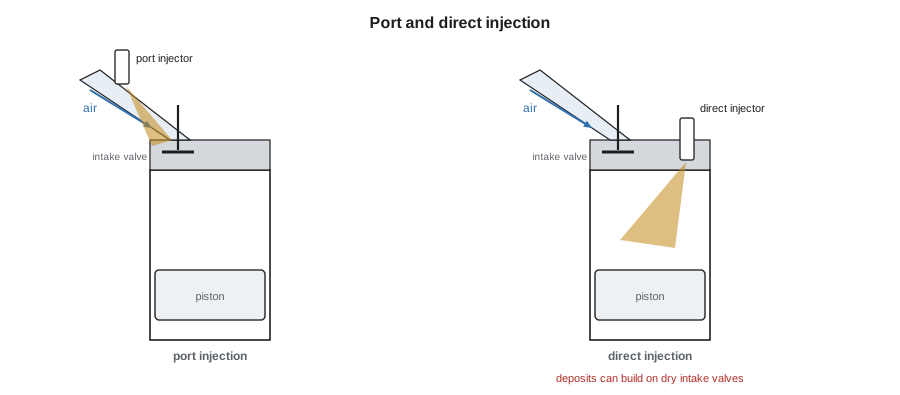
In port fuel injection, one injector per cylinder sprays into the intake port, aimed at the back of the closed intake valve. The fuel has the whole intake stroke and the hot valve to help it evaporate and mix with the air, so port injection produces a well-mixed charge with very little soot. Early systems fired all injectors at once or in groups; modern systems use sequential injection, firing each injector once per cycle, timed so that the fuel lands on the closed valve just before it opens. Port injection runs at low pressure, typically 45 to 60 psi, and the injectors are simple and long-lived.
Port injection has one disadvantage. Fuel that wets the port walls and the back of the valve forms a film, and when the engine is cold or when the throttle suddenly opens, that film changes size and the amount of fuel reaching the cylinder lags behind the amount injected. The engine computer compensates with extra fuel on cold starts and acceleration, called wall-wetting compensation, but some fuel is always wasted on a cold start, which raises HC until the catalyst lights off.
Gasoline direct injection
In gasoline direct injection (GDI), each injector is mounted in the cylinder head and sprays directly into the combustion chamber, at pressures from about 725 psi at idle to 5,000 psi or more at full load. Because the fuel evaporates inside the cylinder, it cools the charge, which reduces knock and lets engineers raise the compression ratio and use turbocharging with less risk. The engine computer can also inject at any point in the cycle, and more than once: several small injections help a cold start heat the catalyst and reduce soot, and an injection late in the compression stroke can create a richer cloud near the spark plug. Direct-injection engines are more efficient, which is why most new gasoline engines, including Hal's vans, use them.
Direct injectors are low-impedance, high-current devices. The engine computer or a separate injector driver module raises the supply to 65 volts or more with a boost circuit to open the injector very quickly, then holds it open at a lower current. Some injectors use piezoelectric stacks instead of solenoids. Either way, the injector drive circuits carry voltages that can give a shock and are not back-probed casually. The fuel arrives in a few milliseconds instead of a whole intake stroke, and fuel that hits the piston or cylinder wall burns poorly and makes soot, which is why GDI engines produce more particulates and why some now carry particulate filters.
Intake valve deposits and dual injection
Port-injected fuel washes the back of the intake valves every cycle. On a direct-injection engine, the intake valves never see fuel, but they do see oil vapor from the positive crankcase ventilation system and exhaust gas pushed back during valve overlap. Over tens of thousands of miles, these bake into hard carbon deposits that restrict airflow and disturb the air's swirl, causing rough idle, misfires on cold starts and loss of power. Cleaning methods include chemical cleaners sprayed into the intake, and walnut-shell blasting with the intake manifold removed and each valve closed in turn. Some manufacturers have added oil separators to the crankcase ventilation system to reduce the problem.
Many recent engines, including the vans' V6, use both: a direct injector and a port injector for each cylinder. The engine computer uses port injection at idle and light load, where it gives a clean mixture and washes the valves, and direct injection at higher loads, where its cooling and knock resistance matter most, often blending the two. To a technician, dual injection means two fuel systems to diagnose, two sets of injector circuits and, on scan data, two sets of pulse widths.
How pulse width is calculated
The engine computer calculates a base fuel quantity from the mass of air entering each cylinder, measured or calculated as Lesson 4 explains, divided by the target air-fuel ratio. It converts that fuel mass to a pulse width using the injector's flow rate at the current fuel pressure, adds a fixed allowance for the time the injector takes to open, called the injector offset or dead time, which grows as battery voltage falls, and then applies corrections: for coolant and intake air temperature, for acceleration and wall wetting, for cold-start enrichment and, once the oxygen sensors are working, for the fuel trims covered in Lesson 5. On direct-injection systems the rail pressure is part of the calculation too, because flow through an orifice rises with the square root of the pressure difference across it.
# Injector sizing: fuel needed per cylinder versus what one injector can flow
import math
flow_rated = 33.0            # injector flow, lb/h, at 43.5 psi
p_rated, p_actual = 43.5, 58
flow_actual = flow_rated * math.sqrt(p_actual / p_rated)
print(f"flow at {p_actual} psi: {flow_actual:5.1f} lb/h")
power_per_cyl = 47         # hp per cylinder at full load
bsfc = 0.49                  # lb/hp-h
need = power_per_cyl * bsfc * 1   # same units as the injector flow
print(f"fuel needed per cylinder at full power: {need:5.1f} lb/h")
print(f"injector duty cycle needed: {need / flow_actual * 100:4.0f} %")flow at 58 psi: 38.1 lb/h fuel needed per cylinder at full power: 23.0 lb/h injector duty cycle needed: 60 %
Testing injectors
Injector faults fall into a few groups. Electrical faults, an open or shorted coil or a driver that does not switch, usually set a code for that injector circuit and are found with resistance and voltage tests and a noid light, a small lamp that plugs into the injector harness and flashes when the computer pulses the circuit. Mechanical faults are harder. An injector can stick shut or open partly, flow too little because its orifice is restricted by deposits, spray a poor pattern, or drip after it closes. A leaking injector causes hard starting after a hot soak, a rich condition, fuel smell and, on direct-injection engines, sometimes oil diluted with fuel.
On port-injection systems, the classic test is the injector balance test. With a gauge on the rail, the pump is run to build pressure and then turned off, and a tester pulses one injector for a fixed time; the pressure drop is recorded, the system is re-pressurized, and each injector is tested in turn. Injectors that are within about 10 percent of the average drop are balanced; one with a much smaller drop is restricted, one with a much larger drop is flowing too much or sticking. Many scan tools can run the same test through the engine computer, and on many vehicles a cylinder contribution test or misfire data narrows the search first. Direct injectors cannot be balance-tested this way; they are judged by misfire counts, fuel trims, rail pressure behavior and, where the manufacturer provides one, a scan tool injector test.
# Injector balance test: pressure drop for each injector pulsed for the same time
drops = {1: 9.0, 2: 8.7, 3: 9.1, 4: 12.2, 5: 8.8, 6: 8.6}   # psi
avg = sum(drops.values()) / len(drops)
print(f"average drop {avg:5.1f} psi")
for cyl, d in drops.items():
    dev = (d - avg) / avg * 100
    note = "ok" if abs(dev) <= 10 else ("flowing too much or sticking" if dev > 0 else "restricted")
print(f"injector {cyl}: {d:5.1f} psi {dev:+5.1f} % {note}")average drop 9.4 psi injector 1: 9.0 psi -4.3 % ok injector 2: 8.7 psi -7.4 % ok injector 3: 9.1 psi -3.2 % ok injector 4: 12.2 psi +29.8 % flowing too much or sticking injector 5: 8.8 psi -6.4 % ok injector 6: 8.6 psi -8.5 % ok
The minivan's hard start
Kiran connects a gauge to the minivan's service port. Key-on prime brings it to 58 psi, and it holds there at idle. After shutdown it falls to 16 psi in four minutes, below the 40 psi the procedure requires. With the supply line blocked at the rail using the proper tool, pressure still falls, so the leak is on the engine side. The balance test above, run through the scan tool, shows injector 4 dropping 12.2 psi against an average of 9.4 psi: it flows too much and does not seal. With the plugs out, cylinder 4's plug is darker and wetter than the others. Kiran replaces the injector with new seals, lubricating the O-rings with clean engine oil as the service information directs, and the pressure now holds above 44 psi for ten minutes. Erik's van starts promptly after a hot soak, and the fuel smell is gone.
Marty asks one more question: why only after a hot soak? Kiran works it out. When the engine is hot, the fuel dripping into cylinder 4 evaporates and fills the cylinder and intake with a rich vapor that is hard to ignite, and the falling rail pressure means the first injections are short of fuel too. Cold, the drip is smaller, and the cold-start enrichment covers the loss.
Worked problem
Duty cycle at full power
An engine at 6,000 rpm needs a pulse width of 15.5 ms. What is the injector duty cycle, and is the injector near its limit?
Show solution
- Cycle time = 2 × 60,000 / 6,000 = 20 ms.
- Duty cycle = 15.5 / 20 × 100 = 77.5 percent.
- That is below about 85 percent, so the injector has some margin.
- If fuel pressure dropped or the engine were modified for more power, it could run out of margin.
Answer: 77.5 percent duty: within the injector's capacity, but not by much.
Common mistakes
MistakeBack-probing a direct-injector circuit like a port injector.
InsteadDirect-injector drive circuits run at high voltage; follow the service information and use the correct test leads.
MistakeReusing direct-injector seals or high-pressure line fittings.
InsteadFit new seals and one-use parts as the service information requires.
MistakeCondemning an injector from one misfire code without testing.
InsteadSwap coils or plugs, test the injector and check compression first; many misfires are not injectors.
MistakeForgetting that hot-soak hard starts can come from a leaking injector.
InsteadCheck pressure leak-down with the supply side blocked.
MistakeCleaning a GDI engine's carbon by pouring cleaner into the fuel tank.
InsteadFuel never touches GDI intake valves; deposits need intake-side cleaning.
Summary and key terms
- An injector is a solenoid or piezo valve; the fuel delivered depends on pulse width and pressure.
- Port injection sprays onto the intake valve at low pressure and gives a well-mixed charge.
- Direct injection sprays into the cylinder at high pressure, cools the charge and allows higher efficiency.
- Direct-injection engines can build carbon on intake valves; dual injection reduces it.
- Pulse width is calculated from air mass, target lambda, injector flow, dead time and corrections.
- Balance tests compare the pressure drop of each port injector; ±10 percent is a common limit.
- A leaking injector causes hot-soak hard starts, rich running and fuel smell.
- Pulse width
- The time, in milliseconds, that an injector is held open.
- Duty cycle
- The percentage of the engine cycle during which the injector is open.
- Port fuel injection
- Injection into the intake port, onto the back of the intake valve.
- Gasoline direct injection (GDI)
- High-pressure injection directly into the combustion chamber.
- Injector dead time
- The time an injector takes to open, added to every pulse.
- Injector balance test
- A comparison of the rail pressure drop when each injector is pulsed for the same time.
- Noid light
- A test lamp that plugs into an injector harness and flashes when the circuit is pulsed.
Practice problems
Work each problem on paper first, then reveal the answer to check.
At 3,000 rpm, what is the cycle time of a four-stroke engine?
Show answer
2 × 60,000 / 3,000 = 40 ms.
An injector flows 26.5 lb/h at 44 psi. About what will it flow at 58 psi?
Show answer
26.5 × √(58 / 44) ≈ 30.4 lb/h.
In a balance test, one injector drops 30 percent less than average. What does that suggest?
Show answer
The injector is restricted, for example by deposits.
Why do GDI engines tend to build intake valve deposits?
Show answer
No fuel washes the valves, so crankcase oil vapor and exhaust deposits bake on.
Lesson quiz · 5 questions
Score 60% or more to complete this lesson.
Create a free account to save your progress, take quizzes and earn a certificate.