
AUTO-230 · Lesson 6 of 12 · 20 min
Ignition systems and coils
Theo Banks has been quiet all week, and on Friday he admits why. His own car, the twelve-year-old compact with the rear drum brakes that Kiran helped him with last year, has started to stumble on wet mornings, and on Thursday it shook so badly on the way to work that the check-engine lamp flashed. He pulled into the shop running on what felt like two cylinders. The scan tool shows P0301 and P0304, misfires on cylinders 1 and 4. Marty glances at the codes and then at Kiran. "One and four," he says. "On this engine, what do cylinders 1 and 4 have in common?" Kiran does not know yet. By the end of the day she does.
This lesson covers how ignition systems make the spark: how an ignition coil works, dwell and coil current, the voltage a spark needs, the main types of ignition system, how spark timing is controlled, and the basic tests for coils and their circuits. Lesson 7 covers spark plugs and misfire diagnosis, and AUTO-330 takes ignition analysis with the lab scope further.
Why an engine needs thousands of volts
To start a flame in the compressed mixture, the spark must jump the gap between the plug's center and ground electrodes. Before it can jump, the gas in the gap has to be ionized, turned from an insulator into a conductor, and the voltage needed to do that rises with the gap width, with cylinder pressure and with how lean the mixture is. A healthy plug in a running engine at light load might need 8 to 12 kilovolts to fire; at full load with high cylinder pressure, or with a worn, wide gap, the requirement can rise above 25 kilovolts. Modern ignition systems can supply 35 to 45 kilovolts or more. The difference between the voltage the system can supply and the voltage the spark needs is the ignition reserve, and anything that raises the requirement, such as a worn plug, or lowers the supply, such as a weak coil or a leak path for the high voltage, eats into it until the engine misfires.
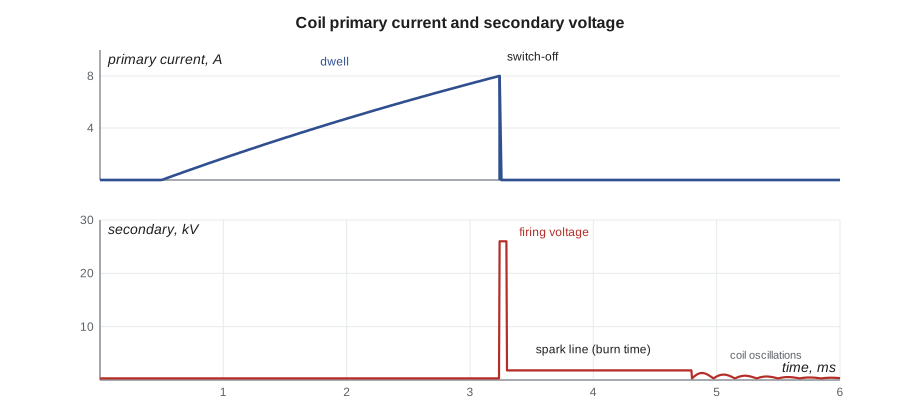
Once the gap is ionized, the voltage needed to keep the spark going falls to perhaps 1 to 2 kilovolts, and the spark burns for about 1 to 2 milliseconds while the coil's stored energy is used up. That burn time, the spark duration, matters as much as the peak voltage: the flame kernel needs enough energy to grow before it is blown out by the moving mixture.
How an ignition coil works
An ignition coil is a transformer with two windings around a laminated iron core. The primary winding has relatively few turns of heavy wire, typically a resistance of about 0.3 to 1 ohm, and is connected to battery voltage on one side and to a switching transistor on the other. The secondary winding has many thousands of turns of very fine wire, typically several thousand ohms, and one end connects to the spark plug. The ratio of secondary to primary turns is often about 80 to 100 to 1.
When the transistor switches on, current flows in the primary and builds a magnetic field in the core. Because the winding has inductance, the current does not jump to its final value; it ramps up over a few milliseconds, following the curve in the equation below. The time the primary is switched on is called dwell. When the engine computer decides it is time to fire, the transistor switches off. The primary current stops abruptly, the magnetic field collapses, and the rapidly changing field induces a high voltage in the secondary, which rises until the plug gap ionizes and the spark fires. The energy delivered depends on how much current was flowing when the primary switched off, which is why dwell is controlled carefully: too short and the coil has not charged; too long and the coil and transistor overheat for no gain.
In the equations, I is primary current, V the supply voltage, R the primary resistance, L the primary inductance, t the time since the primary switched on, and E the energy stored in the coil. Many modern systems switch the primary off at a target current of about 6 to 10 amps rather than after a fixed time, and lengthen dwell when battery voltage is low so that the coil still reaches its target current.
# Primary current rise in an ignition coil and the energy stored at switch-off
import math
V, R, L = 13.8, 0.5, 0.004          # volts, ohms, henries (illustrative coil-on-plug coil)
tau = L / R
print(f"time constant {tau * 1000:4.1f} ms, final current {V / R:4.1f} A")
for dwell_ms in (1.0, 2.0, 3.0, 4.0):
    i = V / R * (1 - math.exp(-dwell_ms / 1000 / tau))
    e_mj = 0.5 * L * i ** 2 * 1000
    print(f"dwell {dwell_ms:3.1f} ms: current {i:4.1f} A, stored energy {e_mj:5.1f} mJ")
for volts in (13.8, 11.0):
    t = -tau * math.log(1 - 8.0 / (volts / R)) * 1000
print(f"supply {volts:4.1f} V: dwell needed to reach 8 A = {t:3.1f} ms")time constant 8.0 ms, final current 27.6 A dwell 1.0 ms: current 3.2 A, stored energy 21.0 mJ dwell 2.0 ms: current 6.1 A, stored energy 74.5 mJ dwell 3.0 ms: current 8.6 A, stored energy 149.0 mJ dwell 4.0 ms: current 10.9 A, stored energy 235.9 mJ supply 13.8 V: dwell needed to reach 8 A = 2.7 ms supply 11.0 V: dwell needed to reach 8 A = 3.6 ms
Types of ignition system
Older engines used a single coil and a distributor: a rotating switch driven by the camshaft that sent each spark to the right cylinder through a rotor, a cap and a set of plug wires. Mechanical breaker points, and later an electronic pickup, switched the coil, and timing advance came from weights and a vacuum diaphragm. Distributors wore, needed adjustment and leaked high voltage through cracked caps on damp days, and they are now found only on older vehicles.
The first distributorless systems used waste-spark coil packs. Each coil serves two cylinders whose pistons reach top dead center together, one on its compression stroke and one on its exhaust stroke; both ends of the secondary connect to plugs, so every time the coil fires, it fires both plugs in series. The spark in the cylinder on compression does the work; the spark in the cylinder on exhaust is wasted, and needs very little voltage because the cylinder pressure is low. On a four-cylinder engine with a firing order of 1-3-4-2, cylinders 1 and 4 share one coil and cylinders 2 and 3 share the other. One plug in each pair fires from center electrode to ground and the other fires in reverse, from ground to center, which wears the two plugs differently.
Most engines now use coil-on-plug ignition, with a separate coil mounted directly on each spark plug and no plug wires at all. Each cylinder's spark can be timed independently, the high-voltage path is only a few centimeters long, and a fault usually affects one cylinder. Many coil-on-plug units are smart coils, with the switching transistor built into the coil: the engine computer sends only a low-voltage trigger signal, and the coil has its own fused power feed and ground. Some engines mount the coils near the plugs with short wires instead. Coil-on-plug boots and springs live in the heat of the cylinder head and in the water that collects in plug wells, and they are a common source of misfires on damp mornings.
A few manufacturers use the spark plug as a sensor between firings. After the spark, the computer applies a small voltage across the plug gap and measures the tiny current carried by ions in the burning gas; this ion-sensing ignition can detect misfire and knock in each cylinder directly. Whatever the type, an ignition secondary can produce 40,000 volts. It will not usually kill a healthy adult, because the current is small, but it can cause a painful shock, a fall from a fender or an involuntary jerk into a fan, and it can damage the engine computer if a coil is fired with its output open. Ridgeline's rule is never to run an engine with a coil disconnected from its plug except with an approved spark tester in place.
Controlling spark timing
The engine computer decides when each cylinder fires, measured in degrees of crankshaft rotation before top dead center. Because the flame takes a roughly fixed time to burn through the mixture, the spark must start earlier as engine speed rises, so that peak cylinder pressure still arrives just after top dead center, where it pushes hardest on the crank. Lean mixtures and light loads burn more slowly and need more advance; heavy loads, high intake temperatures and low-octane fuel need less, because they make the engine more likely to knock. The computer combines a base timing table, indexed by speed and load, with corrections for coolant and intake air temperature, and with knock retard from the knock sensor. On cold starts it often retards timing on purpose to send heat into the exhaust and warm the catalyst, as Ines's hybrid does. Timing on modern engines is not adjustable; a scan tool shows the timing the computer is commanding, and AUTO-330 shows how to check whether the engine is getting it.
Testing coils and circuits
When a coil is suspected, the quickest test on a coil-on-plug engine is to swap it with a coil from another cylinder and see whether the misfire follows it. Resistance tests of primary and secondary windings, where the coil design allows them, find opens and shorts, but a coil can pass a resistance test cold and fail when hot and under load. An adjustable spark tester, set to the gap the manufacturer specifies, shows whether a coil can fire a demanding gap. A low-amps current probe on a coil's power feed shows the primary current ramp on a scope: a healthy coil ramps smoothly to its target current, while a coil with shorted primary turns ramps too fast. For smart coils, the technician checks for battery voltage on the power wire, a clean ground, and the trigger signal from the computer, often a 5-volt square pulse, before condemning the coil.
The boot and spring matter as much as the coil. A cracked or carbon-tracked boot lets the high voltage find an easier path to ground down the side of the plug's ceramic insulator, especially when moisture is present; the result is a misfire that appears on wet or humid days. Inspecting the boot for white or black tracking lines, and the insulator for matching marks, is part of every coil diagnosis.
Theo's misfire
Kiran finds the answer in the service information: Theo's engine uses a waste-spark coil pack with two coils in one housing, and cylinders 1 and 4 share a coil. A misfire on exactly that pair points first to that coil or its two plug wires, not to two separate faults. With the engine idling and the hood up in the dark of bay 6, she mists water lightly over the plug wires from a spray bottle. Small blue sparks crawl along the wire for cylinder 4 where it rests against the valve cover bracket, and the engine stumbles. The wire's insulation has cracked with age, and on damp mornings the high voltage leaks to ground through the crack. Because the two plugs are in series, a leak on one wire weakens the spark in both cylinders. Her ohmmeter confirms that the coil's secondary windings are within specification, and an adjustable spark tester shows a strong spark at both towers.
She replaces the plug wire set and, since they are at the end of their service life and one of them shows signs of tracking, the four spark plugs too. The misfire counters stay at zero through a road test after a rinse at the wash bay. Theo pays for the parts, Marty does not charge him for the labor, and Theo agrees that next time he will bring his own car in when the lamp first comes on instead of when it starts flashing.
Worked problem
Dwell at low voltage
A coil has a primary resistance of 0.5 Ω and an inductance of 4 mH. The computer switches it off at 8 A. How long must dwell be with 13.8 V available, and how long during cranking at 10 V?
Show solution
- Time constant τ = L / R = 0.004 / 0.5 = 8 ms.
- At 13.8 V, final current = 27.6 A; t = −τ ln(1 − 8 / 27.6) ≈ 8 × 0.342 ≈ 2.7 ms.
- At 10 V, final current = 20 A; t = −τ ln(1 − 8 / 20) ≈ 8 × 0.511 ≈ 4.1 ms.
- The computer lengthens dwell at low voltage to keep the spark energy up.
Answer: About 2.7 ms at 13.8 V and about 4.1 ms at 10 V.
Common mistakes
MistakeTreating two misfire codes on a waste-spark pair as two separate faults.
InsteadCylinders that share a coil usually share the cause.
MistakeRunning an engine with a coil unplugged or disconnected from its plug.
InsteadUse an approved spark tester; an open secondary can damage the coil and the engine computer.
MistakeCondemning a coil on a cold resistance test alone.
InsteadSwap it, spark test it or check its current ramp; coils often fail only hot.
MistakeIgnoring the boot when replacing a coil.
InsteadInspect boots and springs for tracking and fit new ones if they are damaged.
MistakeExpecting to adjust base timing on a modern engine.
InsteadTiming is controlled by the computer; read commanded timing with a scan tool.
Summary and key terms
- A spark needs enough voltage to ionize the gap and enough energy to burn long enough to start the flame.
- Ignition reserve is the difference between the voltage available and the voltage required.
- Coil primary current ramps up during dwell; switching it off induces the high secondary voltage.
- Distributor, waste-spark and coil-on-plug systems deliver spark in different ways.
- In a waste-spark system, two cylinders share a coil and fire together.
- Spark timing advances with speed and retards with load, heat and knock.
- Coil tests include swapping, spark testing, current ramp and checking boots for tracking.
- Ignition coil
- A transformer that converts low primary voltage into the high secondary voltage that fires the plug.
- Dwell
- The time the coil primary is switched on to build current before firing.
- Firing voltage
- The voltage needed to ionize the spark plug gap and start the spark.
- Spark duration (burn time)
- The time the spark continues after the gap ionizes.
- Waste-spark ignition
- A system in which each coil fires two cylinders at once, one on compression and one on exhaust.
- Coil-on-plug ignition
- A system with a separate coil mounted directly on each spark plug.
- Carbon tracking
- A conductive path burned along a boot or insulator by leaking high voltage.
Practice problems
Work each problem on paper first, then reveal the answer to check.
A V6 with coil-on-plug ignition misfires on cylinder 5. What is the quickest first test?
Show answer
Swap the cylinder 5 coil with another cylinder's and see whether the misfire follows it.
On a four-cylinder engine with firing order 1-3-4-2 and waste-spark ignition, which cylinder shares a coil with cylinder 2?
Show answer
Cylinder 3.
Why does a misfire that appears only on wet mornings suggest a boot or wire problem?
Show answer
Moisture lets high voltage leak through cracks or tracking to ground.
Why do engines need more spark advance at high speed?
Show answer
The flame takes about the same time to burn, so it must start earlier when the crank turns faster.
Lesson quiz · 5 questions
Score 60% or more to complete this lesson.
Create a free account to save your progress, take quizzes and earn a certificate.