
AUTO-120 · Lesson 8 of 12 · 22 min
Lubrication systems and oil pressure
Hal Osei calls Simone on a Thursday morning. One of his drivers has reported that the oil pressure warning light on van 3 flickers when the van idles in traffic on a hot afternoon, and goes out as soon as she pulls away. Hal wants to know if the van is safe to keep working. Simone books it in immediately and tells Hal to park it until then. “An oil pressure light is never a ‘later’ light,” Marty tells Kiran when the van arrives. “If it's real, the engine is minutes from damage. If it's not real, we need to know that too.”
Every moving part in an engine depends on oil. This lesson describes what oil does, how oil is graded and specified, how the lubrication system delivers it, how oil pressure is produced and measured, and how a technician investigates low oil pressure and oil consumption. It ends with van 3's diagnosis.
What oil does
Engine oil does several jobs at once. It separates moving surfaces with a film so they do not touch, which is lubrication. It carries heat away from the bearings, the pistons and the turbocharger, if there is one, which is cooling; on many engines, jets spray oil onto the undersides of the pistons. It holds soot, metal particles and combustion acids in suspension so they can be removed by the filter or drained with the oil, which is cleaning. It helps the rings seal against the cylinder walls. It protects surfaces from rust and corrosion. And, as Lesson 6 showed, it is the hydraulic fluid that operates lifters, tensioners, cam phasers and deactivation systems.
Oil is a base stock, refined from crude oil or synthesized, plus an additive package that can make up a fifth or more of its volume. The additives include detergents and dispersants that keep the engine clean, anti-wear compounds that protect surfaces where the oil film is thin, antioxidants, friction modifiers, viscosity index improvers that make the oil thin less as it heats, and anti-foam agents. Additives are used up as the oil ages, which is one reason oil is changed even when it still looks clean.
Viscosity and specifications
Viscosity is an oil's resistance to flow. Viscosity grades are defined by the SAE J300 standard. A grade such as 5W-30 is a multigrade: the number before the W, for winter, describes how easily the oil flows and lets the engine crank in the cold, and the number after it describes its viscosity at engine operating temperature. A 0W-20 flows more easily when cold than a 5W-20, and both are thinner when hot than a 5W-30. Thinner oils reduce friction and improve fuel economy, and many modern engines are designed for 0W-20, 0W-16 or even 0W-8, with bearing clearances and oil pumps to match. Using a thicker oil than specified can starve tight passages and confuse variable valve timing; using a thinner one can let the oil film break down.
Performance specifications describe what the oil can do. The American Petroleum Institute's service categories for gasoline engines are API SP and, since March 2025, API SQ, introduced with the ILSAC GF-7 standard; each new category adds tests for problems such as low-speed pre-ignition in small turbocharged engines, timing chain wear and deposits. Many manufacturers also publish their own specifications, such as General Motors' dexos1 or the European ACEA sequences and manufacturer approvals, and an oil must carry the approval the owner's manual lists. Kiran learned in AUTO-110 to look up the viscosity and specification for every engine before an oil service; on a warranty vehicle, using an oil without the required approval can be grounds for a claim to be refused.
Oil specifications can also change during a vehicle's life. In April 2025 General Motors recalled roughly 600,000 trucks and SUVs in the United States with its 6.2 liter V8, the larger relative of Gord's engine, because of manufacturing defects in connecting rods and crankshafts that could lead to bearing failure. Part of the remedy for engines that passed inspection was a change to a higher-viscosity oil, with a new oil filler cap showing the new grade. Recalls like this are one reason Kiran checks the recall database and service bulletins, as AUTO-110 taught, before choosing an oil.
The lubrication system
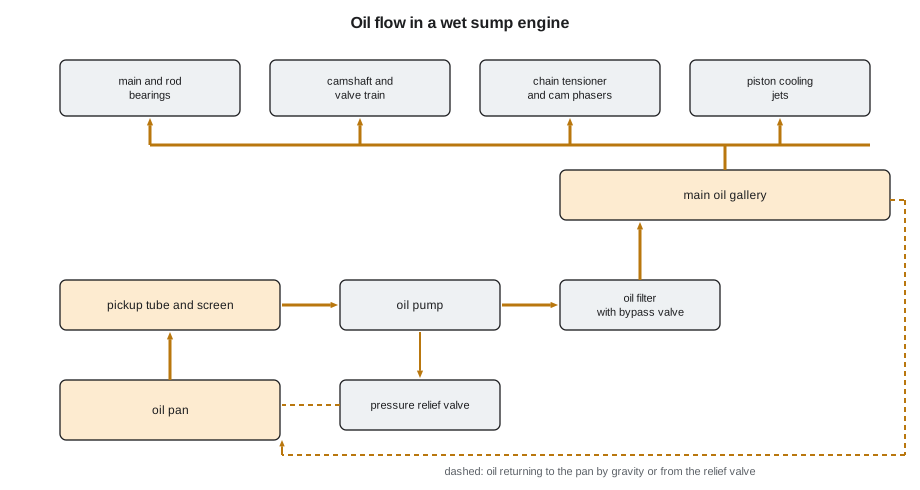
In a wet sump system, used in nearly all cars and light trucks, the oil is stored in the oil pan. The oil pump draws it up through a pickup tube with a screen, which stops large debris, and pushes it through the oil filter, past an oil cooler on many engines, and into the main oil gallery, a passage drilled along the block. From the main gallery, passages carry it to the main bearings, through the crankshaft to the rod bearings, up to the camshaft bearings, lifters, rockers and timing chain tensioners, and to the turbocharger and piston cooling jets where fitted. The oil then drains back to the pan by gravity. Racing cars and some high-performance engines use a dry sump, with a separate tank and several pumps, so oil cannot surge away from the pickup in hard cornering.
The oil pump is driven by the crankshaft, directly or by a chain, or on some pushrod engines by the camshaft. Gear pumps, gerotor pumps with an inner and outer rotor, and crescent pumps are all positive-displacement pumps: each turn moves a fixed volume of oil, so their output rises with engine speed. A pressure relief valve in the pump opens at a set pressure and returns excess oil to the inlet, so the pressure does not rise without limit at high speed or with cold, thick oil. Many newer engines use a variable-displacement pump whose output the control module adjusts, so the engine is not wasting energy pumping more oil than it needs.
The full-flow oil filter cleans all the oil before it reaches the bearings. It contains a bypass valve that opens if the filter becomes clogged, or when the oil is very thick on a cold start, so unfiltered oil reaches the engine rather than none at all. Many filters also have an anti-drainback valve, a rubber flap that stops oil from draining out of the filter and galleries when the engine is off, so oil pressure builds faster at the next start. A cheap filter of the right thread size but the wrong valves or flow capacity can cause low pressure or a rattle at start-up, which is why Ridgeline buys filters by the part number the catalog lists for the engine.
Oil pressure
The oil pump produces flow, not pressure. Pressure appears because the oil has to be pushed through the small clearances of the bearings, lifters and other parts. If those clearances are tight, the same flow creates more pressure; if they are worn and large, oil escapes more easily and the pressure falls. That is why oil pressure falls as an engine wears, why it is lower when the oil is hot and thin than when it is cold, and why it is lower at idle, where the pump turns slowly, than at higher speeds.
The oil pressure sensor or switch on the main gallery reports pressure to the instrument cluster or control module. A switch simply turns the warning light on below a set pressure, often around 5 to 7 psi; a sensor sends a varying signal so a gauge can show the pressure and the module can use it, for example to control a variable pump. A warning light that comes on while driving means that the pressure at the gallery has dropped very low, and the engine should be stopped as soon as it is safe.
When a pressure problem is suspected, the dashboard is not trusted on its own. The technician removes the sender and screws in a mechanical gauge with the correct adapter, warms the engine to operating temperature, and records the pressure at idle and at the speeds in the service information. A common rule of thumb for engines without a specification is about 10 psi per 1,000 rpm, but the manufacturer's figures always take priority.
# Van 3: mechanical gauge readings against the specification (hot engine, illustrative values)
spec_minimum = {700: 10, 2000: 25, 3000: 35}           # rpm: minimum pressure, psi
readings = {700: 6, 2000: 22, 3000: 30}               # rpm: measured pressure, psi
for rpm, minimum in spec_minimum.items():
    p = readings[rpm]
    ratio = p / minimum
    print(f"{rpm:>5} rpm: {p:5.0f} psi (minimum {minimum})  {'OK' if p >= minimum else 'LOW'}  ({ratio * 100:.0f} % of minimum)")
print("warning light switch closes below about 6 psi")700 rpm: 6 psi (minimum 10) LOW (60 % of minimum) 2000 rpm: 22 psi (minimum 25) LOW (88 % of minimum) 3000 rpm: 30 psi (minimum 35) LOW (86 % of minimum) warning light switch closes below about 6 psi
Van 3's pressure is low at every speed, and at a hot idle it is close to the point where the warning switch closes, which explains the flicker in traffic. The sender is not at fault; the pressure really is low. Pressure that is low at every speed points to a problem common to the whole system: the oil itself, the pickup, the pump or its relief valve, or wear throughout the engine. Pressure that is normal at speed but low at idle more often points to worn bearings or a variable pump that is not being commanded correctly.
Causes of low oil pressure
| Cause | What to check |
|---|---|
| Low oil level | Dipstick, with the vehicle level and the engine stopped a few minutes |
| Wrong or diluted oil | Viscosity and specification on the last invoice; smell of fuel; milky oil from coolant |
| Blocked pickup screen | Sludge or gasket material on the screen when the pan is removed |
| Clogged or incorrect filter | Part number; bypass and anti-drainback valves |
| Relief valve stuck open | Valve and spring in the pump |
| Worn pump | Rotor and housing clearances against specification |
| Worn bearings | Bearing clearances; metal in the oil or filter |
| Faulty sender or wiring | Compare with a mechanical gauge |
Kiran starts with the simple things. The oil level on van 3 is just above the minimum mark. The oil is black and thick, and the last invoice in the fleet records shows that this van went 11,000 miles past its scheduled change during a busy period, on a severe-service schedule that calls for changes far more often. She drains the oil into a clean pan and finds it gritty, and the filter's pleats are packed with sludge. With the oil pan off, the pickup screen is about half covered with a black, tar-like sludge.
Sludge forms when oil oxidizes and its dispersants are used up, so the soot and moisture it carries clump together. Short trips that never let the oil get fully hot, long idling, extended change intervals and hard work in heat all speed it up, and courier vans do all of these. A half-blocked screen restricts the pump's inlet, so the pump cannot draw enough oil, especially at idle when it turns slowly and when the oil is hot.
The repair is to clean or replace the pickup and screen, clean the pan, replace the pan gasket, fill with the correct oil and filter, and recheck the pressure with the mechanical gauge. Marty also has Kiran take a sample of the old oil for laboratory analysis, which reports wear metals, fuel and coolant in the oil, and sludge-forming contaminants, so Hal has evidence of how much wear has already occurred. After the repair the pressure is within specification at every speed. Marty recommends a follow-up oil change at half the normal interval to flush out loosened sludge, and a second analysis then.
Oil consumption
All engines use some oil: a little is burned as the rings scrape the cylinder walls, some passes through the valve guides, and some leaves as vapor through the crankcase ventilation system. Manufacturers state what they consider acceptable, often up to about 1 quart per 2,000 miles for some engines, although most healthy engines use far less. When a customer complains of high consumption, the shop performs a consumption test: it fills the engine to the full mark with the oil level recorded and the filler cap or dipstick sealed, the customer drives a set distance, and the shop measures how much oil it takes to refill to the same level.
# Oil consumption test on Gord's pickup (distance between level checks)
start_odometer, end_odometer = 194_580, 195_830        # mi
oil_added = 0.6                               # qt needed to return to the full mark
distance = end_odometer - start_odometer
rate = oil_added / distance * 1000
print(f"driven {distance:,} mi, used {oil_added} qt: {rate:.2f} qt per 1,000 mi")
acceptable = 0.5
print("within the manufacturer's stated limit" if rate <= acceptable else "above the stated limit: investigate rings, valve guides, PCV and leaks")driven 1,250 mi, used 0.6 qt: 0.48 qt per 1,000 mi within the manufacturer's stated limit
High consumption has several possible causes. Leaks, from the valve cover, front or rear crankshaft seals, oil pan or oil cooler, are found by inspection, sometimes with fluorescent dye added to the oil and an ultraviolet light. Worn or stuck oil control rings, a known issue on some engines whose ring grooves fill with carbon, and worn valve guides or seals cause oil to burn, with blue smoke in the exhaust and oil-fouled spark plugs. A blocked or failed positive crankcase ventilation (PCV) system can pressurize the crankcase and push oil past seals and into the intake. On Gord's engine, some oil consumption is also associated with the deactivation system, which is another reason Marty wants a full diagnosis before quoting a repair.
Crankcase ventilation
Blow-by gas that leaks past the rings into the crankcase carries fuel vapor, water and acids, and would pressurize the crankcase and push oil out of the seals if it were trapped. The PCV system draws it into the intake manifold through a valve or calibrated orifice, so it is burned in the cylinders, while fresh filtered air enters the crankcase through a separate hose. An oil separator keeps liquid oil from being drawn in with the gas. When the PCV valve sticks or a hose is blocked, crankcase pressure rises; a technician can check it with a gauge at the dipstick tube, or simply by seeing whether the oil filler cap is pushed or drawn when loosened at idle.
Worked problem
Is van 3 safe now?
After the pickup and screen are cleaned and the oil and filter changed, van 3's hot idle pressure is within specification. Hal asks if the van is now as good as new.
Show solution
- The low pressure has been corrected, and the van is safe to return to service.
- The engine ran with low pressure for an unknown time, so some wear may have occurred; the oil analysis will show whether wear metals are high.
- Loosened sludge may still be in the engine, so a short change interval and a second analysis are recommended.
- The lasting fix is to follow the severe-service oil change schedule, which this van's duty requires.
Answer: It is safe and within specification now, but follow-up oil changes and analysis will show whether lasting wear occurred; the schedule must be kept.
Common mistakes
MistakeTrusting the dash light or gauge alone.
InsteadConfirm pressure with a mechanical gauge.
MistakeUsing any filter with the right thread.
InsteadUse the filter specified for the engine, with the correct valves and flow.
MistakeChoosing oil by viscosity only.
InsteadMatch both the viscosity grade and the specification or approval.
MistakeAdding thicker oil to raise pressure on a worn engine.
InsteadFind the cause; thicker oil can starve tight passages and VVT parts.
MistakeIgnoring the oil change history.
InsteadAsk for it; extended intervals cause sludge, chain wear and lifter problems.
Summary and key terms
- Oil lubricates, cools, cleans, seals, protects and operates hydraulic parts of the valve train.
- SAE J300 viscosity grades describe cold and hot viscosity; API, ILSAC and manufacturer specifications describe performance.
- A positive-displacement pump makes flow; pressure results from resistance in the clearances; a relief valve limits it.
- The full-flow filter has a bypass valve and often an anti-drainback valve.
- Low pressure is confirmed with a mechanical gauge; check level, oil, pickup, filter, pump and wear in that order.
- Oil consumption is measured by a controlled test; causes include leaks, rings, guides and PCV faults.
- Viscosity
- A fluid’s resistance to flow.
- Multigrade oil
- An oil that meets a winter grade when cold and a higher grade when hot, such as 5W-30.
- Main gallery
- The main oil passage that feeds the bearings and valve train.
- Relief valve
- A valve that limits maximum oil pressure by returning oil to the pump inlet.
- Bypass valve
- A valve that lets oil flow around a clogged or cold filter.
- Sludge
- Thick deposits formed when oxidized oil and contaminants clump together.
- PCV system
- The system that draws blow-by gas from the crankcase into the intake to be burned.
Practice problems
Work each problem on paper first, then reveal the answer to check.
A 0W-20 and a 5W-30: which flows more easily when cold?
Show answer
The 0W-20.
Why is oil pressure lower at hot idle than at cold high speed?
Show answer
Hot oil is thinner and the pump turns slowly at idle.
An engine uses 0.8 qt over 2,500 miles. What is its rate per 1,000 miles?
Show answer
0.32 qt per 1,000 miles.
What does the filter bypass valve do?
Show answer
It lets oil reach the engine if the filter is clogged or the oil is too thick to pass through it.
Lesson quiz · 5 questions
Score 60% or more to complete this lesson.
Create a free account to save your progress, take quizzes and earn a certificate.