
AUTO-120 · Lesson 2 of 12 · 24 min
Engine construction and configurations
Gord Haney's pickup is in bay 1 for a front sway bar bushing job he finally approved, and while it is on the lift Marty takes Kiran underneath with a light. He points out the oil pan, the bell housing where the transmission bolts on, the exhaust manifolds on each side of the V, and the harmonic balancer on the front of the crankshaft. Then he walks her back to the training engine in bay 5. “Same parts,” he says. “Different arrangement. Once you know the parts, every engine is just a new arrangement.”
This lesson describes how engines are built: the block, crankshaft, pistons, rings and connecting rods in the bottom end; the cylinder head and valve train in the top end; the materials they are made from; and the ways cylinders are arranged. It also explains how a technician identifies exactly which engine is in a vehicle before ordering a single part.
The cylinder block
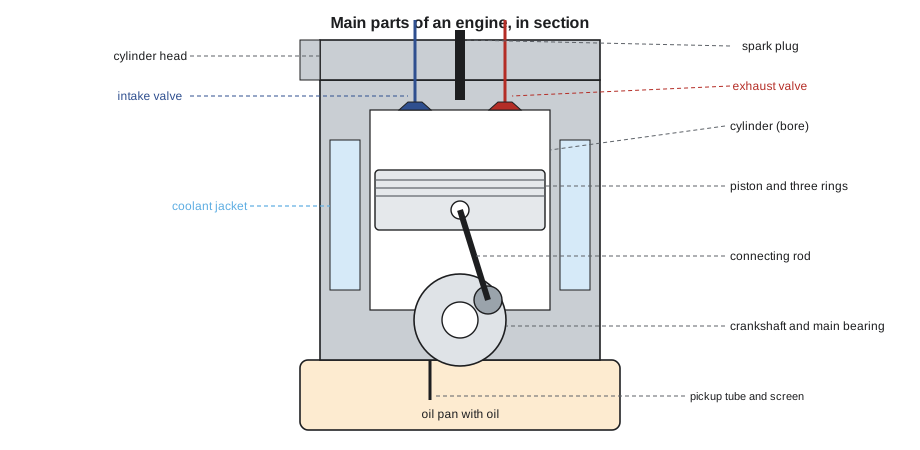
The cylinder block is the foundation of the engine. It contains the cylinders, the passages for coolant, called water jackets, and the passages for oil, called galleries. Its lower part, the crankcase, supports the crankshaft in a row of main bearings. Blocks are cast from gray iron or from aluminum alloy. Iron is strong, stiff, cheap and resists wear, and it is still used in many truck and diesel engines. Aluminum weighs about a third as much for the same volume and conducts heat better, so most modern car engines and many truck engines, including the block in Gord's 5.3 liter V8, are aluminum.
Pistons cannot run directly on most aluminum alloys, so an aluminum block has cylinder liners, also called sleeves, of iron cast into it, or a thin wear-resistant coating sprayed onto the bore. A liner that is cast in place is called a dry liner, because coolant does not touch it. Some engines, mostly heavy diesels, use wet liners that are surrounded by coolant and sealed with O-rings at the top and bottom, so they can be replaced during an overhaul. Whatever the design, the service information gives the bore's size limits, and Lesson 7 shows how to measure them.
The top of the block, where the head sits, is the deck. It must be flat for the head gasket to seal, and its flatness is checked with a straightedge and feeler gauge whenever the head is removed. The bottom of the block is closed by the oil pan, which holds the engine's oil and, on many engines, contains baffles that keep the oil from sloshing away from the pickup when the vehicle turns or brakes.
The crankshaft and bearings
The crankshaft is forged or cast steel or cast iron. It has main journals, which turn in the main bearings in the block, and crankpins, or rod journals, on which the connecting rods turn. Counterweights opposite the crankpins balance the forces of the moving pistons and rods. Oil holes drilled through the crankshaft carry oil from the main bearings to the rod bearings. One main bearing has a thrust surface, or separate thrust washers, that controls the crankshaft's movement front to back, its end play.
Engine bearings are plain bearings: thin steel shells lined with a soft bearing alloy. They do not have balls or rollers. When the engine runs, the turning journal draws a film of oil into the narrow gap between itself and the bearing and rides on it, so the metal surfaces never touch. The gap, the bearing clearance, is typically only one to three thousandths of an inch. If it is too small, there is no room for the oil film; if it is too large, oil leaks away too fast and oil pressure falls. Lesson 7 shows how to measure it with plastic gauge.
On the front of the crankshaft is the harmonic balancer, or vibration damper: a heavy outer ring bonded to the hub with rubber, or filled with a thick fluid. Every power stroke twists the crankshaft a little, and at certain speeds these twists can build up into vibration that breaks crankshafts. The damper absorbs them. On the rear of the crankshaft is the flywheel, for a manual transmission, or the flexplate, for an automatic. Its mass carries the crankshaft through the strokes between power pulses, and its ring gear is where the starter motor engages.
Pistons, rings and connecting rods
Pistons are cast or forged aluminum alloy. The top of the piston, the crown, forms the floor of the combustion chamber and may be flat, domed or dished to set the compression ratio. Below it, grooves called ring lands hold the piston rings, and the skirt below them guides the piston in the cylinder. A hardened steel piston pin, or wrist pin, joins the piston to the small end of the connecting rod.
Most pistons carry three rings. The top compression ring seals the combustion pressure. The second ring helps seal and also scrapes oil down the cylinder wall. The bottom ring, the oil control ring, is usually made of two thin rails and a spacer, and it scrapes most of the oil off the wall and returns it through holes in the piston to the crankcase. A ring is not a closed circle: it has a small end gap, so it can expand with heat without jamming. If the ring end gaps are too large from wear, combustion gas escapes past the rings into the crankcase as blow-by, and oil passes up into the combustion chamber and burns.
The connecting rod is forged steel, powdered and forged metal, or occasionally aluminum. Its big end is split into the rod and a cap, so it can be bolted around the crankpin, with a bearing shell in each half. On many modern rods the cap is made by fracturing the rod at the big end after machining, so the two halves fit together exactly along the broken surface. Such caps can be installed only on their own rod and only one way round, which is why Kiran learns to keep rods and caps together and marked during any teardown.
The cylinder head
The cylinder head closes the top of each cylinder. Its underside contains the combustion chambers, shaped to make the mixture burn quickly and evenly, and it holds the spark plugs and, on direct-injection engines, the fuel injectors. Intake ports carry air from the intake manifold to the intake valves, and exhaust ports carry gas from the exhaust valves to the exhaust manifold. Coolant passages in the head carry heat away from the exhaust valves and spark plugs, the hottest parts of the engine.
Most heads today are aluminum. The valves seat on hardened valve seat inserts pressed into the head and slide in valve guides. Above the valves is the valve train, the camshaft, lifters, rockers and springs that open and close them, covered by the valve cover. Lesson 4 describes the valve train in detail. Between the head and the block is the head gasket, which must seal combustion pressure, coolant and oil at the same time, and which Lesson 11 covers.
Cylinder arrangements
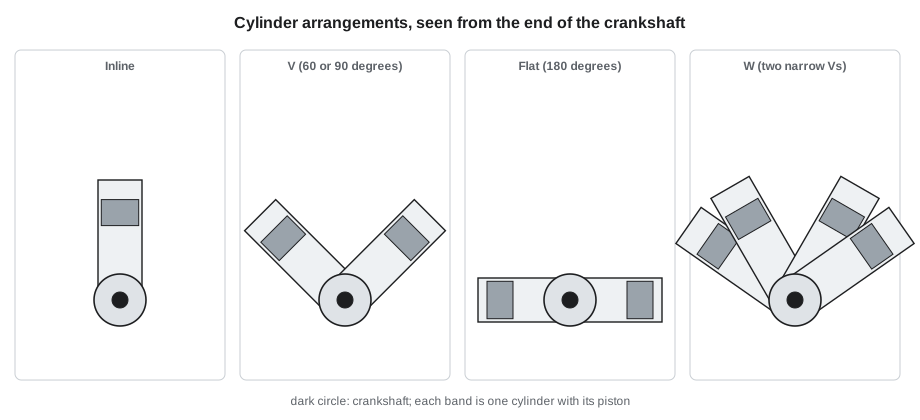
Engines are described first by how their cylinders are arranged. In an inline engine, the cylinders stand in a single row; inline four-cylinder engines are the most common engines in the world, and inline sixes are used in some trucks and luxury cars. In a V engine the cylinders are in two rows, or banks, at an angle to each other, commonly 60 or 90 degrees, sharing one crankshaft. A V6 or V8 is much shorter than an inline engine with the same number of cylinders, so it fits across the front of a front-wheel-drive minivan like the Lindqvists' or along the frame of a pickup like Gord's.
A flat or horizontally opposed engine, sometimes called a boxer, has its two banks lying flat at 180 degrees, so it is low and wide. A W engine joins two narrow-angle V banks on one crankshaft. Rotary engines, which use a triangular rotor in place of pistons, were made in small numbers and are seldom seen in a general shop.
Engines are also described by how they are mounted. A longitudinal engine runs front to back and usually drives the rear wheels or all four through a transmission behind it; Gord's pickup and Hal Osei's cargo vans are built this way. A transverse engine runs across the vehicle and drives the front wheels through a transaxle, as in the Lindqvists' minivan and Ines Moreau's hybrid. On a transverse engine, the front of the engine, where the timing chain is, faces the side of the vehicle, so Kiran learns to say passenger side and driver side, or the bank numbers used in the service information, rather than front and back.
On a V engine, bank 1 is the bank that contains cylinder 1, and bank 2 is the other one. Scan tools and trouble codes use these terms. Sensor 1 on an exhaust bank is the oxygen sensor before the catalytic converter, and sensor 2 is the one after it. Learning to locate bank 1 on each engine she meets is one of the habits Marty insists on.
Valve train layouts
Engines are also named by where their camshafts are. In an overhead valve, or pushrod, engine, a single camshaft in the block operates the valves through lifters, pushrods and rocker arms; Gord's V8 is a pushrod engine, which is compact and has a lot of low-speed torque. In an overhead camshaft engine, the camshaft is in the head. A single overhead camshaft (SOHC) head has one camshaft per bank; a double overhead camshaft (DOHC) head has two, one for the intake valves and one for the exhaust valves, and usually four valves per cylinder. The training engine, the Lindqvists' V6 and Ines Moreau's hybrid are DOHC engines.
| Engine at Ridgeline | Arrangement and mounting | Valve train | Block and head |
|---|---|---|---|
| Training engine, 2.0 L | Inline four, transverse | DOHC, 16 valves, timing belt | Aluminum block with iron liners, aluminum head |
| Gord Haney's pickup, 5.3 L | 90 degree V8, longitudinal | Pushrod, 16 valves, timing chain | Aluminum block and heads |
| Lindqvists' minivan, 3.6 L | 60 degree V6, transverse | DOHC, 24 valves, timing chains | Aluminum block and heads |
| Ines Moreau's hybrid, 1.8 L | Inline four, transverse, Atkinson cycle | DOHC, 16 valves, timing chain | Aluminum block and head |
| Courier vans, 3.5 L | 60 degree V6, longitudinal | DOHC, 24 valves, timing chains | Aluminum block and heads |
Identifying the engine
Many vehicles are offered with more than one engine, and even engines of the same size can differ in parts from year to year. Before looking up a specification or ordering a gasket set, a technician identifies the engine. The eighth character of the vehicle identification number is the engine code on most North American vehicles, and the service information or parts catalog decodes it. The engine itself carries a label or a stamped code on the block, and an emissions label under the hood lists the engine family and its displacement. When the VIN, the label and the engine disagree, which happens after an engine swap, the engine in the vehicle is the one that matters.
Simone Tremblay, the service advisor, enters the VIN into the shop's software for every repair order, and Kiran uses it to pull up the engine code before she opens any procedure. The habit prevents the most common parts-ordering mistake: assuming that every 3.6 liter V6 from a manufacturer uses the same water pump, the same oil filter or the same timing chain set.
# Bore-to-stroke ratio: a quick way to describe an engine's character
engines = [("training 2.0 L inline four", 3.386, 3.386),
           ("pickup 5.3 L V8", 3.780, 3.622),
           ("minivan 3.6 L V6", 3.780, 3.268),
           ("hybrid 1.8 L inline four", 3.169, 3.476)]
for name, bore, stroke in engines:
    ratio = bore / stroke
    kind = "square" if abs(ratio - 1) < 0.02 else ("oversquare (short stroke)" if ratio > 1 else "undersquare (long stroke)")
print(f"{name:<28} bore {bore:5.3f} in, stroke {stroke:5.3f} in, ratio {ratio:4.2f}: {kind}")training 2.0 L inline four bore 3.386 in, stroke 3.386 in, ratio 1.00: square pickup 5.3 L V8 bore 3.780 in, stroke 3.622 in, ratio 1.04: oversquare (short stroke) minivan 3.6 L V6 bore 3.780 in, stroke 3.268 in, ratio 1.16: oversquare (short stroke) hybrid 1.8 L inline four bore 3.169 in, stroke 3.476 in, ratio 0.91: undersquare (long stroke)
An engine whose bore is larger than its stroke is called oversquare. It can rev higher, because the piston travels a shorter distance each stroke, and it has room for larger valves. An undersquare engine, with a longer stroke, tends to make more torque at low speeds and burns its fuel efficiently, which is why many hybrid and economy engines are built that way. Service information gives the bore and stroke of every engine, and Lesson 3 uses them to calculate displacement.
Materials and heat
Aluminum expands about twice as much as iron or steel for the same rise in temperature. Engine designers allow for this: an aluminum piston is made slightly oval and tapered when cold so it becomes round and straight when hot, an aluminum head on an iron block uses a head gasket that tolerates the head sliding slightly as it heats, and bolts are chosen and tightened so they keep their clamping force as the parts around them grow. For the technician, the practical consequences are that measurements are taken at room temperature, as the service information assumes, and that an aluminum head is never removed from an engine while it is hot, because it can warp.
# How much a part grows when it heats from room temperature to engine temperature
coeff = {"aluminum alloy": 12.8e-6, "cast iron": 6.1e-6, "steel": 6.7e-6}   # per degree (typical)
bore = 3.780        # cylinder bore, in
rise = 126          # coolant temperature rise, degrees
for material, a in coeff.items():
    grow = bore * a * rise
    print(f"{material:<15} a 3.780 in bore grows by {grow:.4f} in")
print("piston-to-bore clearance in a typical engine is about 0.0008 to 0.0020 in cold")aluminum alloy a 3.780 in bore grows by 0.0061 in cast iron a 3.780 in bore grows by 0.0029 in steel a 3.780 in bore grows by 0.0032 in piston-to-bore clearance in a typical engine is about 0.0008 to 0.0020 in cold
The difference in growth between an aluminum piston and an iron liner is larger than the whole cold clearance between them, which is why piston designs and the clearances in the service information must be followed exactly. A piston that is fitted too tightly can seize when the engine reaches operating temperature.
Worked problem
Which engine is in the van?
Hal Osei asks for a quote on a water pump for one of his cargo vans. Simone's parts catalog lists two different pumps for that model year, one for the 3.5 liter V6 and one for a turbocharged version of the same engine. How should Kiran find out which one the van needs?
Show solution
- Read the eighth character of the VIN from the repair order and decode it in the service information.
- Check the emissions label under the hood for the engine family and displacement.
- Look at the engine itself: a turbocharged version has turbochargers and intake piping that the naturally aspirated engine lacks.
- If the three agree, order the pump for that engine code; if they disagree, the engine in the van decides and the difference is noted on the repair order.
Answer: Identify the engine by VIN code, label and inspection before ordering the pump.
Common mistakes
MistakeMixing up connecting rod caps during a teardown.
InsteadKeep each cap with its own rod, marked and facing the right way.
MistakeCalling the bank nearest the front of the car bank 1.
InsteadBank 1 is the bank that contains cylinder 1; check the service information.
MistakeOrdering parts by engine size alone.
InsteadIdentify the engine by its VIN code and label.
MistakeRemoving an aluminum head while the engine is hot.
InsteadLet the engine cool to room temperature first.
MistakeMeasuring parts while they are warm.
InsteadSpecifications assume room temperature.
Summary and key terms
- The block carries the cylinders, coolant jackets, oil galleries and the crankshaft in its main bearings.
- Plain bearings ride on an oil film; their clearance is one to three thousandths of an inch.
- Pistons carry two compression rings and an oil control ring; rings have an end gap.
- The head holds the valves, ports, spark plugs and, on overhead camshaft engines, the camshafts.
- Engines are inline, V, flat or W, mounted longitudinally or transversely, with pushrod, SOHC or DOHC valve trains.
- Identify the engine by VIN code, emissions label and the engine itself before looking up specifications or ordering parts.
- Cylinder block
- The main casting containing the cylinders and crankcase.
- Deck
- The top surface of the block where the head gasket seals.
- Main bearing
- A plain bearing in the block that supports a main journal of the crankshaft.
- Blow-by
- Combustion gas that leaks past the piston rings into the crankcase.
- Harmonic balancer
- A damper on the front of the crankshaft that absorbs twisting vibration.
- Bank 1
- The bank of a V engine that contains cylinder 1.
- Oversquare
- An engine whose bore is larger than its stroke.
Practice problems
Work each problem on paper first, then reveal the answer to check.
Why does an aluminum block need liners or a coated bore?
Show answer
Pistons and rings would wear a plain aluminum bore quickly; iron liners or hard coatings resist wear.
What does the oil control ring do?
Show answer
It scrapes most of the oil off the cylinder wall and returns it to the crankcase.
Name the two jobs of the flywheel or flexplate.
Show answer
Carrying the crankshaft between power pulses with its mass, and providing the ring gear for the starter.
Which VIN character is usually the engine code?
Show answer
The eighth.
An engine has a bore of 3.5 in and a stroke of 3.1 in. Is it oversquare or undersquare?
Show answer
Oversquare: 3.5 / 3.1 = 1.13.
Lesson quiz · 5 questions
Score 60% or more to complete this lesson.
Create a free account to save your progress, take quizzes and earn a certificate.