
AUTO-110 · Lesson 7 of 12 · 21 min
Vehicle systems overview
Marty gives Kiran a quiet afternoon task in her second week. Gord Haney's pickup is on a lift waiting for parts, and he asks her to walk under it and around it with a flashlight and a notepad and name every component she can, then trace where each pipe, hose, cable and shaft goes. When she finishes, he goes through her list with her, filling in the gaps and explaining how each part fits into the system it belongs to. “You don't have to know how to fix all of it yet,” he says. “But you have to know what it is, what it does and what it's connected to. Diagnosis starts there.”
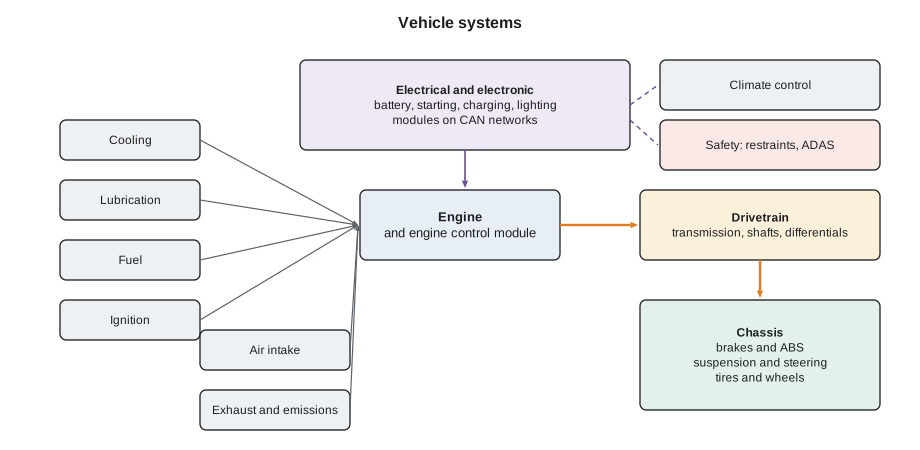
A modern vehicle is a set of systems that depend on each other. This lesson gives an overview of each of them: the body and frame, the engine and its supporting systems, the drivetrain, brakes, suspension and steering, tires and wheels, the electrical and electronic systems, climate control, safety systems and, briefly, hybrid and electric drive. Each is covered in depth in a later course of the program; the aim here is to see how they fit together.
Body and frame
Most cars, minivans and crossovers have a unibody, in which the body panels, floor and roof are welded together into a single strong shell that carries the loads of the suspension and drivetrain. Pickups, large SUVs and many vans have a separate ladder-shaped frame, with the body bolted on top through rubber mounts; this is body-on-frame construction. The difference matters to a technician for lifting points, as Lesson 3 explained, for corrosion inspection, because frame rails and rocker panels rust from the inside where road salt is used, and for collision repair. Both kinds of structure include crumple zones that absorb energy in a collision, and they are never cut, drilled or welded except as the manufacturer allows.
The engine
Most vehicles on the road still have a four-stroke internal combustion engine that burns gasoline or, in some trucks, diesel fuel. In each cylinder a piston moves up and down, connected by a connecting rod to the crankshaft, which turns the reciprocating motion into rotation. The four strokes are intake, when the piston moves down and draws in air, or air and fuel; compression, when it moves up and compresses the mixture; power, when the burning mixture forces the piston down; and exhaust, when it moves up and pushes the burned gases out. Valves in the cylinder head, opened by camshafts driven from the crankshaft by a belt or chain, let the gases in and out at the right times. The engine's displacement, such as 3.6 L for the Lindqvists' V6 or 5.3 L for Gord's V8, is the total volume swept by all the pistons. AUTO-120 covers engines in detail.
Several systems keep the engine running. The cooling system circulates coolant, a mixture of water and antifreeze, through passages in the engine and through the radiator, with a water pump, thermostat, hoses and fans, to hold the engine at its operating temperature, typically around 195 to 220°F. The lubrication system pumps oil from the oil pan through a filter to the bearings, camshafts, valve train and timing components, and Lesson 8 covers its maintenance. The fuel system stores fuel in the tank and delivers it at pressure to the injectors, which spray it into the intake port or directly into the cylinder. The ignition system, on gasoline engines, fires the spark plugs at the correct moment through individual coils controlled by the engine control module. The air intake system draws air through a filter, measures it, and controls it with an electronic throttle. The exhaust system carries the burned gases through the catalytic converter, which converts harmful gases to less harmful ones, and through mufflers to the tailpipe. AUTO-230 covers fuel, ignition and emissions.
All of this is managed by the engine control module, often called the powertrain control module when it also controls the transmission. It reads sensors for engine speed, crankshaft and camshaft position, air flow, throttle position, coolant temperature and the oxygen content of the exhaust, and it controls the injectors, ignition coils, throttle, variable valve timing and many other actuators. It also monitors its own systems and those that affect emissions, and turns on the malfunction indicator lamp, the check engine lamp, when it finds a fault, storing a diagnostic trouble code that a scan tool can read.
The drivetrain
The drivetrain carries the engine's power to the wheels. The transmission changes the ratio between engine speed and wheel speed, so the engine can stay in its useful speed range from a standing start to highway speed. Manual transmissions use a clutch and gears selected by the driver; automatic transmissions use a torque converter and planetary gear sets, or a continuously variable transmission, or a dual-clutch design, controlled electronically. AUTO-310 covers transmissions and drivetrains.
In a front-wheel-drive vehicle, the transmission and the differential are combined in a transaxle, and constant-velocity drive axles carry power to the front wheels, which also steer. In a rear-wheel-drive vehicle, the transmission is behind the engine and a driveshaft carries power to a differential in the rear axle. The differential lets the left and right wheels turn at different speeds in a turn while still driving both. All-wheel drive sends power to all four wheels all the time, through a center differential or an electronically controlled clutch. Four-wheel drive, common on pickups such as Gord's, uses a transfer case that the driver can shift between two-wheel drive, four-wheel drive and a low range for off-road use.
The overall gear ratio between the engine and the wheels, together with the tire size, sets how fast the engine turns at a given road speed. The calculation is useful for diagnosing speedometer errors, choosing replacement tires and understanding why a vehicle feels different after a change of tire size or axle ratio.
Here v is the road speed, n_e the engine speed in revolutions per minute, C_t the tire's rolling circumference, G the transmission gear ratio and A the axle ratio, with the factor of 60 converting minutes to hours when the circumference is given in kilometers or miles.
# Road speed from engine speed, gear ratio, axle ratio and tire size (Gord's pickup, illustrative)
import math
def tire_diameter_mm(width_mm, aspect, rim_in):
    return 2 * width_mm * aspect / 100 + rim_in * 25.4
d = tire_diameter_mm(265, 70, 17)              # 265/70R17
circ = math.pi * d * 0.97                       # rolling circumference, about 3 % less than the static figure
axle = 3.42
gears = [("1st", 4.03), ("3rd", 1.53), ("5th", 1.00), ("6th", 0.67)]
for name, g in gears:
    for rpm in (1500, 2000):
        v = rpm * circ / 1e6 * 60 / (g * axle) / 1.609344
print(f"{name:<4} gear {g:4.2f}: {rpm} rpm -> {v:5.1f} mph")1st gear 4.03: 1500 rpm -> 9.9 mph 1st gear 4.03: 2000 rpm -> 13.2 mph 3rd gear 1.53: 1500 rpm -> 26.1 mph 3rd gear 1.53: 2000 rpm -> 34.9 mph 5th gear 1.00: 1500 rpm -> 40.0 mph 5th gear 1.00: 2000 rpm -> 53.3 mph 6th gear 0.67: 1500 rpm -> 59.7 mph 6th gear 0.67: 2000 rpm -> 79.6 mph
Brakes
The brakes convert the vehicle's motion into heat. Pressing the pedal pushes pistons in the master cylinder, which, assisted by a vacuum or electric booster, sends brake fluid under pressure through steel lines and flexible hoses to the wheels. At each wheel the pressure pushes pistons in a caliper, which clamps pads against a rotor in a disc brake, or pushes shoes outward against a drum in a drum brake. The anti-lock braking system, or ABS, has wheel speed sensors and a hydraulic control unit that release and reapply the pressure many times a second if a wheel begins to lock, so the driver can keep steering. Electronic stability control uses the same hardware to brake individual wheels and keep the vehicle on the driver's intended path. Many vehicles also have an electric parking brake. AUTO-130 covers brake systems.
Suspension, steering, tires and wheels
The suspension holds the wheels in position, lets them move up and down over bumps, and keeps the tires in contact with the road. It is made of springs, which carry the vehicle's weight, shock absorbers or struts, which damp the springs' movement, control arms and links, which locate the wheels, ball joints and bushings, which let them pivot, and a stabilizer, or sway, bar, which reduces body roll. Front suspensions on most cars use MacPherson struts or double wishbones; rear suspensions range from a simple beam axle to multi-link designs.
The steering system turns the front wheels through a rack and pinion on most vehicles, with electric power steering assist on nearly all new ones; older vehicles and some trucks use hydraulic assist or a steering gear box. Wheel alignment, the precise angles of the wheels relative to the vehicle and the road, affects tire wear, handling and straight-line stability. Tires are the only part of the vehicle that touches the road, and their condition and pressure affect braking, handling, comfort and fuel economy; Lesson 9 covers them. AUTO-210 covers suspension, steering and alignment.
Electrical and electronic systems
Every vehicle has a low-voltage electrical system, usually 12 V, powered by a battery and recharged by a generator, the alternator, driven by the engine, or on hybrids and electric vehicles by a DC-to-DC converter from the high-voltage battery. The starter motor cranks the engine. Fuses, relays and circuit breakers protect and switch the circuits. The lighting system, exterior and interior, has its own legal requirements. Body electrical systems include power windows, locks, mirrors and seats, wipers, the horn and the instrument cluster.
A modern vehicle has many electronic control modules, from a dozen on a basic car to well over fifty on a luxury model. They control the engine, transmission, brakes, airbags, body functions, climate, infotainment and driver assistance, and they share information over networks. The main network on most vehicles is the controller area network, or CAN bus, a pair of twisted wires that carries messages between modules at high speed. A technician's scan tool connects to the vehicle through the diagnostic link connector under the dashboard, the same connector required on all vehicles since the 1996 model year in the United States and 1998 in Canada, and reads codes and data from the modules on the network. AUTO-220 covers electrical and electronic systems.
| System | Main parts | Course in the program |
|---|---|---|
| Engine mechanical, cooling and lubrication | Block, heads, valve train, timing drive, pump, radiator, oil pump | AUTO-120 |
| Brakes | Master cylinder, booster, calipers, rotors, drums, ABS unit | AUTO-130 |
| Suspension, steering and alignment | Springs, struts, control arms, rack, power steering, tires | AUTO-210 |
| Electrical and electronic | Battery, starter, alternator, wiring, modules, CAN bus | AUTO-220 |
| Fuel, ignition and emissions | Pump, injectors, coils, catalytic converter, OBD | AUTO-230 |
| Drivetrain and transmissions | Clutch, transmission, driveshafts, differentials, transfer case | AUTO-310 |
| Climate control | Compressor, condenser, evaporator, heater core, blend doors | AUTO-320 |
| Hybrid and electric drive | High-voltage battery, inverter, motors, charger | AUTO-410 |
| Driver assistance | Cameras, radar, ultrasonic sensors | AUTO-420 |
Climate control
The heating, ventilation and air conditioning system keeps the cabin comfortable and the windows clear. Heat comes from engine coolant passing through a heater core in the dashboard, or on electric vehicles from an electric heater or a heat pump. Air conditioning uses a refrigerant compressed by a belt-driven or electric compressor, condensed in a condenser at the front of the vehicle, and expanded and evaporated in an evaporator under the dashboard, where it absorbs heat from the cabin air. Blend doors, moved by small electric actuators, mix hot and cold air and direct it to the vents. Refrigerants are regulated, and only certified technicians may service the system; AUTO-320 covers it.
Safety systems
Passive safety systems protect occupants in a crash. Seat belts with pretensioners and load limiters, frontal, side and curtain airbags, and the crash sensors and module that control them form the supplemental restraint system. Airbags and pretensioners contain explosive charges, and the service information's precautions for disabling the system, waiting for the backup power to drain and handling a live airbag module are followed exactly; an apprentice does not work on them without supervision. Active safety and driver assistance systems use cameras, radar and ultrasonic sensors to warn the driver or intervene: automatic emergency braking, lane keeping, adaptive cruise control, blind-spot monitoring and parking assistance. Many repairs, from a windshield replacement to a wheel alignment, require these sensors to be recalibrated afterwards. AUTO-420 covers them.
Hybrid and electric drive
A hybrid vehicle combines an engine with one or more electric motors and a high-voltage battery that is recharged by the engine and by regenerative braking. A plug-in hybrid has a larger battery that can also be charged from the grid. A battery electric vehicle, such as Dr. Singh's, has no engine: a large high-voltage battery powers one or more electric motors through an inverter, and it is charged from the grid. These vehicles still have a 12 V system, brakes, suspension, steering, tires, climate control and many of the same electronics, and much of their routine service is the same. Their high-voltage systems, however, can kill, and Lesson 11 explains what every technician in a general shop must know about them. AUTO-410 covers their repair.
Worked problem
Tracing a system on the lift
Marty asks Kiran to trace the power path on Gord's four-wheel-drive pickup, from the engine to the front left wheel, naming each part.
Show solution
- Engine crankshaft to the automatic transmission, through the torque converter.
- Transmission output to the transfer case bolted behind it.
- In four-wheel drive, the transfer case sends power forward through the front driveshaft.
- The front driveshaft drives the front differential, which turns the left and right front drive axles.
- The left front drive axle, with constant-velocity joints at each end, turns the hub and wheel.
Answer: Engine, torque converter, transmission, transfer case, front driveshaft, front differential, left front axle, hub and wheel.
Common mistakes
MistakeTreating the vehicle as a set of separate parts.
InsteadSystems interact; a fault in one, such as a wheel speed sensor, can show up in another, such as stability control.
MistakeWorking near airbag components without following the disabling procedure.
InsteadFollow the service information's restraint system precautions exactly, under supervision.
MistakeAssuming an electric vehicle needs no service.
InsteadIt still has brakes, tires, suspension, coolant, cabin filters and a 12 V system.
MistakeConfusing all-wheel drive with four-wheel drive.
InsteadAll-wheel drive is full-time and automatic; four-wheel drive usually has a driver-selected transfer case with low range.
MistakeForgetting that driver assistance sensors may need calibration after a repair.
InsteadCheck the service information after any work that moves a camera, radar or the vehicle's alignment.
Summary and key terms
- Unibody and body-on-frame structures carry the loads differently and are lifted and inspected differently.
- The four-stroke engine depends on cooling, lubrication, fuel, ignition, air intake and exhaust systems managed by the engine control module.
- The drivetrain carries power through the transmission and differentials to the wheels in front-, rear-, all- or four-wheel-drive layouts.
- Brakes, suspension, steering and tires control the vehicle; ABS and stability control add electronic control.
- Electrical and electronic systems include the 12 V system and many modules on networks such as CAN.
- Climate control, safety systems and hybrid and electric drive each have special precautions.
- Unibody
- A body structure in which the body shell itself carries the loads.
- Transaxle
- A transmission and differential combined in one unit, used in front-wheel-drive vehicles.
- Differential
- A gear set that lets the wheels on one axle turn at different speeds.
- Transfer case
- The unit that divides power between front and rear axles in a four-wheel-drive vehicle.
- Engine control module
- The computer that manages the engine and monitors emission-related systems.
- CAN bus
- The controller area network that carries messages between control modules.
Practice problems
Work each problem on paper first, then reveal the answer to check.
Name the four strokes in order.
Show answer
Intake, compression, power, exhaust.
What lets the left and right wheels turn at different speeds in a turn?
Show answer
The differential.
Which system holds the engine at its operating temperature?
Show answer
The cooling system.
Why must the restraint system be disabled before working near an airbag?
Show answer
Airbags contain explosive charges that can deploy and injure the technician.
Lesson quiz · 5 questions
Score 60% or more to complete this lesson.
Create a free account to save your progress, take quizzes and earn a certificate.