
AUTO-110 · Lesson 4 of 12 · 20 min
Hand tools, power tools and measuring tools
Kiran arrives at Ridgeline with a starter tool set bought on her pre-apprenticeship program: two socket sets, a set of combination wrenches, screwdrivers, pliers and a hammer in a small roll cabinet. By the end of the first week Marty has shown her the gaps. “You'll buy tools for the rest of your career,” he says, “so buy them in the order you need them, buy good ones, and look after them. A cheap socket that splits on a seized bolt will cost you more than the socket.” In most shops technicians own their hand tools and the shop supplies the large equipment: lifts, the scan tool, the tire machine, the presses and the specialized diagnostic tools.
This lesson covers the hand tools, power tools and measuring tools a technician uses daily, how to choose the right one, how to use it safely and how to read the precision measuring tools that engine, brake and suspension work depend on.
Wrenches and sockets
Fasteners on modern vehicles are almost all metric, sized by the width across the flats of the hex head in millimeters: 8, 10, 13, 15, 18 and 21 mm are among the most common. Older North American vehicles and some current trucks and aftermarket parts still use fractional inch sizes, such as 1/2, 9/16 and 3/4 in. A technician needs both sets, and must never force a nearly-fitting size: a 13 mm wrench on a 1/2 in head is loose enough to round it.
A combination wrench has an open end on one side and a box end on the other. The box end grips all six corners and is used to break a fastener loose and to tighten it; the open end is quicker for running a loosened fastener in or out where there is no room for a box. A flare-nut wrench, a box end with a slot, grips the soft fittings on brake and fuel lines without rounding them, and it is the only wrench used on those fittings. Ratcheting wrenches save time where swing room is limited.
Sockets fit onto a ratchet, breaker bar, extension or torque wrench by a square drive, in 1/4, 3/8 and 1/2 in sizes for automotive work, with 3/4 and 1 in for heavy trucks. A six-point socket grips the flats of a hex head and is less likely to round a tight or corroded fastener than a twelve-point socket, which grips the corners but is easier to fit in tight places. Deep sockets reach nuts on long studs. Impact sockets are made of a tougher steel, usually black, and are the only sockets used on an impact wrench; a chrome hand socket can shatter under impact. Swivel joints and wobble extensions reach fasteners at an angle.
Other head types need their own drivers. Torx and Torx Plus, six-lobed recesses, are common on body, interior and brake parts; external Torx heads take E-Torx sockets. Hex, or Allen, keys and bits fit socket-head screws. Triple-square and spline bits are used by some European manufacturers. Phillips and other cross-recess screws need the correct size and type of bit to avoid cam-out, which ruins the recess. Marty keeps a magnetic tray on each lift for fasteners and a set of labeled cups for parts that must go back in a particular place.
Screwdrivers, pliers, hammers and pry bars
Screwdrivers are used only for turning screws. A screwdriver used as a pry bar or a chisel bends, chips and slips, and a slip is one of the most common causes of hand injuries in shops. Pliers come in many forms: slip-joint and groove-joint pliers for gripping, needle-nose pliers for small parts, side cutters for cutting wire and cotter pins, locking pliers for holding, and snap-ring pliers for internal and external retaining rings. Pliers are never used on fasteners, which they round.
Hammers include the ball-peen hammer for general metal work, dead-blow and soft-faced hammers that strike without marking or rebounding, and a small sledge for driving stubborn parts. A hammer is never used to strike another hardened tool, such as a second hammer or the end of a wrench, because hardened steel can chip and throw fragments. Pry bars and punches are made for prying and driving; brass and aluminum drifts are used where a steel punch would damage the part.
Power tools and compressed air
Power tools save time but bring their own hazards. An impact wrench, air or battery powered, uses a hammering mechanism to remove tight fasteners quickly. It is excellent for removal and for running fasteners down, but it is not used for final tightening of wheel nuts, cylinder head bolts or any fastener with a specified torque, because its output varies with air pressure, battery charge and the joint, and it easily over-tightens. Lesson 5 explains why that matters. Air ratchets and cordless ratchets run fasteners in and out in tight places. Drills, die grinders, angle grinders and cut-off tools are used for drilling, cleaning, grinding and cutting, with a face shield over safety glasses.
Ridgeline's compressor supplies air through a dryer and filters to drops at each bay, regulated to about 90 psi, the pressure most air tools are designed for. Hoses are inspected for damage and couplers are kept clean. Compressed air is never pointed at a person and never used to clean clothing or skin; air at shop pressure can force dirt into the eyes and, in rare cases, air into the skin or bloodstream. Blow guns used for cleaning parts are fitted with a nozzle that limits the outlet pressure if blocked, which OSHA requires to be under 30 psi for cleaning purposes.
Electric tools and cords are checked before use for damaged insulation, missing ground pins and loose plugs. Battery tools avoid cords on the floor and are now used for most power-tool work in many shops. Bench grinders need their tool rest set within about 1/8 in of the wheel and their tongue guard close to it, and wheels are never used above their rated speed.
Measuring tools and precision
Many repairs depend on measurement: the thickness of a brake rotor, the depth of tire tread, the runout of a wheel hub, the gap of a spark plug, the diameter of a crankshaft journal. Measuring tools range from a steel rule, read to about half a millimeter, to a micrometer, read to a thousandth of a millimeter on some models. Three terms matter. Resolution is the smallest division the tool can display. Accuracy is how close a reading is to the true value. Repeatability is how closely repeated readings agree. A tool with fine resolution can still be inaccurate if it is out of calibration or used carelessly, so precision tools are checked against a standard, such as a micrometer's setting gauge, and handled gently.
Calipers measure outside dimensions, inside dimensions and depths. A dial or digital caliper reads to 0.02 mm or 0.01 mm, or 0.001 in, and is quick and versatile. The jaws must be clean and closed to zero before use, and the part is held square between them with light, even pressure.
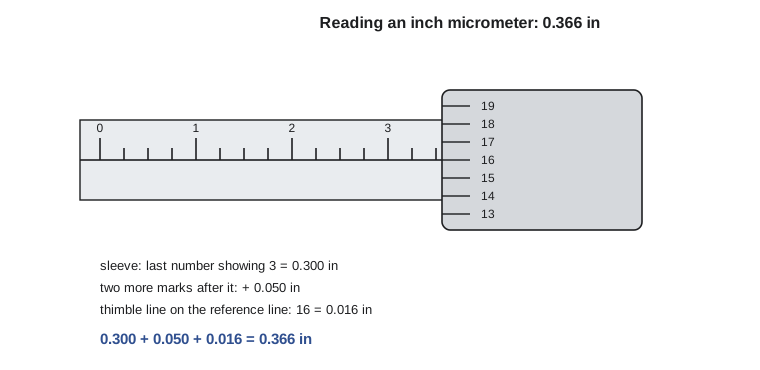
A micrometer is more precise. An outside micrometer measures between a fixed anvil and a spindle that is moved by a fine screw. On a metric micrometer the screw advances 0.5 mm per turn; the sleeve has a line every millimeter above its reference line and every half millimeter below it, and the thimble is divided into 50 parts of 0.01 mm. On an inch micrometer the screw advances 0.025 in per turn; the sleeve is marked every 0.025 in, with numbers every 0.100 in, and the thimble is divided into 25 parts of 0.001 in. The ratchet stop or friction thimble applies the same light pressure every time, so the technician always turns the micrometer by it, not by the thimble.
# Reading a micrometer: sleeve and thimble to a measurement
def read_metric(whole_mm, half_showing, thimble):          # thimble 0-49
    return whole_mm + (0.5 if half_showing else 0) + thimble * 0.01
def read_inch(tenths, marks_after, thimble):               # thimble 0-24
    return tenths * 0.100 + marks_after * 0.025 + thimble * 0.001
for args in ((3, 2, 16), (1, 0, 4), (2, 3, 22)):
    print(f"sleeve {args[0]}, marks {args[1]}, thimble {args[2]:>2} -> {read_inch(*args):6.3f} in")
# a brake rotor is measured at several points; minimum thickness is cast on the rotor
readings = [1.028, 1.027, 1.030, 1.028]
print(f"rotor: thinnest {min(readings):.3f} in, variation {max(readings) - min(readings):.3f} in against a 1.024 in minimum")sleeve 3, marks 2, thimble 16 -> 0.366 in sleeve 1, marks 0, thimble 4 -> 0.104 in sleeve 2, marks 3, thimble 22 -> 0.297 in rotor: thinnest 1.027 in, variation 0.003 in against a 1.024 in minimum
Other measuring tools Kiran will use soon are feeler gauges, thin blades of known thickness for measuring gaps; a dial indicator on a magnetic base, which measures movement such as rotor runout or gear backlash to 0.01 mm or 0.001 in; telescoping and small-hole gauges, which transfer an inside dimension to a micrometer; a straightedge for checking cylinder heads for warpage; and tire tread depth gauges, which Lesson 9 covers. Precision tools are stored in their cases, kept clean and lightly oiled, and never dropped.
Converting between metric and inch measurements
Service information for most vehicles gives specifications in metric units, often with inch and US customary values alongside, and a technician moves between the two systems constantly. One inch is exactly 25.4 mm. Torque converts between newton-meters and pound-feet by a factor of about 1.356, pressure between kilopascals and pounds per square inch by about 6.895, volume between liters and US quarts by about 0.946, and temperature between Celsius and Fahrenheit by the familiar formula. Conversions are rounded sensibly: a rotor thickness of 26.00 mm is 1.024 in, not 1.0236220 in.
# A small conversion helper for the bench (exact factors for length; others to four figures)
from fractions import Fraction
def mm_to_in(mm): return mm / 25.4
def nm_to_lbft(nm): return nm / 1.3558
def kpa_to_psi(kpa): return kpa / 6.8948
def l_to_qt(l): return l / 0.94635
def c_to_f(c): return c * 9 / 5 + 32
checks = [("rotor minimum thickness", 26.00, mm_to_in, "mm", "in", 3),
          ("wheel nut torque", 140, nm_to_lbft, "N m", "lb ft", 0),
          ("tire pressure", 240, kpa_to_psi, "kPa", "psi", 0),
          ("engine oil with filter", 7.6, l_to_qt, "L", "US qt", 1),
          ("thermostat opening", 82, c_to_f, "C", "F", 0)]
for name, v, f, u1, u2, nd in checks:
    print(f"{name:<26} {v:>7} {u1:<4} = {f(v):>8.{nd}f} {u2}")
# nearest fractional wrench to a metric head, and how far off it is
for mm in (13, 19, 22):
    best = min(range(4, 33), key=lambda n: abs(n / 32 * 25.4 - mm))
print(f"{mm} mm head: closest fractional size {Fraction(best, 32)} in = {best / 32 * 25.4:.2f} mm (off by {best / 32 * 25.4 - mm:+.2f} mm)")rotor minimum thickness 26.0 mm = 1.024 in wheel nut torque 140 N m = 103 lb ft tire pressure 240 kPa = 35 psi engine oil with filter 7.6 L = 8.0 US qt thermostat opening 82 C = 180 F 13 mm head: closest fractional size 1/2 in = 12.70 mm (off by -0.30 mm) 19 mm head: closest fractional size 3/4 in = 19.05 mm (off by +0.05 mm) 22 mm head: closest fractional size 7/8 in = 22.22 mm (off by +0.22 mm)
The last lines show why 19 mm and 3/4 in are interchangeable in an emergency (they differ by only 0.05 mm), while 13 mm and 1/2 in are not quite the same and 22 mm and 7/8 in differ enough to round a tight nut. The rule in Ridgeline's shop is to use the correct system every time.
Choosing and caring for tools
Marty's rules for tools are practical. Pull on a wrench rather than pushing it, so that a slip brings the hand toward the body instead of into a sharp edge, and keep the free hand clear. Use the shortest extension that reaches, because long extensions flex and absorb torque. Break a tight fastener loose with a breaker bar or a six-point socket on a ratchet rated for the load, not with a cheater pipe on a ratchet. Never use a damaged tool: a cracked socket, a ratchet that slips or a screwdriver with a rounded tip goes in the bin or back to the supplier under warranty. Clean tools at the end of each day, because oil and grit make them slippery and wear them out. And put them back where they belong, because the time spent looking for a tool is time nobody pays for.
Worked problem
Measuring a brake rotor
Marty asks Kiran to measure the front rotors on the Lindqvists' minivan. The minimum thickness cast on the rotor is 1.024 in. Her four micrometer readings around the left rotor are 1.028, 1.027, 1.030 and 1.028 in. Can the rotor be reused?
Show solution
- Take the thinnest reading: 1.027 in.
- Compare it with the minimum thickness: 1.027 − 1.024 = 0.003 in above.
- Check the variation in thickness, which causes brake pedal pulsation: 0.003 in here. The service information gives the maximum allowed variation, usually a few hundredths of a millimeter or about a thousandth of an inch; this is too much.
- A rotor this close to minimum cannot be machined to remove the variation, because machining would take it below the limit.
Answer: The rotor is above minimum thickness but has too much thickness variation and cannot be refinished, so it is replaced.
Common mistakes
MistakeUsing a twelve-point socket on a tight or rusty fastener.
InsteadA six-point socket grips the flats and is less likely to round it.
MistakeUsing a chrome socket on an impact wrench.
InsteadUse impact sockets only; chrome sockets can shatter.
MistakeTightening wheel nuts with an impact wrench.
InsteadRun them down by hand or impact at low power, then torque with a torque wrench.
MistakeTurning a micrometer by its thimble.
InsteadUse the ratchet stop so the measuring pressure is always the same.
MistakeBlowing dust off clothing with compressed air.
InsteadNever point air at a person; use a brush or vacuum.
MistakeForcing a nearly fitting wrench of the other measuring system.
InsteadUse the correct metric or inch size.
Summary and key terms
- Most current fasteners are metric; a technician needs metric and inch tools and must not mix them.
- Six-point sockets and box ends resist rounding; flare-nut wrenches are used on line fittings; impact sockets go on impact tools.
- Screwdrivers, pliers and hammers are used only for their own jobs.
- Impact wrenches remove fasteners; specified fasteners are tightened with a torque wrench.
- Compressed air is regulated, never pointed at people, and limited in pressure for cleaning.
- Calipers and micrometers must be zeroed, used with light, even pressure and read carefully.
- Six-point socket
- A socket that grips the six flats of a hex head.
- Flare-nut wrench
- A slotted box wrench for brake and fuel line fittings.
- Impact socket
- A socket made of tougher steel for use on impact wrenches.
- Resolution
- The smallest division a measuring tool can display.
- Micrometer
- A precision instrument that measures with a fine screw and graduated thimble.
- Dial indicator
- A gauge that measures small movements such as runout.
Practice problems
Work each problem on paper first, then reveal the answer to check.
A metric micrometer shows 12 whole millimeters, the half-millimeter line, and 31 on the thimble. What is the reading?
Show answer
12 + 0.5 + 0.31 = 12.81 mm.
An inch micrometer shows 4 on the sleeve, one mark after it, and 7 on the thimble. What is the reading?
Show answer
0.400 + 0.025 + 0.007 = 0.432 in.
Convert 110 N m to pound-feet.
Show answer
110 / 1.356 = about 81 lb ft.
Why are impact wrenches not used for final tightening?
Show answer
Their output varies, so they can over- or under-tighten; a torque wrench gives the specified torque.
Lesson quiz · 5 questions
Score 60% or more to complete this lesson.
Create a free account to save your progress, take quizzes and earn a certificate.