
AUTO-110 · Lesson 2 of 12 · 21 min
Shop hazards, PPE and HazCom
On Kiran's second morning Dale walks her through the shop with a clipboard. He is not showing her where things are this time, but what can hurt her. “Every bay has the same dangers,” he says. “A vehicle that moves when you don't expect it, something heavy falling, something hot, something that burns your skin or your lungs, and something loud. Learn to see them before you start, and most days nothing will happen.”
This lesson covers the hazards found in an automotive shop, the order in which they are controlled, the personal protective equipment a technician wears, and the hazard communication system, the Hazard Communication Standard, or HazCom, in the United States, that tells workers what is in the products they use. Colorado has no state occupational safety plan for private employers, so federal OSHA rules apply at Ridgeline, and every employer must assess the hazards of the work, control them and train workers.
The hazards in a shop
Moving vehicles cause some of the worst shop injuries. A vehicle can roll if it is left in neutral, if its parking brake is not set, or if it is started in gear. Someone may drive it into a bay while a technician is in front of it or under it. The rules at Ridgeline are simple: the vehicle is in park, or in gear with the engine off for a manual transmission, with the parking brake set before anyone works on it; wheels are chocked on any vehicle that is on the floor and being worked under or around; nobody stands in front of or behind a vehicle that is being started; and vehicles are driven in the shop only at walking speed, with someone guiding them into a bay.
Lifts and jacks are the next great hazard, because a vehicle falling from a lift or jack can kill. Lesson 3 is devoted to lifting and supporting vehicles. Falling objects include parts removed under a lift, such as a driveshaft, exhaust section or transmission, which are heavier and more awkward than they look, and tools left on a lifted vehicle that fall when it is lowered.
Burns come from hot exhaust parts, which stay hot enough to burn skin for a long time after the engine stops, from hot coolant and steam if a radiator cap is opened on a hot engine, from hot engine oil during a drain, and from contact with chemicals. Cuts and abrasions come from sharp sheet-metal edges, broken parts and slipping tools. Eye injuries come from rust and dirt falling from under a vehicle, splashed fluids, brake cleaner spray, grinding and wire-brushing debris, and pressurized fluid released from a fitting.
Slips, trips and falls are common: oil and coolant on the floor, air hoses and cords across the aisle, parts and tools left on the floor, and climbing in and out of pickups and vans. Spills are cleaned up immediately with absorbent, hoses and cords are coiled when not in use, and the yellow aisle at Ridgeline is kept clear. Strains come from lifting wheels, batteries and brake rotors, and from working in awkward positions; Lesson 1 mentioned the equipment that reduces them.
Health hazards are less obvious because the harm builds up over years. Engine exhaust contains carbon monoxide, which is colorless and odorless and can kill in an enclosed space. Brake cleaner, carburetor and throttle-body cleaner, parts-washer solvent and some degreasers give off vapors that affect the nervous system and the liver, and some are extremely flammable. Used engine oil contains compounds that can cause skin disease and cancer with long contact. Ethylene glycol coolant is poisonous if swallowed and tastes sweet, which makes it a danger to children and animals. Battery acid is corrosive and charging batteries give off hydrogen. Noise from impact wrenches, air hammers and grinders damages hearing over time.
Older vehicles add one more health hazard: asbestos. Brake linings, clutch facings and some gaskets once contained asbestos fibers, and an old vehicle or an imported part may still have them. Asbestos brake parts can still be found, and OSHA's asbestos standard sets out the wet and enclosure methods that brake and clutch shops must use, so a technician working on brakes and clutches still treats the dust as possibly containing asbestos. Brake dust is never blown off with compressed air; it is wetted with a low-pressure water spray or a brake washer and wiped up, and the waste is bagged.
Controlling hazards in the right order
Safety professionals use the hierarchy of controls, which ranks the ways of dealing with a hazard from most to least effective. The best is elimination: removing the hazard altogether. Next is substitution: using something less hazardous, such as a water-based parts washer instead of a solvent tank, or a non-chlorinated brake cleaner instead of a chlorinated one. Then come engineering controls, which separate the worker from the hazard by design: exhaust extraction hoses, a ventilated paint-mixing room, guarding on a bench grinder and lift arm locks. Then administrative controls: procedures, training, signs, work permits, job rotation and inspection schedules. The last line of defense is personal protective equipment, which protects only the person wearing it and only when it is worn correctly.
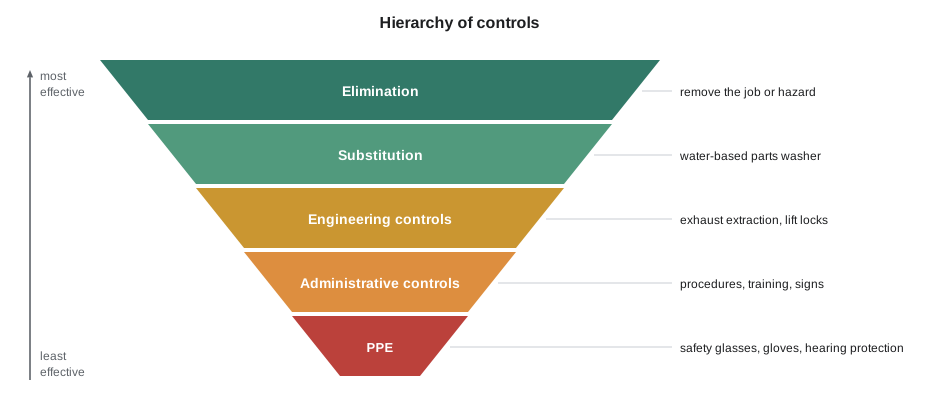
The order matters because a shop that relies only on PPE is relying on every technician wearing it correctly every time. Ridgeline's exhaust extraction system, for example, takes the exhaust out of the building through hoses that clip onto the tailpipe; no respirator could protect everyone in the shop as well.
# Carbon monoxide build-up from an idling engine in a closed bay (dilution model, illustrative)
import math
bay_volume = 7000.0                   # bay air volume, ft3
co_rate = 0.35                   # CO from a warm modern engine at idle, ft3 per minute (illustrative)
limit_ppm = 50                  # OSHA permissible exposure limit for CO (8-hour average), ppm
for air_changes_per_h in (0.5, 2, 6):
    q = bay_volume * air_changes_per_h / 60          # fresh air, ft3 per minute
    steady = co_rate / q * 1e6                       # steady-state concentration, ppm
    t = None
    if steady > limit_ppm:
        t = -math.log(1 - limit_ppm / steady) * bay_volume / q   # minutes to reach the limit
    msg = f"reaches {limit_ppm} ppm after {t:4.0f} min" if t else "stays below the limit"
print(f"{air_changes_per_h:>4} air changes/h: steady {steady:6.0f} ppm, {msg}")0.5 air changes/h: steady 6000 ppm, reaches 50 ppm after 1 min 2 air changes/h: steady 1500 ppm, reaches 50 ppm after 1 min 6 air changes/h: steady 500 ppm, reaches 50 ppm after 1 min
Even a modern engine with a working catalytic converter, which produces very little carbon monoxide once warm, would push a closed bay over the limit within an hour or so with poor ventilation, and a cold engine or an older one produces many times more. That is why Ridgeline's rule is that every running engine indoors has an exhaust hose on it, and the overhead doors are opened if more than one engine must run at once. The CO detector on the wall alarms long before the level becomes immediately dangerous.
Personal protective equipment
Safety glasses with side protection are worn in the shop at all times, not just when grinding. Ridgeline supplies glasses that meet ANSI/ISEA Z87.1, and prescription safety glasses for those who need them. A face shield is worn over the glasses for grinding, wire-brushing, using a cut-off wheel and handling battery acid. Safety footwear with toe protection and a slip-resistant sole is required; OSHA's general PPE rules require protective footwear where there is a danger of foot injury, and shops usually specify boots meeting ASTM F2413.
Disposable nitrile gloves protect the hands from oil, fuel, coolant and most solvents, and they keep the customer's vehicle clean. Nitrile resists petroleum products much better than latex or vinyl. Gloves are changed when torn or heavily soiled, and they are never worn near rotating parts such as a running engine's belts or a drill chuck, where a glove can be caught and pull a hand in. Heavier mechanic's gloves protect against cuts and heat when handling exhaust parts or sharp sheet metal.
Hearing protection is worn during noisy work: air hammers, impact wrenches used for long periods, grinding and cutting. Disposable foam earplugs, when inserted properly, give good protection; earmuffs are quicker to put on and take off. Loose clothing, long hair and jewelry are hazards around rotating parts. Coveralls or a shop uniform are buttoned, long hair is tied back, and rings, watches and necklaces come off; a ring can also short a battery terminal to ground and burn a finger badly.
# Noise dose for a technician's day from three noisy tasks (illustrative levels)
import math
criterion, exchange = 90, 5       # OSHA: 90 dBA for 8 hours, 5 dB exchange rate (hearing conservation starts at 85)
tasks = [("air hammer, exhaust work", 103, 0.4), ("impact wrench, tire rotations", 95, 1.2),
         ("general shop noise", 82, 6.0)]
dose = 0.0
for name, level, hours in tasks:
    allowed = 8 / 2 ** ((level - criterion) / exchange)       # permitted hours at that level
    dose += hours / allowed
    print(f"{name:<32} {level} dBA for {hours:3.1f} h; allowed {allowed:5.2f} h")
twa = criterion + exchange * math.log2(dose)
print(f"daily dose {dose * 100:5.0f} %, equivalent 8-hour level {twa:5.1f} dBA")
print("hearing protection needed for the loud tasks" if dose > 1 else "within the limit")air hammer, exhaust work 103 dBA for 0.4 h; allowed 1.32 h impact wrench, tire rotations 95 dBA for 1.2 h; allowed 4.00 h general shop noise 82 dBA for 6.0 h; allowed 24.25 h daily dose 85 %, equivalent 8-hour level 88.8 dBA within the limit
Under the OSHA criterion this day stays inside the permissible limit, but it is above the 85 dBA action level at which employers must run a hearing conservation program, and under the stricter 85 dBA and 3 dB rule used in Canada the same day would be well over. The practical lesson is the same: a few minutes with an air hammer use up much of a day's allowance, so the hearing protection goes in before the hammer starts.
Hazardous products and the label
HazCom, OSHA's Hazard Communication Standard, is the US system for telling workers about hazardous products. It is based on the Globally Harmonized System of Classification and Labeling of Chemicals, GHS. Suppliers must classify the products they sell, label them and provide a safety data sheet; employers must make sure products are labeled, keep the safety data sheets available, and train workers. OSHA updated the standard in May 2024 to align with a newer edition of the GHS, with compliance dates for manufacturers and employers phased in over the following years and later extended, so older and newer versions of some documents may both be in a shop for a while.
A supplier label on a hazardous product has a product identifier, the supplier's name and contact information, one or more hazard pictograms, a signal word, hazard statements describing the nature of the hazard, and precautionary statements telling the user how to work safely, what to do in an emergency and how to store and dispose of the product. The signal word is danger for the more severe hazards and warning for less severe ones; a product with no significant hazard has none. When a product is poured into another container, such as a spray bottle of brake cleaner from a bulk drum, that container needs a workplace label with at least the product name, safe handling information and a reference to the safety data sheet.
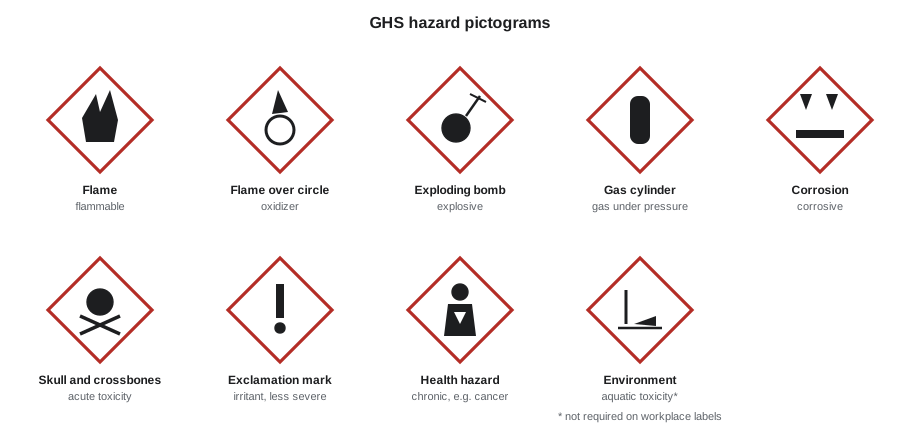
| Product | Typical pictograms | Main hazards and precautions |
|---|---|---|
| Aerosol brake cleaner | Flame, exclamation mark, health hazard | Extremely flammable; vapors affect the nervous system; use with ventilation, away from sparks and hot parts |
| Gasoline | Flame, health hazard, exclamation mark | Extremely flammable; vapor heavier than air; contains benzene; drain only into approved containers |
| Ethylene glycol coolant | Health hazard, exclamation mark | Toxic if swallowed; damages kidneys; clean spills immediately |
| Battery electrolyte | Corrosion | Severe burns to skin and eyes; face shield and gloves; neutralize spills with baking soda |
| Used engine oil | Health hazard (on many safety data sheets) | Long skin contact can cause skin disease; nitrile gloves; recycle |
| Air conditioning refrigerant | Gas cylinder | Frostbite and suffocation in confined spaces; certified recovery only |
The safety data sheet
Every hazardous product has a safety data sheet with sixteen sections in a standard order, so a worker can find the same information in the same place on any sheet. The sections Kiran will use most are section 1, identification; section 2, hazard identification, which repeats the label information; section 4, first-aid measures; section 5, fire-fighting measures; section 6, accidental release measures; section 7, handling and storage; section 8, exposure controls and personal protection, which lists exposure limits and the gloves and respirator to use; and section 13, disposal. Ridgeline keeps a binder at the parts room door and an electronic copy on the shop computer, and Dale shows Kiran how to find the sheet for a product in under a minute.
Training is part of the system. Every worker who uses or may be exposed to hazardous products must be trained on the label and safety data sheet and on the shop's own procedures for those products, and the training must be repeated when products or procedures change. Kiran's training is recorded in her file, and Dale reviews it with her when the shop changes its brake cleaner or parts washer.
Fire, fuel and batteries
Fuel and solvents are the main fire risks in a shop. Gasoline vapor is heavier than air, flows along the floor and can be ignited by a spark from a drop light, a grinder or a switch some distance away. Fuel is drained only into approved, grounded containers, never into an open drain pan. Brake cleaner is never sprayed on hot exhaust parts. Oily rags go into a closed metal can, because oil-soaked rags can heat up and ignite on their own. Ridgeline has a multipurpose ABC extinguisher at each end of the shop and beside the parts washer, and every worker is shown how to use one: pull the pin, aim at the base of the fire, squeeze the handle and sweep from side to side. A fire that is spreading, or bigger than a wastebasket, is a reason to leave and call the fire department.
A charging lead-acid battery gives off hydrogen, which is explosive, so batteries are charged in a ventilated place, the charger is switched off before its clamps are connected or removed, and no sparks or flames are allowed nearby. The positive and negative terminals are never bridged with a tool. Lesson 11 adds the extra precautions for the high-voltage batteries in hybrids and electric vehicles.
Spills, waste and the environment
A shop produces used oil, oil filters, coolant, brake fluid, solvents, batteries, tires, refrigerant and contaminated rags and absorbent. Each is collected separately, because mixing wastes can turn a recyclable product into hazardous waste and cost the shop much more to dispose of. Used oil goes to a tank for a licensed collector; drained filters go into a separate drum; coolant goes to its own tank for recycling; batteries go back to the supplier. Floor drains, if the shop has them, lead to an oil interceptor, and nothing is washed into a storm drain. Ridgeline keeps a spill kit with absorbent pads, socks and granules by the oil dispensing station.
Common mistakes
MistakeTaking off safety glasses for a quick job.
InsteadDebris falls from under vehicles at any time; glasses stay on in the shop.
MistakeWearing gloves while working near a running engine's belts.
InsteadGloves can be caught by rotating parts; keep hands clear and remove gloves for that work.
MistakeBlowing brake dust off with compressed air.
InsteadWet it down or use a brake washer; the dust may contain asbestos and is never made airborne.
MistakeSpraying brake cleaner on a hot exhaust or near a drop light.
InsteadBrake cleaner is extremely flammable; use it only on cool parts away from ignition sources.
MistakePouring a product into an unlabeled bottle.
InsteadEvery decanted container needs a workplace label.
MistakeRunning an engine indoors without an exhaust hose.
InsteadCarbon monoxide builds up quickly; connect the extraction hose every time.
Summary and key terms
- Shop hazards include moving vehicles, lifts, falling parts, burns, cuts, slips, chemicals, exhaust, noise and fire.
- Hazards are controlled first by elimination and substitution, then engineering and administrative controls, and PPE last.
- Safety glasses, safety footwear and appropriate gloves are basic PPE; hearing protection is worn for noisy work.
- HazCom labels and safety data sheets, based on the GHS, tell workers the hazards and precautions for each product.
- Exhaust extraction, fuel and battery precautions and separate waste streams prevent fires, poisoning and pollution.
- Hierarchy of controls
- The ranking of hazard controls from elimination, the most effective, to PPE, the least.
- Safety data sheet
- A sixteen-section document giving a product’s hazards, precautions, first aid and disposal.
- Signal word
- Danger or warning on a label, showing the severity of the hazard.
- Pictogram
- A GHS symbol in a red diamond showing a class of hazard.
- Carbon monoxide
- A colorless, odorless poisonous gas in engine exhaust.
- Workplace label
- The label required on a container a product has been transferred into.
Practice problems
Work each problem on paper first, then reveal the answer to check.
Put these in order from most to least effective: PPE, substitution, engineering controls.
Show answer
Substitution, engineering controls, PPE.
Which section of a safety data sheet lists the gloves to wear?
Show answer
Section 8, exposure controls and personal protection.
Why must gasoline never be drained into an open pan?
Show answer
Its vapor spreads along the floor and can be ignited far from the pan.
Why are oily rags kept in a closed metal can?
Show answer
They can heat up and ignite on their own; the can limits oxygen and contains a fire.
Lesson quiz · 5 questions
Score 60% or more to complete this lesson.
Create a free account to save your progress, take quizzes and earn a certificate.