
AUTO-110 · Lesson 1 of 12 · 22 min
The automotive service trade
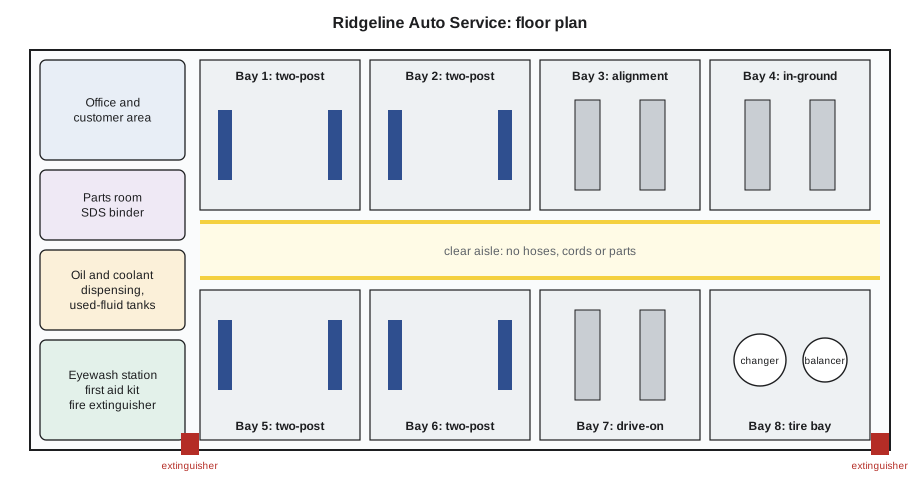
Kiran Dhaliwal parks her bicycle beside the overhead door of Ridgeline Auto Service at ten to eight on her first Monday. The shop is an independent eight-bay garage in north Denver, Colorado, with two two-post lifts, four four-post and in-ground lifts, an alignment rack, a tire machine and balancer, and a small office where the service advisor meets customers. Kiran has finished a high school pre-apprenticeship program and a summer of oil changes at a quick-lube outlet, and this is her first job in a full-service shop. This course follows her first months there, and the people and vehicles she meets will come back throughout the Automotive Service Technician program.
This first lesson describes the trade itself: what technicians do, how the work is organized and paid, how a person becomes qualified, and what a shop expects of a new apprentice. The later lessons in this course cover the safety and shop skills that every other course in the program depends on: hazards and protective equipment, lifting vehicles, tools and fasteners, service information, the vehicle's systems, fluids, tires, inspections and the basic awareness needed around hybrid and electric vehicles.
What an automotive service technician does
An automotive service technician maintains, diagnoses and repairs cars, light trucks and vans. The work falls into three broad kinds. Maintenance is scheduled service done before anything fails: oil and filter changes, fluid exchanges, tire rotations, brake inspections, filter and wiper replacement and the manufacturer's scheduled inspections. Repair is replacing or fixing a part that has failed or worn out, such as brake pads, a water pump, a wheel bearing or a starter. Diagnosis is finding the cause of a complaint when the cause is not obvious: a warning lamp on the dash, a noise, a vibration, a no-start or a fault that appears only on cold mornings. Diagnosis is the most demanding part of the work and the best paid, and it depends on a technician who understands how each system works rather than one who only knows how to replace parts.
Modern vehicles have made the trade more technical than it was a generation ago. A current light vehicle has dozens of electronic control modules talking to each other over networks, sensors that watch the road for the driver assistance systems, and on hybrids and electric vehicles a high-voltage battery and electric drive. A technician now spends as much time with a scan tool, a laptop and a wiring diagram as with a wrench. The mechanical skills still matter, though: a brake job, a timing chain or a suspension repair is still done by hand, and done properly only by someone who understands torque, cleanliness and the service procedure.
The people in the shop
Kiran's first morning is spent meeting the people she will work with. Bev Ostrowski owns Ridgeline. She started as a technician, still holds her ASE certifications, and now runs the business: pricing, hiring, equipment and the shop's relationship with its parts suppliers and fleet customers. Dale Fenwick is the shop foreman. He assigns the jobs to technicians as repair orders come in, checks finished work, runs the Monday safety talk and is the shop's safety coordinator, which means he keeps the training records, the lift inspection log and the safety data sheets binder.
Simone Tremblay is the service advisor. She answers the phone, books appointments, greets customers, writes up their concerns on the repair order, phones them with estimates, and explains the work when they pick up their vehicles. Kiran will learn that a technician's notes on the repair order are what Simone reads to the customer, so they must be clear and complete. Theo Banks is the shop's lube and tire technician, two years ahead of Kiran, and does most of the maintenance services.
Kiran's mentor is Marty Kowalchuk, a ASE-certified Master Automobile Technician who also holds the advanced engine performance certification. He has twenty-two years in the trade, the last eleven at Ridgeline, and does most of the shop's electrical and driveability diagnosis. Marty's first piece of advice is the one he gives every apprentice: “Don't guess. Look it up, test it, then fix it.” The rest of this course is, in a sense, an explanation of what that means.
How a shop is organized and paid
Most independent and dealer shops follow the same flow of work. A customer calls or arrives, and the service advisor opens a repair order, the legal document that records the customer, the vehicle, the concern, the customer's authorization and, later, the work done and the charges. The foreman dispatches the repair order to a technician. The technician inspects or diagnoses the vehicle, records what they find, and the advisor calls the customer with an estimate. When the customer approves the work, the technician orders parts, does the repair, tests the result and records the work on the repair order. The advisor then invoices the job and returns the vehicle.
Labor is usually charged by the flat-rate system. A labor time guide, published by the vehicle manufacturer for warranty work or by information companies for retail work, lists a standard time for each job, such as 1.4 hours to replace a front wheel bearing hub on a particular truck. The shop charges the customer that time multiplied by its posted labor rate, whatever time the job actually takes. Many technicians are also paid on flat rate: they earn the guide time for each job, so a skilled, well-equipped technician who finishes a 1.4-hour job in an hour is paid for 1.4. An apprentice is usually paid by the hour while learning, because they will not beat the guide times for some years. Diagnostic time is often charged at a fixed diagnostic fee or by the hour actually spent.
# Flat-rate labor: what the shop bills and what a flat-rate technician earns (illustrative)
labor_rate = 155.00        # shop's posted retail labor rate, USD per hour
tech_rate = 38.00          # technician's flat-rate pay, USD per flagged hour
jobs = [("front hub bearing", 1.4, 1.0), ("brake pads and rotors, front", 1.6, 1.8),
        ("oil and filter, inspection", 0.5, 0.4), ("diagnose check engine lamp", 1.0, 1.3)]
billed = sum(g for _, g, _ in jobs)
actual = sum(a for _, _, a in jobs)
for name, guide, act in jobs:
    print(f"{name:<32} guide {guide:3.1f} h   actual {act:3.1f} h")
print(f"hours billed {billed:.1f}, hours worked {actual:.1f}")
print(f"labor billed to customers: {billed * labor_rate:7.2f} USD")
print(f"technician's flat-rate pay: {billed * tech_rate:7.2f} USD")
print(f"effective pay per clock hour: {billed * tech_rate / actual:5.2f} USD")front hub bearing guide 1.4 h actual 1.0 h brake pads and rotors, front guide 1.6 h actual 1.8 h oil and filter, inspection guide 0.5 h actual 0.4 h diagnose check engine lamp guide 1.0 h actual 1.3 h hours billed 4.5, hours worked 4.5 labor billed to customers: 697.50 USD technician's flat-rate pay: 171.00 USD effective pay per clock hour: 38.00 USD
The calculation shows why the flat-rate system rewards skill and organization, and why it can tempt a hurried technician to skip steps. A technician who rushes a brake job and skips cleaning the hub face to beat the guide time may cause a vibration complaint that comes back as unpaid rework. Ridgeline, like most good shops, tracks comebacks, and Dale treats a comeback as more serious than a slow job.
Becoming qualified
In most of the United States, including Colorado, automotive technicians are not licensed by the state. Employers judge a technician by training and experience and by voluntary certification from the National Institute for Automotive Service Excellence, ASE. A new technician typically completes a one- or two-year program at a community college or technical school, often combined with paid work in a shop, or learns on the job in a shop-sponsored apprenticeship. Kiran is in such an arrangement: Ridgeline sponsors her and she attends classes at a community college while she works.
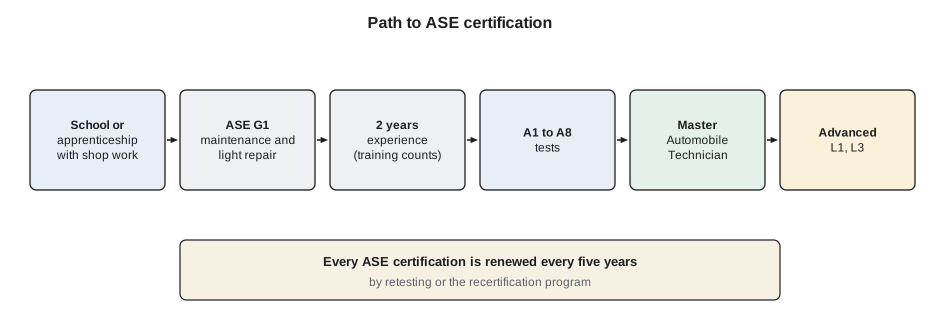
ASE certification is earned by passing a computer-based test in a subject area and showing two years of relevant work experience; formal training can count for part of it. The automobile series covers eight areas, A1 to A8: engine repair, automatic transmission, manual drivetrain and axles, suspension and steering, brakes, electrical and electronic systems, heating and air conditioning, and engine performance. A technician who holds all eight is a Master Automobile Technician. There are also advanced tests, such as L1 for advanced engine performance and L3 for light-duty hybrid and electric vehicles, and an entry-level test, G1, for maintenance and light repair, which is the first one Kiran will sit. ASE certifications must be renewed every five years.
Whatever the route, the trade expects continuous learning. New models, new systems and new procedures arrive every year, and a technician who stops learning after qualifying will soon find that much of the work in the shop is beyond them. Manufacturers and parts suppliers run training courses, and service information systems publish new procedures and bulletins constantly.
What the shop expects of an apprentice
Dale gives Kiran the shop's orientation on her first morning, and much of it is about attitude rather than skill. An apprentice is expected to arrive on time with their own basic tools, to ask before doing anything they have not done before, to keep their bay and tools clean, and to tell the foreman immediately about any damage, injury or mistake. Marty adds three habits of his own. Write everything down: the mileage, the codes, the readings, the part numbers. Check your work before you call a job finished. And never move a customer's vehicle without a reason, because a customer who finds their seat moved, their radio changed or a greasy fingerprint on the door trim will doubt everything else the shop did.
Protecting the customer's vehicle is part of every job. Before getting into a vehicle, the technician puts a disposable seat cover, a floor mat cover and a steering wheel cover in place, and before working under the hood they lay fender covers over the painted surfaces. The vehicle's keys are tagged with the repair order number. Personal belongings are left where they are. When the job is done, the technician removes the covers and checks that the vehicle is as clean as it arrived.
The vehicles Kiran will meet most often in her first months are Ridgeline's regular customers, and they will come back throughout the program. Gord Haney, a landscaper, drives a 2013 full-size pickup with a 5.3 L V8 that has covered 194,000 mi and has its oil changed every month in the summer. Ines Moreau drives a 2019 compact hybrid hatchback for a rideshare service and has put 116,000 mi on it. The Lindqvist family bring in a 2017 minivan with a 3.6 L V6. Dr. Amara Singh drives a 2022 compact electric hatchback. And Front Range Parcel, a courier company, sends its three 2020 high-roof cargo vans in on a fixed schedule; the fleet manager, Hal Osei, wants every service to be done the same way and documented the same way.
| Customer | Vehicle | Distance | Typical visit |
|---|---|---|---|
| Gord Haney | 2013 full-size pickup, 5.3 L V8, four-wheel drive | 194,000 mi | Oil service, brakes, steering and suspension wear |
| Ines Moreau | 2019 compact hybrid hatchback | 116,000 mi | Maintenance at short intervals, tires, brake inspection |
| The Lindqvist family | 2017 minivan, 3.6 L V6 | 92,000 mi | Scheduled maintenance, sliding door and electrical concerns |
| Dr. Amara Singh | 2022 compact electric hatchback | 25,000 mi | Tires, cabin filter, brake fluid, inspections |
| Front Range Parcel | Three 2020 high-roof cargo vans, 3.5 L V6 | about 37,000 mi a year each | Fleet preventive maintenance on a fixed schedule |
Working hours, wages and the shop's money
A shop's income is its labor sales and the margin on the parts it sells. Its costs are wages, rent, equipment, information subscriptions, training, insurance and the many consumables such as rags, cleaners, shop towels, fender covers and disposal fees. Bev explains to Kiran that a technician who leaves a drain plug loose or scratches a bumper costs the shop far more than the job paid, because rework is done at the shop's expense and an unhappy customer tells others. The best way for an apprentice to be valuable early on is to be careful and thorough, not fast.
Worked problem
Pricing a simple job
Simone writes up Gord Haney's pickup for an oil and filter change and a tire rotation. The labor guide gives 0.4 hours for the oil service and 0.4 hours for the rotation. Parts are 8 quarts of 5W-30 oil at 9.00 USD per quart and a filter at 13.00 USD. The labor rate is 155 USD per hour and Ridgeline charges a shop supplies fee of 8 USD. Ridgeline charges sales tax on parts and supplies only, at an illustrative combined rate of 9.15 percent; whether labor is taxed depends on the state and how the invoice is written, so the shop follows its accountant's advice. What is the total?
Show solution
- Labor: (0.4 + 0.4) × 155 = 124.00 USD.
- Parts: 8 × 9.00 + 13.00 = 72.00 + 13.00 = 85.00 USD.
- Taxable parts and supplies: 85.00 + 8.00 = 93.00 USD; tax at 9.15 percent = 8.51 USD.
- Total: 124.00 + 93.00 + 8.51 = 225.51 USD.
Answer: 225.51 USD. Lesson 12 builds a full repair order calculator that handles parts, labor, fees and tax.
Right to repair and service information
Independent shops like Ridgeline depend on getting the same repair information, diagnostic software and parts that dealers use. In the United States, manufacturers agreed in 2014 to make the same service information and diagnostic tools available nationwide that Massachusetts's 2013 right-to-repair law required, and Massachusetts voters later extended the law in 2020 to cover the data vehicles send wirelessly. That extension was challenged in court for years, and federal bills that would set a national rule on vehicle data access have been introduced in Congress but not passed. Shops follow the issue through their trade associations.
For Kiran the practical point is simpler: Ridgeline pays for subscriptions to service information systems and a professional scan tool, and she is expected to use them on every job. Lesson 6 explains how.
Looking after yourself in the trade
Automotive work is physical. Technicians stand on concrete all day, reach overhead under lifts, bend into engine bays and lift heavy parts such as brake rotors, wheels and batteries. The common long-term injuries are to the back, shoulders, knees and wrists, and to hearing. Good work boots with cushioned insoles, anti-fatigue mats at the bench, a creeper and a seat for low work, a wheel dolly and a transmission jack all reduce the strain, and Dale insists they are used. Kiran is also told to report even small injuries, such as a cut from a sharp edge or a minor burn, so that they can be treated and recorded. Lesson 2 covers the hazards in detail.
Common mistakes
MistakeThinking the job is mostly replacing parts.
InsteadDiagnosis is the core skill; parts are replaced only when testing shows they have failed.
MistakeTreating flat-rate time as a target to beat at any cost.
InsteadA comeback costs far more than the time saved; do the job by the procedure.
MistakeLeaving notes off the repair order because the customer will not read them.
InsteadThe service advisor reads them to the customer, and they are the legal record of the work.
MistakeGetting into a customer's vehicle without seat, floor and wheel covers.
InsteadProtect the vehicle on every job and return it as clean as it came in.
MistakeAssuming ASE certification needs no work experience.
InsteadASE requires two years of relevant experience, partly replaceable by training.
Summary and key terms
- Technicians maintain, repair and diagnose vehicles; diagnosis is the most demanding and valued skill.
- Shops run on the repair order: concern, authorization, diagnosis, estimate, repair, record and invoice.
- Labor is usually priced from flat-rate guide times multiplied by the posted labor rate.
- In the US the trade is learned at school, on the job or in an apprenticeship, and proven by voluntary ASE certification, renewed every five years.
- An apprentice is valued for care, honesty and good records more than for speed.
- Independent shops depend on access to service information, tools and parts on fair terms.
- Repair order
- The document recording the customer, vehicle, concern, authorization, work done and charges.
- Flat rate
- A pay and billing system based on standard guide times for each job.
- Comeback
- A vehicle returned because a repair did not fix the concern or caused a new one.
- Service advisor
- The person who writes up customers’ concerns, gives estimates and explains completed work.
- Journeyperson
- A fully qualified tradesperson who has completed an apprenticeship and passed the certification exam.
- Right to repair
- The principle that owners and independent shops should have access to the information, tools and parts needed for repair.
Practice problems
Work each problem on paper first, then reveal the answer to check.
A job has a guide time of 2.2 hours and the labor rate is 160 per hour. What labor is billed?
Show answer
2.2 × 160 = 352.
A flat-rate technician flags 44 hours in a week but works 40. What is their efficiency?
Show answer
44 / 40 = 110 percent.
Name the three kinds of work a technician does.
Show answer
Maintenance, repair and diagnosis.
Why should an apprentice record the mileage and readings on every repair order?
Show answer
They are the record of the work for the customer, the shop and any warranty claim, and they help diagnose later problems.
Lesson quiz · 5 questions
Score 60% or more to complete this lesson.
Create a free account to save your progress, take quizzes and earn a certificate.