
AUTO-110 · Lesson 10 of 12 · 21 min
Maintenance inspections and multi-point checks
Every vehicle that comes into Ridgeline for any reason gets a multi-point inspection, unless the customer declines it. Bev introduced the practice years ago, and she explains it to Kiran simply. “People come in for an oil change and drive away with a tire that's down to the cords or a brake hose that's cracked through,” she says. “We'd rather find it while the car is on the lift than read about it later. And a good inspection is how a customer learns to trust us.”
Inspection is a skill of its own. It means looking at the right things in the right order, measuring rather than guessing, recording what was found, and reporting it honestly, separating what needs attention now from what can wait. This lesson covers maintenance schedules, the multi-point inspection, the checks a technician makes under the hood, under the vehicle and around it, battery testing, how findings are reported, and the government inspections that some vehicles need.
Maintenance schedules
The manufacturer's maintenance schedule, in the owner's manual and the service information, lists what to do and when: oil and filter changes, tire rotations, inspections, filter replacements, fluid changes, spark plugs, belts and other items. Each item has an interval in distance and in time, and it is due at whichever comes first. A vehicle driven 3,000 mi a year still needs its oil changed by time, and a delivery van driven 37,000 mi a year reaches every distance interval long before the time interval. Many schedules have a second, shorter set of intervals for severe service, as Lesson 8 described, and some vehicles use an oil life monitor that sets the oil interval and prompts other items with it.
Shops track each customer's maintenance from the repair orders and remind them when items are due. For a fleet like Front Range Parcel's vans, Hal Osei expects Ridgeline to keep a schedule for each van and to bring them in before anything is overdue, because a van out of service costs him a day's deliveries.
# Maintenance due: distance or time, whichever comes first, with severe service (illustrative)
from datetime import date
schedule = {                     # item: (normal distance, normal months, severe distance, severe months)
    "oil and filter":     (7500, 12, 3750, 6),
    "tire rotation":      (7500, 12, 3750, 6),
    "cabin air filter":   (15000, 24, 7500, 12),
    "engine air filter":  (30000, 48, 15000, 24),
    "brake fluid":        (None, 36, None, 24),
    "spark plugs":        (100000, 96, 75000, 72)}
def due(last_odo, last_date, odo_now, today, severe):
    out = []
    for item, (d_n, m_n, d_s, m_s) in schedule.items():
        d, m = (d_s, m_s) if severe else (d_n, m_n)
        months = (today.year - last_date[item].year) * 12 + today.month - last_date[item].month
        by_dist = d is not None and odo_now - last_odo[item] >= d
        by_time = months >= m
        if by_dist or by_time:
            out.append(f"{item} ({'distance' if by_dist else 'time'})")
    return out
odo = 55600
last_odo = {k: 36400 for k in schedule}
last_odo["spark plugs"] = 0
last_date = {k: date(2026, 4, 14) for k in schedule}
last_date["brake fluid"] = date(2023, 5, 2); last_date["spark plugs"] = date(2020, 3, 1)
for severe in (False, True):
print(f"{'severe' if severe else 'normal'} service schedule due now:", ", ".join(due(last_odo, last_date, odo, date(2026, 11, 2), severe)))normal service schedule due now: oil and filter (distance), tire rotation (distance), cabin air filter (distance), brake fluid (time) severe service schedule due now: oil and filter (distance), tire rotation (distance), cabin air filter (distance), engine air filter (distance), brake fluid (time), spark plugs (time)
The van in the example has covered 19,200 mi in the seven months since its last service. On the normal schedule, the oil, rotation and cabin filter are due by distance, but on the severe schedule that its delivery work requires, the engine air filter is due too, and the original spark plugs are due by age. Its brake fluid is due by time, whatever schedule applies. This is the reasoning the shop's software does automatically, and a technician who understands it can explain to Hal why the van needs more than an oil change.
The multi-point inspection
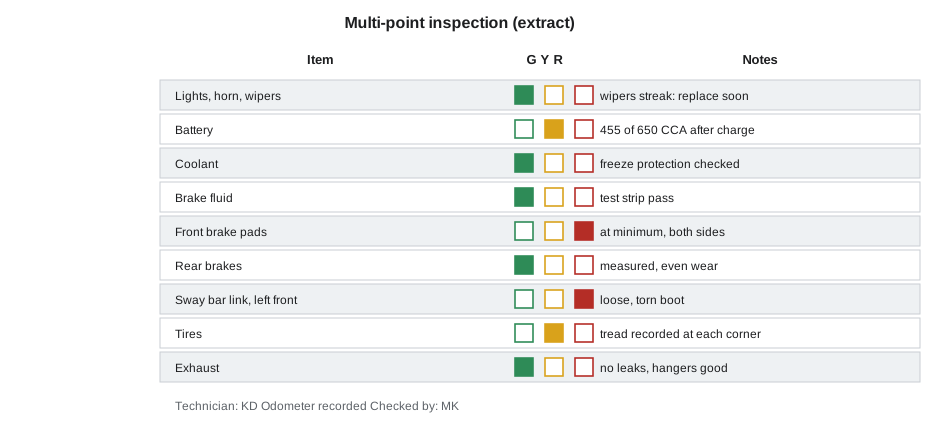
A multi-point inspection is a standard checklist done the same way on every vehicle, so nothing is missed and the results can be compared from one visit to the next. Ridgeline's sheet groups the items by where they are checked, in the order the technician moves around the vehicle, and each item is marked with a color. Green means the item is in good condition. Yellow means it will need attention soon, such as tires at 5/32 in or a battery that tests weak. Red means it needs attention now for safety or to prevent damage, such as brake pads at the minimum or a leaking brake hose. Measurements, such as tread depth, brake pad thickness and battery test results, are written next to the color.
Inside and around the vehicle
The inspection begins before the vehicle is lifted. The technician checks the warning lamps on the instrument cluster with the ignition on, before and after starting; a lamp that stays on, or one that never lights at bulb check, is recorded. They check the horn, wipers and washers, including the condition of the wiper blades; all exterior lights, including the brake lights, reverse lights and license plate light, with help from a second person or by reflections; the seat belts, which must latch and retract; the parking brake; and the condition of the windshield, since a crack in the driver's view may be a safety and inspection issue. The tire pressures are checked cold if possible and recorded as found.
Under the hood
Under the hood the technician checks fluid levels and condition: engine oil, coolant in the reservoir with its freeze protection, brake fluid with a test strip or tester, power steering fluid if fitted, transmission fluid where it can be checked, and washer fluid. They inspect the drive belt for cracks, glazing, missing ribs and groove wear, using a belt wear gauge on ribbed belts, because modern belts wear in their grooves long before they crack. They squeeze the coolant hoses, looking for hoses that are soft, swollen, hard or cracked, and check for leaks and corrosion at the clamps. They inspect the air filter and, at its interval, the cabin filter. They look for oil and coolant leaks, damaged wiring, rodent nests and loose components.
The battery is tested, not just looked at. A 12 V lead-acid battery in good condition reads about 12.6 V at rest, fully charged; 12.4 V is about three-quarters charged and 12.2 V about half. Voltage alone does not show whether the battery can deliver current, however, so Ridgeline uses an electronic conductance tester, which estimates the battery's cold cranking ability and state of health in a few seconds without loading it heavily. The result is compared with the battery's cold cranking amps rating, printed on its label. A battery that tests marginal in October will often fail on the first cold morning, so a weak result in the autumn is marked yellow or red and explained to the customer. Many vehicles with start-stop systems use absorbed glass mat or enhanced flooded batteries, and after a replacement the battery management system must be told that a new battery has been installed, often with a scan tool.
# Battery test: rest voltage to state of charge, and conductance result against the rating (illustrative)
def state_of_charge(volts):              # typical flooded lead-acid at 25 C, at rest
    points = [(11.9, 0), (12.06, 25), (12.2, 50), (12.4, 75), (12.6, 100)]
    if volts <= points[0][0]: return 0
    if volts >= points[-1][0]: return 100
    for (v1, s1), (v2, s2) in zip(points, points[1:]):
        if v1 <= volts <= v2:
            return s1 + (s2 - s1) * (volts - v1) / (v2 - v1)
batteries = [("Gord's pickup", 12.58, 730, 690), ("Lindqvists' minivan", 12.31, 650, 455), ("Front Range van 2", 12.12, 800, 560)]
for name, volts, rated_cca, measured_cca in batteries:
    soc = state_of_charge(volts)
    health = measured_cca / rated_cca * 100
    status = "green" if health >= 85 and soc >= 75 else ("yellow" if health >= 70 else "red")
    if soc < 75: status += ", charge and retest"
print(f"{name:<20} {volts:5.2f} V = {soc:3.0f} % charged; {measured_cca} of {rated_cca} CCA = {health:3.0f} % -> {status}")Gord's pickup 12.58 V = 98 % charged; 690 of 730 CCA = 95 % -> green Lindqvists' minivan 12.31 V = 64 % charged; 455 of 650 CCA = 70 % -> yellow, charge and retest Front Range van 2 12.12 V = 36 % charged; 560 of 800 CCA = 70 % -> yellow, charge and retest
A battery that is partly discharged gives a misleading conductance result, so it is charged and retested before it is condemned, as the last two lines show. The test results are written on the inspection sheet and printed for the customer.
Under the vehicle
With the vehicle on a lift, the technician inspects the underside in a fixed order, front to back. They check the steering and suspension: tie rod ends, ball joints, control arm bushings, stabilizer links, struts and shock absorbers for leaks, and springs for breakage. Looseness is checked by the procedure in the service information, which may involve moving the wheel by hand with the suspension loaded or unloaded, or prying gently at a joint while a helper watches. They check the constant-velocity joint boots for tears, because a torn boot lets grease out and dirt in and soon ruins the joint, and the driveshaft joints on rear- and four-wheel-drive vehicles.
They inspect the brake lines and hoses for corrosion, cracks, bulges and leaks; the brake pads and shoes for thickness, measured where possible; the rotors for scoring and lip; and the calipers for leaks and sticking. On many vehicles the inner pads cannot be seen without removing the wheel, and Ridgeline's rule is that brake measurements are taken with the wheels off whenever the tires are rotated. They inspect the exhaust system for leaks, rust-through and broken hangers, because an exhaust leak under the cabin can let carbon monoxide in. They look for fluid leaks from the engine, transmission, differentials and transfer case, and check the frame and underbody for rust damage, especially on vehicles from salted roads. Tread depth is measured on each tire.
| Item | Typical green | Yellow | Red |
|---|---|---|---|
| Brake pads | More than 6/32 in | 4/32 to 6/32 in | 3/32 in or less, or at the manufacturer's minimum |
| Tire tread | 6/32 in or more | 4/32 to 5/32 in | Less than 4/32 in, or cords or damage |
| Battery | Passes test, fully charged | Marginal test result | Fails test or case damaged |
| Drive belt | No cracks, grooves within gauge | Minor cracking, early groove wear | Missing ribs, worn past gauge, frayed |
| Brake hose | Flexible, dry | Surface cracking | Bulging, leaking or cracked through |
| CV joint boot | Intact | Surface cracks, no leak | Torn, grease thrown |
Reporting findings
An inspection is only useful if its results reach the customer clearly and honestly. The technician records each finding with a measurement or a specific description and, where it helps, a photo or short video; Ridgeline's system attaches them to the repair order, and Simone sends them to the customer by text message with the estimate. Red items are explained first, with what will happen if they are not repaired; yellow items are explained as things to plan for; green items reassure the customer that the rest of the vehicle is in good condition.
Marty warns Kiran about the two ways an inspection goes wrong. One is missing something because the inspection was rushed. The other is overstating a finding to sell work, such as calling a yellow item red. Both damage the shop: the first can lead to an accident, and the second, once a customer realizes it, loses their trust for good. Recommendations a customer declines are recorded, as Lesson 6 explained.
# Turn inspection results into the customer summary Simone sends (Lindqvist minivan)
results = [("front brake pads", "red", "2/32 in inner and outer, both sides"),
           ("left front sway bar link", "red", "loose ball joint, torn boot"),
           ("battery", "yellow", "455 of 650 CCA after charging"),
           ("tires", "yellow", "5/32 in front, 6/32 in rear"),
           ("coolant", "green", "protected to -34 F"), ("lights, wipers, horn", "green", "all working")]
order = {"red": 0, "yellow": 1, "green": 2}
heads = {"red": "Needs attention now", "yellow": "Plan for soon", "green": "Checked and in good condition"}
last = None
for item, color, note in sorted(results, key=lambda r: order[r[1]]):
    if color != last:
        print(heads[color].upper()); last = color
print(f" - {item}: {note}")NEEDS ATTENTION NOW - front brake pads: 2/32 in inner and outer, both sides - left front sway bar link: loose ball joint, torn boot PLAN FOR SOON - battery: 455 of 650 CCA after charging - tires: 5/32 in front, 6/32 in rear CHECKED AND IN GOOD CONDITION - coolant: protected to -34 F - lights, wipers, horn: all working
Government inspections
Some inspections are required by law. Colorado has no regular safety inspection for passenger vehicles, but most gasoline vehicles registered in the Denver metropolitan area and along the northern Front Range must pass a periodic emissions test, done at state-contracted test stations, with newer vehicles exempt for their first years and many vehicles checked remotely by roadside sensors. When a vehicle fails, the owner brings it to a repair shop such as Ridgeline to diagnose and repair the cause, and AUTO-230 covers that work. Commercial vehicles above certain weights are subject to federal and state inspection rules.
Worked problem
Inspecting a fleet van
One of the courier vans comes in for an oil service at 55,600 mi. The multi-point inspection finds: front pads 5/32 in, rear pads 9/32 in; tires 5/32 in all round; a ribbed drive belt with early groove wear; a battery at 12.12 V testing 560 of 800 CCA; a small oil seep at the rear main seal area; and a brake fluid test that fails. How should the findings be graded and reported to Hal Osei?
Show solution
- Brake fluid failing its test: red, replace now, because it lowers the boiling point and corrodes the ABS unit.
- Battery: charge and retest before grading; if it is still low, yellow or red depending on the result, with winter coming.
- Front pads and tires at 5/32 in: yellow, plan for replacement at the next visit, given the van's high distance; rear pads green.
- Drive belt: yellow, replace at the next service.
- Oil seep: yellow, monitor; note its location and photograph it so the next inspection can compare.
- Send the summary with photos and estimates, red items first, and record what Hal approves and declines.
Answer: Grade by safety and by the van's high use; charge before condemning the battery; report clearly with measurements and photos.
Common mistakes
MistakeInspecting in a different order every time.
InsteadUse the checklist in the same order so nothing is missed.
MistakeWriting “brakes OK” without measuring.
InsteadRecord the pad thickness and rotor condition.
MistakeCondemning a battery that is only discharged.
InsteadCharge it and retest before deciding.
MistakeJudging a ribbed belt only by cracks.
InsteadCheck groove wear with a gauge; modern belts wear before they crack.
MistakeCalling yellow items red to sell work.
InsteadGrade honestly; trust is the shop's most valuable asset.
MistakeIgnoring time-based intervals on low-distance vehicles.
InsteadItems are due by distance or time, whichever comes first.
Summary and key terms
- Maintenance items are due by distance or time, whichever comes first, with shorter intervals for severe service.
- A multi-point inspection follows the same checklist every time and grades items green, yellow or red with measurements.
- Check lamps, lights, wipers, belts, hoses, fluids and the battery, with a conductance test on a charged battery.
- Under the vehicle, check steering, suspension, boots, brakes, lines, exhaust, leaks, underbody and tires.
- Report findings clearly and honestly, red first, with photos and measurements, and record declined work.
- Colorado requires emissions testing in the Denver area; it has no periodic safety inspection.
- Multi-point inspection
- A standard checklist inspection with green, yellow and red grades.
- Severe service
- Hard operating conditions that call for shorter maintenance intervals.
- Conductance tester
- An electronic battery tester that estimates cranking ability and health.
- Cold cranking amps
- A battery’s rated current at a low temperature for a short time.
- Belt wear gauge
- A tool that checks the groove wear of a ribbed belt.
- CV boot
- The flexible cover that keeps grease in and dirt out of a constant-velocity joint.
Practice problems
Work each problem on paper first, then reveal the answer to check.
A car is driven very little. Its oil was changed 13 months ago at an interval of 12,000 and 12 months. Is it due?
Show answer
Yes, by time.
A battery reads 12.2 V at rest. About how charged is it?
Show answer
About half charged.
What color grade would you give a brake hose that is bulging?
Show answer
Red.
Why are inspection findings photographed?
Show answer
The customer can see the problem, and the next inspection can compare.
Lesson quiz · 5 questions
Score 60% or more to complete this lesson.
Create a free account to save your progress, take quizzes and earn a certificate.