
AUTO-110 · Lesson 5 of 12 · 21 min
Fasteners, torque and thread repair
The first job Marty gives Kiran on her own is a tire rotation on Ines Moreau's hybrid. When she finishes, he checks her work with his torque wrench and finds two wheel nuts tighter than the others and one well under the specification. “You ran them all down with the impact and then torqued them,” he says. “The torque wrench clicked on the tight ones before it ever turned them. That's why we run them down by hand or on the lowest setting, and why we torque in a star pattern.” The lesson stays with her: a fastener's job depends on the right tightness, and the right tightness depends on the right method.
Vehicles are held together by thousands of threaded fasteners, and many of them, such as wheel nuts, brake caliper bolts, suspension bolts, cylinder head bolts and drain plugs, are safety-critical or cause expensive damage if they fail. This lesson explains how a threaded fastener works, how fasteners are identified, why torque is specified and how to apply it accurately, and how damaged threads are repaired.
How a bolted joint works
A bolt is a threaded fastener passed through parts and tightened with a nut; a screw, or cap screw, threads into one of the parts; a stud is threaded at both ends, with one end in a part and a nut on the other. When a bolt is tightened, it stretches very slightly, like a stiff spring, and that stretch pulls the parts together with a force called the clamp load, or preload. It is the clamp load, not the bolt's resistance to being sheared, that holds most joints together: friction between the clamped surfaces resists sliding, and the preload keeps the joint from separating under vibration and changing loads.
If a bolt is too loose, the joint can slip or open slightly each time it is loaded, and the repeated movement loosens the nut further or cracks the bolt by fatigue. A wheel with loose nuts wears its stud holes, then shears its studs. If a bolt is too tight, it stretches beyond its elastic range and yields, losing clamp load permanently, or it strips its threads or breaks. Tightening to the specified torque is the practical way to reach the designed clamp load without overloading the bolt.
Identifying fasteners
Metric threads are described by diameter and pitch, the distance between threads: M10 × 1.5 is a 10 mm diameter thread with threads 1.5 mm apart. Coarse pitches are standard; fine pitches, such as M10 × 1.25, are common on wheel studs and some engine fasteners. Inch threads are described by diameter and threads per inch: 3/8-16 UNC is a coarse 3/8 in thread with 16 threads per inch, and 3/8-24 UNF is the fine version. A thread pitch gauge, a set of toothed blades, identifies an unknown thread, and a bolt is never forced into a hole of a different thread.
The strength of a bolt is marked on its head. Metric bolts carry a property class such as 8.8, 10.9 or 12.9: the first number is one-hundredth of the tensile strength in megapascals, and the second is the ratio of yield strength to tensile strength, so a 10.9 bolt has a tensile strength of about 1,000 MPa and yields at about 90 percent of that. Inch bolts carry radial lines: three lines for SAE grade 5 and six for grade 8. Nuts have matching classes. A replacement bolt must be at least the same class as the original, and for safety-critical parts it should be the manufacturer's part.
| Marking | System | Approximate tensile strength | Typical use |
|---|---|---|---|
| 8.8 on the head | Metric property class | 800 MPa | General engine and body bolts |
| 10.9 on the head | Metric property class | 1,000 MPa | Suspension, brake and drivetrain bolts |
| 12.9 on the head | Metric property class | 1,200 MPa | Highly loaded socket-head screws |
| Three radial lines | SAE grade 5 | about 120,000 psi | General automotive inch bolts |
| Six radial lines | SAE grade 8 | about 150,000 psi | High-strength inch bolts |
Fasteners are kept from loosening in several ways. Flat washers spread the load under a nut on soft material. Prevailing-torque nuts, which have a nylon insert or a deformed thread, resist turning; most are meant to be used once. Liquid thread-locking compounds fill the threads and harden; the service information specifies when one is needed and which strength. Cotter pins through castle nuts lock axle and steering nuts mechanically. When the service information says a fastener is not to be reused, such as many prevailing-torque nuts, torque-to-yield bolts and some suspension bolts, it is replaced every time.
Torque and clamp load
Torque is a turning force, the force applied to a wrench multiplied by the distance from the center of the fastener to the point where the force is applied. It is measured in newton-meters (N m) or pound-feet (lb ft); smaller values are often given in newton-meters or pound-inches (lb in). A force of 50 lb on a wrench 1.5 ft long gives 75 lb ft.
The second formula is the short-form torque equation used by engineers. It relates the tightening torque T to the nut factor K, the bolt diameter D and the clamp load P. The nut factor, about 0.2 for a plain steel bolt with light oil, accounts for friction in the threads and under the head. That friction absorbs most of the torque: typically around 85 to 90 percent of the applied torque is spent overcoming friction, and only the remaining 10 to 15 percent stretches the bolt. This is why the condition of the threads matters so much. Clean, lightly oiled threads give the expected clamp load. Dry, rusty or damaged threads absorb more torque in friction and give less clamp load. Lubricants and anti-seize reduce friction, so at the same torque they give more clamp load, sometimes enough to stretch the bolt past yield; the manufacturer's specification states whether the torque is for dry or lubricated threads.
# Short-form torque equation: clamp load from torque for different thread conditions (illustrative)
d = 0.5                 # bolt diameter, in (1/2 in bolt)
torque = 75            # applied torque, lb ft
for condition, k in (("dry, slightly rusty", 0.30), ("clean, light oil", 0.20), ("anti-seize applied", 0.14)):
    clamp = torque * 12 / (k * d)
    print(f"{condition:<20} K {k:.2f}  clamp load {clamp:8,.0f} lb")
print("same torque, very different clamp: the specification states the thread condition")dry, slightly rusty K 0.30 clamp load 6,000 lb clean, light oil K 0.20 clamp load 9,000 lb anti-seize applied K 0.14 clamp load 12,857 lb same torque, very different clamp: the specification states the thread condition
Torque wrenches
A torque wrench measures the torque applied. The click type, the most common, is set to the required torque on a scale in the handle; when the torque is reached, an internal mechanism releases with a click and a small movement that the technician feels. A beam type has a pointer that moves over a scale as the beam bends. A dial type has a dial gauge. A digital or electronic type displays the torque and often the angle, and beeps or vibrates at the target. Each is accurate only if it is used correctly and kept in calibration.
To use a click-type wrench, set the torque, hold the wrench by the center of its handle grip, and pull smoothly at a right angle to the handle until it clicks, then stop. Jerking the wrench, pulling past the click or holding it at the end of the handle gives the wrong torque. A click wrench is never used to loosen fasteners. After use it is wound back to its lowest setting, which relieves the spring, and it is stored in its case. Torque wrenches are checked against a calibrated tester on a schedule; the international standard for hand torque tools, ISO 6789, allows a click wrench a tolerance of a few percent, and Ridgeline has its wrenches checked every year or after any drop.
An adapter that extends the length of a torque wrench, such as a crowfoot wrench or an offset adapter, changes the torque delivered to the fastener, because it moves the point where the torque acts. When the adapter points straight along the wrench, the wrench setting must be reduced so that the fastener receives the specified torque. An adapter turned at a right angle to the wrench does not change the length and needs no correction, which is the simplest way to use one.
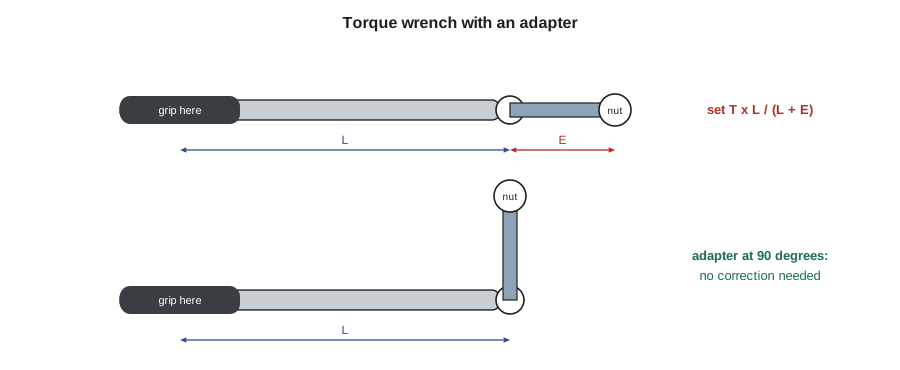
# Torque wrench setting with an in-line adapter, and unit conversion
spec = 30          # specified torque at the fastener, lb ft
L = 16.0                # drive to center of handle grip, in
for E in (0.0, 2.0, 4.0):         # adapter length in line with the wrench, in
    setting = spec * L / (L + E)
    print(f"adapter {E:>4} in: set the wrench to {setting:5.1f} lb ft to give {spec} lb ft at the fastener")
nm_per_lbft = 1.3558
print(f"check: {spec} lb ft = {spec * nm_per_lbft:.1f} N m")adapter 0.0 in: set the wrench to 30.0 lb ft to give 30 lb ft at the fastener adapter 2.0 in: set the wrench to 26.7 lb ft to give 30 lb ft at the fastener adapter 4.0 in: set the wrench to 24.0 lb ft to give 30 lb ft at the fastener check: 30 lb ft = 40.7 N m
Torque sequence and torque-angle tightening
When several fasteners clamp one part, they are tightened in a sequence and in stages, so the part is pulled down evenly. Wheel nuts are tightened in a star, or criss-cross, pattern: each nut is snugged by hand, then all are torqued in the star pattern, and on many vehicles they are checked again in the same pattern. Cylinder heads, intake manifolds, oil pans and valve covers have a sequence printed in the service information, usually starting at the center and working outward in a spiral, and often in two or three passes at increasing torque.
Many modern engine and chassis fasteners are tightened by torque and angle. The fastener is tightened to a low seating torque, which closes the joint, and then turned a specified angle, such as 90 degrees, with an angle gauge or a digital wrench. The angle, not the torque, sets the stretch of the bolt and therefore its clamp load, and it is far less affected by friction than torque alone. Some of these fasteners are torque-to-yield bolts: the final angle stretches them just into their yield range, which gives a very consistent clamp load but leaves them permanently stretched. Torque-to-yield bolts are replaced every time they are removed. Using an old one risks it breaking or failing to clamp.
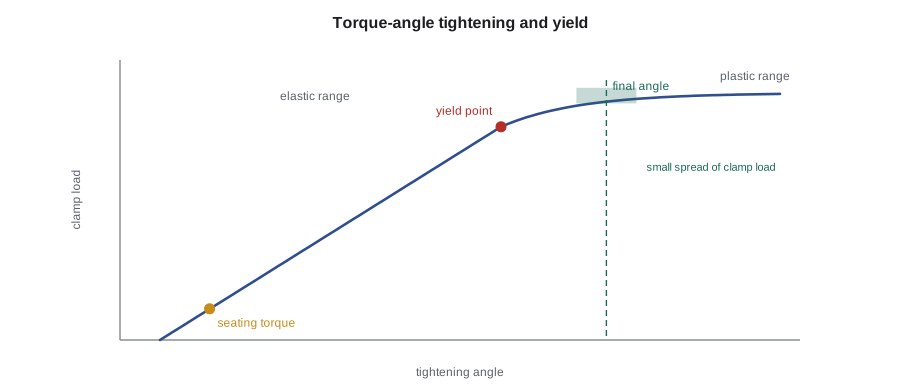
# Torque plus angle: track a three-stage cylinder head bolt specification (illustrative)
stages = [("stage 1", "torque", 22), ("stage 2", "angle", 90), ("stage 3", "angle", 90)]
bolts = 10
total_angle = sum(v for _, kind, v in stages if kind == "angle")
for name, kind, v in stages:
    unit = "lb ft" if kind == "torque" else "degrees"
    print(f"{name}: all {bolts} bolts in sequence, {kind} {v} {unit}")
print(f"total turn after seating: {total_angle} degrees = {total_angle / 360:.2f} of a turn")
pitch = round(1 / 16, 4)                  # thread pitch, in
print(f"bolt head moves {total_angle / 360 * pitch:.2f} in along the thread, taken up by bolt stretch and compression of the joint")stage 1: all 10 bolts in sequence, torque 22 lb ft stage 2: all 10 bolts in sequence, angle 90 degrees stage 3: all 10 bolts in sequence, angle 90 degrees total turn after seating: 180 degrees = 0.50 of a turn bolt head moves 0.03 in along the thread, taken up by bolt stretch and compression of the joint
Thread repair
Damaged threads are common: a drain plug cross-threaded by a hurried technician, a spark plug thread in an aluminum head pulled by over-tightening, a stud thread battered by an impact wrench. Lightly damaged or dirty threads are cleaned with a thread chaser, which reforms the existing thread without removing metal, rather than a tap, which cuts new thread and can enlarge a worn hole. A thread file or die nut cleans external threads.
Stripped internal threads in aluminum or cast iron are repaired with a thread insert. The damaged hole is drilled out, tapped with a special oversize tap, and a coiled-wire or solid insert is installed that gives a new thread of the original size, often stronger than the original in aluminum. Kits exist for most common sizes, including spark plug holes and drain plugs. Repairs on safety-critical threads, such as brake caliper bracket bolts in a steering knuckle, follow the manufacturer's instructions; some manufacturers allow inserts and some require a new part.
Broken bolts and studs are removed by several methods: gripping the exposed part with locking pliers or a stud extractor, applying heat and penetrating oil, drilling a pilot hole and using a screw extractor, or, for a hardened extractor broken in the hole, specialized machining. Marty's advice is to use penetrating oil early and patience before force, and to warn the customer before attempting a removal on a corroded part, because it can turn a short job into a long one.
Aluminum parts deserve care. Aluminum threads are softer than steel and strip more easily, so fasteners into aluminum are started by hand and tightened to specification, never with an impact wrench. Steel fasteners in aluminum can seize by galvanic corrosion, especially where road salt is used; manufacturers sometimes specify a coating or anti-seize, and when they do, they specify the torque for that condition.
Worked problem
Torquing wheel nuts
Ines Moreau's hybrid has five wheel nuts per wheel with a specification of 76 lb ft. Describe the correct procedure after the rotation.
Show solution
- Clean the hub face and the wheel's mounting surface of rust and dirt so the wheel seats flat.
- Start each nut by hand to avoid cross-threading, then run them down with a hand ratchet or an impact wrench on its lowest setting, stopping short of tight.
- Lower the vehicle so the tire carries weight and the wheel cannot turn.
- Set the torque wrench to 76 lb ft and tighten in a star pattern until each nut clicks.
- Go around once more in the same pattern to confirm each nut clicks without turning further.
- Note the torque on the repair order, and advise the customer if the manufacturer recommends rechecking after a short distance.
Answer: Clean, start by hand, snug, lower, torque in a star pattern, recheck and record.
Common mistakes
MistakeFinal-tightening fasteners with an impact wrench.
InsteadSnug with low power or by hand, then use a torque wrench.
MistakeReusing torque-to-yield bolts.
InsteadReplace them every time they are removed.
MistakeAdding anti-seize to a fastener whose torque is given for dry threads.
InsteadLubricant raises clamp load at the same torque and can overstretch the bolt; follow the specification.
MistakeCleaning a worn thread with a tap.
InsteadUse a thread chaser, which reforms the thread without removing metal.
MistakeStoring a click-type torque wrench at a high setting.
InsteadWind it back to its lowest setting after use.
MistakeIgnoring an in-line adapter's length.
InsteadCorrect the setting, or turn the adapter at 90 degrees.
Summary and key terms
- A tightened bolt stretches and clamps the joint; clamp load, not shear strength, holds most joints.
- Fasteners are identified by thread size and pitch and by strength markings such as 10.9 or grade 8.
- Most tightening torque is lost to friction, so thread condition and lubrication change the clamp load.
- Use torque wrenches correctly and keep them calibrated; correct for in-line adapters.
- Tighten in the specified sequence and stages; torque-angle and torque-to-yield methods give consistent clamp loads.
- Repair threads with chasers or inserts, and treat aluminum threads gently.
- Clamp load
- The force with which a tightened fastener holds the parts together; also called preload.
- Pitch
- The distance between adjacent threads.
- Property class
- The metric strength marking on a bolt, such as 8.8 or 10.9.
- Torque-to-yield bolt
- A bolt tightened just into its yield range, which must not be reused.
- Thread chaser
- A tool that cleans and reforms threads without cutting new ones.
- Thread insert
- A coil or solid insert that restores a stripped internal thread.
Practice problems
Work each problem on paper first, then reveal the answer to check.
A force of 200 N is applied 0.3 m from a nut. What is the torque?
Show answer
200 × 0.3 = 60 N m.
Convert 76 lb ft to newton-meters.
Show answer
76 × 1.356 = about 103 N m.
A wrench 0.40 m long has an in-line adapter of 0.05 m. The specification is 50 N m. What setting is needed?
Show answer
50 × 0.40 / 0.45 = 44.4 N m.
What does the 10 in a 10.9 bolt marking tell you?
Show answer
Its tensile strength is about 1,000 MPa.
Lesson quiz · 5 questions
Score 60% or more to complete this lesson.
Create a free account to save your progress, take quizzes and earn a certificate.