
AUTO-110 · Lesson 12 of 12 · 24 min
Capstone: a complete maintenance service from write-up to delivery
By the end of her first three months, Kiran has done every part of a maintenance service many times with someone watching. In the first week of December, Dale decides she is ready to take one from start to finish under Marty's supervision but without his help. The vehicle is Gord Haney's pickup, booked for its winter service: an oil and filter change, tire swap from all-season to winter tires on their own wheels, a multi-point inspection and a battery test, because Gord is heading north to a job site for two weeks and wants the truck ready for real cold. This capstone follows the job from the moment Gord walks in to the moment he drives away, and pulls together everything in the course.
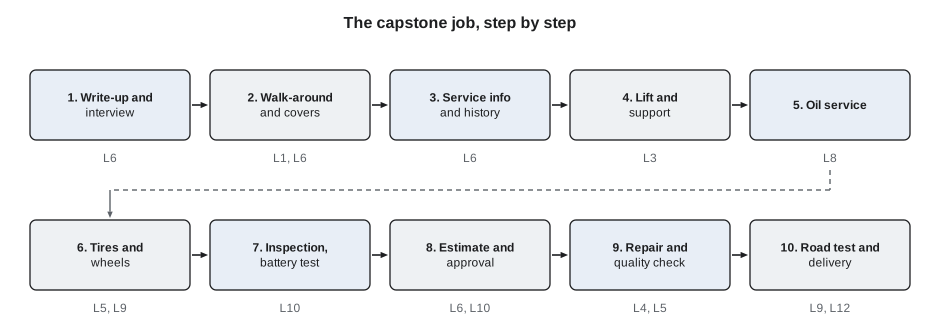
Step 1: write-up and customer interview
Simone greets Gord at the counter and opens the repair order. She confirms his contact details, the truck's VIN against the plate in the windshield, its license plate and the odometer reading, 194,390 mi. She asks Kiran to join the conversation, because Marty wants her to practice the interview. Gord's requests are the oil service and the winter tire swap. Kiran asks whether he has noticed anything else. He has: the truck has been slow to crank on the last few cold mornings, and there is a squeak from the front end over speed bumps. Kiran asks the questions Lesson 6 taught her: how cold it was, how long the truck had been parked, whether the squeak happens when turning or only over bumps, whether it is worse when cold. Simone writes the concerns in Gord's words with the details Kiran gathered, and Gord signs to authorize the services listed and an inspection of the two concerns up to half an hour of diagnostic time, with any further work to be approved by phone.
Simone checks for open recalls using the VIN and finds none. She tags the keys with the repair order number and notes that Gord's winter tires are in storage on their own wheels in the shop's tire room, labeled with his name and their positions from last spring.
Step 2: walk-around, protection and research
Kiran walks around the truck with the repair order and a flashlight before moving it. She notes existing damage on the repair order, a cracked tail light lens and a dent in the tailgate, so there is no dispute later. She puts on the seat, floor and steering wheel covers, then drives the truck into bay 2, the symmetric two-post lift, slowly and with Theo guiding, and with the transmission in park and the parking brake set. She checks the warning lamps at key-on and after starting: all light at bulb check and go out, except that the engine takes a slow, laboring crank before it starts. She switches off and lays fender covers on both front fenders.
At the shop computer she enters the VIN into the service information system and looks up the engine oil specification, capacity and drain plug torque; the oil filter part number; the wheel nut torque and tightening pattern; the lifting points; the TPMS relearn procedure; and the truck's maintenance schedule. She also checks the shop's history for the truck, which shows the battery was installed three and a half winters ago and the front sway bar bushings were noted as worn at the last visit and declined.
Step 3: lifting and the oil service
Kiran sets the lift arms under the frame at the lifting points, raises the truck until the tires just leave the floor, checks all four pads and does the shake test, then raises it to working height and lowers it onto the locks. She drains the oil into the drain pan, replaces the drain plug's washer, removes the old filter, checks that its gasket came off, cleans the base, oils the new filter's gasket and installs the filter by hand to the specified turn. The drain plug goes in by hand and is torqued to its specification. She will fill the engine once the truck is back on the ground.
# Oil service record for the repair order (values looked up in the service information, illustrative)
spec = {"oil": "5W-30, API SQ", "capacity": 8.0, "drain_plug_torque": 18, "filter": "listed filter for this engine"}
added = 8.0
print(f"oil: {spec['oil']}, specified capacity {spec['capacity']} qt, added {added} qt after dipstick check")
print(f"drain plug torqued to {spec['drain_plug_torque']} lb ft with new washer; filter {spec['filter']} installed by hand")
print("leak check: plug dry, filter dry, engine running and after shutdown")
print("oil life monitor reset to 100 %; reminder sticker: next service at 198,140 mi or in 6 months (severe service)")oil: 5W-30, API SQ, specified capacity 8.0 qt, added 8.0 qt after dipstick check drain plug torqued to 18 lb ft with new washer; filter listed filter for this engine installed by hand leak check: plug dry, filter dry, engine running and after shutdown oil life monitor reset to 100 %; reminder sticker: next service at 198,140 mi or in 6 months (severe service)
Step 4: the tire and wheel change
With the truck on the lift, Kiran removes the all-season tires and wheels, marking each with its position, and measures their tread so the record will be ready next spring. She brings out Gord's winter tires, checks each for damage, tread depth and date code, and confirms they are the correct size and load rating for the truck: LT tires, as the placard requires. She cleans the hub faces with a wire brush and the mounting faces of the wheels, then installs the winter wheels in the positions shown on their labels, rotated as the schedule recommends: the rear tires, which wore less, go to the front. She starts each nut by hand and snugs them with the impact wrench on its lowest setting, stopping short of tight.
Once the truck is lowered so the tires carry weight, she torques the nuts with the torque wrench in a star pattern and goes around again to confirm each one clicks without turning. She sets the cold pressures from the placard, adding an allowance because the truck will spend two weeks outdoors in severe cold, and relearns the TPMS sensors with the scan tool. She records the torque and the pressures on the repair order and places a reminder on the dash for Gord to have the nuts rechecked after a short distance, which Ridgeline does free.
# Tire record for the repair order: tread depths, positions and pressures (winter set)
tread = {"LF": 9, "RF": 9, "LR": 8, "RR": 9}       # tread depth after rotation
placard = 55                                                  # psi cold, front and rear
allowance = 4                                               # extra for parking outdoors in severe cold
for pos, depth in tread.items():
    grade = "green" if depth >= 6 else ("yellow" if depth >= 4 else "red")
    print(f"{pos}: tread {depth}/32 in ({grade}), set {placard + allowance} psi in the shop")
print("wheel nuts: 140 lb ft in star pattern, rechecked; TPMS relearned, all four sensors reporting")LF: tread 9/32 in (green), set 59 psi in the shop RF: tread 9/32 in (green), set 59 psi in the shop LR: tread 8/32 in (green), set 59 psi in the shop RR: tread 9/32 in (green), set 59 psi in the shop wheel nuts: 140 lb ft in star pattern, rechecked; TPMS relearned, all four sensors reporting
Step 5: multi-point inspection and battery test
Kiran works through the multi-point inspection in its usual order. Inside and outside, all lights work except the cracked tail light lens, which leaks no water and is recorded. The wiper blades streak and the left blade's rubber is torn: yellow, recommend replacement before a winter trip. Under the hood, coolant tests at −34°F protection, the brake fluid passes its test strip, the drive belt shows groove wear within the gauge, and the hoses are firm. Under the truck, the brakes are measured at 7/32 in front and 6/32 in rear, green, with no leaks. The exhaust is sound. She finds the source of the squeak: the front sway bar bushings are dry, cracked and loose in their brackets, the same item noted last time. Everything else in the steering and suspension is tight.
The battery is the main concern. Its rest voltage is 12.38 V, so she charges it for an hour on the shop charger before testing, as Lesson 10 taught. After charging, the conductance tester reports 410 cold cranking amps against a rating of 730, which is 56 percent, and a failed result. With the slow crank Gord described and two weeks at a cold northern site ahead, she grades it red. She checks the starting and charging system quickly as Marty showed her: cranking voltage drops to 9.2 V, and with the engine running the charging voltage is 14.3 V, which suggests the alternator is working and the battery is the cause. She photographs the tester's printout and the bushings.
# Battery decision from the test results (Gord's pickup, after charging)
rated_cca, measured_cca = 730, 410
rest_volts_before_charge = 12.38
cranking_volts = 9.2
charging_volts = 14.3
health = measured_cca / rated_cca * 100
print(f"rest voltage before charging {rest_volts_before_charge} V (partly discharged, so charged before testing)")
print(f"conductance {measured_cca} of {rated_cca} CCA = {health:.0f} % -> {'fail' if health < 70 else 'pass'}")
print(f"cranking voltage {cranking_volts} V: {'low, consistent with a weak battery' if cranking_volts < 9.6 else 'normal'}")
print(f"charging voltage {charging_volts} V: {'alternator charging normally' if 13.8 <= charging_volts <= 14.8 else 'check the charging system'}")
print("grade: red; recommend replacement before the trip")rest voltage before charging 12.38 V (partly discharged, so charged before testing) conductance 410 of 730 CCA = 56 % -> fail cranking voltage 9.2 V: low, consistent with a weak battery charging voltage 14.3 V: alternator charging normally grade: red; recommend replacement before the trip
Step 6: findings, estimate and approval
Kiran writes her findings in concern, cause and correction form and gives them to Simone with the labor times from the guide and the parts prices from the parts system. She lists them as Lesson 10 taught: red first, then yellow, then green. Simone sends Gord the summary with the photos and calls him to explain. The battery is the cause of the slow crank and has failed its test, and she recommends replacing it before the trip. The squeak is the front sway bar bushings, not a safety problem yet but worse in the cold, and the job is quick. The wiper blades should be replaced before a winter drive. Everything else, including the brakes and tires, is in good condition. Gord approves the battery and the wiper blades and declines the bushings until he returns, and Simone records his decisions, the time and the amounts on the repair order.
# Repair order totals: parts, labor, supplies, environmental fees and tax (illustrative: 9.15 percent sales tax on parts and fees, labor not taxed)
labor_rate = 155.00
lines = [  # (description, type, quantity, unit price or guide hours)
    ("oil and filter service", "labor", 1, 0.4), ("5W-30 oil, 8 qt", "part", 8, 9.00), ("oil filter", "part", 1, 13.00),
    ("install winter tires on wheels, balance check", "labor", 1, 0.6), ("TPMS relearn", "labor", 1, 0.2),
    ("multi-point inspection", "labor", 1, 0.0), ("battery test", "labor", 1, 0.0),
    ("replace battery, register with battery management", "labor", 1, 0.5), ("battery, 730 CCA", "part", 1, 199.00),
    ("wiper blades, pair", "part", 1, 38.00), ("battery core charge (refunded on return)", "fee", 1, 0.00), ("shop supplies", "fee", 1, 8.00)]
labor = parts = fees = 0.0
for desc, kind, qty, val in lines:
    amount = qty * val * (labor_rate if kind == "labor" else 1)
    if kind == "labor": labor += amount
    elif kind == "part": parts += amount
    else: fees += amount
    print(f"{desc:<50} {amount:8.2f}")
tax = round((parts + fees) * 0.0915, 2)
print(f"labor {labor:.2f}, parts {parts:.2f}, fees {fees:.2f}, tax {tax:.2f}")
print(f"total {labor + parts + fees + tax:.2f} USD")oil and filter service 62.00 5W-30 oil, 8 qt 72.00 oil filter 13.00 install winter tires on wheels, balance check 93.00 TPMS relearn 31.00 multi-point inspection 0.00 battery test 0.00 replace battery, register with battery management 77.50 battery, 730 CCA 199.00 wiper blades, pair 38.00 battery core charge (refunded on return) 0.00 shop supplies 8.00 labor 263.50, parts 322.00, fees 8.00, tax 30.20 total 623.70 USD
Ridgeline charges no labor for the multi-point inspection and battery test when they are part of a paid service, which is why their lines show zero; the time is recorded so the shop knows what the inspections cost it. The tax rules vary by place, and the shop's accountant sets up the invoicing system to follow them.
Step 7: the additional work and the quality check
Kiran replaces the battery following the service information: she records the radio presets and other settings that will be lost, uses a memory saver where the procedure allows, disconnects the negative terminal first and reconnects it last, cleans the cable ends, secures the hold-down and applies terminal protector. The truck's battery management system needs to be told a new battery has been installed, so she registers it with the scan tool. She replaces the wiper blades and fills the washer reservoir with fluid rated for −40°F, then fills the engine with oil, runs it, checks the level and looks for leaks. The truck now cranks quickly.
Before she calls the job finished, Kiran does the quality check Marty taught her, and Marty then checks it again himself. Oil level at full, filler cap on, dipstick seated, no leaks. Drain plug and filter tight. Wheel nuts torqued and marked. Tire pressures set and TPMS reporting. Battery hold-down tight, terminals clean and protected, no warning lamps, clock and radio set. Wipers and washers working. Tools, drain pan and lift arms clear. Old battery tagged for return. Fender covers off, interior covers off, no grease on the steering wheel, door handle or seat.
# Delivery checklist: nothing leaves the bay until every item is ticked
checks = ["oil level full after run, cap and dipstick in place", "no leaks at drain plug or filter",
          "wheel nuts torqued in pattern and rechecked", "pressures set, TPMS relearned, no lamp",
          "battery secured, terminals protected, registered", "wipers and washers tested, fluid rated for winter",
          "warning lamps all out with engine running", "tools, pan, stands and lift arms clear",
          "covers removed, interior clean", "old parts tagged; declined bushings recorded",
          "repair order complete: concern, cause, correction, readings"]
done = {c: True for c in checks}
missing = [c for c, ok in done.items() if not ok]
for i, c in enumerate(checks, 1):
    print(f"{i:>2}. [x] {c}")
print("ready for road test" if not missing else f"not ready: {missing}")1. [x] oil level full after run, cap and dipstick in place 2. [x] no leaks at drain plug or filter 3. [x] wheel nuts torqued in pattern and rechecked 4. [x] pressures set, TPMS relearned, no lamp 5. [x] battery secured, terminals protected, registered 6. [x] wipers and washers tested, fluid rated for winter 7. [x] warning lamps all out with engine running 8. [x] tools, pan, stands and lift arms clear 9. [x] covers removed, interior clean 10. [x] old parts tagged; declined bushings recorded 11. [x] repair order complete: concern, cause, correction, readings ready for road test
Step 8: road test, invoice and delivery
Marty rides along on the road test on Ridgeline's set route. The truck starts instantly. The winter tires are quiet and the steering is straight, with no vibration at highway speed. The squeak over the speed bumps is still there, as expected, since the bushings were declined. Back at the shop, Kiran records the road test, 9 mi on the odometer, and completes the repair order: the concerns, the causes with their test results, the corrections, the parts with their numbers and the declined recommendation. Simone prints the invoice.
When Gord arrives, Simone goes through the invoice with him and Kiran explains what she found, showing the battery test printout and the photo of the bushings. She tells him the battery was the cause of the slow crank and the alternator is charging normally; that the bushings will keep squeaking and should be replaced when he is back; that the brakes and the winter tires are in good condition; and that the wheel nuts should be rechecked after about 60 mi, which Ridgeline will do free. She hands him the keys with the covers removed and his all-season tires labeled and stored. Simone books his spring changeover and puts a reminder in the system for the bushings.
Worked problem
Reviewing the job
After Gord leaves, Marty asks Kiran three questions about the job. What could have gone wrong at each stage, and what did she do to prevent it?
Show solution
- At write-up: missing the cranking concern. She asked open questions and got the detail that led to the battery test.
- At lifting: a pad slipping off the frame. She checked the pads at tire height and did the shake test before going higher.
- At the oil service: a loose drain plug or double gasket. She torqued the plug with a new washer and checked the filter gasket and for leaks.
- At the tire change: a wheel coming loose. She cleaned the hub faces, torqued in a star pattern, rechecked, and arranged a free recheck.
- At inspection: condemning a good battery. She charged before testing and checked the cranking and charging voltages.
- At delivery: an unhappy customer. She explained what was found, showed evidence, and recorded the declined repair.
Answer: Each stage of the job has a typical failure, and the habits taught in this course prevent each one.
What comes next
Marty signs the capstone tasks in Kiran's logbook. In the next courses of the program she will learn the systems she has only inspected so far: engines in AUTO-120, brakes in AUTO-130, and in later levels suspension and alignment, electrical systems, fuel and emissions, drivetrains, climate control, diagnostics, hybrid and electric vehicles and driver assistance systems. Gord, Ines, the Lindqvists, Dr. Singh and the Front Range Parcel vans will be back, each with new problems. The habits from this course stay the same throughout: protect yourself and the vehicle, look it up, test before replacing, torque to specification, record everything and check your work.
Common mistakes
MistakeStarting work before reading the whole repair order and the history.
InsteadRead the concerns, the authorization and the history first; the declined bushings were in the record.
MistakeTesting a partly discharged battery.
InsteadCharge it first; a discharged battery fails a good test.
MistakeDoing approved and unapproved work together.
InsteadDo only what is authorized; record approvals and declines.
MistakeSkipping the TPMS relearn after moving wheels.
InsteadRelearn as the service information requires and confirm all sensors report.
MistakeDelivering without a quality check.
InsteadUse the checklist every time, and have a second person check when learning.
MistakeLeaving the explanation to the invoice.
InsteadExplain the findings, show the evidence and say what comes next.
Summary and key terms
- A complete service runs from write-up and interview through research, lifting, service, inspection, estimate, approval, repair, quality check, road test and delivery.
- Good questions at write-up and a careful walk-around prevent missed concerns and disputes.
- Every step uses the service information for specifications and procedures.
- Findings are graded, documented with evidence and approved before work is done.
- Quality checks and road tests catch mistakes before the customer does.
- Clear explanation at delivery and complete records build the customer's trust.
- Write-up
- The service advisor’s recording of the customer’s concerns and authorization.
- Walk-around
- An inspection of the vehicle’s condition before work starts, recording existing damage.
- Quality check
- A final check of the work against a checklist before the vehicle leaves the bay.
- Battery registration
- Telling the vehicle’s battery management system that a new battery has been installed.
- Declined recommendation
- A repair the customer chose not to have done, recorded on the repair order.
- Delivery
- Returning the vehicle to the customer with an explanation of the work.
Practice problems
Work each problem on paper first, then reveal the answer to check.
Why did Kiran charge the battery before testing it?
Show answer
A partly discharged battery gives a misleading conductance result.
Why did she note the cracked tail light lens before moving the truck?
Show answer
To record existing damage so there is no dispute later.
What did the charging voltage of 14.3 V tell her?
Show answer
The alternator was charging normally, so the battery was the cause.
What should be recorded when a customer declines a repair?
Show answer
The finding, recommendation, estimate, the decision and the date.
Lesson quiz · 5 questions
Score 60% or more to complete this lesson.
Create a free account to save your progress, take quizzes and earn a certificate.