
APP-410 · Lesson 5 of 12 · 29 min
Ordering and stocking parts
▶ Video coming soon A video version of this lesson is on the way.
On Saturday, October 3, 2026, Ade Oyelowo and Fenna counted Penfold's parts: the shelves behind the parts counter and the stock on all five vans. It took most of the day. They found 61,400 dollars of parts at cost, close to the 62,000 dollar average Ade had been working to. They also found a shelf of dryer timers for models Penfold had not seen in years, two drain pumps listed in the system that were nowhere to be found, and a box of refrigerator door gaskets that had been ordered for a customer who then replaced the refrigerator and never been returned to the distributor. By Monday Ade had sent the timers back to the distributor for credit, written off the missing pumps, and returned the gaskets inside the distributor's return period. He also changed the truck stock list for the coming winter: more dryer heating elements and igniters, fewer room air conditioner capacitors.
This lesson explains how a service company decides which parts to carry, how it orders them, how genuine and other parts differ, how it handles returns and cores, and how it measures whether its parts stock is working.
Why parts decide the first visit
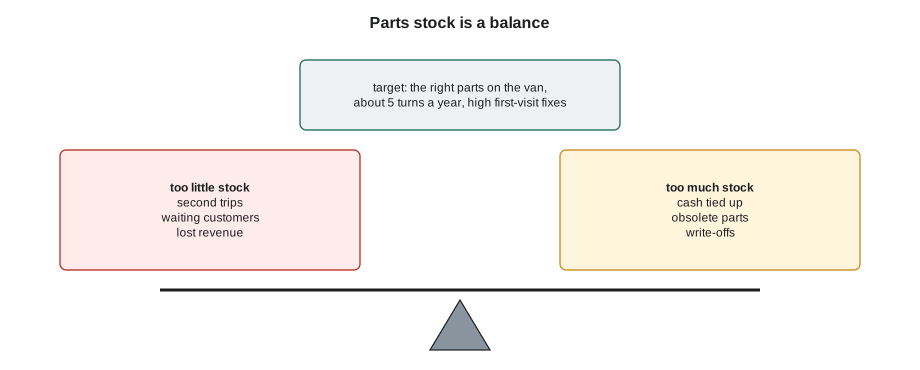
Most service calls can be finished on the first visit only if the right part is on the van. Every part that has to be ordered means a second trip, a customer who waits, and a technician whose time is not being paid for twice. Penfold's first-visit completion rate is about 78 in 100 (APP-110), and most of the rest are calls that need a part not carried on the van. Good parts management is therefore one of the most effective ways to improve customer service and profit at the same time.
Parts are also money sitting on shelves. A part bought and never used is a cost; a part that becomes obsolete is a loss. The parts manager's job is to carry enough of the right parts to finish most calls on the first visit, without tying up so much money that the company runs short of cash.
Truck stock
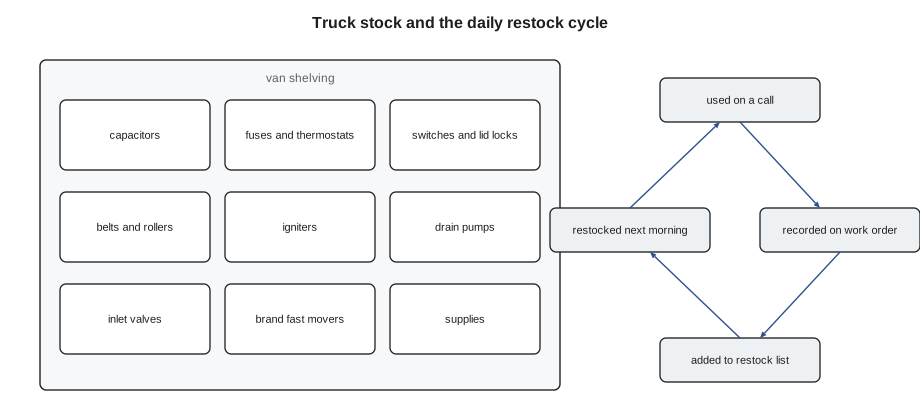
Each Penfold van carries a truck stock of about 4,800 dollars of parts at cost, chosen from Penfold's own call history. The list includes:
- Universal and high-use parts: run capacitors, thermal fuses, cycling thermostats, door switches, lid locks, belts, drum rollers, drain pumps of the commonest types, water inlet valves, igniters for the most common ranges and dryers, and fuses.
- Brand-specific fast movers for the three brands Penfold services under warranty, chosen from the brands' failure data and Penfold's own records.
- Supplies: wire nuts, terminals, cable ties, sealant, foil tape, duct clamps, hoses, fittings, refrigerant and brazing supplies for technicians who do sealed-system work.
Each van has a fixed list with a minimum and a usual quantity for each part. When a technician uses a part, the work order records it, and the system adds it to that van's restock list. Ade restocks the vans each morning from the counter, so a technician who used a drain pump on Tuesday has a replacement on Wednesday. Ade reviews the lists every season, because the parts that fail change through the year: air conditioner capacitors in summer, dryer and range parts in the winter.
Ordering parts that are not stocked
When a part is not on the van, the technician confirms the exact model and serial number, looks up the part in the maker's diagram or the distributor's system, and sends Ade the part number and the customer's details from the van. Ade checks where it can be had soonest: Penfold's own shelves, the distributor's warehouse (often next day), or the maker (sometimes a week or more). Penfold's rules for special orders are:
- Confirm the part number from the model and serial, not from the old part's markings alone, because makers revise parts and the replacement may carry a different number.
- Tell the customer the realistic arrival date and book the return visit as soon as the part is confirmed.
- Take a deposit on expensive special-order parts, such as control boards and sealed-system parts, because many cannot be returned once ordered for a customer (lesson 6).
- Track the order so that Fenna can tell the customer if it is delayed.
Ordering the wrong part is a costly mistake: a second wasted visit, a return to the distributor, and sometimes a restocking fee. Most wrong orders come from guessing at a model number from a worn plate or from a part that "looks the same".
Genuine, aftermarket and used parts
Three kinds of part are available for most appliances:
- Genuine or OEM (original equipment manufacturer) parts are made or approved by the appliance's maker. They are required for warranty repairs and are the safest choice for safety-critical parts such as door interlocks, gas valves and high limits.
- Aftermarket parts are made by other companies to fit. Good ones are cheaper and work well for simple parts such as belts, rollers and some heating elements. Poor ones fail early or fit badly. Aftermarket parts must carry the proper electrical certification (a UL or similar mark) where it applies.
- Used or salvaged parts come from scrapped appliances. Penfold uses them only for hard-to-find cosmetic parts, with the customer's agreement, never for safety parts.
Penfold's rule is to use genuine parts for all warranty work and all safety-related parts, and to offer a quality aftermarket part only where it is known to be reliable and the customer prefers the lower price. The invoice states which kind of part was used.
Returns, credits and cores
Parts that are not used can often be returned to the distributor for credit, within a set period and in their original packaging. Some distributors charge a restocking fee, a share of the price, on returns, and electrical parts that have been installed or opened are often not returnable at all.
Worked problem
The cost of a returned part
A part that cost Penfold 120 dollars was ordered for a customer who then decided not to repair. The distributor accepts the return with a restocking fee of 15 in 100. How much does Penfold lose?
Show solution
- Restocking fee:
- \[120 \times 0.15 = 18\]
Answer: Penfold loses 18 dollars plus the time spent handling the return. For special orders, the deposit discussed in lesson 6 covers this kind of loss.
A core is a used part that a maker or rebuilder takes back to remanufacture, such as some control boards and motors. The price of a remanufactured part may include a core charge that is refunded when the old part is returned in rebuildable condition. Warranty parts often have to be returned as well, so the maker can check the failure. Technicians tag these parts with the work order number at the job and bring them back to the counter; Ade ships them in the maker's return packaging before the deadline.
Measuring parts performance
Two simple measures tell the parts manager whether the stock is working. Inventory turns count how many times the average stock is used and replaced in a year:
Days of supply turn that into the number of days the average stock would last:
Worked problem
Turns and days of supply
In the past year Penfold used parts that cost it 310,000 dollars, and its average parts inventory was 62,000 dollars at cost. What are its inventory turns and its days of supply?
Show solution
- Turns:
- \[310{,}000 \div 62{,}000 = 5.0\]
- Days of supply:
- \[365 \div 5.0 = 73 \text{ days}\]
Answer: Five turns a year, or about 73 days of supply. Higher turns mean less money tied up; but if turns rise because the vans carry too little, first-visit completion falls, so Ade watches both.
The second measure is the first-visit completion rate itself, broken down by reason. If many second visits are for the same part, that part belongs on the van. Ade also watches dead stock, parts that have not moved for a year, and returns or sells them before they become obsolete.
Worked problem
What a second trip costs
A second trip takes a technician about 45 minutes, valued at Penfold's labor rate of 110 dollars an hour, plus about 30 dollars of van cost. What does each second trip cost Penfold?
Show solution
- Time cost:
- \[0.75 \times 110 = 82.50\]
- Total:
- \[82.50 + 30 = 112.50\]
Answer: About 112.50 dollars per second trip, most of which the customer is not charged for. Lesson 7 uses this figure to show what a better first-visit rate is worth.
Distributors, portals and arrival problems
Penfold buys most of its parts from two appliance parts distributors and orders some directly from the three brands it is authorized for, through their service portals. Ade keeps accounts with each and compares price, stock and delivery time. Distributors usually deliver next day in the city; makers' parts that are not stocked locally can take a week or more, and some parts are on back order, with no firm date at all. When a part goes on back order, Fenna tells the customer at once and Ade looks for another source, such as another distributor or a compatible part the maker has approved.
Every part is checked when it arrives, before it goes on the shelf or the van: the right part number and revision, undamaged packaging and no visible damage, and the quantity ordered. A wrong or damaged part is reported to the supplier the same day, because most suppliers set a short time limit for claims. A technician who opens a box at the customer's home and finds the wrong part has wasted a visit; checking at the counter prevents it.
Reorder points
For the parts Penfold stocks on its shelves, Ade sets a reorder point: when the quantity falls to that level, he orders more. The reorder point is the number of parts likely to be used while waiting for the new order to arrive, plus a small safety stock for busy weeks.
Worked problem
Setting a reorder point
Penfold uses about 6 of a common dryer thermal fuse each week. The distributor takes about 2 days to deliver, and Ade keeps a safety stock of 4. Using 5 working days a week, what is the reorder point?
Show solution
- Use per working day:
- \[6 \div 5 = 1.2\]
- Use during the 2-day delivery time:
- \[1.2 \times 2 = 2.4\]
- Reorder point:
- \[2.4 + 4 = 6.4\]
Answer: Ade reorders when the shelf falls to about 7 thermal fuses (rounding up). Fast-moving parts like this have low reorder points because they arrive quickly; slow parts from the maker need much higher reorder points or a decision not to stock them at all.
Parts security and shrinkage
Parts go missing: dropped behind van shelves, used on a job and not recorded, lent between vans, or occasionally stolen. The difference between what the records say and what the count finds is called shrinkage, and Ade's quarterly counts (like the one in October that found two missing drain pumps) measure it. Good habits keep it low: record every part on the work order, return unused special-order parts to the counter the same day, lock the vans, and never take parts for personal use. Shrinkage is a direct cost to the company, and repeated unrecorded parts are treated as a serious matter.
Technicians are part of the parts system, not just its users. Recording every part on the work order, returning unused parts the same day, telling Ade when a part keeps being needed but is not on the van, and handing in warranty and core parts on time all keep the system working. Ade's restock list is only as accurate as the work orders it is built from.
Worked problem
Changing the truck stock for winter
Over last November to February, Penfold's five vans used 85 dryer heating elements of the three commonest types, about evenly split. If each van carries one of each type, and Ade restocks every morning, is that enough for a normal winter day?
Show solution
- Elements used per winter month:
- \[85 \div 4 \approx 21\]
- Per working day (about 21 working days):
- \[21 \div 21 \approx 1\]
- Spread over five vans:
- \[1 \div 5 = 0.2 \text{ per van per day}\]
Answer: About one element a day across the whole company, or one every five days per van, so one of each type per van, restocked daily, covers a normal winter day with room to spare. A cold snap may need a second of the commonest type, which is why Ade watches the weather forecast as well as the history.
Common mistakes
MistakeOrdering a part from the number printed on the old part.
InsteadLook up the part from the model and serial number; makers revise part numbers.
MistakeKeeping parts ordered for customers who canceled.
InsteadReturn them within the distributor's period, or sell them through stock.
MistakeUsing aftermarket parts for interlocks, gas valves or high limits.
InsteadUse genuine parts for safety-related components and warranty work.
MistakeLeaving warranty and core parts loose in the van.
InsteadTag them with the work order number and return them before the deadline.
MistakeJudging parts stock by turns alone.
InsteadWatch turns and first-visit completion together.
Summary and key terms
- The right part on the van decides whether a call is finished on the first visit.
- Each van carries a fixed truck stock list, restocked daily from the work orders and reviewed each season.
- Special orders start from the model and serial number, with a realistic date, a booked return visit and a deposit for expensive parts.
- Genuine parts are used for warranty and safety-related work; quality aftermarket parts may be offered for simple parts.
- Returns may carry restocking fees; cores and warranty parts are tagged and returned on time.
- Inventory turns and days of supply measure money tied up; first-visit completion measures whether the stock is right.
- Truck stock
- The parts each service van carries, from a fixed list.
- Special order
- A part ordered for a particular customer's repair.
- OEM part
- A genuine part made or approved by the appliance's original maker.
- Aftermarket part
- A replacement part made by another company to fit.
- Restocking fee
- A charge a supplier deducts when it accepts a returned part.
- Core
- A used part returned so it can be remanufactured, often with a refundable core charge.
- Inventory turns
- Cost of parts used in a year divided by the average inventory at cost.
- Dead stock
- Parts that have not been used for a long time.
Practice problems
Work each problem on paper first, then reveal the answer to check.
Why is a part number confirmed from the model and serial number?
Show answer
Makers revise parts, and the replacement may have a different number from the old part.
When does Penfold take a deposit on a part?
Show answer
For expensive special-order parts, such as control boards and sealed-system parts.
Parts used cost 310,000 dollars and average inventory is 62,000 dollars. What are the turns?
Show answer
5.0 turns a year.
What are the days of supply at 5 turns?
Show answer
About 73 days.
What does a second trip cost at 45 minutes and 30 dollars of van cost, at 110 dollars an hour?
Show answer
About 112.50 dollars.
Lesson quiz · 5 questions
Score 60% or more to complete this lesson.
Create a free account to save your progress, take quizzes and earn a certificate.