
APP-410 · Lesson 3 of 12 · 25 min
Repair or replace decisions
▶ Video coming soon A video version of this lesson is on the way.
On Friday, August 21, 2026, Barnaby Featherstone in Grove City called because his bottom-freezer refrigerator was warm. Dee found the compressor drawing locked-rotor current and tripping on its overload every few seconds; its windings tested open between two terminals. The refrigerator was 13 years old. Replacing the compressor would mean a sealed-system repair: the compressor, a new filter-drier, refrigerant and brazing supplies, and about four and a half hours of labor, for a total of 1,033 dollars before tax including the service call. A comparable new refrigerator cost about 1,650 dollars delivered and installed. Dee wrote both figures down, explained that the repair would cost more than half the price of a new refrigerator for a unit near the end of its typical life, and said plainly that she would replace it if it were hers. Mr. Featherstone asked whether a new one would use less electricity, and Dee looked up both energy labels on her tablet. He decided to replace it, paid the 95 dollar service call, and Dee helped him move the food into the basement freezer.
This lesson explains how to help a customer decide between repairing and replacing an appliance: the rules of thumb technicians use, the age and expected life of appliances, energy use, parts availability, safety, and the customer's own priorities. The decision always belongs to the customer; the technician's job is to give honest, clear information.
The customer's decision, the technician's information
A repair-or-replace conversation is one of the most important things a technician does, and one of the easiest to get wrong. A technician who always recommends repair may sell a customer an expensive fix for a machine that will fail again in a year. A technician who always recommends replacement may lose a customer's trust, add to the landfill, and look as if they are working for an appliance store. Penfold's rule is that the technician lays out the facts, gives an honest opinion when asked, and respects the customer's choice.
Most customers want the same four pieces of information: what the repair costs, what a new appliance would cost, how much longer the old one is likely to last after the repair, and whether anything else is about to fail.
The half-price rule of thumb
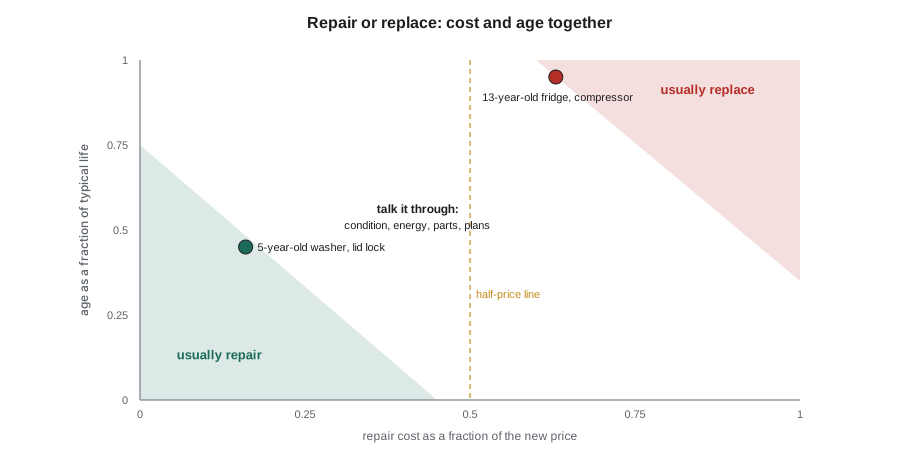
Many technicians and consumer guides use a rule of thumb: when a repair would cost more than half the price of a comparable new appliance, replacement is usually the better choice, especially for an older unit. Penfold uses the same rule as a starting point, not as a law. The comparison must be fair: the full repair cost including the service call, labor, parts and tax, against the full cost of a new appliance including delivery, installation and haul-away of the old one.
Worked problem
Applying the half-price rule
A 13-year-old refrigerator needs a compressor. The repair is the 95 dollar service call, a 385 dollar compressor, an 18 dollar filter-drier, 40 dollars of refrigerant and supplies, and 4.5 hours of labor at 110 dollars an hour. A comparable new refrigerator costs 1,650 dollars installed. What fraction of the new price is the repair?
Show solution
- Labor:
- \[4.5 \times 110 = 495\]
- Total repair before tax:
- \[95 + 385 + 18 + 40 + 495 = 1{,}033\]
- Fraction of the new price:
- \[1{,}033 \div 1{,}650 \approx 0.63\]
Answer: The repair would cost about 63 in 100 of the new price, more than half. With the refrigerator already near the end of its typical life, Dee recommended replacement, and said why.
The rule leans toward repair for a young appliance and toward replacement for an old one. A five-year-old washer with a failed lid lock that costs 140 dollars to fix, against a 900 dollar new washer, is a clear repair at about 16 in 100 of the new price. A 14-year-old dryer that needs a 450 dollar repair is closer, and the customer's plans and the dryer's overall condition decide it.
Age and expected life
Appliances have a typical service life, the age by which many units of that kind have been replaced. These figures vary by brand, model, use and maintenance, and should be quoted as rough guides only. The table gives the ranges Penfold's technicians use in conversation (typical):
| Appliance | Typical life (years) | Notes |
|---|---|---|
| Refrigerator | 10 to 15 | Sealed-system failures late in life are often not worth repairing |
| Freezer (chest or upright) | 12 to 20 | Chest freezers often outlast uprights |
| Washer | 10 to 13 | Bearing and tub failures are expensive |
| Dryer | 12 to 15 | Simple designs; most repairs are economical |
| Range or oven | 13 to 20 | Electric and gas ranges are usually worth repairing |
| Dishwasher | 9 to 12 | Control boards and pumps are common late failures |
| Microwave (countertop) | 7 to 10 | Low price makes most repairs uneconomical |
Age matters for two reasons. An old appliance is more likely to have other worn parts, so the repair may not be the last; and a newer appliance may be much more efficient, which matters most for refrigerators and freezers, which run all day. The technician's look at the rest of the machine is valuable here: rust on a washer cabinet, a dryer drum that is noisy on its rollers, door gaskets that are cracking, or a control board that has been repaired before are all reasons to mention.
Energy and water use
Energy use can tip a close decision. Refrigerators, freezers and dehumidifiers run all year, so a more efficient new model saves money every month. Washers and dishwashers also use far less water and energy than models from twenty years ago. The appliance's energy label gives its rated annual energy use: the yellow EnergyGuide label in the United States. A rated figure is measured under test conditions, so real use differs, but the comparison between two models is fair.
Worked problem
Estimating the energy saving
Mr. Featherstone's old refrigerator was rated at about 640 kWh a year and the replacement at about 450 kWh a year. At a sample electricity price of 0.15 dollars per kWh, what is the yearly saving?
Show solution
- Energy saved per year:
- \[640 - 450 = 190 \text{ kWh}\]
- Money saved per year:
- \[190 \times 0.15 = 28.50\]
Answer: About 28.50 dollars a year at the sample price. That is useful but small; the saving supports replacement here but would not justify replacing a good refrigerator on its own. Technicians should give the figure honestly rather than inflate it.
Customers sometimes hear that a new appliance will "pay for itself". For most kitchen and laundry appliances that is not true; the energy saving helps, but the main reasons to replace are reliability and the cost of the repair.
Parts availability and repairability
A repair is only possible if parts can be found. Makers keep parts for many years, but not forever, and some parts, especially electronic control boards, go out of stock earlier than mechanical parts. Before recommending a repair that depends on a part, Ade checks whether it is in stock with Penfold's distributors and how long it would take to arrive. A customer whose refrigerator is warm cannot wait three weeks for a board.
Right-to-repair laws are changing parts availability. APP-330 described the main ones: the European Union's directive, laws in several US states requiring makers to sell parts, tools and manuals for a set number of years, and Canada's 2024 amendments to the Copyright Act that allow repair work around digital locks. Over time these rules should make more appliances repairable for longer, but technicians should still check parts before promising a repair.
Safety and other factors
Some faults change the decision regardless of cost. A refrigerator with a refrigerant leak inside the insulated walls, a washer whose outer tub has cracked, a range with a cracked cooktop that exposes live parts, or an appliance under a safety recall all deserve a clear explanation of the risk. If the appliance is unsafe and the customer decides not to repair, the technician leaves it disconnected or made safe, explains why in writing on the work order, and follows Penfold's unsafe-appliance procedure from APP-110.
Other factors are personal. A customer who is moving in six months may want the cheapest repair that gets them through. A customer who loves their old range, which fits a space no modern range fits, may want it repaired at almost any price. A customer on a fixed income may need the repair now and the replacement later. Environmental values matter to many customers, who would rather repair than send an appliance to the scrapyard. The technician's job is to ask, listen and respect the answer.
Having the conversation
Dee's way of presenting a repair-or-replace choice follows a simple pattern:
- Give the repair price, with tax, and what it includes.
- Give a fair estimate of a comparable new appliance, installed, or suggest where the customer can check.
- Describe the rest of the appliance's condition honestly: what else looks worn, and what looks fine.
- Mention any energy or safety point that matters.
- If the customer asks for an opinion, give one plainly, with the reason: "If it were mine, I'd replace it, because the repair is more than half the price of a new one and it's at the age where other things start to go."
- Record the choice and the advice on the work order.
If the customer replaces, Penfold charges only the service call and can arrange haul-away through Quarrington Metal Recovery, with the refrigerant recovered first as APP-110 explained. Penfold does not sell new appliances, which helps customers trust that the advice is not a sales pitch.
Comparing over the years ahead
A fair comparison looks forward as well as at today's prices. A repair that buys a few years of use may be good value even if it is costly, while a cheap repair on an appliance likely to fail again soon may not be. One simple way to think about it is the cost per remaining year of use.
Worked problem
Cost per year of use
A 12-year-old washer needs a 410 dollar repair, after which Dee estimates it might last about 3 more years. A new washer costs 1,000 dollars installed and might last about 11 years. Compare the cost per year of use, ignoring energy and other repairs.
Show solution
- Repair, per remaining year:
- \[410 \div 3 \approx 137\]
- New washer, per year:
- \[1{,}000 \div 11 \approx 91\]
Answer: About 137 dollars a year for the repair against about 91 dollars a year for a new washer, so replacement looks better over the long run, even though the repair is under half the price. The estimates of remaining life are uncertain, and the technician should say so, but the comparison helps a customer think beyond today's bill.
Special cases
- Rental properties. Landlords often prefer the lowest-cost repair that restores service quickly, and some replace rather than repair to avoid repeat calls from tenants. The technician gives the landlord the same facts as any customer.
- Built-in and high-end appliances. Built-in refrigerators, wall ovens, cooktops and dishwashers with custom panels are expensive and fitted to the cabinetry, so a repair that would be uneconomical on a freestanding appliance is often well worth it. Replacing a built-in may also mean cabinet work.
- Appliances under warranty or a plan. A covered repair costs the customer little or nothing, so the decision is usually to repair, unless the maker or plan decides to replace.
- Units that cannot be repaired safely. A cracked tub, a corroded gas valve, or a refrigerant leak in the walls may leave replacement as the only safe choice, whatever the cost.
- Recently repaired appliances. An appliance that has needed several repairs in a short time is telling the customer something, and the technician should mention the history in the work orders.
Whatever the case, Dee writes the repair price, the comparison and her advice on the work order, so that if the customer calls back later the office knows exactly what they were told.
The repair-or-replace conversation is also where trust in the whole company is won or lost. A customer who is told honestly that a repair is not worth it, and charged only the service call, often calls Penfold first for the next appliance, and tells friends that Penfold did not try to sell them a repair they did not need.
Common mistakes
MistakeComparing the parts price alone with the price of a new appliance.
InsteadCompare the full repair cost, including service call, labor and tax, with the full installed cost of a new one.
MistakeTreating the half-price rule as a fixed law.
InsteadUse it as a starting point and add age, condition, energy, safety and the customer's plans.
MistakePromising a repair before checking that the part is available.
InsteadCheck stock and delivery time first.
MistakeTelling customers a new appliance will pay for itself in energy savings.
InsteadGive the real saving, which is usually modest.
MistakePushing the customer toward either choice.
InsteadLay out the facts, give an honest opinion if asked, and respect the decision.
Summary and key terms
- The customer decides; the technician gives clear, honest information and an opinion when asked.
- A common rule of thumb favors replacement when a repair costs more than half the price of a comparable new appliance.
- Age, measured against typical service life, and the condition of the rest of the machine matter as much as cost.
- Energy labels allow a fair comparison of running costs, but energy savings rarely justify replacement on their own.
- Parts availability must be checked before a repair is promised.
- Safety faults and recalls change the decision regardless of cost.
- Penfold does not sell appliances, which supports honest advice; it charges the service call and can arrange haul-away.
- Half-price rule
- A rule of thumb favoring replacement when a repair costs more than half the price of a comparable new appliance.
- Typical service life
- The age by which many units of a kind have been replaced; a rough guide only.
- Sealed system
- The closed refrigerant circuit of a refrigerator or freezer, including the compressor.
- Energy label
- The label giving an appliance's rated annual energy use under test conditions.
- Haul-away
- Removal of an old appliance for recycling or disposal.
- Recall
- A maker's or regulator's notice that a product has a safety defect and must be fixed or replaced.
Practice problems
Work each problem on paper first, then reveal the answer to check.
What four things do most customers want to know when deciding?
Show answer
The repair cost, the cost of a new one, how much longer the old one will last, and whether anything else is about to fail.
A repair costs 1,033 dollars and a new unit 1,650 dollars installed. What fraction is the repair?
Show answer
About 0.63, or 63 in 100.
Why do energy savings matter most for refrigerators and freezers?
Show answer
They run all year.
What must be checked before promising a repair that depends on a part?
Show answer
Whether the part is in stock and how long it will take to arrive.
What does Penfold charge a customer who decides to replace?
Show answer
Only the service call.
Lesson quiz · 5 questions
Score 60% or more to complete this lesson.
Create a free account to save your progress, take quizzes and earn a certificate.