
APP-410 · Lesson 10 of 12 · 25 min
Reviews, reputation and marketing
▶ Video coming soon A video version of this lesson is on the way.
On Saturday, September 19, 2026, Odessa Tarrant in Strawberry Farms posted a one-star review of Penfold on its business listing. Her dryer call the day before had been booked for 2 to 4 p.m.; the technician had been held up on an earlier job, the office had not called her, and he arrived at 4:50. "Took a day off work for nothing," she wrote. "Nobody called." The repair itself, a broken belt, had been fine. Harriet read the review on Monday morning, checked the work order, and found that the late-running call had not been flagged to Fenna. She phoned Mrs. Tarrant, apologized, and refunded the service call. Then she posted a short public reply: "Mrs. Tarrant, you're right that we should have called you when we were running late, and I'm sorry we didn't. Thank you for telling us. I've refunded your service call and we've changed how our technicians flag late calls to the office. Harriet Penfold, owner." Two days later Mrs. Tarrant edited her review to three stars and added: "The owner called me and fixed it. Fair enough."
This lesson explains why reputation matters so much to a service business, how to ask for reviews honestly, how to respond to good and bad reviews, what the law says about fake and misleading reviews, and which kinds of marketing work for an appliance service company.
Reputation is the business
Most people choose a service company by asking a neighbor, by searching online and reading reviews, or by calling the company the maker recommends. A local service company's reputation, built call by call, is therefore its most valuable asset. A good reputation brings in work at no cost; a bad one drives work away faster than any advertising can bring it back.
Reputation is built mostly by the things the earlier lessons covered: arriving when promised or calling ahead, explaining clearly, charging what was agreed, protecting the home, fixing the fault the first time, and putting things right when they go wrong. Marketing can make more people aware of a good company; it cannot make a poor company good.
Online reviews
Online reviews on map and search listings, review sites and social media are the modern version of word of mouth. Customers read them before they call, and many look at the most recent reviews and the negative ones first, to see how the company responds. A company with many recent, honest reviews and thoughtful replies looks trustworthy; a company with a few old reviews, or with replies that argue with customers, does not.
Worked problem
How new reviews move an average
Penfold's listing has 412 reviews with an average of 4.6 stars. If the next 30 reviews are all five stars, what will the new average be?
Show solution
- Total stars now:
- \[4.6 \times 412 = 1{,}895.2\]
- Stars added:
- \[5 \times 30 = 150\]
- New average:
- \[(1{,}895.2 + 150) \div 442 \approx 4.63\]
Answer: The average moves only from 4.60 to about 4.63. An established rating changes slowly, which is why one bad review is not a disaster and why steady good service, not a burst of reviews, builds a reputation.
Asking for reviews honestly
Satisfied customers rarely think to leave a review unless asked. Penfold asks every customer in the same way: the evening survey (lesson 1) includes a link to its business listing with the words "If you were happy with our service, we'd be grateful for a review." Technicians may mention it at the end of a call. What Penfold does not do matters as much:
- It does not offer money, discounts or gifts in exchange for reviews, and it never offers a reward only for positive reviews.
- It does not ask employees, family or friends to post reviews as if they were customers.
- It does not write reviews of its own business or of competitors, or pay anyone to.
- It does not ask only the happy customers; the survey link goes to everyone.
- It does not hide or remove honest negative reviews, or pressure customers to change them.
These rules are not just good manners; most of them are also legal requirements.
What the law says about reviews in the United States
In 2024 the Federal Trade Commission finalized a rule, in force since October 21, 2024, banning fake consumer reviews and testimonials, such as reviews by people who never used the business or by AI posing as customers. It also bans buying positive or negative reviews, undisclosed reviews by company insiders, company-controlled review websites that claim to be independent, suppressing negative reviews by threats or false accusations, and buying fake followers. Violations can bring civil penalties for each violation. Ohio's Consumer Sales Practices Act also bans deceptive acts in consumer transactions.
For a small company the practical rules are simple: reviews must come from real customers about their real experience, anything that might influence a review must be disclosed or avoided, and honest negative reviews stay up. A technician who is asked by a friend to "help out" with a review for Penfold should decline.
Responding to reviews
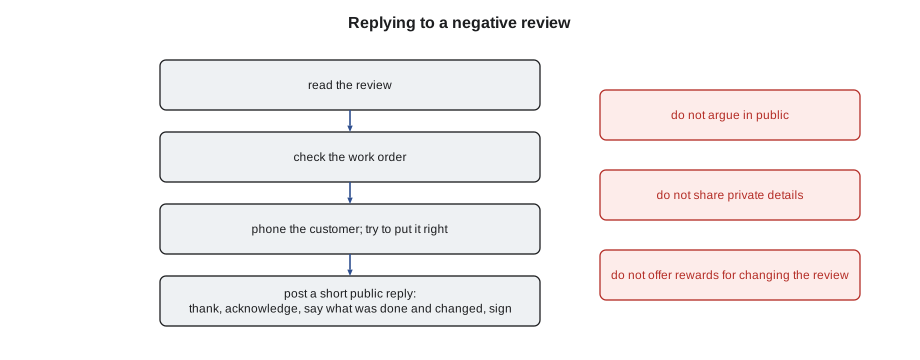
Harriet responds to every review within a few days. Her approach for negative reviews follows the pattern she used with Mrs. Tarrant:
- Check the facts first in the work order before replying, and phone the customer if possible. Many problems are better solved privately.
- Thank the customer and acknowledge what went wrong, in plain words, without excuses.
- Say what has been done to fix it for this customer and to prevent it happening again.
- Keep it short and polite, sign it with a real name, and never share the customer's private details, such as what they paid or what was in their home.
- Do not argue in public, even when the review is unfair. Other readers judge the company by its tone.
Positive reviews get a short thank-you that names the technician where the customer did. When a review is clearly fake or abusive, such as a review from someone who was never a customer, the company can report it to the platform under the platform's rules, but should still reply politely if it replies at all.
Marketing that works for a service company
Most of Penfold's new customers come from five sources, which Fenna tracks by asking "How did you hear about us?" when booking:
- Repeat customers and referrals from friends and neighbors, the largest source.
- Brand referrals from the makers for which Penfold is authorized, who send warranty customers and list Penfold on their websites.
- Online search and map listings, kept up to date with hours, service area, brands serviced, photos and reviews.
- Its own website, which explains the service call charge, the areas served and the brands, and lets customers request a booking.
- Vans and paperwork: clean, clearly marked vans, and the company's name and phone number on every invoice and on a sticker inside every appliance it repairs.
Penfold also runs a small amount of paid online advertising in its slowest months, and it judges every kind of marketing by what each booking costs.
Worked problem
Cost per booking
In February Penfold spent 900 dollars on online advertising, and Fenna recorded 60 bookings from customers who said they found Penfold through those ads. What was the cost per booking?
Show solution
- Cost per booking:
- \[900 \div 60 = 15\]
Answer: About 15 dollars per booking. Compared with the margin on an average call, that is worthwhile; if the cost rose well above what a call earns, Harriet would cut the advertising and put the money into something else, such as asking for more reviews.
Some marketing is not worth its cost for a company like Penfold: printed flyers to every home, deals that train customers to wait for discounts, and anything that promises more than the company can deliver, such as same-day service it cannot guarantee.
Keeping the listing accurate
A business listing is often the first thing a new customer sees, and an out-of-date one loses work. Fenna checks Penfold's listings every month: the hours, including holiday hours; the phone number and website; the service area, so customers outside it are not disappointed; the brands Penfold services and those it does not; photos of real vans and staff, not stock images; and the answers to common questions, such as whether Penfold sells appliances (it does not) and what the service call costs. When Penfold changes anything, such as adding Saturday on-call hours, the listing changes the same day.
Honesty applies to marketing as much as to reviews. Penfold's website says it is a factory-authorized servicer only for the three brands it is authorized for, uses only real customer quotes with permission, and does not promise same-day service it cannot always deliver. Claims that sound good but cannot be kept turn into bad reviews.
Complaints that never reach the internet
For every customer who writes a bad review, several others simply never call again. Fenna's surveys and the follow-up calls in lesson 1 are designed to hear those customers first. A complaint made privately is a chance to fix the problem before it becomes public, and Harriet treats it as a gift: the customer has told the company what went wrong when they could have told everyone else instead.
Penfold's complaint routine is the same whether the complaint arrives by phone, e-mail, survey or review: record it, check the facts in the work order, contact the customer within a working day, put it right where Penfold was at fault, and look for the cause so it does not happen again. Harriet reviews every complaint at the end of the month, looking for patterns, such as the late-call flagging problem behind Mrs. Tarrant's review.
Referral relationships
Referrals from other businesses are valuable because they come with trust already built. Penfold has referral relationships with the makers it is authorized for, with two independent appliance stores that do not offer repairs, with property managers who use Penfold for their buildings, and with Bastien's one-van business for overflow work (lesson 11). These relationships depend on Penfold looking after the referred customers well; a store that sends a customer to Penfold and hears a complaint will not send another.
Worked problem
Is a referral thank-you worth it?
Harriet considers sending a 25 dollar thank-you card to each property manager for every new building they refer. Suppose each new building brings, on average, 12 calls a year, each with an average contribution of about 120 dollars after parts and direct costs. What does one new building contribute in a year, compared with the card?
Show solution
- Contribution per building per year:
- \[12 \times 120 = 1{,}440\]
Answer: About 1,440 dollars a year (sample figures) against a 25 dollar card, so the thank-you is clearly worthwhile. Because the property managers are business partners, not reviewers, a thank-you for a referral is different from paying for reviews, which Penfold never does.
The technician as the brand
However much a company spends on marketing, the customer's impression is formed mostly by one person: the technician who comes to the door. A tidy van, a clean uniform, a polite introduction, a clear explanation, a fair price and a clean floor do more for Penfold's reputation than any advertisement. So does how technicians behave in public: driving a marked van carefully, parking considerately, and being courteous at the parts counter and on job sites. Customers notice a marked van that speeds through a school zone, and some of them write about it.
Technicians should also be careful about social media. A post that complains about a customer, shows the inside of a customer's home, or criticizes a brand while wearing a Penfold uniform can damage the company and break its privacy rules. Penfold's policy is that only Harriet and Fenna post on the company's accounts, and that technicians who post about their work in their own accounts never show customers, homes, addresses or anything identifying.
Harriet measures reputation the same way she measures everything else: with a few numbers watched every month. They are the average survey rating, the number of new reviews and their average, the share of new customers who came from referrals, and the number of complaints. A sudden change in any of them is a signal to look for the cause, whether it is a new technician who needs coaching, a booking problem or a part that keeps failing.
A good reputation takes years to build and can be damaged in a day, but it is rarely destroyed by one bad review handled well. Customers forgive mistakes far more readily than they forgive silence, excuses or dishonesty.
Common mistakes
MistakeOffering a discount to customers who leave a five-star review.
InsteadAsk every customer for an honest review and offer nothing that depends on what they write.
MistakeAsking staff or relatives to post reviews.
InsteadOnly real customers review the business.
MistakeArguing with an unfair review in public.
InsteadCheck the facts, contact the customer privately and reply briefly and politely.
MistakeSharing what a customer paid or what was in their home in a reply.
InsteadKeep private details out of public replies.
MistakeJudging advertising by how many people saw it.
InsteadJudge it by the cost per booking.
Summary and key terms
- A local service company's reputation, built call by call, is its most valuable asset.
- Online reviews are modern word of mouth; recent reviews and the company's replies matter most.
- Ask every customer for an honest review and never reward reviews, use insiders or hide honest negative ones.
- The FTC's 2024 rule bans fake reviews, bought reviews, undisclosed insider reviews and review suppression, with civil penalties.
- Reply to negative reviews by checking facts, contacting the customer, then posting a short, honest, polite reply.
- Repeat customers, referrals, brand referrals, online listings, the website and the vans bring most new work; measure marketing by cost per booking.
- Business listing
- A company's page on a map or search service, with its details and reviews.
- Review
- A customer's public rating and comments about a business.
- Fake review
- A review that does not reflect a real customer's real experience.
- Insider review
- A review written by an owner, employee or relative of the business.
- Referral
- A new customer sent by an existing customer, a maker or another business.
- Cost per booking
- Marketing spending divided by the number of bookings it produced.
Practice problems
Work each problem on paper first, then reveal the answer to check.
What are the steps in replying to a negative review?
Show answer
Check the facts, contact the customer privately if possible, then post a short reply that thanks, acknowledges, says what was done and is signed.
May Penfold give a discount for a five-star review?
Show answer
No; it must not reward reviews, and especially not only positive ones.
412 reviews average 4.6. After 30 five-star reviews, about what is the new average?
Show answer
About 4.63.
900 dollars of advertising produces 60 bookings. What is the cost per booking?
Show answer
15 dollars.
What is the largest source of new customers for Penfold?
Show answer
Repeat customers and referrals.
Lesson quiz · 5 questions
Score 60% or more to complete this lesson.
Create a free account to save your progress, take quizzes and earn a certificate.