
APP-410 · Lesson 2 of 12 · 23 min
Explaining a repair and a quote
▶ Video coming soon A video version of this lesson is on the way.
On Friday, August 14, 2026, Dee answered a call from Henrietta Marchbanks in Hilltop, whose dishwasher had stopped draining. After the service call charge had been confirmed and she had listened to the story, Dee found a seized drain pump. Before picking up a screwdriver she wrote out an estimate on her tablet: the 95 dollar service call already due, Penfold's flat rate of 120 dollars for replacing the drain pump, and 64 dollars for the pump itself, a total of 279 dollars before tax. Mrs. Marchbanks read it, asked whether the price included taking the old pump away, and signed. Halfway through the job Dee found the drain hose split where it passed through the cabinet wall. She stopped, showed Mrs. Marchbanks the split, explained that a new hose would add 18 dollars, and waited for a yes before fitting it. The final invoice was 297 dollars before tax, and nothing on it was a surprise.
This lesson explains what a good estimate contains, how to present it so the customer can decide, what the law in Ohio says about estimates and extra charges, and how Penfold handles changes once work has started.
What an estimate is for
An estimate tells the customer what the technician proposes to do and what it will cost, before the work starts. It protects both sides. The customer can decide with full information and is protected from surprise charges; the company has a signed record of what was agreed, which settles most disputes before they start. A quote is usually understood as a firmer price than an estimate, and some laws treat the two differently, so Penfold's paperwork uses the word estimate and states clearly how much the final bill may change and when the customer will be asked again.
A good estimate is written, even when the law does not require it. Penfold's technicians build the estimate on their tablets from the flat-rate book, and the customer signs on the screen or on a paper copy. The estimate is saved to the work order and a copy is e-mailed or texted to the customer.
What a good estimate contains
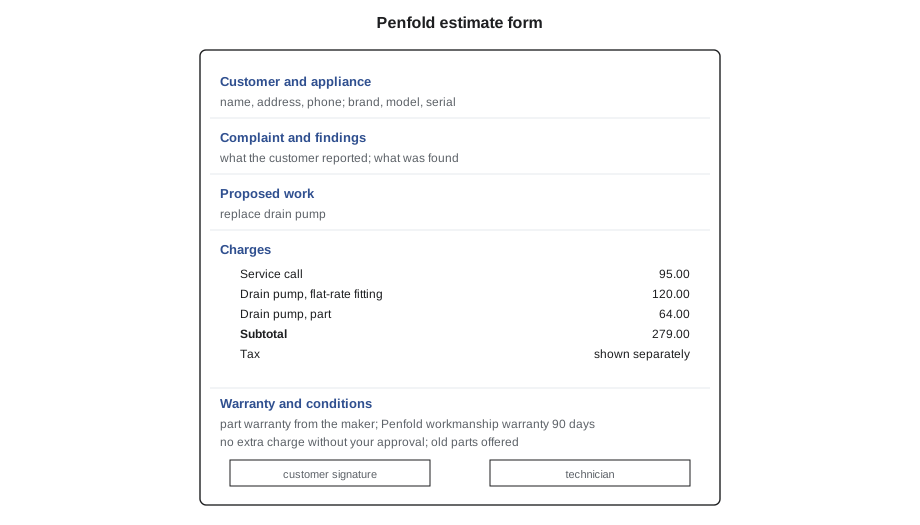
Penfold's estimate form has the same headings on every job:
- Customer and appliance: name, address, phone, the appliance type, brand, model and serial number.
- Complaint and findings: what the customer reported and what the technician found, in plain words.
- Proposed work: each repair, described so a customer can understand it ("replace drain pump", not just a part number).
- Charges: the service call, the labor for each item (flat rate or hours), each part, any disposal or haul-away fee, and tax shown separately.
- Warranty: what is covered and for how long, such as the maker's warranty on the part and Penfold's 90-day labor warranty.
- Conditions: that the customer will be asked again before any extra charge, what happens if the repair cannot be finished today, and whether replaced parts are returned to the customer or kept for warranty.
- Signature and date, with the technician's name.
Presenting the estimate
How an estimate is presented matters as much as what it says. Penfold's technicians are taught to:
- Explain the fault first, then walk through the estimate line by line, pointing to each charge.
- Give the total including tax, out loud, so there is no doubt about the amount.
- Offer real choices when they exist: repair now, repair later, or not repair. If replacement is worth considering, say so (lesson 3).
- Answer questions without hurrying, and invite the customer to take time if they want it.
- Never begin a repair before the customer agrees. A phone approval from a customer who is not home is recorded on the work order with the time and the name of the person who approved it.
A customer who decides not to repair still pays the service call, which covers the visit and the diagnosis. Penfold tells customers this when they book and again on arrival, so nobody is surprised.
What Ohio's law says about estimates
Ohio's Consumer Sales Practices Act is backed by an Attorney General rule on repairs and services to consumer goods, which covers household appliance repair. Under that rule a consumer has the right to an estimate when the expected cost is more than 25 dollars. The business must give the consumer a form on which they choose a written estimate, an oral estimate or no estimate, and the consumer initials their choice; when there is no face-to-face contact, the business must tell the consumer of the right at first contact. The business must also disclose any charges for diagnosis, travel or partly completed work. Once an estimate has been given, the business needs the consumer's authorization before going over it: for an estimate of 50 dollars or less, before any increase of more than 5 dollars, and for an estimate over 50 dollars, before the increase reaches 10 in 100 of the estimate (both excluding tax). Replaced parts must be returned to the consumer unless they go back to the maker under warranty or are rebuilt, and the consumer gets an itemized list of the work done.
Penfold's own rule is stricter than the authorization rule: no extra charge of any size is added without the customer's approval, recorded on the work order. Its estimate form includes the written, oral or no-estimate choice, and its invoices list each repair and part.
Worked problem
Checking an extra charge against the estimate
Dee's estimate for Mrs. Marchbanks was 279 dollars before tax. The split hose would add 18 dollars. By what share does the new total exceed the estimate, and does Ohio's rule require authorization? What is the final bill with 8 in 100 sales tax?
Show solution
- Increase as a share of the estimate:
- \[18 \div 279 \approx 0.065\]
- That is about 6.5 in 100, below the 10 in 100 point at which authorization is required.
- New total before tax:
- \[279 + 18 = 297\]
- Final bill with sales tax:
- \[297 \times 1.08 = 320.76\]
Answer: The increase is about 6.5 in 100, so the rule did not require authorization, but Penfold asked anyway. The final bill was 320.76 dollars.
Ohio and federal law also have rules for home solicitation sales, sales made at a buyer's home with a three-day right to cancel in many cases. Repairs that the customer asked for in an emergency or arranged themselves can fall under exemptions, and how those rules apply depends on the details, so Penfold's office, not the technician, decides how its home-service paperwork handles them, with advice from its lawyer.
When the job changes
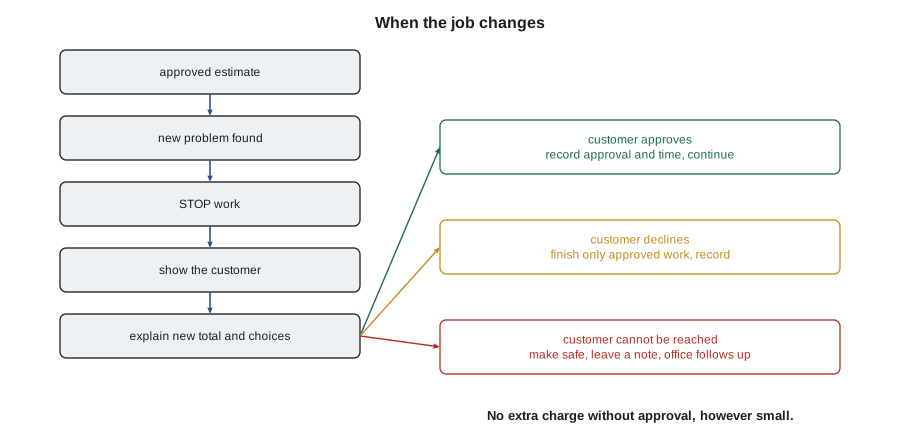
Jobs change once the appliance is open. A second failed part, a damaged hose, a missing bracket or a part that turns out to be on back order all change what the customer agreed to. Penfold's procedure is the same every time:
- Stop before doing any extra work or fitting any extra part.
- Show the customer what was found, with the part, a photo or a meter reading.
- Explain the new total, including tax, and the choices, which may include stopping at the original repair.
- Record the customer's decision on the work order, with the time, and have them sign or initial the change if they are present.
If the customer is not home and cannot be reached, the technician does only the work that was approved, makes the appliance safe, leaves a note, and Fenna follows up. A repair that cannot be finished in one visit, because a part has to be ordered, is written up as a return visit with the agreed price and a deposit if the part is a special order (lesson 6).
Invoices and replaced parts
The invoice is the final record of the job and should match the estimate and any approved changes line by line. It shows the work done, the parts fitted, the charges, the tax, the warranty, the payment received, and Penfold's business details, including its tax registration number in Ohio. Old parts are offered to the customer unless they must go back to the maker for a warranty claim, in which case the invoice says so. Many customers do not want them, but offering them shows that the part really was replaced.
Estimates for return visits and special orders
Many repairs cannot be finished on the first visit, because the part is not on the van. The estimate for a return visit works the same way as any other, but it must be clear about three more things: what the customer has paid today, what they will pay on the return visit, and what happens if they change their mind after the part has been ordered.
Penfold's estimate for a return visit lists the service call as paid today, the part and labor as due on the return visit, and the deposit, if one is needed for a special-order part (lesson 6). It gives the expected arrival date of the part and says that Fenna will phone to book the visit when the part arrives. It also states plainly whether the part can be returned if the customer cancels: many control boards and sealed-system parts cannot, and the deposit covers that risk.
Worked problem
An estimate with a return visit
A refrigerator needs a control board that must be ordered. The service call today is 95 dollars. The board costs 285 dollars and the flat-rate labor to fit it on the return visit is 110 dollars. Penfold asks for a deposit equal to the board's price. How much does the customer pay today, how much on the return visit, and what is the total before tax?
Show solution
- Paid today:
- \[95 + 285 = 380 \text{ (service call and deposit)}\]
- Paid on the return visit:
- \[110 \text{ (labor)}\]
- Total before tax:
- \[95 + 285 + 110 = 490\]
Answer: The customer pays 380 dollars today, including the 285 dollar deposit that is credited against the board, and 110 dollars on the return visit, a total of 490 dollars before tax. Setting this out on the estimate prevents the most common dispute about ordered parts: a customer who thinks the deposit was an extra charge.
When the person at home is not the decision-maker
Sometimes the person who lets the technician in is not the person who will pay: a tenant whose landlord owns the appliance, an adult child helping a parent, a house-sitter, or a property manager's maintenance worker. Penfold's rule is that the estimate is approved by the person responsible for paying. For rental properties, Fenna records the landlord's or property manager's contact details when booking and, where they wish, a pre-approved limit up to which the technician may proceed. Above that limit, or without one, the technician phones the payer, explains the findings and records the approval with the payer's name and the time, exactly as for a customer who is at work.
Tenants are entitled to clear information about what is wrong with an appliance they use every day, and the technician gives it, but decisions about money belong to the owner. A technician should never let a tenant authorize a repair the landlord will be asked to pay for, and should never be drawn into a disagreement between them; the office handles that.
Diagnosis-only visits
Some customers want only to know what is wrong, perhaps to decide whether to buy a new appliance or to make an insurance claim. The service call covers that diagnosis, and the technician writes the findings clearly on the work order and the invoice so the customer has a record. For insurance or warranty disputes, Penfold can provide a written report of the findings, readings and photos, and charges for the time needed to prepare a longer report, stated on the estimate in advance.
The same principles apply to every estimate, however small. A customer who sees exactly what each part of the bill is for, and agrees to it before the work starts, rarely disputes the invoice. A customer who is surprised by the invoice often does, even when the work was good and the price fair.
The disputes that do happen follow a few patterns: a customer who did not understand that the service call is charged even when there is no repair, a customer who expected the deposit to be refundable after the part was fitted, or a phone approval given by someone other than the payer. Each is prevented by the same habits: clear booking scripts, estimates that set out every charge, and approvals recorded with a name and a time.
Common mistakes
MistakeStarting work and giving the price at the end.
InsteadWrite the estimate, explain it, and get approval before starting.
MistakeAdding a small extra part without asking because it is "only a few dollars".
InsteadStop and get approval for any extra charge, however small.
MistakeQuoting the price before tax only.
InsteadGive the total with tax, out loud and on the estimate.
MistakeTreating the legal limit on extra charges as permission to go over the estimate.
InsteadPenfold asks before any extra charge; the legal limit is a ceiling.
MistakeThrowing away the old part without offering it.
InsteadOffer it to the customer unless it must go back for a warranty claim.
Summary and key terms
- An estimate lists the findings, proposed work, each charge, tax, warranty and conditions, and is signed before work starts.
- Technicians explain the fault, walk through the estimate, say the total with tax and offer real choices.
- Ohio's repair rule gives consumers a written, oral or no-estimate choice for repairs over 25 dollars and requires authorization before going over an estimate.
- Penfold asks before any extra charge, however small, and records the approval.
- When the job changes: stop, show, explain, record.
- The invoice matches the estimate and approved changes, shows tax and warranty, and old parts are offered to the customer.
- Estimate
- A statement of the proposed work and its expected cost, given before work starts.
- Flat rate
- A set price for a common repair, regardless of how long it takes on the day.
- Authorization
- The customer's approval of work or an extra charge, recorded on the work order.
- Return visit
- A second visit to finish a repair, usually after a part has been ordered.
- Invoice
- The final bill, listing the work done, parts, charges, tax and payment.
- Work order
- The record of a service call, from booking to payment.
Practice problems
Work each problem on paper first, then reveal the answer to check.
What headings does Penfold's estimate form always contain?
Show answer
Customer and appliance, complaint and findings, proposed work, charges, warranty, conditions, and signatures.
When does Ohio's repair rule give a consumer the right to an estimate?
Show answer
When the expected cost is more than 25 dollars.
What four steps does Penfold follow when a job changes?
Show answer
Stop, show, explain, record.
An estimate is 279 dollars and an extra 18 dollars is needed. Is authorization required by the rule?
Show answer
No, it is about 6.5 in 100, below 10 in 100, but Penfold asks anyway.
What happens to the old part?
Show answer
It is offered to the customer unless it must go back for a warranty claim.
Lesson quiz · 5 questions
Score 60% or more to complete this lesson.
Create a free account to save your progress, take quizzes and earn a certificate.