
APP-330 · Lesson 9 of 12 · 26 min
Wine and beverage coolers
▶ Video coming soon A video version of this lesson is on the way.
Clement Dunstable kept twelve bottles of good wine in a small cooler in his detached garage in Lincoln Village, and in the August heat it had stopped keeping them cool. Dee visited on Thursday, August 13, 2026. The garage was 88 °F by mid-afternoon, and the cooler, set to 55 °F, was holding about 68 °F. Its fans were both turning; the inside heat sink was cold to the touch and the outside one was hot; the power supply delivered its rated 12 V DC. Nothing had failed. The cooler was thermoelectric: it had no compressor, only a solid-state module that pumps heat from the inside to the outside, and its manual said it could hold the cabinet only about 20 °F below the surrounding air. In a 88 °F garage the best it could ever do was about 68 °F. Dee explained, charged only the service call, and suggested either moving the cooler into the house or replacing it with a compressor model rated for the garage's temperatures. Her note in the file read: "Know the limits of the product before you condemn a part."
This lesson covers wine coolers and beverage centers: what temperatures they are meant to hold, how compressor and thermoelectric models work and differ, what limits each one, how they should be installed, and how to diagnose them.
What a wine cooler is for
A wine cooler (wine refrigerator or wine cabinet) stores wine at a steady, moderate temperature, usually about 54 to 57 °F for long-term storage, with separate zones in some models set colder for white wine and warmer for red at serving temperature (typical). Wine is harmed more by swings in temperature than by a degree or two too warm or too cold, and also by vibration, strong light and very dry air, which can shrink corks. Wine cabinets therefore have tinted, UV-filtering glass doors, wooden or wire shelves that cradle bottles on their sides, gentle airflow and, in better models, quiet compressors and vibration-damping mounts.
A beverage center is a small refrigerator for cans and bottles, held much colder, about 35 to 40 °F (typical), often with a glass door and lighting. Some built-in units combine a wine zone and a beverage zone. Both kinds are sold as freestanding units and as built-in, front-breathing units for installation under a counter (lesson 8).
Compressor coolers
A compressor wine cooler or beverage center is a small refrigerator. It has a compressor, condenser, capillary tube and evaporator, usually charged with a few tens of grams of R-600a in current models, a fan that circulates cabinet air evenly over the evaporator and the bottles, and a thermistor and control board. Its sealed system, start components, fans and defrost are diagnosed exactly as the refrigerator course explained. Two features are particular to wine units:
- Because the cabinet is held well above freezing, the evaporator usually defrosts itself during each off cycle, without a defrost heater, and the melt water drains to a pan on the compressor.
- A wine cooler in a cool room may need to warm the cabinet to hold its setting. Many dual-zone and premium models have a small heater so the warmer zone does not drift below its setpoint in a cool basement or a cold garage. A wine zone that is colder than its setting in winter can point to a failed heater or its control.
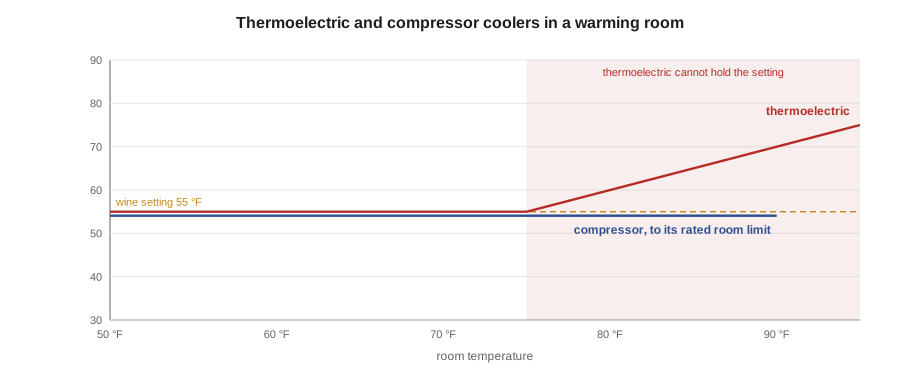
Compressor coolers hold their setting over a wide range of room temperatures, up to the limit the maker gives for the climate class of the unit. Many household models are rated for rooms from about 50 to 90 °F (typical); outside that range a unit may run constantly, or it may not run at all because the room is already colder than its setting.
Thermoelectric coolers
A thermoelectric cooler uses a Peltier module, a thin square tile made of many tiny blocks of two different semiconductor materials joined between ceramic plates. When direct current flows through it, heat is carried from one face to the other: one face gets cold and the other gets hot. The cold face is clamped to an inside heat sink with a small fan that circulates cabinet air across it; the hot face is clamped to a larger outside heat sink with its own fan that dumps the heat into the room. A power supply converts 120 V AC to about 12 V DC for the module and fans, and a thermistor and board switch or vary the module's current to hold the setting.
Thermoelectric coolers are quiet, have no refrigerant, no compressor and almost no vibration, and they are cheap to make. Their weaknesses are just as real:
- They have a limited temperature difference. A typical household unit can hold the cabinet only about 18 to 27 °F below the room, and less in a hot room, so they suit cool, indoor rooms and not garages or sun porches (typical).
- They are inefficient. The module uses more electricity than the heat it moves, so a thermoelectric cooler uses more energy than a compressor cooler of the same size, and its outside heat sink must get rid of both the heat taken from the cabinet and all the electricity the module uses.
- Their fans are the commonest failure. If the outside fan stops, the hot side overheats and the module stops cooling; if the inside fan stops, the cabinet stratifies and the thermistor reads wrong.
Worked problem
Can the thermoelectric cooler hold its setting?
A thermoelectric cooler can hold the cabinet at most 20 °F below the room. The garage reaches 88 °F. The owner wants 55 °F. What is the coldest the cooler can manage, and what room temperature would it need?
Show solution
- Coldest possible:
- \[88 - 20 = 68\ ^\circ\text{F}\]
- Room temperature needed for 55 °F:
- \[55 + 20 = 75\ ^\circ\text{F}\]
Answer: The cooler cannot get below about 68 °F in that garage. To hold 55 °F it needs a room no warmer than about 75 °F, which is why Dee recommended moving it indoors. Nothing was broken.
Worked problem
Where a thermoelectric module's heat goes
A Peltier module runs at 12 V and 5.0 A and moves 25 W of heat out of the cabinet. How much electrical power does it use, how much heat must the outside heat sink reject, and how does its efficiency compare with a small compressor system that moves 25 W while using 17 W?
Show solution
- Electrical power:
- \[12 \times 5.0 = 60 \text{ W}\]
- Heat rejected by the outside sink:
- \[25 + 60 = 85 \text{ W}\]
- Coefficient of performance of the module:
- \[25 \div 60 \approx 0.42\]
- Coefficient of performance of the compressor system:
- \[25 \div 17 \approx 1.5\]
Answer: The module uses 60 W to move 25 W, so its outside heat sink must shed 85 W, more than three times the heat it removed from the cabinet. The compressor system moves the same heat with less than a third of the electricity. That is why the outside fan is critical on a thermoelectric cooler and why compressor coolers are the efficient choice.
Diagnosing a thermoelectric cooler
Thermoelectric coolers are simple, and so is their diagnosis, which follows the heat from the inside out. With the cooler running:
- Check the room temperature and the setting against the maker's limits first, as Dee did. A cooler in too warm a room is not faulty.
- Check both fans. Each should run and move air freely; a fan clogged with dust or with a dry bearing turns slowly or stops. Fans are inexpensive and are the commonest repair.
- Feel the heat sinks. A cold inside sink and a hot outside sink mean the module is working. Both near room temperature mean the module is not receiving power or has failed open. An outside sink that is too hot to touch with its fan stopped means the fan has failed.
- Measure the power supply output at its connector: about 12 V DC under load on most units (typical; the data plate gives the value). A supply that reads correctly with no load but sags when the module is connected is failing.
- Check the module with the unit unplugged and the module disconnected: most modules read a few ohms; an open reading means a failed module (typical). The thermistor is checked against its table.
When a module is replaced, the new one must be fitted with fresh thermal compound or a thermal pad on both faces, the right way up (the hot side to the outside sink) and with its clamps tightened evenly. A module fitted upside down heats the cabinet.
Installation and the glass door
A freestanding cooler needs the clearances its instructions give at the back and sides for its condenser or outside heat sink. A built-in cooler must be a front-breathing model, as for any undercounter unit. In humid rooms the glass door can fog or drip on its outside face, because the glass is colder than the room's dew point; many models have a low-wattage door heater or double- or triple-pane glass to prevent it, and fogging on a door that did not fog before can point to a failed door heater or a gasket that lets cold air leak to the edge of the glass.
Vibration is the other installation complaint. A compressor cooler should stand level on firm floor with its feet adjusted and its compressor mounts intact, away from laundry machines. Customers storing wine for many years may prefer thermoelectric units for their lack of vibration, which is a fair choice in a cool room.
| Feature | Compressor cooler | Thermoelectric cooler |
|---|---|---|
| Cooling method | Sealed refrigeration system, usually R-600a | Peltier module, no refrigerant |
| Holds setting in a warm room | Yes, up to its rated room limit | Only to a fixed difference below the room |
| Energy use | Lower | Higher for the same heat moved |
| Noise and vibration | Low hum and some vibration | Fans only, almost no vibration |
| Common failures | Fans, thermistors, start devices, sealed system | Fans, power supply, module, thermistor |
| Best location | Indoors or a garage within its rated range | Cool indoor rooms |
Diagnosing a compressor cooler
A compressor wine cooler or beverage center is diagnosed like any small refrigerator: confirm the complaint with a thermometer in a glass of water on the middle shelf, check that the condenser is clean and its fan running, check the inside fan, the door gasket and the thermistor, then the start components and compressor. Two common calls are particular to these units. A beverage center that freezes cans at the back usually has a failed inside fan or a misplaced thermistor, so the air does not circulate and the cold stratifies. A wine cooler whose zones drift into each other often has a failed damper or zone fan between the zones. Sealed-system leaks in these small, inexpensive units usually mean replacement, which Penfold explains before quoting any sealed-system work.
Humidity, light and long-term storage
Customers who keep wine for years often ask about humidity. In a very dry cabinet, corks can dry and shrink over many years; in a very damp one, labels grow mold. Most household wine coolers do not control humidity directly. A compressor cooler's evaporator removes some moisture, and some models have a small water tray or a humidity-retaining design; thermoelectric coolers, with their mild cold side, tend to be more humid inside. A humidity reading of roughly 50 to 70 in 100 is commonly suggested for long-term storage (typical). Penfold's technicians answer what they can measure and leave wine advice to wine shops.
Light is the other concern. Tinted, UV-filtering glass protects wine from sunlight and from the fluorescent lights of old basements. LED interior lights produce little heat or UV and switch off when the door closes; a light that stays on with the door shut warms the cabinet and points to a failed door switch.
Customers also ask how fast a cooler should recover after the door is opened or new bottles are loaded. A compressor cooler loaded with a case of room-temperature bottles can take a day or more to bring them down to storage temperature, because wine holds a lot of heat and the cooler is sized to hold temperature, not to chill quickly (typical). A thermoelectric cooler takes even longer. Loading a few bottles at a time, or chilling them first in the household refrigerator, avoids complaints.
Worked problem
How much heat a case of wine holds
A case of 12 bottles holds about 20 lb of wine, which has a specific heat close to water's, about 1 BTU per pound per degree Fahrenheit. How much heat must the cooler remove to bring the case from 72 °F to 55 °F?
Show solution
- Temperature change:
- \[72 - 55 = 17\ ^\circ\text{F}\]
- Heat:
- \[20 \times 17 = 340 \text{ BTU}\]
Answer: About 340 BTU. A small cooler that can remove about 85 BTU/h more than its normal heat gain takes about 340 ÷ 85 = 4 hours at best, and in practice much longer because most of its capacity is already spent holding the cabinet cold.
Common mistakes
MistakeCondemning a thermoelectric module because a garage cooler is warm.
InsteadCheck the room temperature against the cooler's limit first; it may be working correctly.
MistakeReplacing a module before checking the fans.
InsteadCheck both fans first; they are the commonest failure.
MistakeFitting a Peltier module without thermal compound or upside down.
InsteadUse fresh compound or pads on both faces, with the hot side to the outside sink.
MistakeBuilding a freestanding cooler into a cabinet.
InsteadUse a front-breathing built-in model, or leave the freestanding cooler its clearances.
MistakeDiagnosing a cold wine zone in winter as a refrigeration fault.
InsteadCheck the zone heater and its control; the room may be colder than the setting.
Summary and key terms
- Wine coolers hold steady, moderate temperatures; beverage centers hold cans and bottles much colder.
- Compressor coolers are small refrigerators that hold their setting across their rated room range.
- Some wine coolers have heaters so a zone does not fall below its setting in a cool room.
- Thermoelectric coolers use a Peltier module, two heat sinks, two fans and a 12 V DC supply.
- A thermoelectric cooler can hold only a fixed difference below the room and suits cool indoor rooms.
- A Peltier module rejects both the cabinet heat and its own electricity, so its outside fan is critical.
- Diagnose thermoelectric units from the room limit to the fans, heat sinks, supply, module and thermistor.
- Built-in coolers must be front-breathing; glass doors may need heaters to stop fogging.
- Wine cooler
- A cabinet that stores wine at a steady, moderate temperature.
- Beverage center
- A small refrigerator for cans and bottles, held much colder than a wine cooler.
- Thermoelectric cooler
- A cooler that uses a Peltier module instead of a refrigeration system.
- Peltier module
- A solid-state device that moves heat from one face to the other when current flows.
- Heat sink
- A finned metal block that transfers heat to or from the air.
- Coefficient of performance
- The heat moved divided by the electrical power used.
- Climate class
- The range of room temperatures a refrigerated appliance is rated to work in.
Practice problems
Work each problem on paper first, then reveal the answer to check.
Why can a thermoelectric cooler not hold 55 °F in a hot garage?
Show answer
It can only hold a fixed difference below the room temperature.
What is the commonest failure on a thermoelectric cooler?
Show answer
A fan.
Both heat sinks of a thermoelectric cooler are near room temperature. What does that suggest?
Show answer
The module is not getting power or has failed open.
Why does a thermoelectric module's outside sink handle more heat than the cabinet loses?
Show answer
It rejects the cabinet heat plus all the electricity the module uses.
Why might a wine zone be too cold in winter?
Show answer
A failed zone heater or its control, with the room colder than the setting.
Lesson quiz · 5 questions
Score 60% or more to complete this lesson.
Create a free account to save your progress, take quizzes and earn a certificate.